Soft Drinks Packaging Market Size, Share & Industry Analysis, By Material (Plastic, Metal, Paper & Paperboard, Glass, and Others), By Packaging Type (Bottles, Cans, Boxes & Cartons, Pouches & Sachets, and Others), By Application (Carbonated Soft Drinks, Bottled Water, Juices & Nectars, Energy & Functional Drinks, Ready-to-Drink Tea & Coffee, and Others), and Regional Forecast, 2026-2034
 Download Free Sample
(Offer valid till 30th Sep 2026)

Soft Drinks Packaging Market Size and Future Outlook
 Listen to Audio Version
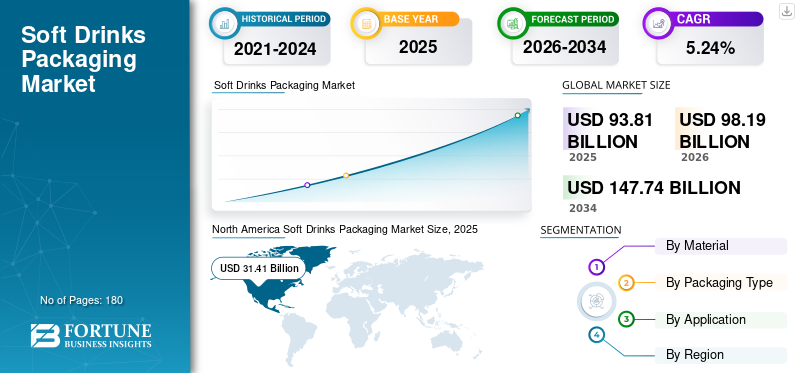
The global soft drinks packaging market size was valued at USD 93.81 billion in 2025. The market is projected to grow from USD 98.19 billion in 2026 to USD 147.74 billion by 2034, exhibiting a CAGR of 5.24% during the forecast period.
Soft drinks packaging includes the manufacturing and distribution of packaging solutions utilized for carbonated soft drinks, bottled water, juices, sports and energy drinks, ready-to-drink teas and coffees, flavored beverages, and various other non-alcoholic drinks. The growing global demand for ready-to-drink beverages, fueled by urbanization, evolving lifestyles, and a heightened preference for convenience, is propelling the adoption of innovative, lightweight, and sustainable packaging formats throughout the soft drinks sector, thus driving the global market growth.
Many key industry players, such as Amcor, Ball Corporation, and Crown Holdings Inc., operating in the market, are focusing on developing innovative packaging solutions and conducting R&D.
Download Free sample to learn more about this report.
SOFT DRINKS PACKAGING MARKET TRENDS
Circular Packaging Innovation Accelerates Material Transformation is a Major Market Trend
The commitments to sustainability from beverage companies, along with stricter regulations regarding packaging waste, are driving the transition toward circular packaging solutions in the global soft drinks packaging sector. Manufacturers are increasingly utilizing recycled PET (rPET), lightweight aluminum cans, returnable glass bottles, fiber-based cartons, and tethered caps to minimize environmental impact while ensuring product performance. Innovations in barrier technologies, digital printing, and mono-material packaging are enhancing recyclability without sacrificing shelf life or product attractiveness. Concurrently, investments in closed-loop recycling systems and design-for-recycling strategies are motivating packaging manufacturers to create solutions that align with the goals of a circular economy, establishing sustainable packaging as a prominent trend in both developed and emerging markets.
MARKET DYNAMICS
MARKET DRIVERS
Download Free sample to learn more about this report.
Rising Global Consumption of Packaged Soft Drinks and Bottled Beverages is Driving Market Growth
The increasing global demand for packaged soft drinks and bottled beverages is the primary factor propelling the soft drinks packaging market growth. Factors such as rapid urbanization, rising disposable incomes, and evolving consumer lifestyles have intensified the need for ready-to-drink beverages, which encompass carbonated soft drinks, bottled water, juices, energy drinks, and functional beverages. Consumers are showing a growing preference for portable, single-serve, and resealable packaging that caters to on-the-go consumption. This shift has prompted beverage manufacturers to enhance production capabilities and diversify packaging options, including PET bottles, aluminum cans, cartons, and pouches. Additionally, the expansion of retail channels, including convenience stores, supermarkets, and e-commerce platforms, continues to boost beverage sales, thereby driving a demand for sustainability, innovative, lightweight, and cost-effective packaging solutions globally.
Market Drivers - Impact & CAGR Contribution (2026–2034)
| Rank | Market Drivers | Expected Impact on Market Growth | Estimated Gross Market Growth Contribution (USD Billion) | Impact: 2026-2028 | Impact: 2029-2031 | Impact: 2032-2034 |
|---|---|---|---|---|---|---|
| 1 | Rising Global Consumption of Packaged Soft Drinks and Bottled Beverages | High | 19.75% | High | High | High |
| 2 | Growing Adoption of Sustainable Packaging and Recycled Materials (rPET, Aluminum, Circular Packaging) | High | 14.88% | Medium | High | High |
| 3 | Expansion of Beverage Manufacturing Capacity and Modern Retail in Emerging Markets | Medium-High | 11.12% | High | High | Medium |
| 4 | Increasing Demand for Convenience Packaging and On-the-Go Beverage Consumption | Medium | 8.36% | Medium | High | High |
| 5 | Technological Advancements in Lightweight Packaging, Smart Labeling, and High-Speed Filling Systems | Medium-Low | 6.92% | Medium | Medium | High |
| 6 | Others (Premium beverage launches, e-commerce-ready packaging, digital printing, refillable packaging systems, product differentiation) | Low | 3.22% | Low | Low | Medium |
| Total Gross Growth Contribution | 64.25% | |||||
Source: Fortune Business Insights
MARKET RESTRAINTS
Stringent Environmental Regulations and Plastic Packaging Restrictions Restrict Market Growth
Stringent environmental regulations and heightened restrictions on plastic packaging continue to be the primary constraints impacting the global market. Governments in North America, Europe, and various Asia Pacific nations are implementing mandates for recycled content, restrictions on single-use plastics, Extended Producer Responsibility (EPR) regulations, and plastic taxes aimed at minimizing packaging waste and carbon emissions. These changing regulatory frameworks necessitate that beverage companies and packaging manufacturers make substantial investments in redesigning packaging, integrating recycled materials, and enhancing manufacturing processes, which significantly raises operational costs. The challenges of compliance are especially pronounced in developing markets where recycling infrastructure is limited, complicating the ability of manufacturers to simultaneously achieve sustainability goals, maintain product performance, ensure affordability, and adhere to regulatory requirements.
Market Restraints - Impact & Negative CAGR Contribution (2026–2034)
| Rank | Market Restraints | Expected Impact on Market Growth | Estimated Reduction in Market Size (USD Billion) | Impact: 2026-2028 | Impact: 2029-2031 | Impact: 2032-2034 |
|---|---|---|---|---|---|---|
| 1 | Stringent Environmental Regulations and Plastic Packaging Restrictions | High | 5.79% | High | High | Medium |
| 2 | Volatility in Raw Material Prices (PET Resin, Aluminum, Glass and Paperboard) | Medium-High | 4.32% | High | Medium | Medium |
| 3 | Inadequate Recycling Infrastructure and Rising Compliance Costs Across Regions | Medium | 3.49% | Medium | Medium | High |
| 4 | Others (Supply chain disruptions, energy price fluctuations, labor shortages, changing consumer preferences, regulatory approval delays) | Low | 1.10% | Low | Low | Low |
| Total Market Reduction | 14.70% | |||||
Source: Fortune Business Insights
MARKET OPPORTUNITIES
Premium and Functional Beverage Growth Expands High-Value Packaging Demand, Offering Potential Growth Opportunities
The swift growth of premium soft drinks, functional beverages, energy drinks, flavored waters, and ready-to-drink health beverages is generating substantial opportunities for packaging manufacturers to create value-added solutions. These beverage categories necessitate packaging that provides exceptional barrier protection, premium aesthetics, convenience features, and distinctiveness on retail shelves. Smart labeling, resealable closures, customized bottle designs, and high-quality decoration technologies are becoming increasingly popular as brands vie for consumer attention. The rising demand for smaller serving sizes, on-the-go consumption, and e-commerce-ready packaging further amplifies the need for innovative formats. This transformation allows packaging companies to enhance profit margins through advanced materials and specialized packaging solutions designed specifically for premium beverage brands.
MARKET CHALLENGES
Recycling Infrastructure Gaps and Material Regulations Increase Operational Complexity and Pose a Critical Challenge to Market Growth
Despite the increasing investments in sustainable packaging, the global market faces significant challenges due to inconsistent recycling infrastructure and changing environmental regulations. The recycling capabilities vary greatly from one country to another, which restricts the effective recovery and reuse of materials such as PET, multilayer packaging, and composite cartons. Simultaneously, the implementation of extended producer responsibility (EPR) policies, mandates for recycled content, plastic taxes, and labeling requirements are raising compliance costs for both packaging manufacturers and beverage producers. Companies are required to continuously innovate their packaging designs to comply with evolving regulations while ensuring product safety, performance, and affordability. The challenge of balancing sustainability objectives with production efficiency and cost competitiveness remains a complex issue within the industry.
Segmentation Analysis
By Material
Lightweight Design, Cost Efficiency, and Versatile Performance to Boost Dominance of Plastic Packaging
Based on material, the market is divided into plastic, metal, paper & paperboard, glass, and others.
The plastic segment is expected to account for the largest soft drinks packaging market share over the forecast period. The growth is attributed to its exceptional lightweight characteristics, cost efficiency, durability, and versatility in manufacturing. The material is particularly prevalent for packaging bottled water, carbonated beverages, juices, and functional drinks, as it provides outstanding clarity, resistance to impact, and sufficient barrier performance, all while significantly lowering transportation expenses in comparison to glass or metal options. Additionally, plastic packaging facilitates rapid production, accommodates various bottle shapes, features resealable closures, and promotes convenient consumption on the go, rendering it highly appealing to both beverage producers and consumers. Moreover, the rising use of recycled PET (rPET), the trend toward lighter bottle designs, and advancements in recycling technologies have enhanced the sustainability credentials of plastic packaging, enabling it to maintain its status as the preferred choice despite increasing environmental regulations and the rise of alternative packaging solutions.
The metal segment is expected to grow at a CAGR of 5.27% over the forecast period.
By Packaging Type
Bottles to Take the Lead Due to Consumer Convenience, Brand Versatility, and High-Volume Beverage Consumption
Based on packaging type, the market is divided into bottles, cans, boxes & cartons, pouches & sachets, and others.
Bottles are expected to account for the largest market share over the forecast period, as they provide an ideal mix of convenience, product safety, and branding adaptability across various beverage types. Plastic and glass bottles are widely utilized for bottled water, carbonated soft drinks, juices, sports drinks, and ready-to-drink beverages, owing to their portability, resealability, and availability in various sizes to accommodate different consumption scenarios. The extensive printable area on these bottles enhances product visibility and aids in brand differentiation within competitive retail settings. Ongoing innovations, including lightweight bottle designs, ergonomic shapes, and tethered caps, have further bolstered the attractiveness of bottles, allowing them to maintain their status as the preferred packaging option despite rising competition from cans, cartons, and flexible packaging alternatives.
The cans segment is expected to grow at a CAGR of 5.32% over the forecast period.
By Application
To know how our report can help streamline your business, Speak to Analyst
Carbonated Soft Drinks to Dominate Market Due to High Global Consumption, Strong Brand Presence, and Packaging Compatibility
Based on application, the market is divided into carbonated soft drinks, bottled water, juices & nectars, energy & functional drinks, ready-to-drink tea & coffee, and others.
Carbonated soft drinks are expected to account for the largest market share over the forecast period, as they represent one of the largest volumes of packaged beverages consumed across the globe. Prominent global and regional beverage brands operate extensive production and distribution networks, which create a steady demand for bottles, cans, and multipack packaging across various channels, including retail, foodservice, and convenience. Furthermore, carbonated beverages necessitate packaging that can endure internal pressure while maintaining carbonation, flavor, and product freshness, which makes PET bottles and aluminum cans particularly appropriate. Moreover, the broad availability of carbonated soft drinks in various pack sizes, ranging from single-serve to family-size formats, contributes to high packaging volumes, further solidifying the segment's dominance in the global market.
The bottled water segment is expected to grow at a CAGR of 5.63% over the forecast period.
Soft Drinks Packaging Market Regional Outlook
By geography, the market is categorized into Europe, North America, Asia Pacific, Latin America, and the Middle East & Africa.
North America
North America Soft Drinks Packaging Market Size, 2025 (USD Billion)
To get more information on the regional analysis of this market, Download Free sample
North America held the dominant share in 2024, valued at USD 29.94 billion, and maintained its leading position in 2025, with a value of USD 31.41 billion. The North American market is propelled by a robust demand for bottled water, carbonated drinks, and energy beverages, along with a consumer inclination toward convenient, single-serve packaging. The sustainability initiatives undertaken by beverage companies are hastening the adoption of recycled PET (rPET), lightweight bottles, and aluminum cans, while strict recycling regulations promote innovation in circular packaging solutions.
U.S. Soft Drinks Packaging Market
Based on North America’s strong contribution and the U.S. dominance within the region, the U.S. market was valued at around USD 24.55 billion in 2025, accounting for roughly 26.17% of global sales. In the U.S. market, high per capita consumption of packaged beverages, ongoing product innovation, and the introduction of premium beverages are key drivers. Beverage manufacturers are making significant investments in lightweight packaging, recycled materials, smart labeling, and advanced filling technologies to achieve sustainability objectives while catering to consumer preferences for convenience, portability, and on-the-go consumption.
Europe
Europe is projected to grow at 5.00% CAGR in the coming years, the second-highest among all regions. The market in Europe reached a valuation of USD 24.57 billion in 2025. The market is largely influenced by stringent environmental regulations, which encompass mandates for recycled content and extended producer responsibility (EPR) initiatives. Additionally, the increasing consumer inclination toward environmentally friendly products further stimulates investment in circular packaging systems and innovations in sustainable materials.
U.K. Soft Drinks Packaging Market
The U.K. market in 2025 was valued at USD 4.44 billion, representing approximately 4.73% of global revenues.
Germany Soft Drinks Packaging Market
The German market was valued at approximately USD 5.20 billion in 2025, equivalent to around 5.55% of global sales.
Asia Pacific
Asia Pacific was valued at USD 19.35 billion in 2025 and secured third place in the market. In Asia Pacific, packaging demand is at the forefront due to swift urbanization, a burgeoning middle class, and an upsurge in the consumption of bottled water, carbonated beverages, juices, and functional drinks. The rapid expansion of retail and e-commerce sectors, along with the growing beverage production capabilities in China, India, and Southeast Asia, persistently propels high-volume packaging demand across various formats.
Japan Soft Drinks Packaging Market
The Japanese market in 2025 was valued at USD 3.72 billion, accounting for roughly 3.97% of global revenues. Japan's soft drink packaging sector is propelled by the consumption of premium beverages, sophisticated vending machine networks, and a preference for high-quality, aesthetically pleasing packaging. Manufacturers prioritize lightweight PET bottles, compact packaging designs, and materials with high recycling rates, while also concentrating on consumer convenience, product differentiation, and technological advancements in packaging design and production.
China Soft Drinks Packaging Market
The Chinese market is projected to be one of the largest globally, with 2025 revenues valued at around USD 6.21 billion, representing roughly 6.62% of global sales.
India Soft Drinks Packaging Market
The Indian market in 2025 was valued at around USD 5.11 billion, accounting for roughly 5.44% of global revenues.
Latin America
Latin America is expected to witness moderate growth in this market space during the forecast period. The market was valued at USD 10.53 billion in 2025. The Latin American market is fueled by increasing consumption of carbonated soft drinks, bottled water, and fruit-based beverages, supported by expanding urban population and modern retail channels. Cost-effective plastic packaging remains dominant, while rising sustainability initiatives and investments in recycling infrastructure are gradually encouraging greater use of recyclable packaging materials.
Middle East & Africa
In the Middle East & Africa, South Africa was valued at USD 2.27 billion in 2025. The Middle East & Africa market is driven by population growth, rising disposable incomes, and increasing demand for bottled water due to climatic conditions and limited potable water access in several countries. Expanding foodservice, hospitality, and retail sectors, together with growing beverage manufacturing investments, continue to stimulate demand for durable and affordable packaging solutions.
Saudi Arabia Soft Drinks Packaging Market
The Saudi Arabian market was valued at approximately USD 2.56 billion in 2025, accounting for roughly 2.73% of global revenues.
COMPETITIVE LANDSCAPE
Key Industry Players
Focus on Expanding Product Launches and Acquisitions by Key Players to Propel Market Progress
The global soft drinks packaging market has a semi-consolidated structure, with prominent players, including Amcor, Ball Corporation, and Crown Holdings Inc. The significant market share of these companies is attributed to numerous strategic initiatives, including collaborations among operating entities to advance research.
- For instance, in June 2026, Amcor broadened its range of lightweight and high-recycled-content PET beverage packaging solutions to assist global soft drink manufacturers in complying with increasingly rigorous recycled-content regulations and corporate sustainability objectives. The company has enhanced the commercial availability of bottles that incorporate higher proportions of recycled PET (rPET) while refining lightweight bottle designs to minimize resin usage.
Other notable players in the global market include Tetra Pak International SA, AptarGroup, and Toyo Seikan Group Holdings Ltd. These companies are expected to prioritize new product launches and collaborations to increase their global market share during the forecast period.
LIST OF KEY SOFT DRINKS PACKAGING COMPANIES PROFILED
- Amcor (Switzerland)
- Ball Corporation (U.S.)
- Crown Holdings Inc. (U.S.)
- Tetra Pak International SA (Switzerland)
- AptarGroup (U.S.)
- Toyo Seikan Group Holdings Ltd. (Japan)
- Owens-Illinois Inc. (U.S.)
- Graham Packaging Company (U.S.)
- Ardagh Group SA (Luxembourg)
- CANPACK (Poland)
- Refresco Group N.V. (Netherlands)
- CKS Packaging Inc. (U.S.)
- Silgan Holdings Inc. (U.S.)
- Huhtamaki Oyj (Finland)
- Mondi (U.K.)
KEY INDUSTRY DEVELOPMENTS
- March 2026: Ball Corporation announced investments in its sustainable aluminum beverage packaging portfolio, enhancing manufacturing capabilities for lightweight cans and high-recycled-content packaging. This expansion was prompted by the ongoing demand from global beverage brands looking for alternatives to virgin plastic packaging.
- October 2025: CANPACK augmented its beverage can manufacturing capabilities throughout Europe to meet the rising demand from producers of carbonated soft drinks, energy drinks, and flavored beverages. This expansion included the addition of high-speed production lines, advanced decoration technologies, and enhanced sustainability initiatives aimed at reducing energy consumption and increasing the use of recycled aluminum.
- May 2025: Tetra Pak launched an improved beverage carton packaging that incorporates a greater percentage of plant-based polymers and certified recycled materials. This innovation aims to reduce carbon emissions while ensuring the protection of products and maintaining shelf-life performance for juices, ready-to-drink teas, and various non-carbonated soft drinks.
- September 2024: Ardagh Metal Packaging increased its production capacity for infinitely recyclable aluminum beverage cans to accommodate the growing demand for soft drinks, sparkling water, and energy beverages. The company has made investments in enhancing manufacturing efficiency, developing lightweight can technologies, and implementing improved recycling initiatives that minimize material usage and lower greenhouse gas emissions.
- April 2024: Silgan Holdings broadened its beverage closure offerings by continuing to invest in lightweight plastic caps and dispensing solutions tailored for bottled beverages. The company is dedicated to enhancing closure performance while decreasing resin consumption and aiding beverage producers in achieving their sustainability goals.
REPORT COVERAGE
The soft drinks packaging market analysis includes a comprehensive study of market size & forecast across all market segments included in the report. It includes details on the market dynamics and market trends expected to drive the market growth over the forecast period. It provides information on key aspects, including technological advancements, pipeline candidates, the regulatory environment, regional insights, and product launches. Additionally, it details partnerships, mergers & acquisitions, key industry developments, and their prevalence by key regions. The global market research report also provides a detailed competitive landscape, including market share and profiles of key operating players.
Request for Customization to gain extensive market insights.
Report Scope and Segmentation
| ATTRIBUTE | DETAILS |
| Study Period | 2021-2034 |
| Base Year | 2025 |
| Estimated Year | 2026 |
| Forecast Period | 2026-2034 |
| Historical Period | 2021-2024 |
| Growth Rate | CAGR of 5.24% from 2026 to 2034 |
| Unit | Value (USD Billion) |
| Segmentation | By Material, Packaging Type, Application, and Region |
| By Material |
|
| By Packaging Type |
|
| By Application |
|
| By Region |
|
Frequently Asked Questions
According to Fortune Business Insights, the global market value stood at USD 93.81 billion in 2025 and is projected to reach USD 147.74 billion by 2034.
In 2025, the market value of North America stood at USD 31.41 billion.
The market is expected to grow at a CAGR of 5.24% over the forecast period of 2026-2034.
By material, the plastic segment is expected to lead the market.
Rising global consumption of packaged soft drinks and bottled beverages is driving market growth.
Amcor, Ball Corporation, and Crown Holdings Inc. are the major players in the global market.
North America dominated the market in 2025.



- 2021-2034
- 2025
- 2021-2024
- 180
-
(Offer valid till 30th Sep 2026)
Get 30-60 hrs Free Customization
Expand Regional and Country Coverage, Segments Analysis, Company Profiles, Competitive Benchmarking, and End-user Insights.









-
US +1 833 909 2966 ( Toll Free )
-
Get In Touch With Us