Carbonated Soft Drinks Market Size, Share & Industry Analysis, By Product Type (Cola Beverages, Lemonades, Tonic Water, and Others), By Packaging (PET/Plastic Bottles, Tins/Cans, Glass Bottles, and Tetra Pack), By Distribution Channel (HoReCa/Foodservice and Retail [Supermarkets/Hypermarkets, Convenience stores, Online Retail, and Others]), and Regional Forecast, 2026-2034
 Download Free Sample
(Offer valid till 30th Sep 2026)

Carbonated Soft Drinks Market Size and Future Outlook
 Listen to Audio Version
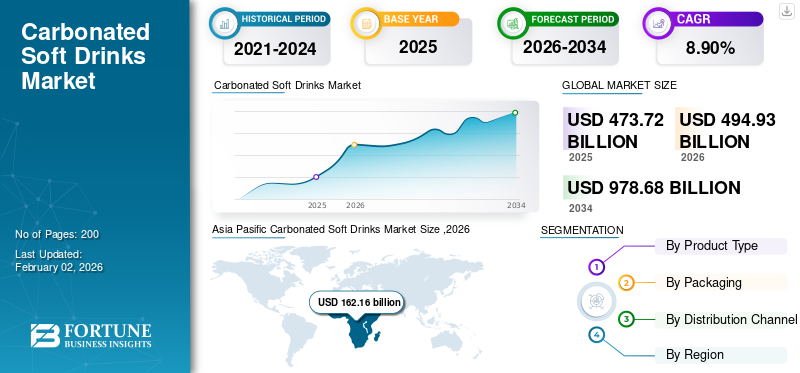
The global carbonated soft drinks market size was valued at USD 473.72 billion in 2025 and is projected to grow from USD 494.93 billion in 2026 to USD 978.68 billion by 2034, exhibiting a CAGR of 8.90% during the forecast period. Asia Pacific dominated the global carbonated soft drinks market with a market share of 34.23% in 2025.
Carbonated soft drinks (CSDs) are non-alcoholic beverages made primarily from carbonated water infused with carbon dioxide gas, which creates effervescence or fizz, combined with flavorings and sweeteners such as sugar, high-fructose corn syrup, or non-caloric alternatives. In the global carbonated soft beverages market, consumers seek novel flavors and formulations that align with their wellness goals. Global carbonated soft drinks (CSDs) market growth is primarily driven by rising disposable incomes, urbanization, and expanding consumer demand for convenient, ready-to-drink beverages in emerging economies. Health-conscious shifts boost low/no-sugar variants, while flavor innovations and premiumization attract younger demographics amid busy lifestyles.
The global market is dominated by major players, including The Coca-Cola Company, PepsiCo, Inc., Keurig Dr Pepper Inc., Suntory Beverage & Food Limited, and Britvic plc. These companies represent the most influential constituents of the global carbonated soft drinks value chain based on brand portfolios, bottling and distribution reach, marketing investments, and innovation capabilities.
Download Free sample to learn more about this report.
Carbonated Soft Drinks Market KEY TAKEAWAYS
 Market Size & Forecast
- 2025 Market Size: USD 473.72 billion
- 2026 Market Size: USD 494.93 billion
- 2034 Forecast Market Size: USD 978.68 billion
- CAGR: 8.90% from 2026–2034
 Market Share
- Asia Pacific dominated the carbonated soft drinks market with a 34.23% share in 2025.
- The cola beverages segment held a 56.73% market share in 2025.
- The retail segment accounted for a 63.76% market share in 2025.
 Key Regional Highlights
North America
Value growth is expected at around 9.05% CAGR, powered by premiumization, energy-style carbonates, and strong HoReCa recovery.
Europe
European CSD value is projected to grow at about 8.50% CAGR, led by premium tonic waters, flavored colas, and glass-pack HoReCa sales.
Asia Pacific
Asia Pacific accounted for the largest market share, reaching USD 162.16 billion in 2026 and climbing to USD 362.11 billion by 2034, with a CAGR of 9.84%.
U.S.
Growth is driven by demand for zero-sugar colas, craft sodas, and premium carbonated beverage innovations.
Japan
Stable demand supported by premium beverage formats and increasing preference for functional and low-sugar drinks.
Read More

MARKET DYNAMICS
Market Drivers
Product Variety and Flavor Innovation to Drive Market Growth
Product variety and flavor innovation are key drivers propelling the global carbonated soft drinks (CSD) market, alongside health trends such as low-sugar and functional beverages options. Brands innovate with novel profiles such as elderflower-lime, lychee, spicy cola, and botanical mixes such as ginger-turmeric to enhance refreshment and appeal. Mystery and seasonal releases, including Coca-Cola's Happy Tears Zero Sugar and Pepsi's Electric Blue, boost engagement, while fruity-tropical options such as watermelon-strawberry lead launches. Texture enhancements, such as nitrogen-infused creaminess or juice pulp, add premium sensory experiences.
- For instance, in February 2024, Coca-Cola Company, an American multinational corporation, launched Happy Tears Zero Sugar, a limited‑edition Coca‑Cola Creations flavor in the U.S. and Great Britain. It is a zero‑sugar formulation, aligning it with other Coca‑Cola Creations variants that experiment with taste profiles while remaining calorie‑
Market Restraints
Competition from Non-Carbonated and “Better-For-You” Drinks to Impede Market Growth
Non-carbonated and "better-for-you" beverages, including still bottled water, RTD tea/coffee, functional drinks, and plant-based options, are rapidly expanding and eroding market share from traditional sugary carbonated soft drinks (CSDs) due to consumer growing demand for hydration, low-sugar, and functional health benefits.
- According to the U.S. Department of Agriculture (USDA), the ready-to-drink tea and beverage shops in China exceeded 49 billion in 2024, reflecting a year-on-year growth rate of 6.4%.
Market Opportunities
Omnichannel and E-Commerce Expansion to Shape Industry
Omnichannel and e-commerce expansions create significant growth opportunities in the global CSD market by enhancing accessibility, personalization, and sales through integrated digital-physical channels. Brands leverage data analytics for personalized recommendations, click-and-collect, and social platform shopping, while direct-to-consumer (D2C) models enhance margins via quality control and targeted marketing.
Carbonated Soft Drinks Market Trends
Healthy Alternatives and Sustainable Packaging to Offer New Prospects
Healthy alternatives such as low-calorie, sugar-free, and functional carbonated soft drinks, infused with probiotics, vitamins, or natural sweeteners such as stevia, are driving new global market growth prospects by addressing health-conscious consumer demands. Sustainable packaging innovations, including recyclable aluminum cans, bio-based PET bottles, and glass options, appeal to environmentally aware buyers and support regulatory pushes for eco-friendliness. Manufacturers are coming up with innovative product launches in order to meet the increasing global carbonated soft drinks market demand.
- For instance, in November 2025, Radnor Hills launched a new carbonated soft drink range called Radnor Spring, which features sparkling spring water with added B vitamins and is low-calorie. The range includes four fruity flavors, such as black cherry & blackcurrant, mango & passion fruit, pineapple & grapefruit, and strawberry & raspberry.
Download Free sample to learn more about this report.
SEGMENTATION ANALYSIS
By Product Type
Brand Power and Occasion Versatility to Sustain Cola Segment Leadership
By product type, the market is segmented into cola beverages, lemonades, tonic water, and others.
Cola beverages are expected to remain the largest segment, underpinned by iconic brands and deep emotional connections with consumers. The cola beverages segment accounts for around 56.73% of the global carbonated soft drinks market share in 2025. In value terms, colas are estimated to hold a USD 268.74 million market size of the global CSD market in 2025, growing at a CAGR of about 8.65% from 2026 to 2034. Growth is slower than the category average due to sugar-reduction pressures, but is supported by zero-sugar variants, packaging innovation, and strong emerging-market demand.
The lemonades segment emerges as the fastest growing in the forecast period with a CAGR of 10.40% in 2026.
To know how our report can help streamline your business, Speak to Analyst
By Packaging
PET Bottles’ Convenience and Cost Efficiency to Sustain Segment Dominance
On the basis of packaging, the market is segmented into PET/plastic bottles, tin/cans, glass bottles, and tetra pack.
The PET/plastic bottles remain the dominant segment, as they are lightweight, shatter-resistant, and cost-effective for multi-serve and single-serve formats. With rising adoption of recycled PET and lightweighting initiatives, PET formats are expected to grow at an 8.52% CAGR during the forecast period.
The tetra pack segment is anticipated to grow at a CAGR of 11.63% during the global carbonated soft drinks market forecast period.
By Distribution Channel
Wide product variety, and Bulk discounts and promotions, Fuels Retail Segment Market Leadership
On the basis of the distribution channel, the market is segmented into HoReCa/foodservice and retail, with retail further broken down into supermarkets/hypermarkets, convenience stores, online retail, and others.
The retail segment is expected to maintain the largest share of 63.76% in 2025, expanding at a CAGR of 8.04%. Retail provides one-stop access to diverse brands, flavors, and sizes, catering to varied preferences and ensuring high visibility over other channels such as convenience stores. These outlets offer competitive pricing, bulk deals, and eye-catching displays, drawing price-sensitive consumers for family-sized purchases.
The HoReCa/foodservice segment is anticipated to grow at a CAGR of 10.27% during the forecast period.
Carbonated Soft Drinks Market Regional Outlook
Regionally, the report covers the global market analysis across North America, Europe, Asia Pacific, South America, and the Middle East & Africa.
Asia Pasific Carbonated Soft Drinks Market Size, 2025 (USD Billion)
To get more information on the regional analysis of this market, Download Free sample
Asia Pacific
Asia Pacific accounted for the largest market share, reaching USD 162.16 billion in 2026 and climbing to USD 362.11 billion by 2034, with a CAGR of 9.84%. Asia Pacific holds the largest share of the global CSD market due to its massive population, rapid urbanization, rising disposable incomes, and expanding retail networks in key economies such as China, India, and Southeast Asia. Rising disposable incomes in emerging markets enable greater spending on branded CSDs from giants such as Coca-Cola and PepsiCo, supported by aggressive marketing and innovation.
North America
North America remains one of the most valuable CSD regions owing to high per-capita consumption, although long-term volumes have trended slightly downward as consumers shift to low-/no-calorie drinks and alternatives. The region is increasingly driven by premium mixers, craft sodas, and zero-sugar colas. Value growth is expected at around 9.05% CAGR, powered by premiumization, energy-style carbonates, and strong HoReCa recovery.
Europe
Europe has witnessed extensive sugar-tax adoption, e.g., the U.K. Soft Drinks Industry Levy and reformulation. As a result, CSD portfolios have shifted toward low-sugar and no-sugar products, with stable to modestly growing volumes but improving value through premium brands and mixers. To cater to evolving consumer preferences, companies are focusing on natural ingredients, reduced sugar content, and functional beverage options. European CSD value is projected to grow at about 8.50% CAGR, led by premium tonic waters, flavored colas, and glass-pack HoReCa sales.
South America
South America's carbonated soft drinks market growth is supported by a deep tradition of flavored carbonates and guarana sodas. The region is expected to achieve a 6.71% CAGR in value, with upside from premiumization and continued urbanization.
Middle East & Africa
In the Middle East, carbonated soft drinks benefit from hot climates and strong out-of-home consumption, though sugar-reduction initiatives are emerging. Overall, carbonated soft drinks in the Middle East & Africa are projected to grow at a 7.17% CAGR, driven by population growth and network expansion of modern trade and QSR chains.
COMPETITIVE LANDSCAPE
Key Industry Players
Technological Edge in Carbonated Soft Drinks Processing to Support Market Growth
The global market is dominated by multinational giants, including The Coca-Cola Company, PepsiCo, Inc., and Keurig Dr Pepper, Inc., alongside players such as Suntory Holdings, Asahi Group Holdings, and Monster Beverage Corporation. These companies control major market shares through extensive brand portfolios, global distribution networks, and bottling partnerships. Growing emphasis on natural ingredients and reduced sugar content continues to appeal to health-conscious consumers across the global carbonated soft beverages market. Players such as Coca Cola and Pepsico focus on product innovation to address health trends, emphasizing low-sugar, zero-calorie, energy drinks and functional variants such as probiotics or vitamins. Limited edition offerings have become a key strategy to engage younger consumers in the global carbonated soft beverages market.
Key Players in the Carbonated Soft Drinks Market
|
Rank |
Company Name |
|
1 |
Coca-Cola Company |
|
2 |
PepsiCo, Inc. |
|
3 |
Keurig Dr Pepper Inc. |
|
4 |
Suntory Beverage & Food Limited |
|
5 |
Britvic plc |
List of Key Carbonated Soft Drinks Companies Profiled:
- The Coca-Cola Company (U.S.)
- PepsiCo, Inc. (U.S.)
- Keurig Dr Pepper Inc. (U.S.)
- Suntory Beverage & Food Limited (Japan)
- Britvic plc (U.K.)
- Arca Continental, S.A.B. de C.V. (Mexico)
- Refresco Group B.V. (Netherlands)
- Monster Beverage Corporation (U.S.)
- Parle Agro Private Limited (India)
- Refresco Holding (Netherlands)
KEY INDUSTRY DEVELOPMENTS:
- July 2025: PepsiCo launched the first-ever prebiotic cola in the traditional cola category, called Pepsi Prebiotic Cola. This product is notable for being the first major innovation in the segment in two decades, combining the classic cola taste with enhanced functionality for gut health.
- May 2025: Milo’s Tea Company, a family-owned business based in Birmingham, Alabama, launched three new refrigerated beverages for summer: Strawberry Lemonade, Raspberry Lemonade, and Lemon Sweet Tea. These additions expand their leading refrigerated tea and fast-growing lemonade lines, using natural ingredients without caffeine, preservatives, artificial flavors, colors, acids, or dyes in the lemonades.
- January 2025: True Citrus introduced new lemonade flavors under its True Lemon brand, including Triple Citrus Lemonade (combining lemon, orange, and lime), Passionfruit Lemonade, and others highlighted in recent promotions.
- October 2024: Uncle Matt’s Organic expanded its lemonade lineup with several organic, low- or no-sugar-added variants, including a notable ginger honey lemonade.
- August 2024: Franklin & Sons introduced a new format for its soft drinks with the launch of a sleek 250ml recycled aluminum can. This format is initially available in three of its best-selling flavors: Elderflower, Raspberry, and Dandelion & Burdock.
REPORT COVERAGE
The global carbonated soft drinks industry report analyzes the market in depth and highlights crucial aspects such as global market trends, market dynamics, prominent companies, investment in research and development, and end-use. Besides this, the report also provides insights into the global carbonated soft drinks market analysis and highlights significant industry developments.
Request for Customization to gain extensive market insights.
REPORT SCOPE & SEGMENTATION
| ATTRIBUTE | DETAILS |
| Study Period | 2021-2034 |
| Base Year | 2025 |
| Forecast Period | 2026-2034 |
| Historical Period | 2021-2024 |
| Growth Rate | CAGR of 8.90% from 2026 to 2034 |
| Unit | Value (USD Billion) |
| Segmentations | By Product Type, Packaging, Distribution Channel, and Region |
| Segmentation | By Product Type
|
By Packaging
|
|
By Distribution Channel
|
|
By Region
|
Frequently Asked Questions
Fortune Business Insights says that the global market was USD 473.72 billion in 2025 and is anticipated to reach USD 978.68 billion by 2034.
At a CAGR of 8.90%, the global market will exhibit steady growth over the forecast period.
By product type, the cola beverages segment leads the market.
Asia Pacific held the largest market share in 2025.
Product variety and flavor innovation are the crucial factors driving the market growth.
The Coca-Cola Company, PepsiCo, Inc., Keurig Dr Pepper Inc., Suntory Beverage & Food Limited, and Britvic plc are the leading companies in the market.
Healthy alternatives and sustainable packaging are shaping the industry.



- 2021-2034
- 2025
- 2021-2024
- 200
-
(Offer valid till 30th Sep 2026)
Get 30-60 hrs Free Customization
Expand Regional and Country Coverage, Segments Analysis, Company Profiles, Competitive Benchmarking, and End-user Insights.




















-
US +1 833 909 2966 ( Toll Free )
-
Get In Touch With Us