Southeast Asia Automotive HVAC Market Size, Share & Industry Analysis, By Type (Automatic and Manual), By Component (Compressor, Condenser, Evaporator, Receiver Dryer, Expansion Valve, and Others), By Vehicle Type (Passenger Vehicle (Hatchback, Sedan, and SUV) and Commercial Vehicle (LCV and HCV)), By Distribution Channel (OEM and Aftermarket), and Regional Forecast, 2025-2032
 Download Free Sample
(Offer valid till 31st Oct 2026)

KEY MARKET INSIGHTS
 Listen to Audio Version
The Southeast Asia automotive HVAC market size was valued at USD 2.16 billion in 2024. The market is projected to grow from USD 2.34 billion in 2025 to USD 5.84 billion by 2032, exhibiting a CAGR of 14.0% during the forecast period.
The market is set to grow in the forthcoming years due to growth in government initiatives and increasing urbanization and industrialization. Government initiatives to restore the automotive industry are important in terms of market expansion. For example, efforts in India encouraging foreign investment and technology adoption in the automotive sector are likely to spur HVAC system uptake. Southeast Asia's high rates of urbanization and industrialization are boosting construction work and raising the demand for efficient HVAC systems in both commercial and residential areas. This is most evident in cities where climate control measures are most necessary because of hot and humid environments. Additionally, companies such as Sanden, Denso and Mahle are at the forefront of this growth with a wide distribution network and investments in establishing production facilities in the region.
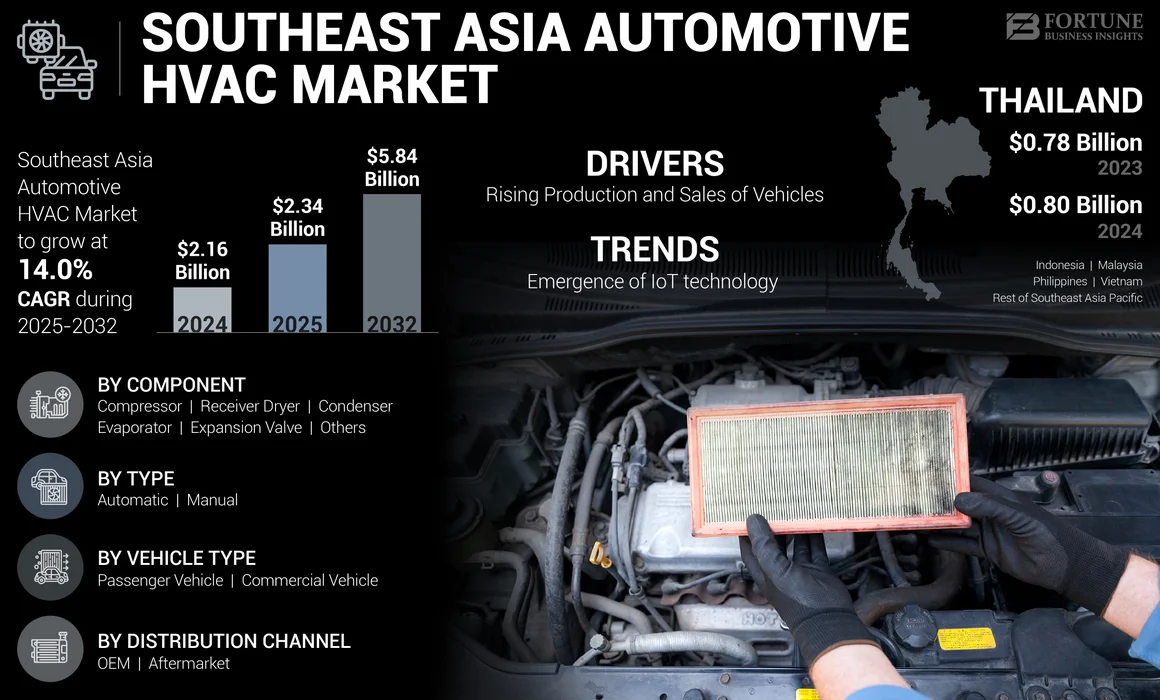
Automotive HVAC, recognized for heating, ventilation, and air conditioning, is a technology in the vehicle that manages and controls the internal climate of the vehicle cabin. Overall, it maintains passenger comfort by proficiently regulating temperature and air quality in the vehicle. The refrigerant is converted from liquid to gas and vice versa while absorbing heat. The key components that HVAC includes are condensers, evaporators, compressors, and blowers, which collectively deliver conditioned air for passengers and achieve optimal thermal comfort.
Download Free sample to learn more about this report.
Market Dynamics
Market Drivers
Rising Production and Sales of Vehicles Contribute to Substantial Growth of the Market
The economic development and demographic transition of the Southeast Asia are significant drivers for rising car production and sales, leading to growing market demand. This is majorly due to an increase in the middle-class populace. Developing nations, such as Vietnam and the Philippines, with relatively high economic progress rates, have a higher income class and out-of-pocket spending in the motor automobile sector.
There is growing access to credit facilities, dropping interest rates, and greater demand for private over public transport. The region is also becoming increasingly important for global automotive manufacturers with low labor costs and well-positioned locations. It has allowed manufacturers to localize, meeting internal demand and export demand.
Light-vehicle production in the region has been remarkable, with a huge year-over-year increase in output, supported by OEMs trying to catch up on orders and take advantage of the opportunities offered by the increased demand. This balance of domestic production capacity and increased consumer demand makes the Southeast Asia region a strategic market for automotive manufacturing. All these factors, collectively, contribute to the Southeast Asia automotive HVAC market growth.
Market Restraints
Increasing Cost of Advanced HVAC Systems to Act as a Major Restraint for the Market
High repair and maintenance costs for automotive HVAC systems in Southeast Asia pose the biggest challenge to vehicle owners and manufacturers. The key reasons for such costs include regular servicing, which is essential for optimum performance. HVAC systems demand services from experienced technicians who have special tools for their servicing, adding to the cost and are inaccessible to some regions. Moreover, the harsh weather conditions of the region are prone to frequent system breakdowns, thereby increasing the chance of repairs in huge volumes.
Different parts for HVACs are expensive, especially if one is dealing with advanced or specific parts. Getting these parts for older vehicles proves to be problematic, and the associated cost of repairing can thereby increase. Due to the unavailability of a large number of qualified service centers, vehicle owners may have to travel a large distance to get the maintenance done, adding to extra time and transportation expenses. Therefore, this high cost of repairing and maintaining may prevent the consumer from investing in a vehicle that incorporates an advanced HVAC system. Consequently, the perceived costs incurred for continuous maintenance in the operation of the HVAC will result in the adoption of a simpler system with low efficiency and older designs.
Market Opportunities
Growing Demand for Electric Vehicles in Southeast Asia to Offer Market Expansion Opportunity
A synergy of economic, environmental, and technological drivers supports the surging demand for electric vehicles in Southeast Asia. Consumers are enlightened on the environmental impact of traditional internal combustion engine vehicles and thus are opting for alternative, greener choices that lower carbon footprints. This trend has been further catalyzed by government initiatives for the adoption of EVs through tax incentives and infrastructure development, such as charging stations. In 2023, EV sales in the Southeast Asia region almost tripled to about 153,500 units and are projected to be at 56% of the global market by 2040. In fact, Thailand and Vietnam are on high-growth trajectories, with Thailand witnessing four times the sales volume due to the conducive policies and low prices from the Chinese makers. The falling price of EV batteries also makes these vehicles more consumer-friendly. As cities grow and fuel prices remain volatile, the economic aspects of EVs become more compelling. This sets up the Southeast Asia region as an emerging market for electric mobility and promises huge opportunities for vehicle makers as well as infrastructure developers.
Market Challenges
Regulatory Requirements Challenges Market Development
The main regulatory challenges in the automotive HVAC sector in the Southeast Asia region lie in the inconsistency of standards that vary by region. Initiatives that govern and control refrigerant usage include the Montreal Protocol and a variety of national energy policies to enforce greater efficiency in terms of energy usage. Inconsistent harmonization will challenge compliance for manufacturers operating across multiple countries. While efforts, including the ASEAN SHINE Initiative, seek to establish Minimum Energy Performance Standards (MEPS) for air conditioners, implementing these vary significantly, leading to uncertainty in HVAC market share conditions. Additionally, the absence of stringent enforcement mechanisms allows for lower-quality products to enter the market, undermining efforts to promote advanced, energy-efficient HVAC technologies. This regulatory disintegration not only challenges innovation but also hampers local manufacturers from meeting both environmental goals and consumer expectations concerning comfort and efficiency.
Southeast Asia Automotive HVAC Market Trends
Emergence of IoT Technology Leads to a Major Market Trend
The integration of IoT technology supports smart HVAC systems. In smart HVAC systems, vehicle climates can be remotely operated through mobile applications. Such development enables convenience for users. Energy management and increased demand are driven by the need for connectivity by consumers. Currently, concentration on air inside vehicles has moved from including finer filtration systems fitted with a PM2.5 filter and a HEPA filter. These systems help to enhance indoor air quality by effectively removing pollutants and allergens.
Impact of COVID-19
The COVID-19 pandemic severely affected the Southeast Asia automotive HVAC market share, majorly due to disruptions in the supply chain and reduced vehicle production. The lockdown caused subsequent delays in manufacturing, therefore resulting in a considerable decrease in automotive output, especially in Indonesia, which suffered drastic declines in sales.
Initially, consumers reduced the demand for vehicles, focusing more on safety and financial security. However, as the economies started coming out of the crises, demand for vehicles with modern HVAC systems that improve the quality of air and health security resurfaced.
In the future, this demand is expected to rebound with further technological advancements in the automotive industry and government interventions to revive it. Businesses are likely to focus on innovative HVAC solutions that meet new environmental standards, positioning the market for significant growth as consumer confidence returns and demand for safer and more efficient vehicles increases.
Segmentation Analysis
By Type
Growing Consumer Demand for Comfort Propelled the Automatic Segment Growth
On the basis of type, the market has been divided into automatic and manual.
The automatic segment held the largest market share, owing to advancements in sensor technology, Artificial Intelligence (AI), and climate control algorithms that enable more sophisticated automatic HVAC systems. These advancements improve performance, efficiency, and user experience, further driving the demand for the automotive HVAC market in India.
The manual segment is set to rise at the highest CAGR in the coming years. Manual HVAC systems are typically simpler and less expensive to manufacture than other systems. This cost-effectiveness increases the demand for manual systems, especially for Indian auto manufacturers, to provide affordable models to a broader consumer base. This change is attributed to the rising consumer inclination toward convenience and ease of use, mainly by the younger age group. Manual automatic vehicles, also called dual-clutch transmissions, provide a seamless driving experience with the capacity to shift gears automatically, eliminating the need for a traditional clutch pedal. Manufacturers such as Volkswagen, Ford, and Hyundai are expanding their offerings of manual automatic vehicles, fulfilling this rising demand, which will further generate a demand for automotive HVAC.
By Vehicle Type
Increased Sales of Electric Vehicle to Propels the Growth of Passenger Vehicles Segment
Based on vehicle type, the market is divided into passenger vehicle and commercial vehicle.
The passenger vehicle segment is expected to witness significant growth during the forecast period. Electric vehicle trends highly influence the growth of the HVAC market. For instance, in March 2024, BYD announced the launch of the Seal electric sedan in India. The car can go 200 km with 15 minutes of charging. BYD claimed the car can accelerate from zero to 100 km/h in just 3.8 seconds. It has automatic rain-sensing wipers and electrically adjustable AC vents. These developments drive market segment growth.
The commercial vehicle segment is experiencing notable growth in the market, attributed to the expansion of e-commerce sectors, urbanization, and last-mile delivery services. The rising sales of commercial vehicles in the logistics and delivery sectors fuels the demand for the product in the Southeast Asia region.
To know how our report can help streamline your business, Speak to Analyst
By Component
Rising Demand for Comfort Features in Vehicles across all Segments Augmented Condenser Installations
Based on component, the market is segmented into compressor, condenser, evaporator, receiver dryer, expansion valve, and others.
The condenser segment held the leading market share in 2024. Modern vehicles require efficient heat exchange systems due to tighter engine compartments and higher efficiency demands. The condenser needs frequent replacement due to exposure to road debris, corrosion, and physical damage. The increasing integration of comfort features across all vehicle segments has also driven up the demand for condensers. Condensers play a vital role in overall HVAC system performance by effectively converting refrigerant from gas to liquid state while managing heat dissipation. Their market dominance stems from their frequent replacement requirements due to exposure to harsh conditions combined with the increasing demand for comfort features across all vehicle segments.
The compressor segment is expected to grow at the highest growth rate over the forecast period. This growth is primarily driven by the automotive industry's shift toward electrification, the rising adoption of electric compressors in hybrid and electric vehicles, and the increasing demand for variable displacement compressors that enhance fuel efficiency. Additionally, stringent regulations on refrigerant emissions are pushing manufacturers to develop more efficient compressor technologies, while the integration of smart features and electronic controls in modern vehicles is creating new opportunities for advanced compressor systems. The transition toward electric vehicles, which require specialized electric compressors, is further accelerating this segment's growth.
By Distribution Channel
Development of Advanced HVAC Systems for Passenger Vehicles Boosted OEM Segment Growth
Based on the distribution channel, the market has included OEM and aftermarket.
The OEM segment accounted for a dominating market share in 2024. The rising vehicle sales and demand for passenger vehicles, along with the growing awareness of EVs, have led to an increase in demand for the OEM-fitted HVAC market. Moreover, major automakers in the region are developing affordable and efficient passenger cars to cater to the demand. For instance, in August 2023, Tata Motors announced the launch of four electric vehicles in the second quarter of 2024. This propels the market growth of OEM-fitted HVAC companies in the region.
The OEM segment is highly dominating in terms of automotive HVAC since OEMs equip their vehicles with automotive HVAC for vehicles of the highest durability and quality. Furthermore, the rolling out of new vehicles and the production rate of new vehicles have significantly increased, addressing the growing demand for next-generation vehicles. These factors also aid in the development of the automotive HVAC market in India.
The aftermarket segment is expected to grow at a significant CAGR owing to the growth in e-commerce and consumer spending on maintenance. As consumers learn more about the need for maintenance to ensure long life and efficiency of vehicles, demand for replacement parts and servicing of HVAC equipment also rises accordingly. Additionally, advances in automotive HVAC technology, such as smart and efficient systems, are encouraging vehicle owners to upgrade and replace, leading to growth in the aftermarket business.
Southeast Asia Automotive HVAC Market Regional Outlook
Thailand
Thailand led the market share in 2024 as the country’s growing middle-class population has led to an increase in vehicle ownership. As a result, there is a higher demand for passenger cars, which requires HVAC systems. Thailand's automotive industry is growing rapidly, driven by investments from international manufacturers, including Toyota, Honda, and Ford. This growth is creating new opportunities for HVAC system suppliers and manufacturers. The Thai government has implemented various regulations to reduce emissions and improve air quality. As a result, manufacturers are focusing on developing more efficient and eco-friendly HVAC systems, which is driving demand for advanced HVAC technologies.
Indonesia
The Indonesia market is forecast to achieve the highest growth rate in the coming years. The overall growth of Indonesia's automotive industry is driving demand for various vehicle components, including HVAC systems across passenger vehicles. Growing awareness of air quality issues is leading to a growing demand for HVAC systems with air purification features. Indonesian consumers are increasingly valuing comfort and convenience features in their vehicles.
Competitive Landscape
Key Industry Players
The competitive landscape of the Southeast Asia automotive HVAC market offers insights into various competitors. This includes an overview of each company, their financial performance, revenue generation, market potential, investments in research and development, new initiatives, strengths and weaknesses, product and brand portfolios, product launches, mergers and acquisitions, and their applications. The data provided focuses specifically on the companies' engagement within the market. Key players in the market include Denso, Pt Mahle Indonesia and Sanden. These players have an eminent presence and are putting continuous efforts to sustain in the market.
List of Key Automotive HVAC Companies in Southeast Asia:
- PT Mahle Indonesia (Indonesia)
- Denso (Japan)
- PT. Sanden Indonesia (Indonesia)
- Sanden (Thailand)
- Hanon Systems (South Korea)
- Marelli (Japan)
- Valeo (France)
Key Industry Developments
- July 2024: The Vitality and Trade Innovation trade division of the Bosch Bunch plans to acquire worldwide HVAC commerce for private and light commercial buildings from Johnson Controls. The company aims to obtain 100% of the Johnson Controls-Hitachi (JCH) joint venture, counting Hitachi's 40% stake.
- July 2024: China's BYD procured a 20% stake in its wholesaler, Rever Car, in Thailand, its biggest showcase exterior of China, where it is an electric vehicle advertising pioneer. The Shenzhen-based automaker opened its new facility to begin with a production line in Southeast Asia in Thailand. The USD 490 million plant will have a yearly fabricating capacity of 150,000 vehicles and utilize 10,000 specialists.
- May 2024: India-based electric vehicle component creator Matel raised USD 4 million in funding from clean energy-focused venture fund Transition Venture Capital.
- April 2024: Phononic, a worldwide pioneer in maintainable strong state cooling, declared the launch of its subsidiary in Thailand as its Asia Pacific base camp. The Thailand office will arrange deals back, and supply chain associations will be dynamic within the locale as of now.
- October 2023: Tata Engines launched the new model of its premium SUVs, the facelifted Harrier and Safari. The highlights of the two SUVs include an immersive driving experience increased by top-notch, feature-laden insides. The premium materials and wraps inside the two vehicles are highlighted by an exquisite Touch Control Board, situated underneath the discussed vents and created by Antolin, the global provider of car overhead systems.
- September 2023: BYD, a Chinese electric vehicle front-runner, moved ahead early in the small but rapidly growing Southeast Asian EV market, partly due to its multiple distribution partnerships with large conglomerates in the country. BYD cars are sold by Sime Darby Motors, the automotive arm of Malaysian trading and logistics giant Sime Darby, in two of the region's wealthiest countries.
- August 2023: Ayala Organization partnered with the Philippine merchant of BYD, the world pioneer in cross-breed and immaculate electric vehicles. This deal between one of the biggest multi-brand car bunches within the Philippines and the world's leading EV brand is a cornerstone of the group's objective of quickening the long run of versatility within the nation.
Report Coverage
The Southeast Asia automotive HVAC market research report analyzes the market in-depth and highlights crucial aspects such as prominent companies, market segmentation, competitive landscape, vehicle type, and technology adoption. Besides this, the report provides insights into the market trends and highlights significant industry developments. In addition to the aspects mentioned earlier, the report encompasses several factors contributing to the market's growth over recent years.
Request for Customization to gain extensive market insights.
Report Scope & Segmentation
|
ATTRIBUTE |
DETAILS |
|
Study Period |
2019-2032 |
|
Base Year |
2024 |
|
Estimated Year |
2025 |
|
Forecast Period |
2025-2032 |
|
Historical Period |
2019-2023 |
|
Growth Rate |
CAGR of 14.0% from 2025 to 2032 |
|
Unit |
Value (USD Billion) |
|
Segmentation |
By Type
By Vehicle Type
By Component
By Distribution Channel
By Region
|
Frequently Asked Questions
The market was valued at USD 2.16 billion in 2024 and is projected to reach USD 5.84 billion in 2032.
The market is projected to grow at a CAGR of 14.0% over 2025-2032.
The OEM segment accounted for a majority of the market in 2024.
Rising vehicle production and sales will lead to substantial growth in the market.
Denso, Mahle, and Sanden are some of the leading players in the market.



- 2019-2032
- 2024
- 2019-2023
- 151
-
(Offer valid till 31st Oct 2026)
Get 30-60 hrs Free Customization
Expand Regional and Country Coverage, Segments Analysis, Company Profiles, Competitive Benchmarking, and End-user Insights.




















Related Reports
-
US +1 833 909 2966 ( Toll Free )
-
Get In Touch With Us