Sovereign Cloud IaaS Market Size, Share & Industry Analysis, By Component (Solution and Services), By Deployment Model (Public Sovereign Cloud, Private Sovereign Cloud, Hybrid Sovereign Cloud, and On-Premises Sovereign Cloud), By Sovereignty Type (Data Sovereignty, Operational Sovereignty, and Technical Sovereignty), By End-user (Government & Public Sector, BFSI, Healthcare, IT & Telecom, Manufacturing, Energy & Utilities, Aerospace & Defense, and Others), and Regional Forecast, 2026-2034
 Download Free Sample
SOVEREIGN CLOUD IAAS MARKET SIZE AND FUTURE OUTLOOK
 Listen to Audio Version
The global sovereign cloud IaaS market size was valued at USD 58.51 billion in 2025. The market is projected to grow from USD 71.39 billion in 2026 to USD 489.14 billion by 2034, exhibiting a CAGR of 27.20% during the forecast period. Asia Pacific dominated the sovereign cloud IaaS market with a market share of 56.81% in 2025.
Sovereign cloud IaaS includes cloud infrastructure services designed to keep sensitive data, workloads, operations, and access controls aligned with national or regional sovereignty requirements. These solutions include sovereign compute, storage, networking, virtualization, encryption, identity and access management, local data residency, customer-controlled key management, audit logging, sovereign cloud regions, air-gapped infrastructure, and hybrid/on-premises cloud environments. Unlike standard public cloud IaaS, sovereign cloud IaaS is built to address stricter requirements around jurisdictional control, operational autonomy, regulatory compliance, critical workload protection, and trusted local governance across government agencies, BFSI, healthcare, telecom, defense, energy, and other regulated sectors.
The rapid expansion of data localization rules, cybersecurity requirements, government cloud programs, regulated industry cloud migration, sovereign AI, and critical infrastructure modernization is driving the market growth. Organizations are increasingly investing in these platforms to host sensitive citizen data, financial records, healthcare data, defense-linked workloads, telecom infrastructure, utility systems, and industrial data in compliant cloud environments. Sovereign cloud IaaS also helps customers improve data control, reduce foreign jurisdiction exposure, strengthen auditability, manage privileged access, and support resilient digital operations.
Key players such as Amazon Web Services, Microsoft Corporation, Google LLC, and Oracle are strengthening their sovereign cloud capabilities through local cloud regions, dedicated sovereign infrastructure, air-gapped cloud, customer-controlled encryption, local operations, national partner clouds, and compliance-ready cloud platforms. These companies are focusing on solutions that support data residency, operational sovereignty, technical sovereignty, regulated cloud migration, AI workloads, secure government platforms, and sector-specific cloud requirements.
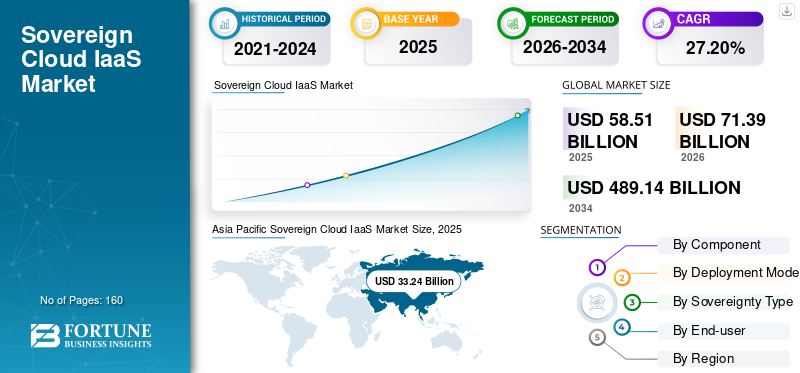
Download Free sample to learn more about this report.
Sovereign Cloud IaaS Market Key Takeaways
 Global Market Size & Forecast
- 2025 Market Size: USD 58.51 billion
- 2026 Market Size: USD 71.39 billion
- 2034 Forecast Market Size: USD 489.14 billion
- CAGR: 27.20% from 2026-2034
 Market Share
- Asia Pacific dominated the sovereign cloud IaaS market with a 56.81% share in 2025.
- The energy & utilities segment is projected to grow at the highest CAGR of 33.90% during the forecast period.
- The services segment is expected to grow at the highest CAGR of 30.90% during the forecast period.
 Key Regional Highlights
North America
North America was valued at USD 9.73 billion in 2025, making it the second-largest regional market.
Asia Pacific
Asia Pacific held the largest market share in 2025, driven by the highest concentration of state-driven digital infrastructure demand.
Europe
Europe is expected to grow at a significant CAGR during the forecast period due to increasing sovereign cloud adoption.
U.S.
The U.S. market was valued at USD 13.42 billion in 2025, accounting for roughly 22.9% of global sales.
Japan
Japan's market was valued at USD 4.05 billion in 2025, representing approximately 6.9% of global revenues.
Read More

SOVEREIGN CLOUD IAAS MARKET TRENDS
Growth of Sector-specific Sovereign Cloud for Regulated Industries to Shape Market Growth
Sovereign cloud IaaS is increasingly expanding beyond its original public-sector base into highly regulated industries such as BFSI, healthcare, energy, telecom, manufacturing, and defense. These industries manage sensitive data, critical operations, and compliance-heavy workloads, so they require infrastructure that can provide data residency, operational resilience, customer-controlled encryption, auditability, cyber protection, and evidence-based compliance. For instance,
- In May 2026, Tata Consultancy Services recently expanded its Sovereign Secure Cloud into the European Union, targeting governments, public-sector organizations, and regulated industries. The offering is designed to help European Union entities comply with requirements such as GDPR, DORA, NIS2, and the Cyber Resilience Act. It includes a three-layer approach covering sovereign cloud, national sovereign cloud, and enterprise cloud services.
This shows that sovereign cloud is becoming sector-specific, where providers are tailoring infrastructure and services for financial institutions, public agencies, healthcare providers, telecom operators, and other compliance-sensitive users rather than offering only a generic cloud platform.
MARKET DYNAMICS
Market Drivers
Download Free sample to learn more about this report.
Increasing Cybersecurity and Critical Infrastructure Protection Needs to Drive Market Growth
The rising frequency of cyberattacks on critical sectors is driving demand for sovereign cloud IaaS, as organizations in energy, utilities, telecom, defense, BFSI, and healthcare need stronger control over sensitive data, cloud access, encryption, backup, audit trails, and incident response. Standard public cloud may not fully address these requirements for nationally important workloads, especially where data must remain within approved jurisdictions and operations must be handled by trusted entities. For instance,
- FBI’s 2025 Internet Crime Complaint Center report, which recorded 655 ransomware attacks against critical infrastructure organizations in 2025, with reported losses of USD 261 million.
- 2025 Qantas cyberattack, where attackers exposed the personal data of up to 6 million customers after exploiting an offshore IT call center through social engineering.
This type of incident highlights why regulated and critical sectors are moving toward sovereign cloud models that provide tighter access governance, local operational control, stronger third-party risk management, and more resilient infrastructure for mission-critical workloads.
Market Restraints
High Implementation and Compliance Cost May Limit Market Growth
Sovereign cloud IaaS market growth is often restrained by the high cost of building and operating cloud environments that meet local data residency, operational control, cybersecurity, and regulatory requirements. Unlike standard public cloud IaaS, sovereign cloud may require local data centers, isolated or dedicated infrastructure, country-specific compliance controls, local support teams, customer-managed encryption, continuous auditing, legal governance, and stricter vendor oversight. These requirements increase both capital and operating expenses for cloud providers and raise adoption costs for end-users, especially SMEs and price-sensitive enterprises. For instance,
- AWS’s plan to invest USD 8.41 billion through 2040 in the AWS European Sovereign Cloud in Germany, reflecting the scale of investment needed to create sovereign infrastructure with separate governance, local operations, and compliance capabilities.
This shows that while sovereign cloud is important for regulated workloads, its cost structure can slow adoption among organizations that cannot justify premium pricing, complex migration, or ongoing compliance management.
Market Opportunities
Rising Demand for Local Cloud Regions and National Cloud Ecosystems to Create Growth Opportunities
The growing push for digital sovereignty is creating strong opportunities for sovereign cloud IaaS providers as countries encourage local cloud regions, national data centers, and domestic cloud partnerships to reduce reliance on foreign-controlled infrastructure. Governments and regulated industries increasingly want sensitive workloads to be hosted within approved jurisdictions, operated under local compliance frameworks, and supported by trusted local partners.
This creates opportunities not only for hyperscalers but also for telecom operators, national cloud providers, system integrators, cybersecurity firms, and managed service providers that can support local data residency, migration, compliance, and sovereign operations. For instance,
- Oracle EU Sovereign Cloud, which offers cloud regions located only within European Union geographic boundaries and allows commercial and public-sector organizations to host applications and customer data within the European Union to meet data protection and sovereignty requirements.
- Oracle’s EU Sovereign Cloud includes regions in Frankfurt and Madrid, showing how providers are building region-specific cloud infrastructure to address local sovereignty needs.
This reflects a wider opportunity for cloud providers to build national and regional ecosystems that combine cloud scalability with local governance, operational control, and regulatory alignment.
Segmentation Analysis
By End-user
Rising Digital Government Initiatives Strengthened Government & Public Sector Leadership
Based on end-user, the market is classified into government & public sector, BFSI, healthcare, IT & telecom, manufacturing, energy & utilities, aerospace & defense, and others.
Government & public sector captured the highest market share in 2025, as sovereign cloud adoption is strongly linked to national data control, citizen service modernization, and public-sector cybersecurity. Government agencies manage highly sensitive datasets such as citizen identity records, tax information, defense-linked data, public health records, law enforcement systems, and national digital platforms, which cannot be migrated to standard cloud environments without strict jurisdictional and access controls. This makes sovereign IaaS a preferred infrastructure model for hosting public workloads under local laws, approved operations, audit requirements, and national security frameworks. The segment attained 34.4% of the market share in 2025.
Energy & utilities segment is anticipated to grow at the highest CAGR of 33.90% during the forecast period.
To know how our report can help streamline your business, Speak to Analyst
By Component
Hybrid Sovereignty and Hyperscale Capabilities Led to Dominance of Solutions Segment
Based on component, the market is divided into solutions and services.
Solutions captured the largest market share in 2025, as it offers the best balance between sovereignty controls and hyperscale cloud benefits. Government agencies and regulated enterprises can use local data residency, jurisdiction-specific compliance, encryption, access control, and audit features without building fully dedicated private or on-premises infrastructure.
Services segment is expected to grow at the highest CAGR of 30.90% during the forecast period.
By Deployment Model
Increasing Focus on Data Sovereignty and Scalability Fueled Growth of Public Sovereign Cloud Market
Based on deployment model, the market is divided into public sovereign cloud, private sovereign cloud, hybrid sovereign cloud, and on-premises sovereign cloud.
Public sovereign cloud captured the largest market share of 45.7% in 2025, as it offers a cost-effective way for organizations to meet data residency and regulatory requirements without investing in dedicated infrastructure. It combines the scalability and flexibility of public cloud services with sovereign controls over data location, access, and governance.
Hybrid sovereign cloud segment is expected to grow at the highest CAGR of 31.30% during the forecast period.
By Sovereignty Type
Growing Focus on Local Data Control Strengthened Data Sovereignty Segment Leadership
Based on sovereignty type, the market is categorized into data sovereignty, operational sovereignty, and technical sovereignty.
Data sovereignty segment captured the largest market share in 2024, as it addresses a major compliance risk in cloud adoption by giving organizations greater visibility into data location and the legal requirements that govern it. For most buyers, especially government, BFSI, healthcare, and telecom, the first approval condition is whether citizen records, financial data, patient information, or critical operational data can remain within national or approved regional boundaries. The segment captured 58.2% of the market share in 2025.
Operational sovereignty segment is expected to grow at the highest CAGR of 30.50% during the forecast period.
Sovereign Cloud IaaS Market Regional Outlook
By region, the market is categorized into North America, South America, Europe, the Middle East & Africa, and Asia Pacific.
Asia Pacific
Asia Pacific Sovereign Cloud IaaS Market Size, 2025 (USD Billion)
To get more information on the regional analysis of this market, Download Free sample
Asia Pacific holds the majority sovereign cloud IaaS market share mainly as it has the largest concentration of state-driven digital infrastructure demand, led by China, and supported by rapid cloud adoption in India, Japan, South Korea, ASEAN, and Australia. China alone creates a very large base as sovereign cloud demand is closely linked to government data control, domestic cloud ecosystems, data security rules, AI infrastructure, and state-backed digital platforms. For instance,
- China’s data center electricity capacity increased 30% in 2025 to around 30 GW, while Chinese cloud service providers’ capital expenditure increased by around 65% in 2025, reflecting aggressive investment in domestic cloud and AI infrastructure.
- China is drafting a nearly USD 295 billion plan to build a national AI data center grid with a strong domestic technology sourcing requirement, showing how cloud, AI, and sovereign infrastructure are becoming national priorities in Asia Pacific.
Therefore, the region leads the market as it combines a China-heavy sovereign cloud base with fast-growing digital government, BFSI, telecom, manufacturing, healthcare, and critical infrastructure cloud adoption across the wider region.
Japan Sovereign Cloud IaaS Market
The Japan market was valued at USD 4.05 billion in 2025, accounting for roughly 6.9% of global revenues.
China Sovereign Cloud IaaS Market
China’s market is projected to be one of the largest globally, with 2025 revenues valued at USD 19.58 billion, representing roughly 33.4% of global sales.
India Sovereign Cloud IaaS Market
The Indian market was valued at USD 2.15 billion in 2025, accounting for roughly 3.7% of global market share.
North America
North America is the second-largest market, valued at USD 9.73 billion in 2025, as the region has a mature cloud infrastructure base, strong government cloud adoption, and high demand from regulated sectors such as federal agencies, defense, BFSI, healthcare, and critical infrastructure. The U.S. is the key contributor, supported by FedRAMP, which provides a government-wide standardized approach to security and risk assessment for cloud products and services used by federal agencies. For instance,
- S. Department of Defense’s Joint Warfighting Cloud Capability, a multi-vendor cloud contract vehicle designed to meet DoD enterprise cloud requirements across unclassified, secret, and top-secret levels.
- Canada also strengthens the regional base through its cloud-first strategy and digital sovereignty framework, where the government emphasizes the need to manage and protect digital systems, data, and infrastructure securely and independently.
U.S. Sovereign Cloud IaaS Market
Given North America’s strong contribution and the U.S. dominance in the region, the U.S. market was valued at USD 13.42 billion in 2025, accounting for roughly 22.9% of sales.
Europe
Europe is expected to grow at a significant CAGR as sovereign cloud demand in the region is moving beyond basic data localization toward deeper control over cloud operations, administrator access, encryption, and regulatory auditability. European banks, healthcare systems, manufacturers, utilities, and public agencies are under stronger pressure to prove where sensitive data is hosted, who can access it, and how cloud service providers manage operational risk. This is creating steady demand for European Union-based sovereign cloud regions, trusted cloud partnerships, sector-specific compliance environments, and hybrid sovereign infrastructure, especially across Germany, France, the U.K., Italy, Spain, Benelux, and the Nordics.
U.K. Sovereign Cloud IaaS Market
The U.K. market was valued at around USD 1.03 billion in 2025, representing roughly 1.7% of global revenues.
Germany Sovereign Cloud IaaS Market
Germany’s market reached USD 1.20 billion in 2025, equivalent to around 2.0% of global sales.
Middle East & Africa
Middle East & Africa is expected to grow at the highest CAGR over the forecast period and reached a valuation of USD 2.79 billion in 2025, as the region is starting from a smaller base but is now seeing rapid cloud adoption across government, energy, defense, financial services, telecom, and smart city projects. GCC countries, especially Saudi Arabia and the UAE, are actively pushing cloud-first policies, local data hosting, national cybersecurity frameworks, and sovereign AI infrastructure, which creates strong demand for locally governed cloud IaaS. For instance,
- Saudi Arabia’s Cloud First Policy covers government and semi-government entities and is designed to accelerate cloud adoption by requiring these entities to consider cloud options for new IT investments.
- A strong recent instance is the UAE Sovereign Launchpad, launched by AWS and for the UAE’s public sector and regulated industries, with backing from the UAE Cybersecurity Council to support local compliance and trusted cloud adoption.
- In addition, cloud infrastructure investment is expanding rapidly in Saudi Arabia, with hyperscale providers such as AWS, Microsoft, and Oracle building market presence to support Vision 2030 digital transformation.
This combination of low base, government-led digital transformation, critical infrastructure modernization, data localization, and hyperscaler-backed sovereign cloud initiatives makes the region the fastest-growing region through 2034.
GCC Sovereign Cloud IaaS Market
The GCC market reached around USD 1.25 billion in 2025, representing roughly 2.1% of global revenues.
South America
South America is expected to grow at a slow and steady CAGR as sovereign cloud adoption in the region is still concentrated in a few major markets, mainly Brazil, while Argentina and the rest of South America are progressing from a smaller infrastructure and regulatory base. Demand is supported by public-sector digitalization, BFSI compliance, data localization, healthcare modernization, and energy infrastructure needs, but adoption is slower compared with Middle East & Africa or Europe due to limited local cloud regions, lower enterprise cloud maturity, budget constraints, and uneven regulatory enforcement across countries.
COMPETITIVE LANDSCAPE
KEY INDUSTRY PLAYERS
Leading Companies are Implementing Partnerships and Sovereign Cloud Expansion Strategies to Gain a Strong Foothold
Leading companies in the Sovereign Cloud IaaS market are focusing on partnerships, local cloud region expansion, dedicated sovereign infrastructure, and sector-specific cloud offerings to strengthen their competitive position. Market players are collaborating with telecom operators, national cloud providers, system integrators, cybersecurity firms, and government-backed entities to meet local data residency, operational control, and compliance requirements. Companies are also launching sovereign cloud regions, isolated cloud environments, customer-controlled encryption capabilities, and hybrid/on-premises deployment models to serve government, BFSI, healthcare, defense, telecom, energy, and other regulated industries. These strategic initiatives help providers build trust with public-sector and regulated customers, reduce concerns over foreign access, and expand their presence in high-growth markets.
LIST OF KEY SOVEREIGN CLOUD IaaS COMPANIES PROFILED IN REPORT
- Amazon Web Services, Inc. (U.S.)
- Microsoft Corporation (U.S.)
- Google LLC (U.S.)
- Oracle (U.S.)
- IBM Corporation (U.S.)
- SAP SE (France)
- OVHcloud (South Korea)
- T-Systems International Gmbh (Germany)
- Orange Business (France)
- Thales SA (France)
- Capgemini SE (France)
- Tata Consultancy Services Limited (India)
KEY INDUSTRY DEVELOPMENTS
- June 2026: Telefónica Tech partnered with Google Cloud to offer sovereign cloud services in Spain. The offering targets Spanish public administrations and private organizations in highly regulated industries. This supports Spain’s push toward local, trusted cloud infrastructure and strengthens Google Cloud’s sovereign cloud partner-led model in Europe.
- June 2026: ARIS became the exclusive process intelligence launch partner for AWS European Sovereign Cloud. The partnership is aimed at helping enterprises manage digital sovereignty requirements while adopting AI-driven transformation. This indicates that sovereign cloud demand is moving beyond infrastructure toward compliance, process visibility, and AI governance.
- June 2026: The European Commission introduced a broader tech sovereignty package to reduce reliance on U.S. and Chinese technology. The package includes the Cloud and AI Development Act, which aims to strengthen European cloud and AI infrastructure. This policy direction is expected to support European sovereign cloud providers and regulated cloud adoption.
- November 2025: Google Cloud launched its first Sovereign Cloud Hub in Munich, Germany. The hub was positioned as part of Google Cloud’s commitment to European innovation and sovereign cloud adoption. This strengthens Germany’s role as one of the key European centers for sovereign cloud infrastructure and ecosystem development.
- September 2025: SAP expanded its sovereign cloud portfolio with SAP Sovereign Cloud On-Site, made available globally. The model allows customers to host SAP-managed cloud infrastructure within their own facilities. This directly supports demand from highly regulated organizations needing physical control, data residency, and sovereign operations without fully giving up cloud capabilities.
- June 2025: Oracle announced Oracle Compute Cloud@Customer Isolated, a sovereign and air-gapped cloud offering. The service is designed for governments and regulated industries handling classified or confidential workloads and can be disconnected from the internet. This supports demand for on-premises, isolated, and defense-grade sovereign cloud infrastructure.
REPORT COVERAGE
The sovereign cloud IaaS market report provides a detailed analysis of the market and focuses on key aspects such as leading companies, component, deployment model, sovereignty type and leading end-user. Besides, the report offers insights into the market trends and highlights key industry developments. In addition to the factors above, the report encompasses several factors that contributed to the growth of the market in recent years.
Request for Customization to gain extensive market insights.
REPORT SCOPE & SEGMENTATION
| ATTRIBUTE | DETAILS |
| Study Period | 2021-2034 |
| Base Year | 2025 |
| Estimated Year | 2026 |
| Forecast Period | 2026-2034 |
| Historical Period | 2021-2024 |
| Growth Rate | CAGR of 27.20% from 2026-2034 |
| Unit | Value (USD Billion) |
| Segmentation | By Component, Deployment Model, Sovereignty Type, End-user, and Region |
| By Component |
|
| By Deployment Model |
|
| By Sovereignty Type |
|
| By End-user |
|
| By Region |
|
Frequently Asked Questions
According to Fortune Business Insights, the global market value stood at USD 58.51 billion in 2025 and is projected to reach USD 489.14 billion by 2034.
In 2025, the Asia Pacifics market value stood at USD 33.24 billion.
The market is expected to grow at a CAGR of 27.20% over the forecast period.
By end-user, government & public sector segment led the market.
Increasing cybersecurity and critical infrastructure protection needs to drive market growth.
Microsoft Corporation, Google LLC, Oracle, and Amazon Web Services, Inc. are the top players in the global market.
Asia Pacific held the largest market share in 2025.



- 2021-2034
- 2025
- 2021-2024
- 160
Get 30-60 hrs Free Customization
Expand Regional and Country Coverage, Segments Analysis, Company Profiles, Competitive Benchmarking, and End-user Insights.




















-
US +1 833 909 2966 ( Toll Free )
-
Get In Touch With Us