Soy-based Dairy Alternatives Market Size, Share & Industry Analysis, By Type (Non-Dairy Milk, Butter, Cheese, Yogurt, Ice Cream, and Others), By Distribution Channel (Supermarkets/Hypermarkets, Convenience Stores, Online Retail, and Others), and Regional Forecast, 2026-2034
 Download Free Sample
(Offer valid till 15th Oct 2026)

KEY MARKET INSIGHTS
 Listen to Audio Version
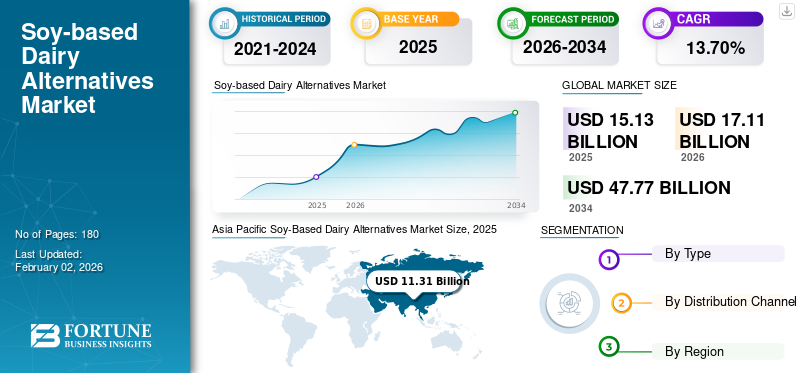
The global soy-based dairy alternatives market size was valued at USD 15.13 billion in 2025. The market is projected to grow from USD 17.11 billion in 2026 to USD 47.77 billion by 2034, exhibiting a CAGR of 13.70% during the forecast period. Asia Pacific dominated the soy-based dairy alternatives market with a market share of 58.99% in 2025.
Soy-based dairy alternatives are plant-centric products formulated to replicate the nutritional profile, texture, and taste of dairy items. These substitutes are composed of soybeans and are a famous choice for consumers who have dairy allergies or follow a vegetarian/vegan diet. Some common products include soy-based flavored milk, cheese, ice cream, and others. With respect to nutritional value, soy-based substitutes are recognized as a good source of vitamins, calcium, and protein. Moreover, these items are cholesterol-free and offer reduced calories compared to their dairy counterparts. Additionally, it comprises beneficial compounds such as isoflavones and other antioxidants, known for minimizing the risk of contracting health ailments. The increasing consumer demand for plant-based products and product innovation in the dairy alternatives sector support the global market expansion.
A few key players in the market include Danone S.A., The Campbell's Company, and The Hershey Company, among others.
Download Free sample to learn more about this report.
Soy-based Dairy Alternatives Market Key Takeaways
 Market Size & Forecast
- 2025 Market Size: USD 15.13 billion
- 2026 Market Size: USD 17.11 billion
- 2034 Forecast Market Size: USD 47.77 billion
- CAGR: 13.70% from 2026–2034
 Market Share
- Asia Pacific dominated the soy-based dairy alternatives market with a 58.99% share in 2025.
- Non-dairy milk was the leading type segment in 2024.
- Supermarkets/hypermarkets dominated the distribution channel segment in 2024.
 Key Regional Highlights
Asia Pacific
Asia Pacific generated USD 11.31 billion in 2025, accounting for 58.99% of the global market, and is projected to reach USD 12.82 billion in 2026.
Europe
Europe reached USD 1.80 billion in 2025 with a 26.74% market share and is expected to grow to USD 2.01 billion in 2026.
North America
North America was valued at USD 1.06 billion in 2025, representing 11.38% of the global market, and is projected to reach USD 1.18 billion in 2026.
U.S.
The U.S. remained the leading country in North America, supported by rising demand for plant-based dairy alternatives.
Japan
Japan is witnessing growing demand for soy-based dairy alternatives, driven by increasing health awareness and plant-based food adoption.
Read More

MARKET DYNAMICS
Market Drivers
Surging Popularity of Vegan Diets to Spur Market Expansion
The growing popularity of plant-based diets in the global market is a critical driver for the soy-based dairy alternatives industry. In today's healthy era, most individuals are switching toward vegan diets, which exclude all animal-centric items. This type of diet provides numerous health advantages, such as enhanced heart health and a reduced risk of chronic diseases. Moreover, individuals who do not adhere to vegetarian and vegan diets are incorporating plant-centric options such as soy dairy alternatives into their daily diet. Moreover, the increasing focus on ethical concerns regarding animal welfare further influences consumers to turn toward soy items. These factors are anticipated to augment the global soy-based dairy alternatives market growth.
Market Restraints
Hurdles in Attaining Desired Sensory Attributes and Rising Allergies May Inhibit Industry Growth
One of the pivotal difficulties faced by the dairy substitutes market is the challenge of attaining desired sensory attributes. Globally, most consumers find the texture and taste of a few plant-centric milks, especially soy, to be less desirable compared to traditional milk. Soy-based dairy substitutes have a beany flavor, owing to the presence of urease that can impact their culinary appeal. Further, soy-based dairy alternatives may have a chalky texture or unpleasant off-flavors, influencing consumer preferences.
Another restraint hindering the global market growth is the rising prevalence of allergies. Soy is one of the most common allergens affecting adults and young children. This allergy aggravates after the consumption of soy-based products, leading to respiratory problems, skin reactions, and digestive challenges, creating hindrances for industry growth.
Market Opportunities
Introduction of Kids-Friendly Soy-Based Alternatives to Bring Growth Possibilities
The rising demand for kids' specific soy-based substitutes unlocks numerous growth opportunities for global market players. A majority of parents are seeking healthier products for their children, which offer a large amount of nutrients. This trend of healthy eating fuels the demand for plant-centric products, which have high fiber and low sugar. To align with this demand, food manufacturers aim to launch new dairy substitutes, particularly for kids. For instance, in July 2025, Danone S.A., a prominent dairy firm in France, announced its latest range of yogurt alternatives and plant-sourced milk for kids across the U.K. The products are introduced via the Alpro kids range and comprise strawberry soy milk, chocolate oat milk, and strawberry soy yogurts, and contain 30% less sugar.
Soy-based Dairy Alternatives Market Trends
Growing Inclination toward Functional Fortification is a Current Trend
Functional fortification emerged as a notable trend in the global space, escalated by growing consumer awareness of improved health advantages and nutritional value. The majority of consumers are looking for plant-sourced substitutes to traditional dairy that provide a superior or comparable nutritional profile. Functional fortification, which includes the particular addition of nutrients, is a pivotal strategy to fulfil such requirements. Commonly, soy milk is fortified with vitamin B12, vitamin D, and calcium, which helps address nutritional inadequacies and offers health benefits such as a lower risk of chronic diseases and enhanced bone health. Considering such advantages, the food producers focus on creating new soy-based milk substitutes such as cheese alternatives, soy yogurt, and flavored soy beverages.
SEGMENTATION ANALYSIS
By Type
Non-Dairy Milk Segment Dominated Market Due to Its Several Advantages
Based on type, the market is distributed into non-dairy milk, butter, cheese, yogurt, ice cream, and others.
The non-dairy milk segment led the global market and generated the highest share in 2024. Such plant-based milk is an ideal option for consumers with dairy allergies/lactose intolerance as it is free from lactose and contains minimal fats. This soy-based milk is fortified with Vitamin D and calcium to match the nutritional value of traditional milk. Moreover, plant-centric milk is associated with a lowered risk of type 2 diabetes, cardiovascular challenges, and cancers. Such advantages bolster the global soy-based dairy alternatives market share.
The yogurt segment emerged as the fastest-growing segment and is expected to grow at the same pace in the future. Non-dairy yogurts comprise healthy fats and are rich in probiotics and prebiotics. Moreover, it has high fiber content and offers minimal sugar and sodium, further escalating the segment expansion.
By Distribution Channel
Supermarkets/Hypermarkets Led Market Due to Their Convenience and Vast Product Range
Depending on the distribution channel, the market is segmented into supermarkets/hypermarkets, convenience stores, online retail, and others.
The supermarkets/hypermarkets segment dominated the global market in 2024. This retail outlet provides numerous advantages, including convenience, a vast product range, and affordability. Moreover, supermarkets offer bulk purchasing options and promotional schemes such as cashback and discounts. Additionally, the freedom of selection, variety of payment options, and competitive pricing spur segment growth.
The online retail segment holds the highest CAGR and is predicted to maintain the same growth during the forecast period. The time-saving advantages, potential for better discounts and deals, and home delivery option fuel the segment's growing momentum.
Soy-Based Dairy Alternatives Market Regional Outlook
Based on region, the market is segmented into North America, Europe, Asia Pacific, South America, and the Middle East & Africa.
Asia Pacific
Asia Pacific Soy-Based Dairy Alternatives Market Size, 2025 (USD Billion)
To get more information on the regional analysis of this market, Download Free sample
The Asia Pacific market was valued at USD 11.31 billion in 2025, capturing 58.99% of global revenue, and is estimated to reach USD 12.82 billion in 2026. Asia Pacific dominated the global market, holding the largest market share. The improved health consciousness trend and increasing awareness of veganism are key factors that support the market's potential. Compared to other plant-sourced ingredients, soybeans are economical and widely available, making them a convenient option for producing non-dairy items. Moreover, technological advancements in the dairy-free sector help in enhancing the texture and taste of end products, further strengthening the consumption of soy-based dairy alternatives. Additionally, the growing awareness campaigns and government initiatives promoting plant-based diets bolster the regional growth.
Download Free sample to learn more about this report.
Europe
Europe accounted for USD 1.8 billion in 2025, representing 26.74% of the global market share, and is projected to reach USD 2.01 billion in 2026. Europe is a renowned region experiencing high trajectory growth in the soy-based dairy alternatives market. The European population is highly conscious of clean labelling, ingredient origin, and sustainability. Such factors influence their purchasing behavior, resulting in increased intake of plant-based items. Moreover, the region is observing a trend of functional beverages as they offer a vast range of essential nutrients. Along with this, well-built retail channels in the region, such as online retail and supermarkets/hypermarkets, make soy-based dairy alternatives widely available. These factors are poised to enhance the market's momentum.
North America
North America contributed 11.38% to the global market in 2025, with a valuation of USD 1.06 billion, and is projected to reach USD 1.18 billion in 2026. North America is a prominent region in the global soy-based dairy alternatives market in 2024. In this region, consumers are actively seeking plant-based options to dairy products, owing to perceived health advantages. Most of the individuals in the region experience dairy sensitivities, which leads them to substitutes. To avoid such conditions, most Americans are cutting down their dairy intake and are turning toward dairy-free alternatives. Moreover, the growing animal welfare concerns fuel the adoption of soy-based non-dairy products. Additionally, the presence of established dairy-free item producers in the region and increasing innovation collectively escalate the nation's growth.
Among all countries, the U.S. is the leading nation in the region, followed by Canada and Mexico. The surging focus on sustainability and improved marketing of dairy-free alternatives strengthens the market's momentum.
South America
The South American market is at its nascent stage and is expected to grow at a higher pace in the future. The growing demand for high-protein, content-rich items and rising private-label players of soy-based dairy alternatives bolster the region's growth.
Middle East & Africa
The market in Middle East & Africa reached USD 0.02 billion in 2025, representing 50.71% of total market revenue, and is projected to reach USD 0.02 billion in 2026. The market in the Middle East & Africa is at a progressive stage and is anticipated to maintain similar growth in the near term. The increasing veganism trend and surging cases of lactose intolerance strengthen the demand for dairy alternatives.
COMPETITIVE LANDSCAPE
KEY INDUSTRY PLAYERS
Active Players to Expand Their Base by Launching New Products
Key players in the global market include Danone S.A., The Campbell's Company, and The Hershey Company, among others. These enterprises aim to enhance their product portfolio by offering new products. Via such new launches, companies can entice a new customer base, which helps them boost their revenue generation.
List of Key Soy-based Dairy Alternative Companies Profiled
- Danone S.A. (France)
- The Campbell's Company (U.S.)
- Vitasoy International Holdings Limited (Hong Kong)
- The Hershey Company (U.S.)
- SunOpta (Canada)
- Dean Foods Company (U.S.)
- Eden Foods (U.S.)
- Natura Foods (Canada)
- Pulmuone Co., Ltd. (South Korea)
- Hiland Dairy (U.S.)
KEY INDUSTRY DEVELOPMENTS
- February 2025: Jumbo, a Dutch supermarket chain, released its latest range of plant-sourced yogurts, composed of soy, grown in the Netherlands. The product range has been launched under the "De Nieuwe Melkboer" brand across the Netherlands.
- January 2025: RIND, a U.S.-based snacks enterprise, unveiled its variety of vegan cheese, "ALPINE SVVISS," made up of cashew. This cheese is cholesterol and gluten-free and manufactured in 4-oz. blocks. The firm launched this item at the Specialty Food Association Winter Fancy Food Show in Las Vegas, U.S.
- September 2024: Oxbow Brands, an Indian company, introduced a new brand, "Vegan Drink Company," providing plant-centric substitutes. Each beverage, produced from plant-based proteins, is available in numerous variants such as almond, soy, and millets.
- June 2024: Fuji Oil Group, a Japanese firm, announced its first retail soy milk butter cream through its plant-based food brand (PBF). This butter can be purchased via Pal System delivery services and Co-op Deli in the Kanto region.
- January 2024: Ben & Jerry, a brand of Unilever based in the U.K., launched its latest vegan flavor across the U.S. market. The new Strawberry Cheezecake ice cream comprises oat milk and can be purchased by U.S.-based consumers.
REPORT COVERAGE
The market research report includes quantitative and qualitative insights into the market. It also offers a detailed analysis of the market size and growth rate for all possible market segments. Key insights in the global market report include an overview of related markets, a competitive landscape, recent industry developments such as mergers & acquisitions, the regulatory environment in critical countries, and current global market trends.
Request for Customization to gain extensive market insights.
REPORT SCOPE & SEGMENTATION
|
ATTRIBUTE |
DETAILS |
|
Study Period |
2021-2034 |
|
Base Year |
2025 |
|
Estimated Year |
2026 |
|
Forecast Period |
2026-2034 |
|
Historical Period |
2021-2024 |
|
Unit |
Value (USD Billion) |
|
Growth Rate |
CAGR of 13.70% from 2026 to 2034 |
|
Segmentation |
By Type
|
|
By Distribution Channel
|
|
|
By Region
|
Frequently Asked Questions
Fortune Business Insights says that the global market size was valued at USD 15.13 billion in 2025.
The market is expected to grow at a CAGR of 13.70% during the forecast period (2026-2034).
By distribution channel, the supermarkets/hypermarkets led the market in 2025.
The surging popularity of vegan diets is a key factor enhancing market expansion.
Danone S.A., The Campbell's Company, and The Hershey Company are a few of the top players in the market.
Asia Pacific held the highest share of the market.
The introduction of kid-friendly soy-based alternatives is anticipated to offer growth opportunities for industry players.



- 2021-2034
- 2025
- 2021-2024
- 180
-
(Offer valid till 15th Oct 2026)
Get 30-60 hrs Free Customization
Expand Regional and Country Coverage, Segments Analysis, Company Profiles, Competitive Benchmarking, and End-user Insights.




















Related Reports
-
US +1 833 909 2966 ( Toll Free )
-
Get In Touch With Us