Space Frame Market Size, Share & Industry Analysis, By Vehicle Application (Sports & Supercars, Luxury Performance Vehicles, Motorsport/Racing Vehicles, and Specialty & Bespoke Vehicles), By Material Type (Aluminum Space Frame, Steel Space Frame, Multi-Material Space Frame, and Other Material Space Frames), By Propulsion Type (ICE and Electric), By Frame Construction Technology (Tubular Space Frames, Extruded Space Frames, Cast-and-Extruded Space Frames, and Hybrid Space Frames), and Regional Forecast, 2026-2034
 Download Free Sample
(Offer valid till 30th Sep 2026)

Space Frame Market Size and Future Outlook
 Listen to Audio Version
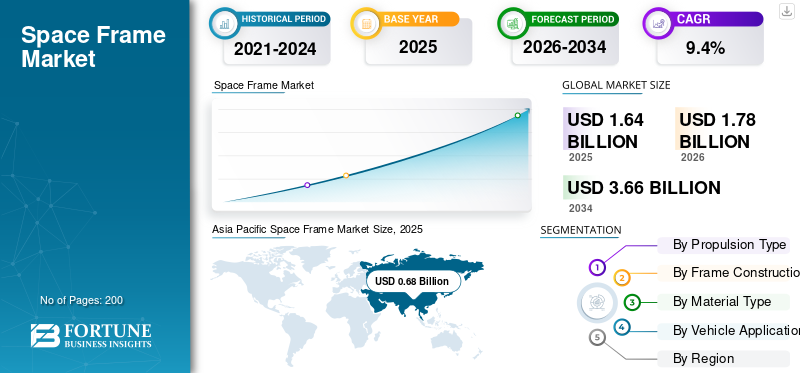
The space frame market size was valued at USD 1.64 billion in 2025. The market is projected to grow from USD 1.78 billion in 2026 to USD 3.66 billion by 2034, exhibiting a CAGR of 9.4% during the forecast period. Asia Pacific dominated the space frame market with a market share of 41.46% in 2025.
A space frame is a lightweight structural vehicle framework made of interconnected beams or tubes that supports body panels, absorbs loads, and improves stiffness, crash safety, and design flexibility. Market growth is driven by rising demand for lightweight vehicles, fuel efficiency, electric vehicle platforms, improved crash performance, aluminum adoption, and automakers’ focus on stronger, modular, and sustainable vehicle structures.
Major players in the market include Audi AG, Mercedes-Benz Group AG, Ferrari N.V., and Lotus Cars, competing through lightweight architecture, aluminum-intensive structures, electric vehicle integration, crash safety performance, modular platform design, and advanced manufacturing technologies.
Download Free sample to learn more about this report.
SPACE FRAME MARKET TRENDS
Multi-Material Space Frames Reshapes Market Trends
One of the key market trends is the growing use of multi-material space frames that combine aluminum, steel, carbon fiber, and composite components. This approach helps automakers balance cost, weight reduction, crash safety, and manufacturability. Multi-material construction also allows engineers to place stronger materials in high-load zones and lighter materials in non-critical areas. This trend is especially visible in premium vehicles, EVs, performance cars, and advanced mobility concepts requiring optimized structural efficiency.
- In September 2025, Karma Automotive revealed the Gyesera luxury plug-in hybrid at The Quail, featuring an evolved all-aluminum space-frame architecture, aluminum and carbon-reinforced composite body, Hybrid EREV powertrain, and planned production from the fourth quarter of 2025.
Advanced Joining Technologies Improves Space Frame Manufacturing and is an Emerging Market Trend
Automotive manufacturers are increasingly adopting advanced joining methods such as adhesive bonding, laser welding, riveting, and friction stir welding for space frame production. These techniques help connect different composite materials while maintaining strength, durability, and dimensional accuracy. The trend supports better crash performance, reduced structural weight, and improved production quality. As vehicle designs become more complex, joining technology is becoming a critical part of market adoption and competitiveness.
MARKET DYNAMICS
MARKET DRIVERS
Download Free sample to learn more about this report.
Rising Lightweight Vehicle Demand Drives Space Frame Adoption
Automakers are increasingly using space frame structures to reduce vehicle weight without compromising strength and safety. Aluminum, high-strength steel, and multi-material frames help improve fuel efficiency, extend electric vehicle driving range, and meet stricter emission targets. This supports space frame market growth as OEMs seek lightweight body architectures for premium cars, sports cars, EVs, and low-volume performance models where structural rigidity, crashworthiness, and design flexibility are important purchase and engineering factors.
- In June 2026, Audi unveiled the Nuvolari near-production supercar featuring Audi Space Frame technology, CFRP exterior, hybrid powertrain, adaptive aerodynamics, torque vectoring, and motorsport-derived braking, with 499 units scheduled for delivery from the first half of 2027.
Electric Vehicle Platform Expansion Driving Structural Innovation is Boosting Market Development
The shift toward electric vehicles is increasing demand for strong, lightweight, and modular vehicle structures. Space frames support battery pack integration, improved load distribution, and crash protection around high-voltage components. EV manufacturers are adopting advanced frame designs to improve range, safety, and vehicle performance. This is driving market growth, especially in premium EVs, electric sports cars, concept vehicles, and specialized mobility platforms where flexible architecture and reduced body weight are key priorities.
- In May 2023, Caterham planned an electric sports car designed by Anthony Jannarelly, using steel space-frame construction such as the Seven with modifications for road use, while offering aluminum or carbon-fiber body options and expected production around 2026.
MARKET RESTRAINTS
High Manufacturing Cost Limits Mass-Market Adoption
The market faces restraint due to high material, tooling, engineering, and assembly costs. Aluminum-intensive and multi-material structures require specialized joining, precision manufacturing, and skilled labor, making them more expensive than traditional unibody designs. This limits adoption mainly to premium vehicles, sports cars, EVs, and low-volume models. For cost-sensitive mass-market vehicles, conventional monocoque platforms often remain more practical, reducing the overall market share potential of space frame architectures.
MARKET OPPORTUNITIES
Low-Volume Mobility and Specialty Vehicles Supports New Growth Avenues for Market
Specialty vehicles, autonomous shuttles, motorsport vehicles, supercars, and low-volume mobility platforms offer growth opportunities for space frame structures in body and automotive industrial roofing structures. These applications value design flexibility, fast development cycles, modularity, and high structural performance more than large-scale cost effectiveness. Space frames can support customized body layouts and lightweight construction, making them attractive for emerging mobility companies, concept programs, and performance-focused vehicle manufacturers looking to differentiate products through advanced architecture and structural innovation.
- In March 2026, General Motors confirmed support for Questionable Garage’s restoration of an EV1, highlighting the vehicle’s pioneering aluminum space frame chassis, electric propulsion, regenerative braking, by-wire controls, heat pump, and lasting influence on GM’s modern EV technologies.
MARKET CHALLENGES
Complex Repairability and Insurance Costs Challenge Market Growth
A major challenge for the market is repairing complexity after collision damage. Aluminum and multi-material frames often require specialized tools, trained technicians, and controlled repair procedures. This can increase repair time, insurance cost, and ownership concerns compared to conventional steel body structures. As space frame vehicles expand beyond premium niches, OEMs must improve service networks, repair guidelines, and parts availability to support customer confidence and broader market acceptance.
Segmentation Analysis
By Propulsion Type
Established ICE Vehicle Base Leads to ICE Segment Dominance
Based on propulsion type, the market is segmented into ICE and electric.
The ICE segment held the largest space frame market share in 2025. The growth of this segment is due to the large existing ICE vehicle production base, mature supply chain, and established use of space frame structures in performance, premium, and specialty vehicles. Continued demand from sports cars, luxury models, and lightweight body applications supports its increasing adoption despite the gradual transition toward electric mobility.
The electric segment is estimated to develop at the fastest-growing CAGR of 11.2% over the forecast period. This growth is supported by EV platform expansion, battery weight reduction needs, lightweight architecture demand, and rising use of aluminum-intensive space frames in premium electric vehicles.
By Frame Construction Technology
Lightweight Structural Efficiency Boosts Tubular Space Frames Segment Growth
Based on frame construction technology, the market is segmented into tubular space frames, extruded space frames, cast-and-extruded space frames, and hybrid space frames.
The tubular space frames segment held the largest market share in 2025. The growth of this segment is due to its established use in sports cars, specialty vehicles, lightweight prototypes, and performance-focused platforms. Its high stiffness-to-weight ratio, design flexibility, proven manufacturability, and suitability for low-volume production supports continued adoption across premium and niche automotive applications.
The hybrid space frames segment is projected to develop at the fastest-growing CAGR of 11.0%, supported by multi-material construction, optimized load management, and automakers’ focus on combining aluminum, steel, and composites for balanced cost, strength, and lightweight performance.
To know how our report can help streamline your business, Speak to Analyst
By Material Type
Lightweight Performance Requirements Propels Aluminum Space Frame Segment Demand
Based on material type, the market is segmented into aluminum space frame, steel space frame, multi-material space frame, and other material space frames.
The aluminum space frame segment accounted for largest market share in 2025. The growth of the segment is due to its strong weight-reduction benefits, single layer, corrosion resistant, high stiffness, and suitability for premium vehicles, sports cars, and electric vehicle platforms. Automakers prefer aluminum space frames to improve range, efficiency, handling, and crash performance while supporting advanced body architecture.
- In December 2025, Toyota GAZOO Racing premiered the GR GT and GR GT3 prototypes, featuring Toyota’s first all-aluminum body frame, aluminum space-frame chassis, CFRP body panels, V8 twin-turbo hybrid performance, and motorsport-led development for launch around 2027.
The multi-material space frame segment is estimated to develop at the fastest-growing CAGR of 10.8% over the forecast period. This growth is supported by rising use of aluminum, steel, composites, and castings in one structure to balance lightweighting, cost, strength, and crash safety.
By Vehicle Application
Premium Vehicle Lightweighting Needs Augements Luxury Performance Vehicles Segment Growth
Based on vehicle application, the market is segmented into sports & supercars, luxury performance vehicles, motorsport/racing vehicles, and specialty & bespoke vehicles.
The luxury performance vehicles segment held the largest market share in 2025. The growth of this segment is due to strong adoption of lightweight, rigid, and safety-focused space frame structures in premium vehicle platforms. Automakers use space frames to improve handling, acceleration, crash performance, and design flexibility while supporting brand differentiation, electrification readiness, and high-value vehicle engineering.
- In September 2024, Rolls-Royce was developing an electric sedan and SUV, following Spectre’s strong demand, with both models potentially using the brand’s aluminum space-frame architecture while supporting its plan to sell only EVs by 2030.
The specialty & bespoke vehicles segment is estimated to develop at the fastest-growing CAGR of 11.3% over the forecast period. This growth is supported by customized vehicle programs, low-volume manufacturing, modular architectures, and rising demand for lightweight structures in niche mobility, concept, and limited-edition vehicles.
Space Frame Market Regional Outlook
By geography, the market is categorized into Asia Pacific, North America, Europe, South America, and Middle East & Africa.
Asia Pacific
Asia Pacific Space Frame Market Size, 2025 (USD Billion)
To get more information on the regional analysis of this market, Download Free sample
Asia Pacific dominated the space frame market in 2025, supported by strong vehicle production, expanding EV manufacturing, and rising adoption of lightweight vehicle structures. China, Japan, South Korea, and India supports regional demand through premium vehicles, electric platforms, and advanced automotive manufacturing ecosystems. Automakers in the region are increasingly using aluminum and multi-material structures to improve efficiency, range, and crash safety. Strong supplier networks and cost-efficient production further contributes to Asia Pacific’s leading market position.
- In January 2025, Gensol Electric Vehicles unveiled EZIO and EZIBOT at Bharat Mobility Global Expo 2025, securing 30,000 pre-orders, with EZIO featuring a high-tensile steel space frame chassis, 200 km range, and urban fleet-focused design.
China Space Frame Market
The China market in 2026 is estimated at around USD 0.26 billion, accounting for roughly 14.7% of global revenues. This growth is driven by EV production, premium vehicles, and lightweighting demand.
Japan Space Frame Market
The Japan market in 2026 is projected at around USD 0.21 billion, accounting for roughly 11.8% of global revenues. This is supported by advanced engineering, lightweight materials, and performance vehicles.
India Space Frame Market
The India market in 2026 is estimated at around USD 0.11 billion, accounting for roughly 6.3% of global revenues. Fastest-growing demand is driven by EV platforms, premiumization, and local manufacturing.
North America
North America held the third-largest market share in 2025, driven by strong demand for premium vehicles, electric vehicles, specialty vehicles, and performance-oriented models. The U.S. remains a key contributor due to advanced automotive engineering, EV platform development, and demand for lightweight vehicle structures. Regional growth is supported by OEM investments in electrification, battery protection, crash safety, and modular vehicle architecture. However, adoption remains more concentrated in higher-value vehicles rather than mass-market models.
U.S. Space Frame Market
The U.S. market in 2026 will be at approximately USD 0.36 billion, accounting for roughly 19.9% of global space frame revenues. Growth is driven by EV development, premium vehicles, and lightweight platform innovation.
Europe
Europe was second-largest region in the market in 2025 and is projected to grow at a 8.9% CAGR during the forecast period. This growth is supported by premium vehicle manufacturing, sports car production, strict emission targets, and strong lightweighting requirements. Germany, the U.K., Italy, and France contributes significantly through luxury, performance, and specialty vehicle platforms. European OEMs are also advancing aluminum-intensive and multi-material body architectures to improve safety, sustainability, and vehicle efficiency.
- In September 2025, Sekura Cabins Group opened a new manufacturing facility in Brașov, Romania, expanding European production of low-noise space-frame cabins for off-highway vehicles while strengthening OEM supply, sustainable manufacturing, and delivery capacity across agriculture, construction, mining, logistics, and automotive sectors.
Germany Space Frame Market
The Germany market in 2026 is estimated at around USD 0.14 billion, accounting for roughly 7.7% of global revenues. This is supported by luxury OEMs, sports cars, and aluminum-intensive vehicle architecture.
U.K. Space Frame Market
The U.K. market in 2026 is projected at around USD 0.07 billion, accounting for roughly 4.1% of global sales. Growth is driven by performance cars, motorsport heritage, and specialty vehicle manufacturing.
South America
South America accounted for the least market share in 2025, as space frame adoption remains limited compared to larger automotive manufacturing regions. This demand is mainly supported by niche premium vehicles, specialty applications, motorsport activities, and gradual modernization of automotive platforms. Brazil is the key contributor in the Latin America market due to its relatively stronger vehicle production base. Although the current market size is small, future growth is supported by lightweighting awareness, premium vehicle demand, and selective EV-related structural applications.
- In January 2023, WRC outlined plans to evolve 2025 Rally1 regulations, building on safer space-frame chassis, 1.6-liter turbo hybrid powertrains, expanded hybrid and EV modes, and sustainable fuel to attract new manufacturers and stabilize top-tier rally competition.
Brazil Space Frame Market
The Brazil market in 2026 is estimated at around USD 0.04 billion, accounting for roughly 2.1% of global revenues. Growth is supported by specialty vehicles, premium imports, and gradual lightweighting adoption.
Middle East & Africa
The Middle East & Africa held the fourth-largest market share in 2025, and is also espected to be the fastest-growing region, with a 16.7% CAGR during 2026-2034. Growth in the Middle East & Africa is supported by rising luxury vehicle ownership, supercar demand, motorsport development, and increasing interest in specialty and bespoke vehicles. The UAE and Saudi Arabia support demand through premium automotive consumption and performance vehicle culture. Adoption is expanding from a low base, creating strong percentage growth over the forecast period.
- In May 2026, Jannarelly was profiled as a Dubai-based custom supercar maker using steel-aluminum mixed tubular space frame chassis technology in its Design-1 series, supporting lightweight retro sports cars, low-volume customization, composite body craftsmanship, and global niche expansion.
UAE Space Frame Market
The UAE market in 2026 is estimated at around USD 0.03 billion, accounting for roughly 1.4% of global revenues. Growth is driven by luxury vehicle demand, supercars, and bespoke automotive applications.
COMPETITIVE LANDSCAPE
Key Industry Players
Lightweight Structures, EV Platforms, and Advanced Material Integration Define Market Competitive Landscape
The market is moderately consolidated, with competition concentrated among premium automakers, performance vehicle manufacturers, EV companies, and specialized structural engineering suppliers. Key players such as Audi AG, Mercedes-Benz Group AG, Ferrari N.V., and Lotus Cars compete through lightweight aluminum structures, multi-material integration, EV platform compatibility, crash safety, and advanced joining space frame technologies. To gain an edge, companies focus on modular architectures, battery enclosure integration, reduced vehicle weight, improved stiffness, and collaborations with material suppliers to strengthen premium, sports, luxury, and specialty vehicle applications.
LIST OF KEY SPACE FRAME COMPANIES PROFILED
- Audi AG (Germany)
- Mercedes-Benz Group AG (Germany)
- Ferrari N.V. (Italy)
- Aston Martin Lagonda Global Holdings plc (U.K.)
- Lotus Cars (U.K.)
- Radical Motorsport (U.K.)
- Caterham Cars (U.K.)
- Robinson Race Cars (U.K.)
- Arma Automotive (Canada)
- Lamborghini (Italy)
- Alunox Advanced Tube Engineering Limited. (U.K.)
- EDCON Steel (Australia)
KEY INDUSTRY DEVELOPMENTS
- January 2026: Mercedes-Benz highlighted 140 years of vehicle icons, including the 1954 300 SL Gullwing, whose space-frame chassis helped define lightweight performance engineering and reinforced the brand’s long-standing innovation in automotive design.
- October 2025: Ferrari revealed early details of its first EV, the Elettrica, featuring a clean-sheet aluminum architecture, space-frame chassis, aluminum suspension parts, 122 kWh battery, quad-motor powertrain, and launch planned for 2026.
- July 2025: Ferrari’s 12Cilindri Spider was highlighted as a V12-powered roadster featuring aluminum space-frame architecture, 830 horsepower, retractable hardtop, open-air GT performance, and purist design inspired by Ferrari grand tourers of the 1950s and 1960s.
- April 2025: JUBU Performance introduced the Lotus Emira 600 Clubsport, featuring an aluminum space-frame chassis, GRP and CFRP body panels, 600 hp upgraded V6 powertrain, carbon aerodynamic parts, reduced weight, improved suspension, and track-focused daily usability.
- March 2023: AC Cars announced the new AC Cobra GT Roadster, featuring an advanced extruded aluminum space-frame chassis, carbon composite body, V8 engine, improved torsional rigidity, optimized suspension geometry, and limited production beginning from 2024.
- November 2022: Radical Motorsport teased its Project 25 track-only car, featuring the company’s signature space-frame chassis, V6 bi-turbo engine with expected 850 bhp output, closed-cockpit design, 25-unit production limit, and customer deliveries planned for late 2023.
- October 2022: Rolls-Royce unveiled the Spectre as its first electric vehicle, featuring a lightweight aluminum space-frame chassis, 30% higher rigidity, embedded battery structure, 520 km estimated range, and planned market launch by late 2023.
- May 2021: Mercedes-Benz unveiled the upcoming AMG SL’s new bodyshell, featuring an aluminum space frame with self-supporting structure, composite aluminum chassis, advanced joining techniques, improved rigidity, lightweight material mix, and production planned at the Bremen plant.
REPORT COVERAGE
The space frame market analysis provides an in-depth study of the market size & forecast by all the market segments included in the market report. It includes details on the market dynamics and trends expected to drive the market over the forecast period. It offers information on technological advancements, new product launches, key automotive body construction industry developments, and details on strategic partnerships, mergers, and acquisitions. The market report scope also encompasses a detailed competitive landscape with information on the market share and profiles of key operating players.
Request for Customization to gain extensive market insights.
Report Scope & Segmentation
| ATTRIBUTE | DETAILS |
| Study Period | 2021-2034 |
| Base Year | 2025 |
| Estimated Year | 2026 |
| Forecast Period | 2026-2034 |
| Historical Period | 2021-2024 |
| Growth Rate | CAGR of 9.4% from 2026 to 2034 |
| Unit | Value (USD Billion) |
| Segmentation | By Propulsion Type, By Frame Construction Technology, By Material Type, By Vehicle Application, and By Region |
| By Propulsion Type |
|
| By Frame Construction Technology |
|
| By Material Type |
|
| By Vehicle Application |
|
| By Region |
|
Frequently Asked Questions
Fortune Business Insights says that the global market value stood at USD 1.64 billion in 2025 and is projected to reach USD 3.66 billion by 2034.
In 2025, the Asia Pacific market value stood at USD 0.68 billion.
The market is expected to exhibit a CAGR of 9.4% during the forecast period of 2026-2034.
The tubular space frames segment led the market by frame construction technology.
Rising lightweight vehicle demand drives space frame adoption.
Major players in the market include Audi AG, Mercedes-Benz Group AG, Ferrari N.V., and Lotus Cars.
Asia Pacific holds the largest share of the market.



- 2021-2034
- 2025
- 2021-2024
- 200
-
(Offer valid till 30th Sep 2026)
Get 30-60 hrs Free Customization
Expand Regional and Country Coverage, Segments Analysis, Company Profiles, Competitive Benchmarking, and End-user Insights.




















-
US +1 833 909 2966 ( Toll Free )
-
Get In Touch With Us