"Smart Strategies, Giving Speed to your Growth Trajectory"
Sports Management Software Market Size, Share & Industry Analysis, By Deployment (Cloud and On-premise), By Application (Player & Team Management, Event & League Management, Fan & Customer Engagement, and Ticketing & Sponsorships), By End-User (Team, Sports Association, Event Organizers and Tournament Hosts, Sponsors & Marketers, Media & Broadcasters, and Others), and Regional Forecast, 2026–2034
Last Updated: September 07, 2026
| Format: PDF
| Report ID:
FBI113121
Thank you for your interest in the
"United States Medical Devices Market!"
To receive a sample report, please provide the following details:
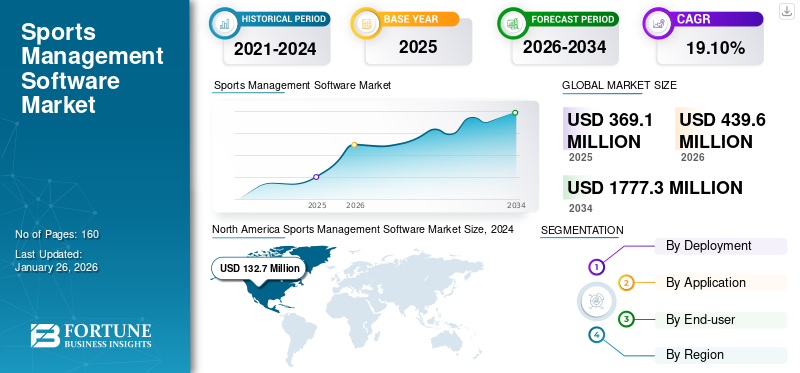
The global sports management software market size is projected to grow from USD 439.6 million in 2026 to USD 1,777.3 million by 2034, exhibiting a CAGR of 19.10% during the forecast period. North America dominated the sports management software market with a market share of 42.60% in 2024.
Sports management software consists of a wide range of digital solutions and tools that are specially designed for sports clubs, teams, and organizations to streamline their administrative tasks and operations. Sports facilities are increasingly using data to enhance performance, optimize strategies, and make better decisions. Due to these factors, the demand for sports management software is increasing, as it helps to analyze the vast amount of data collected through fan interaction, ticket sales, and player statistics.
GLOBAL SPORTS MANAGEMENT SOFTWARE MARKET Key Takeaways
Market Size & Forecast
2024 Market Size: North America dominated the sports management software market with a market share of 42.60% in 2024.
2026 Market Size: USD 439.6 million
2034 Forecast Market Size: USD 1,777.3 million
CAGR: 19.10% from 2026–2034
Market Share
North America dominated the sports management software market with a market share of 42.60% in 2024.
The cloud segment held the largest market share in 2024 due to increasing adoption of cloud-based sports management platforms.
The player & team management segment dominated the market in 2024 owing to growing demand for performance tracking, scheduling, and team administration solutions.
Key Regional Highlights
North America
North America led the market, supported by standardized data collection practices and ongoing investments in sports technology infrastructure.
Asia Pacific
Asia Pacific is expected to register the highest growth rate during the forecast period due to rising fan engagement and increasing investments in sports infrastructure and digital ecosystems.
Europe
Europe emerged as the second-largest market, driven by the growing adoption of analytics tools by sports academies and organizations to enhance player development.
U.S.
The market is expected to witness strong growth due to the rapid expansion of the e-sports industry and increasing investments from major brands in competitive gaming ecosystems.
Japan
Growing digital transformation across sports organizations and increasing adoption of data-driven athlete performance management solutions are expected to support market growth.
Read More
Growing Investor Interest in Sports Management Software
The increase in investments from Venture Capital (VC) and Private Equity (PE) is fueling innovation in sports management software. PE activity remained stable from 2019 to 2022, with most completed deals toward the end of that period being add-on acquisitions for existing portfolio companies. In contrast, VC activity was strong, with a surge of innovative new entrants seeking early-stage funding.
IMPACT OF GENERATIVE AI
Generative AI is transforming various aspects of sports management including performance analytics to fan engagement and operational efficiency. Integration of GenAI into sports management software helps to enhance training, talent scouting, and tactical planning, which allows teams to improve their performance. Generative AI helps sports organizations automate the creation of schedules and event planning based on various factors, including team preference, venue availability, and other factors.
For enhancing fan experience sports organizations are integrating chatbots into their sports management software. Gen AI chatbots interact with fans and provide them with information regarding player statistics, match schedules, and event details and also generate personalized match summaries for the fans. Generative AI is transforming sports management software by automating routine tasks, enhancing fan engagement, and improving operational efficiency.
SPORTS MANAGEMENT SOFTWARE MARKET TRENDS
Rise in Use of Wearables and Mobile Apps among Athletes is Driving Market Growth
Wearable technology is witnessing remarkable growth, transforming and redefining the way users interact with technology. According to industry reports, the global wearable technology market is estimated to exceed USD 150 billion by 2025. By 2025, the connection between mobile apps and wearables will create opportunities for sports organizations. Wearables, including GPS trackers, smartwatches, and fitness bands, collect a wide range of data related to an athlete’s performance, including speed, heart rate, calories burned, distance covered, and movement patterns, and mobile apps allow athletes, coaches, and managers to access this data in real-time.
For instance, in a Soccer match, players wear GPS trackers that monitor their position, movement, and speed. This data is sent to a mobile app that coaches use to make real-time tactical decisions.
Sports management software solutions store this data for further analysis and generate informational insights regarding performance trends, making strategies, risk of injury, and post-event reviews. These insights help sports organizations to optimize performance and training regimens.
MARKET DYNAMICS
MARKET DRIVERS
Growing Demand for Fan Engagement is Propelling Market Growth
Fans are a vital aspect of a sports organization and are increasingly expected to have personalized experiences, both online and at live events. With a surge in digital platforms, sports organizations are seeking to enhance fan engagement through tailored content, interactive features, and loyalty programs. Engaging with fans is a great opportunity to learn about their preference and opinions. Sports organizations are using sports management software to interact with fans by offering them real-time updates, personalized communication, mobile ticketing, and exclusive content.
According to The State of Sports Fan Engagement 2023 Study, around 71% of sports professionals said that fan engagement is important to reach their organizational goals.
As per the same survey, the most common organization’s fan engagement goals include growing revenue, growing website traffic, and social followers.
Therefore, increasing demand for fan engagement is driving the sports management software market growth.
MARKET RESTRAINTS
Data Privacy and Security Concerns to Limit Market Expansion
Sports organizations manage sensitive information related to performance data, players’ health records, personal details, sponsors' details, and other vital information. There are increasing concerns regarding data security, especially while using cloud based solutions. Data breaches can lead to significant damage to sports organizations.
For instance, the Association of Tennis Professionals experienced a cyberattack during one of its premier tournaments where an attacker group named Fancy Bear leaked the medical records of several leading tennis players.
Therefore, data privacy and security concerns are restricting market growth.
MARKET OPPORTUNITIES
Growing Popularity of e-sports is expected to Create Market Development Opportunities
e-Sports has gained immense popularity and is rapidly evolving globally with a massive audience and growing infrastructure. As the e-sports sector is expanding, it is creating opportunities for sports management software players in the market.
According to Phaedra, e-sports is growing by 11.7% every year, and 73% of the audience for e-sports is younger than 35. The popularity of e-sports has exploded, and e-sports tournaments have started to outrank traditional gaming tournaments in terms of viewership.
The below figure represents the e-sports viewership:
As e-sports have a massive fan base, there is a growing demand for immersive fan experience through live streaming, mobile apps, and interactive content. To fulfill the demand for the audience through sports management software, players are focusing on developing solutions such as live match statistics, exclusive content, and fan interaction tools, including polls, voting, or MVPs, that can be integrated with mobile apps, social media platforms and live streaming services to engage e-sports fans. Thereby, the growing popularity of e-sports is expected to drive the sports management software market share.
SEGMENTATION ANALYSIS
By Deployment
Increasing Demand for Cloud-Based Software to Drive Segmental Growth
Based on deployment, the market is classified into on-premise and cloud.
Among these, the cloud dominated the market in 2024 and is estimated to register the highest CAGR during the forecast period, as cloud-based software provides real-time updates and communication tools for teams, administration, and coaches. The cloud-based software helps coaches, players, and managers access the centralized database, and this helps to streamline the process, including performance tracking, scheduling, and event management.
On-premise is estimated to grow significantly in coming years, as on-premise software relies on the organization’s hardware, so it offers better performance, especially in terms of speed and response time.
By Application
Player & Team Management to Dominate Owing to Increasing Adoption of Software for Tracking Performance
Based on application, the market is segmented into player & team management, event & league management, fan & customer engagement, and ticketing & sponsorships.
The player & team management segment dominated the market in 2024, as sports organizations are increasingly adopting sports management software for managing players, tracking performance, scheduling, and handling contracts of teams and players. Every sports team or player needs such a tool for effective operations.
Event & league management is estimated to register the highest CAGR during the forecast period. This is due to the increasing number of sports events and leagues and the growing complexity of managing tournaments and schedules. The rise in larger events, including World Cups, Olympics, and also e-sports, is increasing the demand for sports management software for event & league management.
By End-user
Adoption of Sports Management Software to Streamline Processes Boost Growth of Event Organizers and Tournament Hosts
Based on end-user, the market is segmented into team, sports association, event organizers and tournament hosts, sponsors & marketers, media & broadcasters, and others.
Among these, event organizers and tournament hosts dominated the market in 2024. Sports management software helps event organizers to streamline processes, reduce staffing requirements, and save time. Some software includes features including integrating sponsorship, monetizing live streams, or facilitating in-app purchases during the tournament or event and these features help event organizers to generate new revenue streams for the event.
Sponsors and marketers are estimated to register the highest CAGR during the forecast period. The adoption of sports management software helps sponsors and marketers to streamline operations, manage campaigns, and analyze audience data. The software collects data on fan preferences, which allows marketers to align their marketing efforts with the audience’s needs.
SPORTS MANAGEMENT SOFTWARE MARKET REGIONAL OUTLOOK
By geography, the market is categorized into North America, South America, Europe, the Middle East & Africa, and Asia Pacific.
North America
North America Sports Management Software Market Size, 2024 (USD Million)
To get more information on the regional analysis of this market, Download Free sample
North America dominates the market with the highest share. As North American leagues formalize data collection standards and invest in infrastructure, the overall ecosystem is contributing to sustained growth in sports management software. These developments help standardize methodologies and ensure data quality, which is essential for the long-term success of these initiatives.
The U.S. is estimated to witness significant growth in the coming years, owing to an increase in the e-sports industry. As e-sports continues to attract more players, viewers, and investments, its influence on sports management software is increasing. Many brands are heavily investing in e-sports in the U.S. For instance,
Brands such as Blizzard Entertainment, Red Bull, and ESL are investing in the e-sports industry in the U.S., which currently has an active player base of around 3,530.
Asia Pacific
Asia Pacific is estimated to grow with the highest CAGR during the forecast period, owing to an increase in fan engagement and increasing investment in sports infrastructure. China and India are emerging and are dominating Asia’s sports tech industry. With high mobile penetration rates, a digital ecosystem, and 5G network, and the ubiquity of super apps, ASEAN countries are attracting investors to invest in sports infrastructure.
Europe
Europe is the second-largest market for sports management software. Sports academies across Europe are increasingly adopting analytics to enhance player development and performance. By leveraging data on player metrics, training effectiveness, and game strategies, these institutions are able to make informed decisions to optimize athlete potential.
Middle East & Africa
Middle East & Africa is estimated to witness significant growth in coming years, as the region has become a powerful source of new investment in sports. Bids of the Soccer World Cup in 2022, Olympics in 2020, as well as remarkable investments in horse racing and Formula One motor racing, showcase the interest in sports by investors in the region.
South America
South America region is likely to register a steady growth rate over the forecast period, owing to the popularity of sports due to broadcasting of mega sports events and their brand promotions.
According to Emerald Publishing, in 2022, around 58% of Soccer fans are in South America.
COMPETITIVE LANDSCAPE
KEY INDUSTRY PLAYERS
Leading Companies Stay Competitive with Continuous Development and Introduction of New Products
Key players in the market form strategic alliances and collaborations to enlarge their business, products, technologies, and other offerings with year-on-year revenue growth. Partnerships and collaborations vary according to business requirements, such as the enlargement of the product portfolio, which helps to expand the global presence and acquire a new customer base. Players are expanding their operations into emerging markets to tap into new customer bases. Companies are investing in research and development to innovate and improve their offerings and stay competitive in the market.
According to a PwC survey, around 45% of sports executives said that data and analytics are transforming the way teams and leagues make decisions regarding player performance and fan engagement.
As per the Sports & Fitness Industry Association Survey, around 80% of sports organizations reported that sports management software improved their overall efficiency.
List of KeySports Management Software Companies Profiled
January 2025: Arbiter acquired rSchoolToday to enhance its expertise in K-12 athletic and event management. This acquisition strengthens collaboration within K-12 education systems, improving support for schools and associations while boosting functionality and connectivity.
January 2025: League Apps partnered with Ankored to automate safety protocols, creating safer environments for young athletes and reducing the administrative burden on program leaders.
January 2025: Courtreserve entered into partnership with Brivo to develop a new CourtReserve integration for entry management and facility security.
February 2024: SAP, in collaboration with German Professional Soccer Club Hertha BSC, expanded the SAP Sports One Solution with AI features.
October 2024: TeamLinkt launched an AI-powered assistant named "Emi" for youth sports leagues, clubs, and associations. Emi aims to address the challenge of efficient time management faced by sports administrators.
REPORT COVERAGE
The global sports management software market analysis provides market size & forecast by all the segments included in the report. It includes details on the market dynamics and trends expected to drive the market growth in the forecast period. It offers information on key regions/countries, key industry developments, new product launches, details on partnerships, and mergers & acquisitions. The report covers a detailed competitive landscape with information on market share and profiles of key players.
The global sports management software market size is projected to grow from USD 439.6 million in 2026 to USD 1,777.3 million by 2034, exhibiting a CAGR of 19.10% during the forecast period.
What you are looking for? Use our deep market intelligence to beat the curve!
The global sports management software market size is projected to grow from USD 439.6 million in 2026 to USD 1,777.3 million by 2034, exhibiting a CAGR of 19.10% during the forecast period.
 Download Free Sample

 Market Size & Forecast
 Market Share
 Key Regional Highlights






















