Sustainable Beverage Market Size, Share & Industry Analysis, By Beverage Category (Non-Alcoholic Beverages {Packaged Water, Clean-label/Natural CSDs, Juices & Juice Concentrates, Functional Beverages, Ready-to-Drink Tea & Coffee} and Alcoholic Beverages {Beer, Wine, Spirits and Low-/No-Alcohol Beverages}), By Distribution Channel (Modern Trade, Foodservice, Convenience Stores, Online/D2C and Specialty & Organic Stores), By Sustainability Attribute (Conventional and Organic), and Regional Forecast, 2026-2034
 Download Free Sample
(Offer valid till 15th Oct 2026)

Sustainable Beverages Market Size and Future Outlook
 Listen to Audio Version
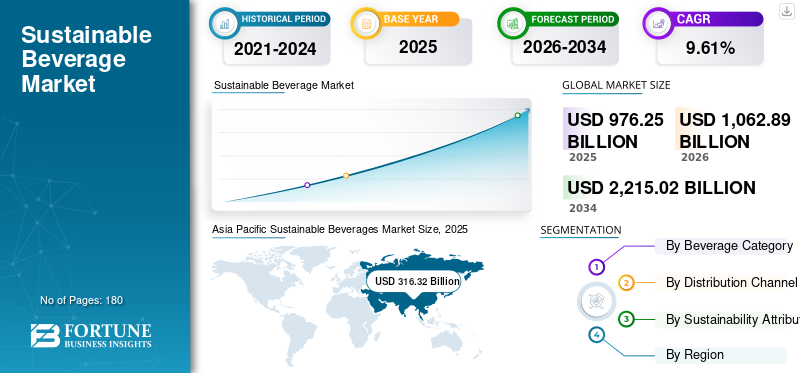
The global sustainable beverages market size was valued at USD 976.25 billion in 2025. The market is projected to grow from USD 1,062.89 billion in 2026 to USD 2,215.02 billion by 2034, exhibiting a CAGR of 9.61% during the forecast period. Asia Pacific dominated the global sustainable beverage market with a market share of 32.40% in 2025.
Sustainable beverages are drinks made, packaged, and manufactured in an environmentally sustainable manner that supports social and economic responsibility. Such drinks are manufactured efficiently with emphasis on carbon emissions. They often use recyclable or eco-friendly packaging solutions, choose clean-label or organic ingredients, save energy during production, and support fair trade or farmers. Sustainable beverages can be non-alcoholic or alcoholic, such as bottled water, plant based beverages, ready-to-drink beverages, beer, wine, and spirits.
Companies such as Coca-Cola, PepsiCo, Nestlé, Danone, AB InBev, and Heineken and others are some of the key players operating in this market. Scale-driven sustainability integration is the key strategy adopted to boost product sales and support the market growth.
Download Free sample to learn more about this report.
Sustainable Beverage Market Key Takeways
 Global Market Size & Forecast
- 2025 Market Size: USD 976.25 billion
- 2026 Market Size: USD 1,062.89 billion
- 2034 Forecast Market Size: USD 2,215.02 billion
- CAGR: 9.61% from 2026–2034
 Market Share
- Asia Pacific dominated the sustainable beverages market with a 32.40% share in 2025.
- The non-alcoholic beverages segment accounted for the largest market share in 2025.
- Modern trade was the leading distribution channel, holding the largest market share in 2025.
 Key Regional Highlights
Asia Pacific
Asia Pacific led the global market with a valuation of USD 316.32 billion in 2025 and remains the fastest-growing regional market.
North America
North America reached a market value of USD 259.84 billion in 2025, supported by strong consumer demand for sustainable beverage products.
Europe
Europe was the second-largest regional market, valued at USD 234.17 billion in 2025.
U.S.
U.S. The market reached USD 215.32 billion in 2025, driven by growing demand for affordable and sustainable beverage options.
Japan
Japan The market was valued at USD 39.65 billion in 2025, representing approximately 4.06% of global market revenue.
Read More

SUSTAINABLE BEVERAGES MARKET TRENDS
Sustainable Packaging and Product Diversification is a Key Trend Shaping Up Industry Growth
Sustainability efforts in packaging, such as using recycled materials, making packages lighter, and using such packaging materials in bottled water and ready-to-drink product manufacturing. Organic and regenerative farming methods are becoming more popular in alcoholic drinks and high-end non-alcoholic products, particularly in Europe and North America. More companies are using data-based sustainability measures, such as lifecycle assessments and carbon footprint labels, to track their impact. Moreover, alcohol beverage brands are updating their product lines by offering low-alcohol, low-carbon, and responsibly made choices. As regional trends are diversifying, with affordability-driven sustainability in emerging markets and premium, certification-led sustainability in developed economies shaping the market’s future.
Download Free sample to learn more about this report.
MARKET DYNAMICS
MARKET DRIVERS
Growing Demand for Clean Label Low-Sugar Products Supports Market Growth
The sustainable beverage market is driven by a convergence of consumer health consciousness, environmental awareness, and corporate ESG commitments. More consumers now witness sustainable products as higher quality, safer, and better for long-term health. This is driving up demand for clean-label, low-sugar, responsibly sourced, and eco-friendly products. As cities grow and incomes rise, especially in developed and growing economies, people are more willing to pay extra for sustainable features. Beverage companies are making sustainability a key part of their business to manage risks from climate change, water scarcity, and regulations. Retailers, especially large chains, now require sustainable products, creating opportunities for functional drinks, ready-to-drink options, and the premium alcoholic beverage sector to innovate. These products often use natural ingredients, focus on ethical sourcing, and aim to lower their environmental impact.
MARKET RESTRAINTS
Operational Complexity and High Cost Risk Impede Market Growth
Even though the market is growing, it faces challenges with costs, complexity, and different regulations in various regions. Sustainable and organic drinks usually cost more to produce due to certified ingredients, high cost of raw materials, special packaging, and meeting regulations. These higher costs make it harder to sell in price-sensitive markets. Moreover, different regions have their own definitions and standards for sustainability, which complicates operations and increases compliance costs for global companies. Economic aberrations, inflation, and changing currency values also limit the consumption behavior of premium sustainable drinks, especially in South America, Africa, and parts of the Asia Pacific.
MARKET OPPORTUNITY
Limited Penetration in Emerging Markets Create Opportunity For Growth
The sustainable beverage market offers strong opportunities for premium product manufacturers and sustainable beverages market growth opportunities in new regions. Functional drinks, plant-based beverages, organic alcohol, and premium bottled water have high growth potential, creating opportunities for brand differentiation. Emerging markets offer long-term potential as sustainability initiatives are still evolving in these countries. Hence, companies that act early can shape consumer behavior by offering affordable products with better packaging. New types of recyclable, refillable, and lightweight packaging, along with digital tools such as QR codes that show where products come from, help companies save money and build trust with customers. Online sales and direct-to-consumer options also help smaller sustainable brands grow without investing heavily in traditional distribution.
Segmentation Analysis
By Beverage Category
Non-Alcoholic beverages Held Majority Market Share Due To High Appeal Among Health-Conscious Consumers
The market is segmented by beverage category into non-alcoholic beverages and alcoholic beverages
Non-alcoholic beverages is the largest segment accounting for the largest sustainable beverages market share in 2025. Non-alcoholic beverages make up the largest portion of the sustainable beverage market share, as people drink them often, and such products appeal to a wide range of health-conscious consumer segments. Products such as bottled water, ready-to-drink tea, functional drinks, and juices are witnessed as available in sustainable formats that are manufactured using simple ingredients and recyclable packaging. These drinks are available in stores and restaurants, which helps them reach more consumers.
Alcoholic beverages is another major category that has a CAGR of 9.17% during the forecast period. Alcoholic beverages sales are impacted by the focus on higher quality and more sustainable options in beer, wine, and spirits. Products such as organic, low-carbon, and responsibly made alcoholic drinks command higher prices in the market. Hence, such products are popular in Europe and North America.
By Distribution Channel
Modern Trade Channel Accounted For Leading Market Share Due To Strong Consumer Trust and High Volume Purchase
Based on the distribution channel, the sustainable beverage market segment includes modern trade, foodservice, convenience stores, online/D2C and specialty & organic stores.
Modern trade channels account for the largest market share in 2025. Retail distribution channels lead the sustainable beverage market as this channel has a strong consumer trust, and a huge consumer purchase from this channel, ensuring high sales volumes. Retail channels such as Supermarkets, hypermarkets, and convenience stores give sustainable beverages wide exposure, making it easier for customers to purchase products on impulse. More retailers now opt for products with sustainability standards, so retailers are expanding the presence of such products on their shelves.
Online/D2C is another major segment, amounting to 11.11% CAGR during the forecast period. Online channels are growing the fastest, due to the convenience of purchasing food, focus on premium products, and direct connections between brands and customers. E-commerce and direct-to-consumer platforms help niche and organic brands grow rapidly. Such channels appeal to tech-savvy shoppers who want clear information on the products, product variety, and subscription options.
To know how our report can help streamline your business, Speak to Analyst
By Sustainability Attribute
Conventional Beverages Accounts For Majority Market Share Due to High Affordability and Accessibility
The market is segmented by sustainability attribute into conventional and organic.
The conventional segment is projected to hold the largest market share in 2025 dominating the sustainable beverage market. Conventional beverages make up the largest share of the sustainable beverage market as they are more affordable, widely available, and easier to produce on a large scale. These products focus on sustainability by improving packaging, using water more efficiently, and offering cleaner labels, without incurring additional costs of organic certification. Therefore, emerging and price-sensitive countries have the opportunity to choose sustainable options at lower prices, leading to higher sales volumes.
Organic food is another major segment, amounting to 9.90% CAGR during the forecast period. Organic foods are the second-largest segment, due to strong consumer demand, perceived health benefits, and premium image. Although higher prices and certification costs limit purchase in emerging economies, organic products are still popular among urban, health-focused shoppers and high-end retailers.
Sustainable Beverages Market Regional Outlook
By region, the market is categorized into Europe, North America, Asia Pacific, South America, and the Middle East & Africa.
Asia Pacific
Asia Pacific Sustainable Beverages Market Size, 2025 (USD Billion)
To get more information on the regional analysis of this market, Download Free sample
The Asia Pacific market was valued at USD 316.32 billion in 2025 and is one of the fastest growing regions and the leading region in the world. Consumer behavior in the Asia Pacific is diverse and varies from country to country. In countries such as China, India, and Southeast Asia, a significant portion of consumers are price-sensitive, although premium urban shopper categories continue to grow as disposable incomes have increased over the years. As regulatory enforcement is inconsistent due to variations in laws from country to country, sustainability efforts also vary. Such sustainable opportunities are gradually being adopted through scalable packaging, the development of premium ready-to-drink products, and increased sales through e-commerce portals. Several beverage manufacturers are focusing on adopting more efficient packaging materials and creating clean-label, low-carbon products.
India Sustainable Beverages Market
The India market value for sustainable beverages in 2025 was around USD 39.21 billion, accounting for roughly 4.02% of global market revenues.
China Sustainable Beverages Market
China’s market value in 2025 was around USD 111.67 billion, representing roughly 11.44% of global market sales.
Japan Sustainable Beverages Market
The Japan market value in 2025 reached around USD 39.65 billion, accounting for roughly 4.06% of global market revenues.
North America
The market in North America cereal ingredients market reached USD 259.84 billion in 2025. In North America, beverage consumption is influenced by consumer awareness and a willingness to pay for sustainability-related value, especially among urban and higher-income groups. As consumers become more health- and environmentally conscious, they prefer recycled packaging, beverages with reduced sugar content, and transparently sourced products. Regulatory pressure to adopt sustainable practices is increasing, with Extended Producer Responsibility (EPR) laws and packaging mandates influencing material selection and manufacturing processes across the beverage industry in this region. In response to changing consumer behavior, companies are exploring opportunities and introducing premium functional beverages, and implementing refill-and-reuse packaging models to help them generate higher margins and reinforce brand credibility.
U.S. Sustainable Beverages Market
In 2025, the U.S. market reached USD 215.32 billion and further mass-market consumers prioritize affordable, sustainable products. Whereas premium buyers prefer certified organic and regenerative options, which influences the sustainability initiatives undertaken by the companies. Sustainability-related regulations are complex and vary from state to state, creating opportunities for innovation as well as challenges. The companies' market expansion initiatives are driven by portfolio renovation, private-label partnerships, and sustainability-focused brand extensions.
Europe
The European market reached USD 234.17 billion by 2025 and secure the position of the second-largest region in the market. European consumers have strong expectations that manufacturers will include sustainability initiatives and develop products with a low carbon impact. However, such products are typically expensive, and hence, price and availability are critical competitive factors for the beverage manufacturers. The European Union also has stringent regulations related to packaging waste and carbon disclosure, and promotes companies to adopt environmentally friendly designs for their products. Manufacturers have the opportunity to innovate and develop organic alcoholic beverages that support compliance-led innovation in the low-carbon packaging and circular systems.
Germany Sustainable Beverages Market
The market in Germany in 2025 reached around USD 49.04 billion, representing roughly 5.02% of global market revenues.
U.K. Sustainable Beverages Market
U.K. market value reached approximately USD 36.83 billion in 2025, equivalent to around 3.77% of global market sales.
South America and Middle East and Africa
Over the forecast period, South America is expected to experience significant growth in this market. The South America market in 2025 recorded USD 55.40 billion and consumers focus on price and accessibility when purchasing products. This behavior also includes the beverage purchasing decision in the region and impacts the adoption of sustainability initiatives by the manufacturers operating there. Although sustainability-related regulations are changing, they are not uniform across the region. Manufacturers have the opportunity to improve packaging, develop organic drinks for export, and build sustainable brands, especially in beer and wine. The Middle East and Africa region was valued at USD 110.52 billion in 2025. In the Middle East & Africa region, climate and income differences influence water usage, with high consumer awareness of sustainability initiatives. Regulations adopted by the countries are targeted toward water efficiency and reducing plastic use. Companies have opportunities in premium bottled water by sourcing products locally through sustainable methods and using lighter packaging, to comply with the regulations in these countries.
GCC Countries Sustainable Beverages Market
GCC countries market is set to grow at a CAGR of 8.34% during the forecast period. Bottled water and ready-to-drink beverages are the major products consumed in the region followed by organic products which are sold mostly in tourist and urban areas.
COMPETITIVE LANDSCAPE
Key Industry Players
Scale-driven Sustainability Integration by Global Beverage Manufacturers Intensifies Competition
The sustainable beverage market is a moderately consolidated and highly competitive market wherein Global leaders such as Coca-Cola, PepsiCo, Nestlé, Danone, AB InBev, and Heineken, and local players are competing with each other. Such companies are expanding their production scale, enhancing their distribution reach, and capital intensity, and integrating a sustainability approach across their portfolios. Such initiatives include water stewardship, packaging circularity, and carbon reduction initiatives. Other strategies adopted by the companies include launching organic certified products and positioning themselves as a clean label product manufacturer in the market.
LIST OF SUSTAINABLE BEVERAGES COMPANIES PROFILED
- The Coca-Cola Company (U.S.)
- PepsiCo, Inc. (U.S.)
- Nestlé S.A. (Switzerland)
- Danone S.A. (France)
- AB InBev (Belgium)
- Heineken N.V. (Netherlands)
- Diageo plc (U.K.)
- Asahi Group Holdings (Japan)
- Keurig Dr Pepper (U.S.)
- Tata Consumer Products (India)
KEY INDUSTRY DEVELOPMENTS
- September 2024: HEINEKEN partnered with Arcadis, NIRAS, and Royal HaskoningDHV to develop advanced packaging initiatives such as long-term decarbonization programs to support energy savings and boost HEINEKEN’s global ambition to reach net zero in scope 1 and 2 by 2030.
- October 2023: Diageo introduced two regenerative agriculture programmes in Scotland and Mexico for its Scotch and tequila sectors. Such programs are aimed at supporting a reduction in scope 3 carbon emissions, improving water stewardship, carbon reduction, and better soil health management practices.
- October 2023: The Coca-Cola Company offered 100% recycled plastic bottles, which are sold across 40 markets across the world. This strategy is a part of its “World Without Waste goal of making bottles with 50% recycled content by 2030”.
- July 2021: Nestle Belgium launched a water brand named Valvert by launching a new bottle made of entirely recycled PET (rPET) in the Europe market.
- June 2021: Keurig Dr Pepper (KDP)improved its sustainability initiatives for its beverage products by advancing its sustainable packaging goals and increasing the use of recycled content in PET bottles. By 2023, around 95% of its products were designed using recyclable or compostable bottles.
REPORT COVERAGE
Request for Customization to gain extensive market insights.
Report Scope & Segmentation
|
ATTRIBUTE |
DETAILS |
|
Study Period |
2021-2034 |
|
Base Year |
2025 |
|
Estimated Year |
2026 |
|
Forecast Period |
2026-2034 |
|
Historical Period |
2021-2024 |
|
Growth Rate |
CAGR of 9.61% from 2026-2034 |
|
Unit |
Value (USD Billion) |
|
Segmentation |
By Beverage Category, Distribution Channel, Sustainability Attribute, and Region |
|
By Beverage Category |
· Non-Alcoholic Beverages o Packaged Water o Clean-label / Natural CSDs o Juices & Juice Concentrates o Functional Beverages o Ready-to-Drink Tea & Coffee · Alcoholic Beverages o Beer o Wine o Spirits o Low-/No-Alcohol Beverages |
|
By Distribution Channel |
· Modern Trade (supermarkets/hypermarkets) · Foodservice (HoReCa, cafés, bars) · Convenience Stores · Online / D2C · Specialty & Organic Stores |
|
By Sustainability Attribute |
· Conventional
|
|
By Region |
North America (Beverage Category, By Distribution Channel, By Sustainability Attribute and Country)
Europe (By Beverage Category, By Distribution Channel, By Sustainability Attribute and Country)
Asia Pacific (By Beverage Category, By Distribution Channel, By Sustainability Attribute and Country)
South America (By Beverage Category, By Distribution Channel, By Sustainability Attribute and Country)
Middle East and Africa (By Beverage Category, By Distribution Channel, By Sustainability Attribute and Country)
|
Frequently Asked Questions
Fortune Business Insights says that the global market value stood at USD 976.25 billion in 2025 and is projected to reach USD 2,215.02 billion by 2034.
In 2025, the market value stood at USD 316.22 billion.
The market is expected to exhibit a CAGR of 9.61% during the forecast period
By beverage category, non-alcoholic beverage segment led the global market in 2025.
The growing demand for clean label low-sugar products supports market growth.
Coca-Cola, PepsiCo, Nestle, Danone, AB InBev, and Heineken, among others are a few players in the market.
Asia Pacific held the largest market share in 2025.
The sustainable packaging and product diversification is a key trend shaping up industry growth.



- 2021-2034
- 2025
- 2021-2024
- 180
-
(Offer valid till 15th Oct 2026)
Get 30-60 hrs Free Customization
Expand Regional and Country Coverage, Segments Analysis, Company Profiles, Competitive Benchmarking, and End-user Insights.




















Related Reports
-
US +1 833 909 2966 ( Toll Free )
-
Get In Touch With Us