Sustainable Travel Accessories Market Size, Share & Industry Analysis, By Product Type (Travel Bags & Backpacks, Luggage & Suitcases, and Packing Cubes), By Material (Recycled Polyester & Nylon, Recycled Plastic, and Organic Cotton), By Traveler Type (Leisure Travelers, Business Travelers, and Adventure Travelers), By End-user (Individual Consumers, Corporate Buyers, and Hotels & Hospitality Companies), By Price Range (Economy, Mid-Range, Premium, and Luxury), By Distribution Channel (E-Commerce Marketplaces, Brand-Owned Websites, and Specialty Stores), and Regional Forecast, 2026-2034
 Download Free Sample
(Offer valid till 30th Sep 2026)

Sustainable Travel Accessories Market Size and Future Outlook
 Listen to Audio Version
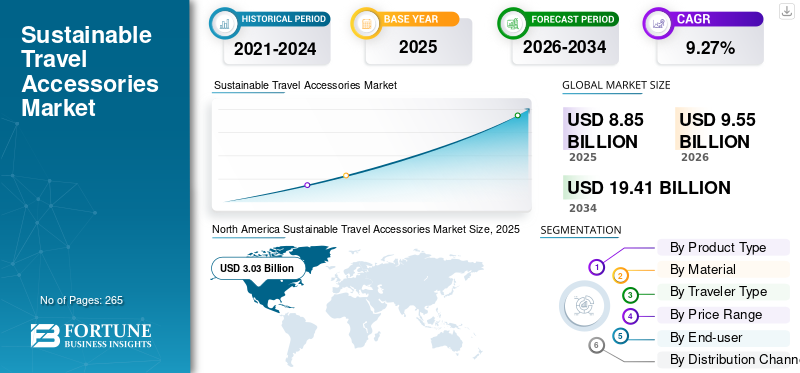
The global sustainable travel accessories market size was valued at USD 8.85 billion in 2025. The market is projected to grow from USD 9.55 billion in 2026 to USD 19.41 billion by 2034, exhibiting a CAGR of 9.27% during the forecast period. North America dominated the sustainable travel accessories market with a market share of 34.24% in 2025.
The sustainable travel accessories market has been experiencing strong growth due to the rise in usage of more durable, reusable, and ecological accessories compared to traditional solutions. These include luggage, organizers, toiletry cases, bottles, bags, and other accessories manufactured from recycled plastic, organic material, plant-based material, and others. Market development has been driven by rising environmental awareness, concerns over plastic pollution, the growth of eco-tourism, and increasing consumer preference for ethical brand products. At the same time, the promotion of low-waste products by airlines, hotels, retail stores, and travel agencies has increased their popularity among customers. E-commerce websites make the purchase of sustainable brands easier, and innovations in product manufacturing continue to enhance their functionality and appearance.
Key players operating in the market include Samsonite Group S.A., Patagonia, Inc., Thule Group AB, DELSEY S.A.S., and Fenix Outdoor International AG. One of the key competitive strategies in this industry is increasing the use of durable travel accessories, such as bags, luggage, and organizing kits, made from recycled plastics, recycled polyester, bio-circular materials, and other sustainable materials.
Download Free sample to learn more about this report.
sustainable travel accessories market KEY TAKEAWAYS
 Global Market Size & Forecast
- 2025 Market Size: USD 8.85 Billion
- 2026 Market Size: USD 9.55 Billion
- 2034 Forecast Market Size: USD 19.41 Billion
- CAGR: 9.27% from 2026-2034
 Market Share
- North America dominated the market with a revenue share of 34.24% in 2025.
- Travel bags & backpacks held the largest market share by product type in 2025.
- Recycled polyester & nylon held the largest market share by material in 2025.
 Key Regional Highlights
North America
North America dominated the market with a value of USD 3.03 billion in 2025.
Europe
Europe ranked second with a market value of USD 2.65 billion in 2025.
Asia Pacific
Asia Pacific reached USD 2.18 billion in 2025 and is projected to grow at a CAGR of 10.63%.
U.S.
The market reached USD 2.38 billion in 2025, supported by strong travel spending and sustainable product demand.
Japan
The market was valued at USD 0.44 billion in 2025, driven by demand for durable, compact, and reusable travel accessories.
Read More

sustainable travel accessories market TRENDS
Recycled and Bio Based Materials Drive Sustainable Product Innovation
Growing concern over plastic waste and carbon emissions is encouraging travelers to prefer accessories made from recycled polyester, ocean-bound plastic, organic cotton, cork, and plant-based materials. As a result, manufacturers are redesigning luggage, bags, organizers, and toiletry products using lower-impact materials while maintaining durability and functionality. This shift is increasing demand for plastic-free travel accessories, strengthening brand differentiation, supporting premium positioning, and accelerating partnerships with responsible material suppliers across the sustainable travel accessories market.
MARKET DYNAMICS
MARKET DRIVERS
Download Free sample to learn more about this report.
Rising Adoption of Sustainable Travel Products to Fuel Industry Expansion
With growing problems about plastic pollution, carbon footprints, and the excessive consumption of natural resources, many tourists are opting for eco-friendly travel gear rather than disposable and classic accessories. This trend is driving a rising need for environmentally friendly luggage, travel bags, cosmetic boxes, water bottles, organizers, and personal care travel kits. In response, manufacturers are launching innovative product ranges, becoming more open regarding the materials used for the production process, and introducing recycled or biodegradable materials. Growing consumer interest in green travel essentials encourages retailers, airlines, hotels, and tour operators to offer sustainable travel products.
|
Rank |
Market Driver |
Expected Impact on Market Growth |
CAGR Contribution |
Impact: 2026-2028 |
Impact: 2029-2031 |
Impact: 2032-2034 |
|
1 |
Rising Preference for Sustainable Travel Products |
High |
+2.85% |
High |
High |
High |
|
2 |
Expansion of Global Travel and Tourism Activity |
High |
+2.45% |
High |
High |
Medium |
|
3 |
Innovation in Recycled, Bio-based, and Low-impact Materials |
Medium-High |
+2.15% |
Medium |
High |
High |
|
4 |
Corporate Sustainability Commitments and Travel-industry Partnerships |
Medium |
+1.80% |
Medium |
Medium |
Medium |
|
5 |
Increasing preference for SPF 50+ and premium facial sunscreen products |
Medium |
+1.50% |
Medium |
Medium |
High |
|
6 |
Expansion of E-commerce and Direct-to-consumer Distribution |
Medium |
+0.80% |
High |
Medium |
Medium |
|
|
Total Positive Growth Contribution |
|
+11.55% |
|
|
|
MARKET RESTRAINTS
Higher Retail Prices to Hamper Market Growth
Traveling accessories made from sustainable materials tend to be more expensive due to the higher cost associated with the use of recycled materials, certification of source, ethical production practices, and small volume of manufacturing. Cost-conscious customers are more likely to prefer affordable traditional products over premium-priced solutions. High retail prices can further affect inventory turnover, hamper retailer expansion, lower manufacturers’ ability to achieve economies of scale, and thereby limit sustainable travel accessories market growth.
|
Rank |
Market Restraint |
Expected Impact on Market Growth |
Negative CAGR Contribution (2026-2034) |
Impact: 2026-2028 |
Impact: 2029-2031 |
Impact: 2032-2034 |
|
1 |
High retail prices |
Medium |
−0.95% |
High |
High |
Medium |
|
2 |
Limited Availability and Scalability of Sustainable Materials |
Medium |
−0.70% |
High |
Medium |
Low |
|
3 |
Inconsistent Sustainability Standards and Greenwashing Concerns |
Medium |
−0.45% |
Medium |
Medium |
Low |
|
4 |
Others |
Low |
−0.18% |
Low |
Low |
Low |
|
|
Total Negative Growth Impact |
|
−2.28% |
|
|
|
MARKET OPPORTUNITIES
Innovation in Sustainable & Smart Travel Solutions to Create New Growth Potential
The growing need for personalized travel products and services due to technological advancements opens up opportunities to find a balance between environmental sustainability and convenience. Companies are developing biodegradable travel essentials, modular luggage, tracking tags, solar power chargers, refilled toiletries, and custom organizers made from recycled materials to meet environmental and practical needs. It helps attract young customers, support premium pricing, build customer loyalty, and open up new streams of income through direct-to-consumer sales and business travel partnerships worldwide.
MARKET CHALLENGES
Limited Transparency to Increase Greenwashing Risks
Non-standardized sustainability criteria and low supply chain transparency make it challenging for consumers to determine whether their travel accessories are environmentally sustainable. Such an approach can increase the chance of greenwashing and create problems for buyers, leading to additional costs on the part of producers. In addition, smaller companies may find it hard to compete, reducing the overall attractiveness of the market on a global scale.
Segmentation Analysis
By Product Type
Broad Everyday Utility of Travel Bags & Backpacks Boosted Segment Growth
By product type, the market is segmented into travel bags & backpacks, luggage & suitcases, travel organizers & packing cubes, reusable bottles & drinkware, and others.
Travel bags & backpacks emerged as the dominant segment in terms of revenue in 2025 in the market due to their widespread use in leisure travel, business trips, adventure travel, and regular day-to-day travel. The regular replacements for the items, a wide range of price points, and the suitability of recycled polyester, nylon, and organic fabrics have led to increased sales. With customers opting for light and durable products, companies are offering more sustainable products.
To know how our report can help streamline your business, Speak to Analyst
The travel organizers & packing cubes segment is anticipated to rise at the fastest CAGR of 10.77% over the forecast period.
By Material
Durability and Scalable Production to Drive Growth of Recycled Polyester & Nylon Segment
Based on material, the market is divided into recycled polyester & nylon, recycled plastic, organic & recycled cotton, plant-based & bio-based materials, and others.
The recycled polyester & nylon segment held the highest sustainable travel accessories market share in 2025, as both materials offer a blend of lightweight, durability, water resistance, and wide manufacturing accessibility. These materials’ applicability to products such as backpacks, luggage linings, packing cubes, organizers, and other outdoor accessories allows their usage across various product segments. Growing production capacity and increasing customer preference for recycled polyester and nylon over virgin materials are driving the commercial demand for these sustainable materials.
The plant-based & bio-based materials segment is anticipated to rise at the fastest CAGR of 11.72% over the forecast period.
By Traveler Type
High Demand for Sustainable Travel Products Encouraged the Growth of Leisure Travelers Segment
Based on traveler type, the market is divided into leisure travelers, business travelers, adventure & outdoor travelers, backpackers & budget travelers, and others.
The leisure travelers segment dominated the market in 2025 as they form the largest and broadest category of travelers, among domestic holidays, international vacations, family trips, and short recreational travel activities. These travelers purchase a wide range of products, including luggage, backpacks, and organizers, reusable travel products such as water bottles, a toiletries kit, and comfort accessories. Growing environmental consciousness is increasing demand for sustainable travel products among this consumer group.
The adventure & outdoor travelers segment is anticipated to rise at the fastest CAGR of 10.70% over the forecast period.
By Price Range
Balanced Pricing and Sustainability Benefits Encouraged the Growth of Mid-Range Segment
Based on price range, the market is divided into economy, mid-range, premium, and luxury.
The mid-range category accounted for the major market share in 2025, as it provides a strong balance of affordability, longevity, functionality, and environmental credentials. Mid-range products tend to make use of recycled travel bags along with other materials and superior manufacturing processes while remaining affordable than premium and luxury products. As travelers become increasingly concerned and seek environmentally friendly yet affordable products, there is growing demand for mid-range luggage, backpacks, organizers, and reusable accessories.
The premium segment is anticipated to rise at the fastest CAGR of 10.27% over the forecast period.
By End-user
Broad Personal Purchasing Demand to Sustain Individual Consumers’ Market Leadership
By end-user, the market is segmented into individual consumers, corporate & business buyers, hotels & hospitality companies, airlines & travel operators, and others.
The individual consumers segment held the highest market share in 2025, as the majority of luggage, backpacks, organizers, reusable water bottles, and travel accessories are bought for personal use. With increasing awareness of environmental protection, travelers prefer durable, reusable, and environmentally friendly luggage accessories over traditional ones. As consumers become more aware of sustainable materials and brands when making purchasing decisions, demand continues to increase through various channels such as online markets, branded websites, and retail stores. As a result, the individual consumers segment generates larger revenues than other end-user segments.
The corporate & business buyers segment is anticipated to rise at the fastest CAGR of 10.85% over the forecast period.
By Distribution Channel
Wider Product Access and Convenient Delivery Boosted E-commerce Marketplaces Segment Growth
Based on distribution channel, the market is segmented into e-commerce marketplaces, brand-owned websites, specialty travel & outdoor stores, department stores, and others.
E-commerce marketplaces held the dominant market share in 2025, owing to their wide range of product access, affordability, customer reviews, and convenient delivery. They provide a platform for well-known brands and emerging sustainable outdoor gear brands in the travel accessory sector. This leads to increased purchase confidence and higher sales volume due to comparisons made by buyers online. As a result, e-commerce marketplaces generate more sales compared to other retail channels.
The brand-owned websites segment is projected to grow at the second-fastest CAGR of 9.50% during the forecast period.
sustainable travel accessories market Regional Outlook
By geography, the market is categorized into Europe, North America, Asia Pacific, South America, the Middle East & Africa.
North America
North America Sustainable Travel Accessories Market Size, 2025 (USD Billion)
To get more information on the regional analysis of this market, Download Free sample
North America dominated the global market and is projected to grow at a CAGR of 8.47% during the forecast period. The region reached a valuation of USD 3.03 billion in 2025. The region’s growth is driven by high domestic travel expenditure that drives the need for bags, backpacks, and travel organizers. With increasing awareness of waste generated from material use, consumers and companies are embracing eco-conscious travel products that are recyclable, repairable, and more durable. The increasing growth of e-commerce has made it easier for consumers to access sustainable brands and compare products.
U.S. Sustainable Travel Accessories Market
Supported by North America’s strong contribution and the U.S.’ dominance within the region, the U.S. market reached USD 2.38 billion in 2025, accounting for roughly 26.94% of global market sales. Strong consumer preference for durable and environmentally responsible travel products, high travel spending, and a well-developed e-commerce infrastructure are driving the growth of the U.S. market.
Europe
Europe held the second-largest share in 2025, valued at USD 2.65 billion, accounting for 29.95% of the global market. European rules emphasizing recycled content, recycling, material efficiency, reuse, and repair are driving the development of sustainable travel bags, backpacks, organizers, and other travel accessories. Moreover, well-established environmental awareness among consumers is increasing demand for ethically sourced, reusable, repairable, and recycled-material accessories, encouraging brands and retailers to broaden sustainable product portfolios, driving market expansion.
U.K. Sustainable Travel Accessories Market
The U.K.’s market reached USD 0.52 billion in 2025, representing roughly 5.86% of global market revenues.
Germany Sustainable Travel Accessories Market
Germany’s market reached USD 0.55 billion in 2025, equivalent to around 6.21% of global market sales.
Asia Pacific
Asia Pacific ranked third globally, reaching USD 2.18 billion in 2025 and is projected to grow at a CAGR of 10.63% during the forecast period. The market in Asia Pacific is witnessing exponential growth due to increasing disposable income, increasing domestic and international tourism, and the rapid expansion of e-commerce. Growing environmental consciousness among the younger generation has led brands to introduce affordable travel accessories made from eco-friendly materials.
Japan Sustainable Travel Accessories Market
The Japanese market was valued at USD 0.44 billion in 2025, accounting for roughly 5.00% of global revenues. Growth in Japan’s market is driven by the strong consumer preference for durable, compact, superior-quality, and reusable toiletry bottles, that align well with the country’s waste reduction culture through zero-waste travel accessories. Furthermore, the expansion of e-commerce, growing domestic tourism, and rising adoption of bags, luggage, organizers, and bottles made from recycled materials are augmenting market growth.
China Sustainable Travel Accessories Market
China’s market was valued at USD 0.67 billion in 2025, representing roughly 7.62% of global sales.
India Sustainable Travel Accessories Market
The Indian market was valued at USD 0.34 billion in 2025, accounting for roughly 3.89% of global market revenues.
South America, the Middle East & Africa
The South America and Middle East & Africa region is expected to witness moderate growth during the forecast period. The South American market reached USD 0.54 billion in 2025. Market growth is driven by the expansion of the domestic tourism industry, increasing environmental consciousness, and improved access to e-commerce across the region. In the Middle East & Africa, the UAE reached USD 0.08 billion in 2025.
South Africa Sustainable Travel Accessories Market
The South African market reached USD 0.07 billion in 2025, representing roughly 0.81% of global revenues.
COMPETITIVE LANDSCAPE
Key Industry Players
Major Players Focus on Material Innovation to Reduce their Environmental Footprint
The market is moderately fragmented, with companies such as Samsonite Group S.A., Thule Group AB, DELSEY S.A.S, Patagonia, Inc., Fenix Outdoor International AG, VF Corporation, Osprey Packs, Inc., and Bellroy Pty Ltd, competing through material innovations and brand differentiation. Major players are developing products made from recycled polyester, nylon, plastics, and other eco-friendly fabrics in order to cut down their environmental footprint. They are focusing on durability, modularity, reparability, extended warranties, and other value-added features to enhance customer appeal. In addition, direct-to-consumer sales via web portals and other e-commerce arrangements, sustainability reporting, and premiumization are additional strategies being pursued.
LIST OF KEY SUSTAINABLE TRAVEL ACCESSORIES COMPANIES PROFILED
- Samsonite Group S.A. (Luxembourg)
- Thule Group AB (Sweden)
- DELSEY S.A.S. (France)
- Patagonia, Inc. (U.S.)
- Fenix Outdoor International AG (Switzerland)
- VF Corporation (U.S.)
- Osprey Packs, Inc. (S.)
- Bellroy Pty Ltd (Australia)
- Peak Design (S.)
- HS New Travel GmbH – Horizn Studios (Germany)
KEY INDUSTRY DEVELOPMENTS
- June 2026: Monos partnered with Reformation to launch a limited-edition collection of sustainable travel accessories. The capsule collection included compressible packing cubes made from deadstock fabrics, a cosmetic pouch made from reclaimed materials, and a luggage tag made from deadstock leather, supporting material reuse while strengthening both companies’ lifestyle-travel positioning.
- April 2026: Samsonite announced the continued rollout of its Sustainable Materials Guidance and plans to pilot the framework with selected suppliers. The initiative is intended to standardize preferred material choices across luggage and travel accessories while increasing the use of verified recycled and lower-impact inputs.
- September 2025: Samsonite launched its Paralux luggage and bag collection globally, featuring recycled materials and customer-replaceable components. The collection uses recycled polypropylene, aluminum, and PET across major components, while repairable wheels and pull handles help extend product life and reduce premature disposal.
- April 2025: Samsonite and Circularise launched the ESSENS Circular and PROXIS Circular limited-edition luggage collections with Digital Product Passports. The initiative improved product-level transparency by providing information concerning material origins, recycled content, repair guidance, and end-of-life options.
- April 2024: Samsonite introduced the ESSENS Limited Edition suitcase as its first luggage product incorporating materials recovered from pre-owned suitcases. Its shell contained at least 35% recycled material from old luggage and at least 45% post-consumer recycled waste, demonstrating a practical closed-loop design approach.
REPORT COVERAGE
The global sustainable travel accessories market provides a comprehensive study of the market & forecast by all the market segments. This qualitative and quantitative report includes details on the market dynamics and trends that are expected to drive the market over the forecast period. It provides information on key aspects, including technological advancements, the regulatory environment, and product launches. It also provides information on partnerships, mergers & acquisitions, and key industry developments. Furthermore, it presents a detailed competitive landscape, including market share and profiles of key players.
Request for Customization to gain extensive market insights.
Report Scope & Segmentation
| ATTRIBUTE | DETAILS |
| Study Period | 2021-2034 |
| Base Year | 2025 |
| Estimated Year | 2026 |
| Forecast Period | 2026-2034 |
| Historical Period | 2021-2024 |
| Growth Rate | CAGR of 9.27% from 2026 to 2034 |
| Unit | Value (USD Billion) |
| Segmentation | By Product Type, Material, Traveler Type, Price Range, End-user, Distribution Channel, and Region |
| By Product Type |
|
| By Material |
|
| By Traveler Type |
|
| By Price Range |
|
| By End-user |
|
| By Distribution Channel |
|
| By Region |
|
Frequently Asked Questions
According to Fortune Business Insights, the global market value stood at USD 8.85 billion in 2025 and is projected to reach USD 19.41 billion by 2034.
In 2025, the market value stood at USD 3.03 billion.
The market is expected to grow at a CAGR of 9.27% over the forecast period.
By product type, the travel bags & backpacks led the market.
Rising environmental awareness is a key factor driving the growth of the global market.
Samsonite Group S.A., Thule Group AB, DELSEY S.A.S., Patagonia, Inc., and Fenix Outdoor International AG are the major players in the global market.
North America dominated the market.



- 2021-2034
- 2025
- 2021-2024
- 265
-
(Offer valid till 30th Sep 2026)
Get 30-60 hrs Free Customization
Expand Regional and Country Coverage, Segments Analysis, Company Profiles, Competitive Benchmarking, and End-user Insights.



















Related Reports
-
US +1 833 909 2966 ( Toll Free )
-
Get In Touch With Us