Digital Printing Ink Market Size, Share & Industry Analysis, By Type (Solvent-based, Water-based, UV-based, and Others), By Application (Textile, Ceramics, Packaging & Labels, Print Media, and Others), and Regional Forecast, 2026-2034
 Download Free Sample
(Offer valid till 31st Oct 2026)

Digital Printing Ink Market Size and Future Outlook
 Listen to Audio Version
The global digital printing ink market size was valued at USD 3.93 billion in 2025. The market is projected to grow from USD 4.20 billion in 2026 to USD 7.29 billion by 2034, exhibiting a CAGR of 7.1% during the forecast period. North America dominated the digital printing ink market with a market share of 31.55% in 2025.
Digital printing inks are specialized formulations designed for inkjet and digital press technologies used across packaging, textiles, ceramics, and commercial printing. Unlike conventional offset or gravure printing, digital printing enables short production runs, rapid design changes, and on-demand customization. Digital inks are formulated to ensure fast drying, color consistency, substrate adhesion, and compatibility with high-speed printing equipment. Increasing demand for personalized packaging, rapid product launches, and e-commerce labeling solutions significantly supports market growth. Additionally, the expansion of textile digital printing and decorative ceramic applications strengthens consumption. Growing sustainability awareness is also encouraging the adoption of eco-friendly water-based and UV-curable inks. As industries prioritize efficiency, flexibility, and reduced inventory waste, digital printing technologies are gaining broader acceptance, thus reinforcing the steady expansion of the market.
Major players operating in the market are Sun Chemical, Siegwerk Druckfarben AG & Co. KgaA, INX International Ink Co., Marabu GmbH & Co. KG, Nazdar, DuPont, and others.
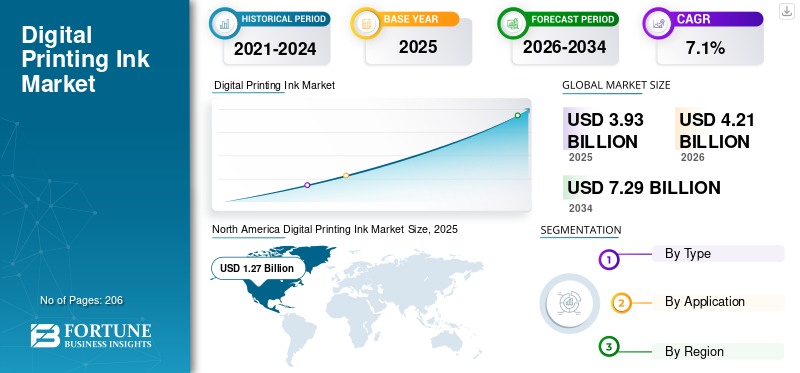
Download Free sample to learn more about this report.
Digital Printing Ink Market Key Takeaways
 Global Market Size & Forecast
- 2025 Market Size: USD 3.93 billion
- 2026 Market Size: USD 4.20 billion
- 2034 Forecast Market Size: USD 7.29 billion
- CAGR: 7.1% from 2026-2034
 Market Share
- North America dominated the digital printing ink market with a 31.55% share in 2025.
- The water-based segment is projected to grow at the highest CAGR of 8.5% during the forecast period.
- The print media segment is expected to grow at a CAGR of 6.5% during the forecast period.
 Key Regional Highlights
North America
North America held the largest market share in 2025 and is expected to maintain its dominance during the forecast period.
Asia Pacific
Asia Pacific is projected to emerge as the fastest-growing regional market during the forecast period.
Europe
Europe is expected to witness steady growth, supported by technological advancements in the textile and packaging industries.
U.S.
The market accounted for USD 1.03 billion in 2025, representing approximately 26.3% of global revenues.
Japan
Rising demand for high-quality commercial and industrial printing applications is supporting market growth.
Read More

DIGITAL PRINTING INK MARKET TRENDS
Expansion and Sustainable Printing Solutions Reshaping Industry Dynamics
The market is evolving due to rapid growth in e-commerce and increasing demand for customized packaging and labels. Brand owners are shifting toward digital label printing to enable variable data printing, faster turnaround times, and smaller batch production. Sustainability trends are encouraging the adoption of low-VOC, water-based, and UV-curable inks. Textile printing is also transitioning from analog to digital platforms to reduce water usage and improve design flexibility. Technological advancements in printhead capabilities and pigment dispersion are improving color vibrancy and substrate compatibility. Additionally, demand for decorative ceramics and industrial printing applications is expanding beyond traditional commercial print media. These customization and sustainability-driven shifts are redefining industry standards, thus supporting the long-term evolution of digital printing ink.
MARKET DYNAMICS
MARKET DRIVERS
Download Free sample to learn more about this report.
Increased Preference for Short-Run Production and Reduced Setup Costs Fuels Market Growth
The primary driver of the digital printing ink market growth is the shift toward short-run, customized printing that reduces setup time and inventory waste. Digital printing eliminates the need for plates and cylinders, significantly lowering production costs for smaller batches. Rising demand from the packaging, labels, and textile sectors further supports ink consumption. Additionally, growth in on-demand printing systems in commercial and promotional activities strengthens usage in print media.
Expanding global trade and regulatory labeling requirements increase demand for flexible packaging solutions. Technological innovations in ink formulation ensure better adhesion, durability, and faster curing. These operational efficiency and customization advantages collectively sustain strong adoption trends, thus maintaining steady growth in the market.
MARKET RESTRAINTS
High Ink Costs and Equipment Investment Limit Market Penetration
Digital printing inks are generally more expensive per liter compared to conventional printing inks, which may limit adoption in cost-sensitive markets. High capital investment required for digital printing equipment also acts as a barrier for small-scale printers. Substrate compatibility challenges in certain applications may restrict market penetration. Additionally, UV-based systems require specialized curing units, increasing operational expenses. Regulatory restrictions regarding chemical composition and VOC emissions can further influence product development costs. These pricing and capital investment constraints create adoption challenges, hence moderating growth in specific regional markets.
MARKET OPPORTUNITIES
Growing Personalized Packaging Demand and Textile Digitalization Creating Expansion Potential
Significant opportunities arise from increasing demand for personalized and short-run packaging solutions across the food, beverage, and consumer goods industries. Packaging & labels represent a major growth avenue due to brand differentiation and regulatory labeling requirements. The rapid digitalization of textile printing, especially in fashion and home décor, presents additional expansion prospects. Emerging economies investing in digital press infrastructure are also driving ink consumption. Furthermore, advancements in high-speed industrial inkjet systems enable penetration into new substrates such as corrugated packaging and flexible films. The integration of smart packaging and QR-coded labels further enhances demand for digital printing technologies. As manufacturers prioritize flexibility, reduced waste, and faster production cycles, digital printing ink adoption is expected to accelerate, therefore strengthening long-term market growth.
MARKET CHALLENGES
Upholding Color Consistency and Substrate Compatibility is a Key Market Challenge
Maintaining consistent color output across different substrates and print speeds remains a key challenge. Digital printing ink formulation must balance viscosity, drying speed, and adhesion properties to ensure compatibility with multiple materials. Additionally, rapid technological evolution in printheads requires continuous ink reformulation. Competition from traditional high-volume printing technologies in large batch applications also presents challenges. Ensuring sustainability compliance while maintaining performance standards increases R&D complexity. These technical and competitive pressures influence profitability and operational performance, therefore shaping strategic positioning within the market.
Segmentation Analysis
By Type
Solvent-Based Segment Held Dominant Share Due to Its Beneficial Properties in Various Industries
On the basis of type, the market is categorized into solvent-based, water-based, UV-based, and others.
The solvent-based segment accounted for a dominant digital printing ink market share in 2025. Solvent-based inks are widely used in digital printing, owing to their excellent adhesion, durability, and resistance to water, light, and abrasion. These inks are also known for their ability to print on a variety of substrates, including plastics, metals, and textiles. The growing demand for solvent-based inks from various end-use industries such as packaging, textiles, and advertising is expected to drive market growth. In addition, the development of eco-friendly solvent-based inks that are free from harmful chemicals is expected to create new opportunities for players in the market.
The water-based segment is set to grow at the highest CAGR of 8.5% during the forecast period. Water-based inks are known for their vibrant colors, fast-drying properties, and eco-friendly nature. They are less toxic compared to other types of inks, which makes them a safer option for printing. Furthermore, water-based inks work by penetrating the fibers of the substrate, which results in high-quality prints that are resistant to fading. They are easy to use and maintain, making them a preferred choice for many printing businesses. In addition, water-based ink is compatible with a wide range of printing machines, making it a versatile option for various printing needs.
By Application
To know how our report can help streamline your business, Speak to Analyst
Growing Focus on Reducing Waste to Propel Packaging & Labels Segment Growth
Based on application, the market is divided into textile, ceramics, packaging & labels, print media, and others.
The packaging & labels segment is expected to hold a leading market share during the forecast period due to the increasing demand for printing on materials such as cardboard, plastic, and metal, which are commonly used for packaging and labeling products. This type of ink is known for its vibrant colors, fast-drying properties, and ability to adhere to a wide range of materials. Digital printing technology has made it possible for businesses to print high-quality labels and packaging materials on demand, which has revolutionized the printing industry. The use of digital printing in the packaging sector is also eco-friendly, as it produces less waste compared to traditional printing methods. Further, the digitally printed ink is resistant to fading, smudging, and water damage, which ensures that labels and packaging materials remain legible and attractive throughout the product's lifecycle.
The print media segment is expected to grow at a CAGR of 6.5% during the forecast period. Digital printing inks are widely used in print media applications such as books, magazines, newspapers, and brochures owing to their ability to produce high-quality prints with sharp text and vibrant colors. The growing demand for customized prints and shorter print runs is expected to drive the segment growth. In addition, the increasing adoption of digital printing in the publishing industry and the development of new technologies that enable printing on a variety of substrates are expected to create new opportunities for players in the market.
Digital Printing Ink Market Regional Outlook
By geography, the market is categorized into North America, Europe, Asia Pacific, Latin America, and the Middle East & Africa.
North America
North America Digital Printing Ink Market Size, 2025 (USD Billion)
To get more information on the regional analysis of this market, Download Free sample
North America held the largest share in 2025 and is expected to dominate the global market during the forecast period. The growing adoption of new technology and the presence of key players in the region are the primary reasons for market growth. The U.S. is a crucial contributor and is set to register a significant share of the regional market over the forecast period. The growing demand for consumer durables, high disposable income, and rising demand for packaged foods are the driving factors for market growth.
U.S. Digital Printing Ink Market
The U.S. market accounted for USD 1.03 billion in 2025, accounting for approximately 26.3% of global revenues. Growth is driven by rising demand for customized packaging, labels, and digitally printed textiles supported by e-commerce and personalization trends.
To know how our report can help streamline your business, Speak to Analyst
Asia Pacific
Asia Pacific is set to emerge as the fastest-growing regional market over the forecast period. The regional growth is due to the expanding retail industry and the growing product demand in packaging and labeling applications. Emerging economies such as China and India are witnessing the demand for digital printing.
China Digital Printing Ink Market
The Chinese market in 2025 accounted for USD 0.41 billion, representing approximately 24.7% of global revenues. Growth is driven by expanding textile, packaging, and industrial printing demand, with digital inks gaining traction for faster, high-volume, design-flexible production.
India Digital Printing Ink Market
The Indian market in 2025 accounted for USD 0.17 billion. Growth is supported by rising adoption of digital textile printing for fashion, home décor, and customized apparel applications.
Europe
Technological advancements in the textile and packaging industry in Europe are set to drive the market growth during the forecast period. Rising expenditure on advertising in Europe is set to propel the market demand in the region.
Germany Digital Printing Ink Market
Germany’s market accounted for USD 0.39 billion in 2025, equivalent to around 10.0% of global revenues. Growth is supported by the shift toward sustainable, low-waste digital printing technologies across packaging, industrial, and textile applications.
Latin America and Middle East & Africa
The demand is rising in the Middle East & Africa, particularly in applications such as ceramics packaging, magazines, newspapers, and others, which helps to drive market growth in the region. GCC, South Africa, and Egypt are significant contributors to the market in the Middle East & Africa.
Latin America is projected to register significant growth during the forecast period. The expansion is due to the increasing investment in Brazil for the development of the textile and packaging industries. The growth of ceramics, print media, and packaging activities is also propelling the product demand in the region.
GCC Digital Printing Ink Market
The GCC market accounted for USD 0.11 billion in 2025, representing approximately 2.7% of regional revenues. Growth is driven by increasing demand for premium packaging, advertising graphics, and personalized print solutions across retail, hospitality, and consumer goods sectors.
COMPETITIVE LANDSCAPE
Key Industry Players
Partnerships, Acquisitions, and Capacity Expansion are Major Strategies Adopted by Industry Players to Increase Market Presence
Prominent companies operating in the digital printing ink market are Sun Chemical, Siegwerk Druckfarben AG & Co. KgaA, INX International Ink Co., Marabu GmbH & Co. KG, Nazdar, DuPont, and others. Companies are involved in new product launches, capacity expansion, acquisitions, joint ventures, and partnerships to secure a competitive edge in the market.
Sun Chemical has a strong presence in North America and Europe. The company is the region's key supplier of specialty printing inks. Similarly, the other major market players have established a robust regional presence, robust channels of distribution, and a range of product offerings.
LIST OF KEY DIGITAL PRINTING INK COMPANIES PROFILED
- Sun Chemical (U.S.)
- Siegwerk Druckfarben AG & Co. KGaA (Germany)
- INX International Ink Co. (U.S.)
- Marabu GmbH & Co.KG (Germany)
- Nazdar (U.S.)
- DuPont (U.S.)
- NUtec Digital Ink (Pty) Ltd. (South Africa)
- Splashjet Inkjet Ink Pvt. Ltd. (India)
- INKBANK Group Inc. (China)
- Hilord Chemical Corporation (U.S.)
KEY INDUSTRY DEVELOPMENTS
- May 2026: DuPont Artistri and Polyprint announced a partnership to showcase a powder-free Direct-to-Film solution at FESPA 2026, using DuPont Artistri JA1100 Jettable Adhesive with Artistri P1600 DTF inks and DTF-120 film to replace traditional powder application with digitally jetted adhesive technology.
- April 2026: INX Europe announced the introduction of a new digital water-based ink for corrugated packaging applications at FESPA Global Print Expo 2026, strengthening its portfolio for visual communication, corrugated, and industrial digital printing applications.
REPORT COVERAGE
The global digital printing ink market analysis provides an in-depth study of the market size & forecast by all the market segments included in the report. It includes details on market dynamics and trends expected to drive the market during the forecast period. It offers information on technological advancements, new product launches, key industry developments, and partnerships, mergers & acquisitions. The market research report also includes a detailed competitive landscape, including market share and profiles of key players.
Request for Customization to gain extensive market insights.
Report Scope & Segmentation
| ATTRIBUTE | DETAILS |
| Study Period | 2021-2034 |
| Base Year | 2025 |
| Estimated Year | 2026 |
| Forecast Period | 2026-2034 |
| Historical Period | 2021-2024 |
| Growth Rate | CAGR of 7.1% from 2026 to 2034 |
| Unit | Value (USD Billion) Volume (Million Ton) |
| Segmentation | Type, Application, and Region |
| By Type |
|
| By Application |
|
| By Region |
|
Frequently Asked Questions
Fortune Business Insights says that the global market size was valued at USD 3.93 billion in 2025 and is projected to reach USD 7.29 billion by 2034.
Recording a CAGR of 7.1%, the market is slated to exhibit steady growth during the forecast period of 2026-2034.
The packaging & labels segment is expected to lead the market during the forecast period.
North America held the highest market share in 2025.
Increased preference for short-run production and reduced setup costs fuel market growth.



- 2021-2034
- 2025
- 2021-2024
- 250
-
(Offer valid till 31st Oct 2026)
Get 30-60 hrs Free Customization
Expand Regional and Country Coverage, Segments Analysis, Company Profiles, Competitive Benchmarking, and End-user Insights.


















-
US +1 833 909 2966 ( Toll Free )
-
Get In Touch With Us