Tax Advisory Services Market Size, Share & Industry Analysis, By Service Type (Corporate Tax Advisory, International Tax Advisory, Transaction Tax Advisory, and Indirect Tax Advisory), By Client Type (Large Enterprises, SMEs, HNWIs, and Government & Public Sector), By Delivery Model (Traditional Consulting, Managed Tax Services, and Technology-Enabled Advisory), By Provider Type (Big Four Firms, Global Professional Services Firms, and Regional & Local Firms), By Industry Vertical (Financial Services, Technology & Telecommunications, and Manufacturing), and Regional Forecast, 2026-2034
 Download Free Sample
Tax Advisory Services Market Size and Future Outlook
 Listen to Audio Version
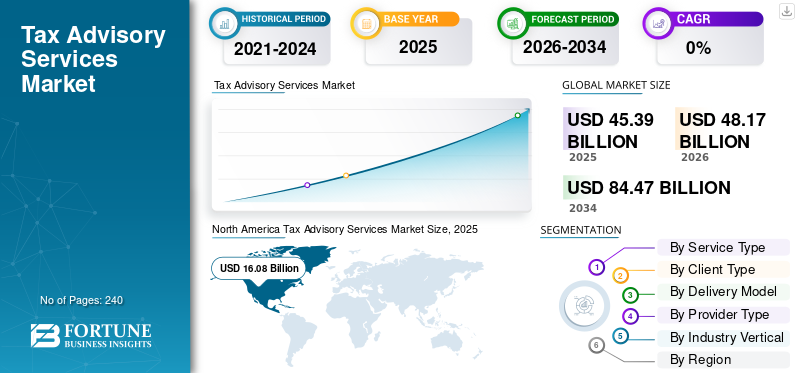
The global tax advisory services market size was valued at USD 45.39 billion in 2025. The market is projected to grow from USD 48.17 billion in 2026 to USD 84.47 billion by 2034, exhibiting a CAGR of 7.3% during the forecast period. North America dominated the tax advisory services market with a market share of 35.43% in 2025.
Increasing complexity of domestic and international tax regulations, expanding cross-border business activities, and the rapid digitalization of tax administration systems are supporting the market growth. As governments introduce stricter compliance requirements, real-time reporting mandates, transfer pricing regulations, and global minimum tax frameworks, organizations are increasingly seeking specialized tax advisory services to manage risks and optimize tax strategies. Multinational corporations are investing heavily in tax planning, regulatory compliance, transaction structuring, and tax technology solutions to navigate evolving regulatory environments. The growing adoption of digital tax platforms, artificial intelligence-based compliance tools, tax data analytics, and automated reporting systems is further accelerating market expansion across developed and emerging economies.
- For instance, the implementation of the OECD’s Pillar Two Global Minimum Tax framework across multiple jurisdictions has significantly increased demand for international tax advisory, compliance assessment, tax technology integration, and corporate restructuring services. Businesses operating across borders are increasingly engaging tax advisors to evaluate global tax exposure, ensure compliance with new reporting requirements, and optimize operational structures in response to evolving international tax regulations.
Leading companies, including Deloitte Touche Tohmatsu Limited, PricewaterhouseCoopers (PwC), Ernst & Young Global Limited (EY), KPMG International, and BDO Global, continue to strengthen their market positions through investments in technology-enabled tax services, global compliance solutions, and specialized advisory capabilities. Industry participants are expanding expertise across corporate tax planning, indirect tax advisory, transfer pricing, transaction tax services, tax risk management, and digital tax transformation initiatives to address increasingly complex client requirements. At the same time, growing adoption of cloud-based tax management platforms, predictive analytics, Robotic Process Automation (RPA), and artificial intelligence-driven compliance tools is helping organizations improve tax efficiency, reduce compliance risks, and enhance reporting accuracy. Strategic collaborations with enterprises, government agencies, technology providers, and regulatory bodies remain central to supporting large-scale tax transformation and compliance modernization initiatives globally.
Download Free sample to learn more about this report.
Tax Advisory Services Market Key Takeaways
 Global Market Size & Forecast
- 2025 Market Size: USD 45.39 billion
- 2026 Market Size: USD 48.17 billion
- 2034 Forecast Market Size: USD 84.47 billion
- CAGR: 7.3% from 2026–2034
 Market Share
- North America dominated the tax advisory services market with a 35.43% share in 2025.
- Tax technology advisory is projected to grow at a CAGR of 9.2% during the forecast period.
- Small & Medium Enterprises (SMEs) are expected to grow at a CAGR of 8.1% during the forecast period.
 Key Regional Highlights
North America
North America held the largest share of the tax advisory services market in 2025.
Asia Pacific
Asia Pacific is projected to register the fastest growth with a CAGR of 9.4% during the forecast period.
Europe
Europe is supported by its sophisticated regulatory environment and increasing emphasis on tax transparency.
U.S.
The U.S. market is projected to reach USD 14.09 billion in 2026, representing approximately 29.3% of global revenues.
Japan
Japan is expected to witness steady growth during the forecast period.
Read More

TAX ADVISORY SERVICES MARKET TRENDS
Increasing Adoption of Tax Technology and Digital Compliance Solutions to Drive Market Growth
Organizations across industries are increasingly investing in digital tax transformation initiatives to address growing regulatory complexity, improve compliance accuracy, and enhance operational efficiency. Governments globally are accelerating the adoption of electronic invoicing, real-time tax reporting, digital tax filing systems, and automated audit frameworks, compelling businesses to modernize their tax management processes. As a result, demand for tax advisory services that combine regulatory expertise with advanced technology capabilities continues to rise.
The integration of artificial intelligence (AI), machine learning, robotic process automation (RPA), cloud-based tax platforms, and advanced analytics is enabling businesses to streamline tax reporting, improve data quality, reduce compliance risks, and strengthen tax governance. Companies are increasingly seeking advisory support for tax technology implementation, data management, transfer pricing compliance, indirect tax automation, and global tax reporting requirements. The growing focus on real-time visibility, predictive tax risk assessment, and automated compliance workflows is creating significant growth opportunities for tax advisory service providers worldwide.
- In August 2025, BDO expanded global tax digital transformation services focused on AI-driven compliance, tax data governance, and indirect tax automation.
MARKET DYNAMICS
MARKET DRIVERS
Download Free sample to learn more about this report.
Rising Complexity of Global Tax Regulations and Compliance Requirements to Accelerate Market Growth
The increasing complexity of tax regulations across jurisdictions has become one of the primary factors driving the tax advisory services market growth. Governments are introducing new tax transparency rules, transfer pricing requirements, digital taxation frameworks, environmental taxes, and global minimum tax regulations, creating significant compliance challenges for businesses. Multinational corporations, private enterprises, and high-net-worth individuals are increasingly relying on tax advisors to navigate evolving tax legislation, mitigate compliance risks, optimize tax structures, and ensure accurate reporting across multiple jurisdictions.
In addition, tax authorities are accelerating the adoption of digital tax administration systems, real-time reporting requirements, electronic invoicing mandates, and data-driven audit programs. Organizations are therefore seeking specialized expertise in international tax planning, indirect tax management, transaction structuring, transfer pricing, and tax technology implementation. The growing frequency of regulatory changes and heightened scrutiny from tax authorities are further strengthening the need for professional tax advisory services globally.
- In June 2025, Saudi Arabia expanded Phase 2 e-invoicing integration requirements under ZATCA, increasing demand for VAT compliance and tax technology solutions.
MARKET RESTRAINTS
Shortage of Skilled Tax Professionals and Regulatory Uncertainty to Limit Market Expansion
The tax advisory industry faces challenges related to the shortage of experienced tax professionals capable of managing increasingly complex international tax regulations, digital tax compliance requirements, and technology-driven tax transformation initiatives. Frequent changes in tax legislation, varying interpretations across jurisdictions, and evolving regulatory frameworks create uncertainty for both service providers and clients. Additionally, tax advisory firms must continuously invest in employee training, technology upgrades, and regulatory monitoring capabilities to remain competitive and compliant.
MARKET OPPORTUNITIES
Growing Adoption of AI-Powered Tax Technology and Digital Tax Transformation to Create Growth Opportunities
Advancements in artificial intelligence, machine learning, robotic process automation (RPA), and cloud-based tax management platforms are creating significant growth opportunities for tax advisory service providers. Organizations are increasingly seeking advisory support to automate tax compliance processes, improve data quality, enhance reporting accuracy, and reduce operational costs. AI-enabled solutions can analyze large volumes of tax data, identify compliance risks, automate tax calculations, and support real-time regulatory monitoring, enabling businesses to improve tax governance and decision-making.
Furthermore, the growing adoption of electronic invoicing, continuous transaction controls (CTCs), digital tax administration systems, and global minimum tax compliance requirements is accelerating demand for tax technology implementation and advisory services. Tax advisory firms that combine regulatory expertise with digital transformation capabilities are well-positioned to capitalize on these emerging opportunities.
- For instance, in March 2024, Thomson Reuters expanded artificial intelligence capabilities within its ONESOURCE platform to help organizations automate tax compliance, reporting, and regulatory monitoring activities, reflecting the increasing adoption of AI-powered tax technology solutions across global enterprises.
MARKET CHALLENGES
Managing Complex Global Tax Regulations and Data Integration Requirements are Key Challenges
The increasing complexity of international tax regulations presents a major challenge for organizations and tax advisory service providers. Businesses operating across multiple jurisdictions must comply with diverse tax laws, transfer pricing requirements, indirect tax regulations, reporting obligations, and global minimum tax rules. Frequent legislative changes require continuous monitoring and adaptation, increasing compliance burdens and operational risks.
At the same time, organizations often maintain tax-related information across multiple enterprise systems, finance platforms, ERP solutions, and local reporting tools. Integrating and standardizing tax data from disparate sources can be challenging, particularly for multinational enterprises with complex operating structures. Inaccurate or inconsistent tax data can increase compliance risks, complicate reporting processes, and expose organizations to regulatory scrutiny. Consequently, tax advisory firms must increasingly focus on data governance, technology integration, compliance automation, and cross-border regulatory expertise to effectively support clients in a rapidly evolving tax environment.
Segmentation Analysis
By Service Type
Corporate Tax Advisory Dominates due to Increasing Demand for Tax Planning, Compliance, and Risk Management
Based on service type, the market is divided into corporate tax advisory, international tax advisory, transaction tax advisory, indirect tax advisory, personal tax advisory, tax compliance & reporting advisory, and tax technology advisory.
Corporate tax advisory dominates the market, owing to its critical role in helping businesses manage complex tax obligations, optimize tax structures, reduce liabilities, and ensure compliance with evolving regulations. Organizations across industries increasingly rely on corporate tax advisors to support strategic decision-making related to mergers and acquisitions, business restructuring, transfer pricing, tax risk management, and regulatory compliance. The growing complexity of domestic and international tax frameworks, coupled with heightened scrutiny from tax authorities, continues to drive demand for corporate tax advisory services among multinational corporations and large enterprises.
Tax technology advisory is expected to be the fastest-growing segment with a CAGR of 9.2% during the forecast period, driven by the rapid adoption of digital tax solutions, artificial intelligence, robotic process automation, cloud-based tax platforms, and advanced analytics technologies. Organizations are increasingly investing in tax automation tools to streamline compliance processes, improve reporting accuracy, enhance data management capabilities, and reduce operational costs. The implementation of electronic invoicing, real-time tax reporting, continuous transaction controls (CTCs), and OECD Pillar Two compliance requirements is further accelerating demand for technology-enabled tax advisory services.
To know how our report can help streamline your business, Speak to Analyst
By Client Type
Large Enterprises Dominate Due to Growing Cross-Border Operations and Complex Tax Compliance Requirements
Based on client type, the market is segmented into large enterprises, small & medium enterprises (SMEs), high-net-worth individuals (HNWIs), government & public sector, and non-profit organizations.
Large enterprises account for the major tax advisory services market share as multinational corporations and large domestic organizations operate across multiple jurisdictions and face increasingly complex tax regulations, transfer pricing requirements, indirect tax obligations, and global reporting mandates. These organizations require comprehensive tax advisory support for corporate tax planning, international tax structuring, mergers and acquisitions, tax risk management, regulatory compliance, and implementation of global tax reforms such as the OECD Pillar Two framework. Furthermore, large enterprises possess greater financial resources to invest in specialized advisory services, managed tax solutions, and tax technology transformation initiatives, contributing significantly to segment dominance. The increasing focus on tax transparency, ESG-related tax disclosures, and digital tax administration requirements further strengthens demand from this segment.
Small & Medium Enterprises (SMEs) are expected to register the fastest CAGR of 8.1% during the forecast period, driven by increasing regulatory complexity, globalization of business operations, and the growing need for cost-effective tax management solutions. SMEs often lack in-house tax expertise and are increasingly turning to external advisors for assistance with compliance management, tax planning, GST/VAT obligations, digital reporting requirements, and cross-border transactions. The rising adoption of cloud-based accounting platforms, automated tax compliance tools, and technology-enabled advisory services is making professional tax support more accessible and affordable for smaller businesses.
By Delivery Model
Traditional Consulting Leads Market Due to High Demand for Specialized Tax Expertise and Strategic Advisory Services
Based on delivery model, the market is segmented into traditional consulting, managed tax services, technology-enabled tax advisory, and hybrid advisory services.
Traditional consulting holds the largest market share due to continued demand for expert-led tax planning, regulatory compliance, transfer pricing, transaction structuring, and strategic tax advisory services. Large enterprises and multinational corporations rely on experienced tax professionals to navigate complex regulations, audits, tax disputes, business restructuring, and cross-border transactions, sustaining the dominance of the traditional consulting model.
Technology-enabled tax advisory is expected to register the highest CAGR of 8.4% during the forecast period, driven by growing adoption of AI, machine learning, robotic process automation (RPA), cloud-based tax platforms, and advanced analytics. The expansion of e-invoicing mandates, real-time tax reporting requirements, digital tax administration systems, and automated compliance solutions is accelerating demand for technology-driven tax advisory services.
By Provider Type
Big Four Firms Lead Market Due to Their Global Presence and Comprehensive Tax Service Portfolios
Based on provider type, the market is segmented into big four firms, global professional services firms, regional & local tax advisory firms, law firms with tax practices, and tax technology & managed service providers.
Big four firms hold the largest market share due to their extensive global networks, strong brand recognition, deep industry expertise, and ability to provide end-to-end tax advisory services across multiple jurisdictions. Firms such as Deloitte, PwC, EY, and KPMG are widely engaged by multinational corporations for corporate tax planning, international tax advisory, transfer pricing, transaction tax services, regulatory compliance, and tax technology implementation. Their ability to support complex cross-border tax matters and large-scale transformation projects continues to strengthen their market leadership.
Tax technology & managed service providers are expected to register the highest CAGR of 8.7% during the forecast period, driven by the increasing adoption of tax automation, cloud-based tax platforms, artificial intelligence (AI), robotic process automation (RPA), and digital compliance solutions. Growing demand for outsourced tax operations, real-time reporting, e-invoicing compliance, and technology-enabled tax management is encouraging organizations to partner with specialized providers that can deliver scalable, cost-efficient, and data-driven tax solutions.
By Industry Vertical
Financial Services Lead the Market Due to High Regulatory Complexity and Tax Compliance Requirements
Based on industry vertical, the market is segmented into financial services, technology & telecommunications, manufacturing, healthcare & life sciences, consumer & retail, energy & utilities, real estate & construction, transportation & logistics, media & entertainment, mining & metals, and others.
Financial services hold the largest market share due to extensive regulatory oversight, complex tax structures, cross-border transactions, and ongoing compliance requirements. Banks, insurance companies, asset managers, and investment firms rely heavily on tax advisory services for tax planning, regulatory compliance, transaction support, and risk management.
The technology & telecommunications segment is expected to register the highest CAGR of 9.0% during the forecast period, driven by rapid digitalization, increasing global operations, evolving digital tax regulations, and growing demand for advisory services related to transfer pricing, indirect taxes, and international tax compliance. The expansion of cloud computing, SaaS, e-commerce, and digital platforms continues to create significant opportunities for tax advisory providers.
Tax Advisory Services Market Regional Outlook
By geography, the market is categorized into North America, Europe, Asia Pacific, the Middle East & Africa, and South America.
North America
North America Tax Advisory Services Market Size, 2025 (USD Billion)
To get more information on the regional analysis of this market, Download Free sample
North America held the largest market share in 2025. Key factors driving the North American market include increasing regulatory complexity, growing cross-border business activities, and the rapid adoption of digital tax compliance frameworks. Organizations across the region are investing in tax planning, transfer pricing, tax technology implementation, and compliance management to address evolving regulatory requirements. Additionally, the increasing focus on tax transparency, real-time reporting, and automation of tax processes is accelerating demand for specialized tax advisory services. The presence of major advisory firms and widespread adoption of advanced tax technologies further support market growth.
U.S. Tax Advisory Services Market
In 2026, the U.S. market will reach USD 14.09 billion, representing roughly 29.3% of the global revenues. The U.S. market is driven by frequent tax policy changes, increasing IRS modernization initiatives, and growing demand for corporate tax planning and compliance services. Rising adoption of tax automation platforms, increasing cross-border transactions, and heightened regulatory scrutiny are further supporting demand for tax advisory and tax technology services across large enterprises and SMEs.
Europe
Europe's market is supported by the region's highly sophisticated regulatory environment, increasing emphasis on tax transparency, and growing enforcement of cross-border tax compliance standards. Businesses are increasingly seeking specialized advisory services to manage evolving corporate taxation rules, transfer pricing documentation requirements, and indirect tax obligations across multiple jurisdictions. The market is also benefiting from the rising complexity of multinational business structures, ongoing tax harmonization efforts, and increased scrutiny from tax authorities. In addition, the accelerating shift toward digital tax ecosystems, including mandatory e-invoicing and electronic reporting frameworks, is encouraging organizations to invest in strategic tax planning, compliance optimization, and tax transformation initiatives.
U.K. Tax Advisory Services Market
In 2026, the U.K. market will reach USD 3.47 billion, representing roughly 7.2% of global revenues.
Germany Tax Advisory Services Market
Germany’s market is estimated at USD 2.98 billion in 2026, equivalent to around 6.2% of the global sales.
Asia Pacific
Asia Pacific is expected to register the fastest growth with a CAGR of 9.4% during the forecast period, driven by rapid economic expansion, increasing cross-border business activity, and ongoing digitalization of tax administration systems. Countries such as China, India, Japan, South Korea, and Southeast Asian nations are implementing e-invoicing mandates, electronic tax reporting frameworks, and enhanced compliance requirements, creating significant demand for tax advisory services. Additionally, rising foreign direct investment (FDI), expanding multinational operations, and evolving indirect tax regulations are encouraging businesses to seek professional support for tax planning, compliance management, transfer pricing, and tax technology implementation. The growing adoption of digital tax solutions and government-led tax modernization initiatives continues to accelerate market growth across the region.
China Tax Advisory Services Market
China’s market is projected to remain dominant in Asia Pacific, with revenues projected to reach USD 4.22 billion in 2026, representing roughly 8.8% of global sales.
India Tax Advisory Services Market
In 2026, India is estimated at USD 2.64 billion, accounting for roughly 5.5% of the global revenues.
South America
The South American market is driven by ongoing tax reforms, increasing regulatory complexity, and the growing adoption of digital tax administration systems across the region. Governments are increasingly implementing electronic invoicing mandates, real-time reporting requirements, and enhanced tax compliance frameworks to improve tax collection and transparency. As a result, businesses are seeking professional tax advisory services to navigate evolving regulations, manage compliance risks, and optimize tax strategies. Additionally, rising foreign investment, expanding cross-border trade activities, and continued modernization of tax systems are expected to support long-term market growth.
Brazil Tax Advisory Services Market
In 2026, Brazil is projected to achieve a revenue of USD 1.38 billion, representing roughly 2.9% of global revenues.
Middle East & Africa
The Middle East & Africa’s growth is attributed to ongoing tax system modernization, expanding VAT and corporate tax frameworks, and increasing regulatory oversight across the region. Governments, particularly across the GCC, are implementing digital tax administration initiatives, e-invoicing requirements, and enhanced compliance measures to strengthen tax collection and transparency. These developments are driving demand for tax advisory services related to indirect tax, regulatory compliance, tax technology implementation, and corporate tax planning. Additionally, economic diversification strategies, rising foreign investment, and the growing presence of multinational enterprises are supporting the adoption of specialized tax advisory solutions across the region.
GCC Tax Advisory Services Market
The GCC market will reach USD 1.18 billion in 2026, representing roughly 2.4% of global revenues.
COMPETITIVE LANDSCAPE
Key Industry Players
Technology-Driven Tax Transformation and Strategic Service Expansion to Strengthen Market Positions
The market is moderately concentrated, with major participants, including Deloitte Touche Tohmatsu Limited, PricewaterhouseCoopers (PwC), Ernst & Young Global Limited (EY), KPMG International, and BDO Global. Leading firms are focusing on expanding their capabilities across corporate tax advisory, international taxation, transfer pricing, transaction tax, indirect tax, and tax technology consulting services. Increasing regulatory complexity, digital tax administration initiatives, and global tax reforms are encouraging providers to invest in technology-enabled tax solutions, managed tax services, and AI-powered compliance platforms.
- In September 2024, EY announced expanded AI capabilities across its Tax and Finance Operate services, leveraging advanced analytics and automation technologies to help organizations streamline tax compliance, improve reporting accuracy, and manage increasingly complex global tax obligations.
LIST OF KEY TAX ADVISORY SERVICE COMPANIES PROFILED
- Deloitte Touche Tohmatsu Limited (Deloitte) (U.K.)
- PricewaterhouseCoopers (PwC) (U.K.)
- Ernst & Young Global Limited (EY) (U.K.)
- KPMG International (Netherlands)
- BDO Global (Belgium)
- Grant Thornton International Ltd. (U.K.)
- RSM International (U.K.)
- Baker McKenzie (U.S.)
- Crowe Global (U.S.)
- Forvis Mazars Group (France)
KEY INDUSTRY DEVELOPMENTS
- February 2025: Germany finalized the phased rollout of mandatory B2B electronic invoicing requirements, encouraging businesses to invest in tax technology modernization, compliance automation, and VAT advisory services to meet evolving digital tax reporting obligations.
- January 2025: Deloitte expanded its Tax Operate managed services Client Type to help multinational organizations outsource tax compliance, reporting, data management, and regulatory monitoring activities through technology-enabled delivery models, strengthening its position in the growing managed tax services segment.
- November 2024: The European Union approved key provisions of the VAT in the Digital Age (ViDA) initiative, accelerating the adoption of electronic invoicing and digital reporting requirements across member states. The reform created significant opportunities for indirect tax advisory and tax technology implementation providers.
- August 2024: KPMG enhanced its Digital Gateway platform with advanced automation, data analytics, and compliance monitoring capabilities, enabling tax departments to streamline reporting processes, improve tax data management, and support global tax transformation initiatives.
- March 2024: Vertex Inc. acquired ecosio, a leading e-invoicing and B2B integration provider, strengthening its global indirect tax and electronic invoicing capabilities amid growing demand for real-time tax reporting and digital compliance solutions.
REPORT COVERAGE
The global tax advisory services market analysis includes a comprehensive study of the market size & forecast by all segments in the report. It includes details on the market dynamics and market trends expected to drive the market over the forecast period. It provides information on key aspects, including an overview of technological advancements, regulatory environment, and product launches. Additionally, it details partnerships, mergers & acquisitions, as well as key industry developments. The research report also provides a detailed competitive landscape with information on the market share and profiles of key players.
Request for Customization to gain extensive market insights.
Report Scope & Segmentation
| ATTRIBUTE | DETAILS |
| Study Period | 2021-2034 |
| Base Year | 2025 |
| Estimated Year | 2026 |
| Forecast Period | 2026-2034 |
| Historical Period | 2021-2024 |
| Growth Rate | CAGR of 7.3% from 2026 to 2034 |
| Unit | Value (USD Billion) |
| Segmentation | By Service Type, Client Type, Delivery Model, Provider Type, Industry Vertical, and Region |
| By Service Type |
|
| By Client Type |
|
| By Delivery Model |
|
| By Provider Type |
|
| By Industry Vertical |
|
| By Region |
|
Frequently Asked Questions
According to Fortune Business Insights, the global market value stood at USD 45.39 billion in 2025 and is projected to reach USD 84.47 billion by 2034.
In 2025, the market value in North America stood at USD 16.08 billion.
The market is expected to exhibit a CAGR of 7.3% during the forecast period.
Corporate tax advisory is the leading service type segment in the market.
Rising complexity of global tax regulations and compliance requirements to accelerate market growth.
Deloitte Touche Tohmatsu Limited, PricewaterhouseCoopers (PwC), Ernst & Young Global Limited (EY), KPMG International, and BDO Global are the major players in the global market.
North America dominated the market share in 2025.



- 2021-2034
- 2025
- 2021-2024
- 240
Get 30-60 hrs Free Customization
Expand Regional and Country Coverage, Segments Analysis, Company Profiles, Competitive Benchmarking, and End-user Insights.











Related Reports
-
US +1 833 909 2966 ( Toll Free )
-
Get In Touch With Us