Tennis Equipment Market Size, Share & Industry Analysis, By Product (Racquets, Strings, Balls, and Nets & Posts), By Distribution Channel (Specialty Sports Retail Stores, Online Retail, Hypermarkets & Supermarkets, Department Stores, Institutional/Direct Sales (B2B), and Others), and Regional Forecast, 2026-2034
 Download Free Sample
(Offer valid till 30th Sep 2026)

Tennis Equipment Market Size and Future Outlook
 Listen to Audio Version
The global tennis equipment market size was valued at USD 14.67 billion in 2025. The market is projected to grow from USD 15.64 billion in 2026 to USD 23.37 billion by 2034, exhibiting a CAGR of 5.15% during the forecast period. Europe dominated the tennis equipment market with a market share of 42.94% in 2025.
Modern tennis equipment, including rackets, strings, and balls, optimizes users’ performance by enhancing players’ ball-hitting power, control, and swing speed while reducing injury risk. Advancements in the development of rackets, balls, grips, strings, and other equipment, driven by frame geometry, graphite composites, and vibration-control systems, are contributing to global market expansion. Yonex, an innovative brand, is producing Isometric Technology, which provides a larger sweet spot for accuracy and precision.
Key companies in the global market include Amer Sports Corporation, YONEX Co., Ltd., HEAD Sport GmbH, Babolat VS S.A., and Tecnifibre SAS.
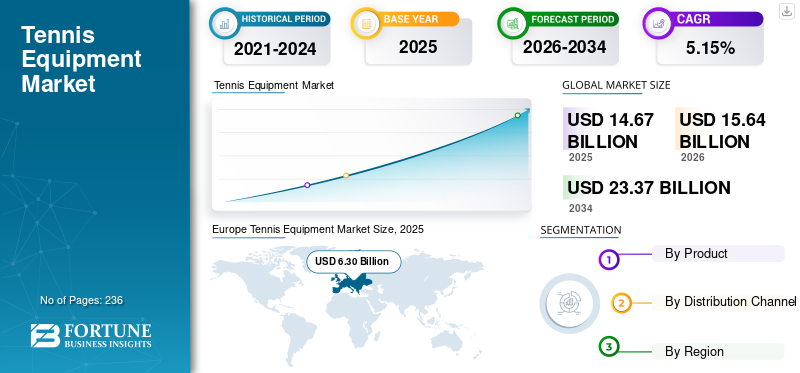
Download Free sample to learn more about this report.
Tennis Equipment Market Takeaways
 Global Market Size & Forecast
- 2025 Market Size: USD 14.67 billion
- 2026 Market Size: USD 15.64 billion
- 2034 Forecast Market Size: USD 23.37 billion
- CAGR: 5.15% from 2026–2034
 Market Share
- Europe dominated the tennis equipment market with a 42.94% share in 2025.
- The racquets segment accounted for a leading 39.19% market share in 2025.
- The specialty sports retail stores segment held a 40.80% market share in 2025.
 Key Regional Highlights
North America
North America held a 12.97% global market share in 2025, with the regional market projected to reach USD 2.00 billion in 2026.
Europe
Europe held a leading 42.91% share of the global tennis equipment market in 2025, with the regional market size projected to reach USD 6.62 billion in 2026.
Asia Pacific
Asia Pacific accounted for 36.60% of the global market in 2025, reaching a market size of USD 5.37 billion.
U.S.
The U.S. market reached USD 1.40 billion in 2025, representing approximately 9.55% of global market sales.
Japan
The Japanese market was valued at USD 0.44 billion in 2025, contributing around 2.98% of global product revenues
Read More

TENNIS EQUIPMENT MARKET TRENDS
Rising Demand for Rackets of Customized Fittings to Augment Market Growth
The rising demand for tennis rackets and strings with customizable features, including grip sizes, string patterns, balance points, and more, is driving the global tennis equipment market growth. In addition, the growing number of retailers offering rackets equipped with a digital fitting system that recommends racquet specifications based on biometrics and personal style is favoring global market expansion.
MARKET DYNAMICS
MARKET DRIVERS
Download Free sample to learn more about this report.
Increasing Tennis Sports Participation to Drive Product Demand
The increasing global participation in tennis and the expanding number of tennis courts and club facilities seeking ergonomically designed tennis racquets and handles are driving growth in the worldwide tennis goods market. In addition, the growing popularity of international league tournaments and the consistent promotion of athlete-sponsored rackets and tennis balls are accelerating global market expansion. According to the U.S. Tennis Association, around 27.3 million U.S. citizens played tennis in 2025, 54% up from 2019.
MARKET RESTRAINTS
High Cost of Tennis Equipment to Restrain Market Growth
The high cost of premium tennis products is hampering demand among price-sensitive institutional and retail consumers worldwide. In addition, the high costs of tennis court bookings, training memberships, coaching sessions, and tournament entry fees are negatively affecting discretionary consumer spending on tennis goods, thereby restraining global market growth.
MARKET OPPORTUNITIES
Rising Eco-Conscious Consumers’ Demand for Sustainable Tennis Products to Create New Market Opportunities
The rising demand for recyclable racquet balls and rackets made with bio-based grip materials, recycled polyester strings, water-based adhesives, and reduced-plastic packaging among consumers, clubs, and tournament organizers is creating new market growth opportunities. In addition, increasing federation and tournaments that prioritize sustainability standards are encouraging manufacturers to adopt eco-friendly production practices, positively contributing to global market expansion.
MARKET CHALLENGES
Intense Competition from Unorganized Industry Manufacturers to Challenge Key Players' Business Expansion
Intense competition from unorganized manufacturers of tennis products, which offer products at competitive prices, is negatively impacting the key players’ product sales across many countries. Furthermore, increasing consumers’ access to counterfeit tennis racquets and balls sold at lower prices is hindering sales of premium products worldwide.
Segmentation Analysis
By Product
Wider Usage of Racquets in Tennis Sports Led to Dominance of Racquets Segment
By product, the market is segmented into racquets, strings, balls, and nets & posts.
The racquets segment accounted for the leading global tennis equipment market share of 39.19% in 2025. Its major share is due to the wider use of racquets in tennis compared to its counterparts worldwide. In addition, manufacturers’ consistent development of racquets featuring advanced graphite composites, aerodynamic beam structures, vibration-dampening systems, and spin-enhancing string patterns is positively contributing to the segment’s growth.
To know how our report can help streamline your business, Speak to Analyst
The strings segment is projected to grow at the fastest rate of 5.68% from 2026 to 2034. The rising adoption of polyester- and co-polyester-based strings for enhanced spin control and durability is driving the strings segment’s growth.
By Distribution Channel
Wider Assortment of Premium Equipment and Technical Guidance Provision at Specialty Stores Led Segmental Dominance
Based on the distribution channel, the market is segmented into specialty sports retail stores, online retail, hypermarkets & supermarkets, department stores, institutional/direct sales (B2B), and others.
The specialty sports retail stores segment exhibited a leading global market share of 40.80% in 2025. Its leading share is attributed to consumers’ access to a wider assortment of premium equipment and expert technical product guidance at specialty retail stores. In addition, the growing number of manufacturers and retailers expanding their retail presence in the international markets is positively contributing to the product sales from these stores.
The online segment is set to grow at the fastest CAGR of 6.69% from 2026 to 2034. The rising number of online shoppers and the emergence of federation-certified online retailers, with platforms offering a broader range of sports equipment, are driving the segment’s growth.
Tennis Equipment Market Regional Outlook
By region, the market is categorized into North America, Europe, Asia Pacific, South America, and Middle East & Africa.
North America
Europe Tennis Equipment Market Size, 2025 (USD Billion)
To get more information on the regional analysis of this market, Download Free sample
The North America region held 12.97% of the global market share in 2025. The North American market size is estimated to reach USD 2.00 billion by 2026. A robust tennis culture, widespread tennis court infrastructure, and the immense popularity of tennis leagues, including the USTA Adult League and the USTA Pro Circuit, are generating considerable product revenues across the region. In addition, expanding tennis community programs and rising female participation in tennis are driving market demand across the region.
U.S Tennis Equipment Market
The U.S. market size reached USD 1.40 billion in 2025. The U.S. market accounted for around 9.55% of the global market sales in 2025. The rising adoption of performance-driven rackets and polyester strings, and the growing trend of ordering customized products, are creating new market growth opportunities across the U.S.
Europe
The European region exhibited a leading global market share of 42.91% in 2025. The region’s market size is expected to reach USD 6.62 billion in 2026. The region is expected to maintain its leading international market position during the forecast period. Rising participation in tennis training academies, where facilities need to procure professional-grade equipment to improve player performance, is generating considerable product revenues across Western Europe. In addition, the growing number of tennis clubs and small court facilities is driving the market growth across eastern and central Europe.
U.K Tennis Equipment Market
The U.K market in 2025 was valued at USD 0.72 billion, representing approximately 4.93% of global product revenues.
Germany Tennis Equipment Market
Germany’s market reached a market value of USD 0.76 billion in 2025, equivalent to around 5.15% of global product sales.
Asia Pacifia
The Asia Pacific region held the largest global market share of 36.60% with a market size of USD 5.37 billion in 2025. The region’s market is projected to grow at the second-fastest rate of 6.09% during the forecast period. The growing number of middle-income consumers seeking affordable tennis rackets and balls for amateur play is driving market growth across India and Southeast Asia. In addition, the rising number of institutional consumers replacing their existing products with newer technology-based goods is favoring product sales across Japan, South Korea, and China. Governmental investment in sports club infrastructure is augmenting product demand across the region.
Japan Tennis Equipment Market
The Japanese market in 2025 reached USD 0.44 billion, accounting for roughly 2.98% of global product revenues. The well-established sports culture and tennis training programs seeking advanced sports equipment are driving the market growth across Japan.
China Tennis Equipment Market
China’s market is projected to be one of the largest worldwide, with revenues valued at around USD 2.90 billion in 2025, representing roughly 19.78% of global product sales.
India Tennis Equipment Market
The Indian market in 2025 reached a market value of USD 0.74 billion, accounting for roughly 5.10% of global market revenues.
South America
Over the global market forecast period, the South American market is expected to grow at a moderate rate. The South America market in 2025 reached a valuation of USD 0.72 billion. The increasing institutional purchases of equipment from clubs and training facilities are driving growth in the South American market.
Middle East & Africa
The Middle East & African region’s market is projected to grow at the fastest rate of 7.17% during 2026-2034. Increasing disposable incomes, expanding sports infrastructure, and rising international tournament hosting are expected to increase participation in tennis and drive product demand across Saudi Arabia, South Africa, the UAE, and Qatar. In the Middle East & African market, Saudi Arabia reached a market value of USD 0.062 billion in 2025.
South Africa Tennis Equipment Market
The South African market reached USD 0.046 billion in 2025, accounting for roughly 0.32% of the global market revenues.
COMPETITIVE LANDSCAPE
Key Industry Players
Significant Technology Investment to Uplift Key Players’ Market Position
The key players operating in the global market are Amer Sports Corporation, YONEX Co., Ltd., HEAD Sport GmbH, Babolat VS S.A., and Tecnifibre SAS. These players focus on product innovation and investments in procuring advanced racket materials, including high-performance graphite composites, frame geometry, vibration-damping systems, and spin-enhancing string patterns, to offer high-end tennis goods to professional consumers.
LIST OF KEY TENNIS EQUIPMENT COMPANIES PROFILED
- Amer Sports Corporation (Finland)
- YONEX Co., Ltd. (Japan)
- HEAD Sport GmbH (U.S.)
- Babolat VS S.A. (France)
- Tecnifibre SAS (France)
- Authentic Brands Group LLC (U.S.)
- Solinco Sports LLC (U.S.)
- Dunlop Sports Co., Ltd. (Japan)
- Toalson Co., Ltd. (Japan)
- Gamma Sports (U.S.)
KEY INDUSTRY DEVELOPMENTS
- February 2026: Carlos Alcaraz in collaboration with Babolat unveiled Carlitos Junior range of tennis rackets and bags. These rackets are made of advanced grip system and innovative string patterns, contributing in correcting to the users ball stroke while playing.
- December 2025: Tennis Premier League established a multi-year partnership with JioHotstar and began their collaboration with TPL Season 7, held in Ahmedabad, India. Through such a partnership, tennis fans can access the tennis tournaments streaming on the broadcasting channel. This partnership is expected to increase tennis popularity and drive product demand across India.
- September 2025: Boldfit, an Indian sports & fitness brand, announced a partnership with legendary sports & fitness icon Sania Mirza to co-create and promote its new range of tennis rackets and pickleball paddles in India.
- July 2025: HEAD Tennis unveiled limited edition of Arthur Ashe racquet inspired from the 50th anniversary of the Arthur Ashe's historic 1975 Wimbledon win. The racket is made of aluminum material and equipped with blends nostalgic design elements for the players’ complementary performances.
- May 2025: Functional Tennis Saber launched a limited-edition racket, the 2025 Paris Edition Saber, for the grand slam tennis season, starting at Roland Garros, France.
- August 2024: Wilson, in partnership with Roger Federer, unveiled the RF Collection, a revolutionary tennis product line for professional league players.
- February 2023: Roger Federer, a tennis player, launched the 14th version of the popular racquet, the Wilson Pro Staff V14, for global athletes.
REPORT COVERAGE
The global tennis equipment market analysis provides an in-depth study of market insights, market size, and forecast by distribution channel, as well as all other market segments included in the report. In addition, the report on the market outlooks market dynamics, consumer preferences for products, and market trends expected to drive the market in the forecast period. The report on the market includes information on technological advancements, new product launches, key developments in the tennis goods industry, and details on partnerships, mergers & acquisitions. The market research report also encompasses a detailed competitive landscape with information on the market share and profiles of key operating players.
Request for Customization to gain extensive market insights.
Report Scope & Segmentation
| ATTRIBUTE | DETAILS |
| Study Period | 2021-2034 |
| Base Year | 2025 |
| Estimated Year | 2026 |
| Forecast Period | 2026-2034 |
| Historical Period | 2021-2024 |
| Growth Rate | CAGR of 5.15% from 2026 to 2034 |
| Unit | Value (USD Billion) |
| Segmentation | By Product, Distribution Channel, and Region |
| By Product |
|
| By Distribution Channel |
|
| By Region |
|
Frequently Asked Questions
Fortune Business Insights says that the global market value stood at USD 14.67 billion in 2025 and is projected to reach USD 23.37 billion by 2034.
In 2025, the market value stood at USD 6.30 billion.
At a CAGR of 5.15%, the global tennis equipment market forecasted to grow during 2026-2034.
By product, the racquets segment is projected to hold the leading global market share throughout the forecast period.
Increasing participation in tennis sports is driving market growth.
Amer Sports Corporation, YONEX Co., Ltd., HEAD Sport GmbH, Babolat VS S.A., and Tecnifibre SAS are among the prominent players in the market.
Europe dominated the market in 2025.
The rising demand from eco-conscious consumers for sustainability-made tennis products is creating new market growth opportunities.



- 2021-2034
- 2025
- 2021-2024
- 236
-
(Offer valid till 30th Sep 2026)
Get 30-60 hrs Free Customization
Expand Regional and Country Coverage, Segments Analysis, Company Profiles, Competitive Benchmarking, and End-user Insights.



















Related Reports
-
US +1 833 909 2966 ( Toll Free )
-
Get In Touch With Us