Terrain Awareness and Warning System Market Size, Share & Industry Analysis, By System Class (Class A TAWS, Class B TAWS, and Helicopter/Mission-Specific TAWS), By Aircraft Type (Commercial Aircraft, Business & General Aviation Aircraft, Military Aircraft, Helicopters, and Unmanned Aerial Vehicles), By Component (TAWS Computer/Processing Unit, Terrain & Obstacle Database, Cockpit Display System, and Audio & Visual Warning Units), By End User (Commercial Airlines, Business Jet Operators, General Aviation Operators, Helicopter Operators, and Defense Forces), and Regional Forecast, 2026-2034
 Download Free Sample
Terrain Awareness and Warning System Market Size and Future Outlook
 Listen to Audio Version
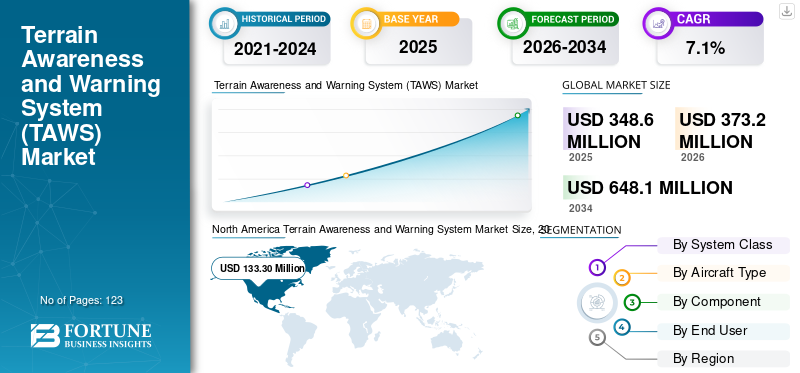
The global terrain awareness and warning system market size was valued at USD 348.6 million in 2025 and is projected to grow from USD 373.2 million in 2026 to USD 648.1 million by 2034, exhibiting a CAGR of 7.1% during the forecast period.North America dominated the terrain awareness and warning system market with a market share of 38.24% in 2025.
The Terrain Awareness and Warning System (TAWS) market comprises technologies designed to alert pilots of potential collisions with terrain, obstacles, or the ground, thereby preventing controlled flight into terrain incidents. These systems integrate GPS positioning, terrain databases, and predictive algorithms to provide real-time visual and aural alerts across various flight phases. TAWS solutions cater to a wide spectrum of aircraft types, including commercial, business, and military aviation, and are increasingly witnessed as essential safety equipment rather than optional add-ons. The market encompasses hardware components, software algorithms, and integrated avionics suites that continuously evolve to enhance situational awareness, reduce false alerts, and support safer flight operations across diverse operating environments.
Key players in the market include Honeywell International Inc. (U.S.), Collins Aerospace (U.S.), Garmin Ltd. (Switzerland), Acron Aviation (U.K.), and Thales Group (France). These companies compete through advanced terrain database accuracy, broader avionics product portfolios, integration with flight management and navigation systems, reduced nuisance-alert algorithms, and tailored solutions. These solutions are implemented for commercial, business, and military aviation applications, reinforcing their positions through continuous innovation and strategic partnerships across the aerospace value chain.
Download Free sample to learn more about this report.
Terrain Awareness and Warning System Market KEY TAKEAWAYS
 Global Market Size & Forecast
- 2025 Market Size: USD 348.6 million
- 2026 Market Size: USD 373.2 million
- 2034 Forecast Market Size: USD 648.1 million
- CAGR: 7.1% from 2026–2034
 Market Share
- North America dominated the terrain awareness and warning system market with a 38.24% share in 2025.
- The Class A TAWS segment accounted for the largest market share in 2025.
- The Unmanned Aerial Vehicles (UAVs) segment is projected to register the fastest growth, with a 10.7% CAGR during the forecast period.
 Key Regional Highlights
North America
North America maintained its leading position in 2025, with the market valued at USD 133.30 million.
Europe
Europe is projected to reach USD 94.6 million by 2026, retaining its position as the second-largest regional market.
Asia Pacific
Asia Pacific is expected to be the fastest-growing region, reaching USD 80.1 million by 2026 with an 8.6% CAGR during the forecast period.
U.S.
U.S. The market is projected to reach approximately USD 115.1 million by 2026.
Japan
Japan The market is estimated to reach approximately USD 15.1 million by 2026.
Read More

TERRAIN AWARENESS AND WARNING SYSTEM MARKET TRENDS
Growing Integration of TAWS with Advanced Avionics and Flight Deck Systems is Observed as a Key Trend
Aircraft manufacturers and avionics providers are increasingly embedding TAWS functionality within integrated flight deck suites rather than offering it as a standalone unit. This convergence allows terrain data to be cross-referenced with weather radar, traffic collision avoidance systems, and synthetic vision displays, giving pilots a more unified and intuitive picture of surrounding hazards. Such integration simplifies cockpit workflows, reduces pilot workload, and supports faster decision-making during critical flight phases. As avionics architecture becomes more digital and interconnected, this trend is reshaping how terrain awareness capabilities are designed, certified, and delivered across commercial, business, and military aircraft platforms.
MARKET DYNAMICS
MARKET DRIVERS
Download Free sample to learn more about this report.
Stringent Aviation Safety Regulations Mandating Collision Avoidance Systems Drives Market Growth
Regulatory bodies across major aviation markets have progressively mandated TAWS installation to curb controlled flight into terrain accidents, historically among the leading causes of fatal aviation incidents. These mandates apply across commercial, cargo, and increasingly business aviation segments, compelling operators to equip or upgrade their fleets. Additional impetus comes from insurers and leasing companies that now favor aircraft equipped with certified terrain awareness systems, alongside airlines seeking to strengthen safety reputations. Together, these regulatory and commercial pressures continue reinforcing TAWS as indispensable safety equipment across nearly all categories of powered aircraft operations globally.
MARKET RESTRAINTS
High Costs of System Installation, Certification, and Maintenance Limit Market Growth
The installation and certification of TAWS, particularly for retrofitting older aircraft, involves considerable expense related to hardware procurement, wiring modifications, software integration, and regulatory approval processes. Smaller operators, regional carriers, and general aviation owners often find these costs burdensome relative to their operating budgets, slowing adoption despite safety benefits. Ongoing maintenance, database updates, and periodic recertification add further recurring costs. These financial barriers are particularly pronounced in price-sensitive or emerging aviation markets, where fleet operators must balance safety upgrades against limited capital availability, thereby constraining the pace of widespread TAWS deployment across all aircraft categories. These factors are responsible for limiting the terrain awareness and warning system market growth.
MARKET OPPORTUNITIES
Retrofit Potential across Aging Aircraft Fleets Creates Market Opportunities
A substantial share of aircraft currently in operation were manufactured before modern TAWS became mandatory or standardized, creating a sizable retrofit opportunity for avionics providers. Operators of older commercial, regional, and business aircraft are increasingly upgrading their fleets to meet evolving safety mandates and insurance requirements. This retrofit demand extends to helicopters and general aviation aircraft, which have historically lagged behind fixed-wing commercial platforms in TAWS adoption. Manufacturers offering lightweight, cost-effective, and easily installable TAWS units stand to benefit significantly as fleet operators worldwide seek to enhance safety without undertaking full aircraft replacement programs.
MARKET CHALLENGES
Managing False Alerts and Pilot Trust in Automated Warnings Impedes Market Challenges
A persistent challenge for TAWS providers is minimizing nuisance or false alerts, which can erode pilot confidence and lead to warnings being disregarded during genuine emergencies. Complex terrain, unusual approach paths, and incomplete or outdated terrain databases can trigger unnecessary alerts, complicating cockpit workflows. Manufacturers must continually refine algorithms and expand database accuracy while ensuring compatibility with varied aircraft types and operating conditions. Balancing alert sensitivity with reliability remains technically demanding, and any lapse in system performance risks undermining the very safety objective TAWS is designed to achieve, making continuous refinement essential.
Segmentation Analysis
By System Class
Rising Incidence of Controlled Flight into Terrain Risk is Driving Demand for the Class A TAWS Segment
Based on system class, the market is segmented into class A TAWS, class B TAWS, and helicopter/mission-specific TAWS.
The class A TAWS segment is anticipated to account for the largest market share in 2025. Demand for Class A TAWS is rising as commercial and large business aircraft require the most comprehensive terrain and obstacle alerting capabilities available. Regulatory mandates for higher-capacity aircraft further reinforce adoption, as operators prioritize advanced predictive alerting, forward-looking terrain display, and reduced nuisance warnings to enhance operational safety standards.
The helicopter/mission-specific TAWS segment is anticipated to rise with a CAGR of 8.4% over the forecast period.
To know how our report can help streamline your business, Speak to Analyst
By Aircraft Type
Expanding Commercial Fleets and Passenger Safety Expectations Are Driving Demand for the Commercial Aircraft Segment
Based on aircraft type, the market is segmented into commercial aircraft, business & general aviation aircraft, military aircraft, helicopters, and unmanned aerial vehicles.
In 2025, the commercial aircraft segment dominated the global market. Demand for the commercial aircraft segment is rising as airlines continuously expand and modernize fleets to meet growing passenger traffic while satisfying strict regulatory safety requirements. Heightened public expectations around flight safety, combined with insurer and leasing mandates, are pushing commercial operators to prioritize TAWS as standard equipment across new aircraft deliveries.
The unmanned aerial vehicles segment is projected to grow at a CAGR of 10.7% over the forecast period.
By Component
Growing Emphasis on Processing Accuracy is Driving Demand for the TAWS Computer/Processing Unit Segment
Based on component, the market is segmented into TAWS computer/processing unit, terrain & obstacle database, cockpit display system, audio & visual warning units, and software, sensor interface & installation kits.
The TAWS computer/processing unit segment is anticipated to witness a dominating market share over the forecast period. Demand for the TAWS computer/processing unit segment is rising as accurate, real-time terrain data processing forms the core of reliable alerting performance. As aircraft systems become more digitally integrated, operators increasingly prioritize advanced processing units capable of handling larger terrain databases and delivering faster, more precise hazard computations.
The software, sensor interface & installation kits segment is projected to grow at a high CAGR of 9.0% over the forecast period.
By End User
Fleet Safety Compliance Priorities are Driving Demand for Commercial Airlines Segment
Based on end user, the market is segmented into commercial airlines, business jet operators, general aviation operators, helicopter operators, defense forces, and aircraft OEMs & MRO providers.
The commercial airlines segment dominated the terrain awareness and warning system market share in 2025. Demand for the segment is rising as airlines face continuous pressure to comply with international safety regulations while protecting brand reputation and passenger confidence. Growing route networks, denser air traffic, and operations into challenging terrain regions further encourage airlines to prioritize robust terrain awareness systems fleet-wide.
In addition, the helicopter operators segment is projected to grow at a CAGR of 8.5% during the forecast period.
Terrain Awareness and Warning System Market Regional Outlook
By region, the market is categorized into North America, Europe, Asia Pacific, and the Rest of the World.
North America
North America Terrain Awareness and Warning System Market Size, 2025 (USD Million)
To get more information on the regional analysis of this market, Download Free sample
North America held the dominant share in 2024, valuing at USD 124.55 million, and also maintained the leading share in 2025, with USD 133.30 million. Demand remains strong due to a mature commercial aviation sector, stringent FAA safety mandates, and early adoption of advanced avionics, with continued fleet modernization and retrofit programs sustaining consistent regional uptake.
U.S. Terrain Awareness and Warning System Market
Based on North America’s strong contribution and the U.S. dominance within the region, the U.S. market can be analytically approximated at around USD 115.1 million by 2026, representing roughly 6.3% of CAGR over the forecast period. Demand remains high due to a large commercial and business aviation fleet, strict FAA mandates, and strong presence of leading avionics manufacturers driving continuous innovation and system upgrades nationwide.
Europe
Europe is estimated to reach USD 94.6 million by 2026 and secure the position of second-largest region in the market. Demand is supported by strict EASA regulations, a well-established aerospace manufacturing base, and growing business aviation activity, further encouraging airlines and operators to prioritize advanced terrain awareness and collision avoidance technologies.
U.K. Terrain Awareness and Warning System Market
The U.K. market growth in 2026 is estimated at around USD 17.7 million, representing roughly 6.3% of CAGR over the forecast period. Demand is steady, supported by a mature aviation sector, strong regulatory oversight, and significant business aviation activity requiring advanced terrain awareness capabilities across diverse aircraft categories.
Germany Terrain Awareness and Warning System Market
Germany’s market is projected to reach approximately USD 16.9 million by 2026. Demand is driven by a robust aerospace manufacturing ecosystem, strict EASA compliance requirements, and growing emphasis on modernizing commercial and business aircraft fleets across the country.
Asia Pacific
Asia Pacific is projected to record a CAGR of 8.6% during the forecast period, which is the highest among all regions, and is set to reach a valuation of USD 80.1 million by 2026. Demand is rising rapidly due to expanding commercial fleets, increasing air travel, and growing regulatory alignment with international safety standards, prompting airlines across the region to invest in modern avionics systems.
China Terrain Awareness and Warning System Market
China’s market is projected to be one of the largest in Asia Pacific, with 2026 revenues estimated at around USD 31.1 million. Demand is rising sharply due to rapid commercial fleet expansion, increasing domestic air travel, and growing alignment with international aviation safety and certification standards.
Japan Terrain Awareness and Warning System Market
The Japan market share in 2026 is estimated at around USD 15.1 million, accounting for roughly 6.3% of CAGR during the forecast period. Demand is supported by a technologically advanced aviation industry, strict safety regulations, and ongoing fleet modernization efforts among major commercial carriers.
India Terrain Awareness and Warning System Market
The India market in 2026 is estimated at around USD 13.7 million. The demand is increasing due to expanding commercial aviation, rising domestic air travel, and growing regulatory emphasis on aligning safety standards with global aviation practices.
Rest of the World
The rest of the world includes the Middle East & Africa and Latin America. These regions are expected to witness moderate growth in this market space during the forecast period. The Middle East & Africa and Latin America market is set to reach a valuation of USD 24.8 million and USD 14.9 million in 2026. Demand is gradually increasing as emerging aviation markets strengthen safety regulations, expand fleets, and modernize aging aircraft, though adoption pace varies due to differing regulatory maturity and budget constraints.
COMPETITIVE LANDSCAPE
Key Industry Players
Key Players Focus on Integrated Avionics, Helicopter Safety, and Tactical Terrain Awareness to Boost Market Growth
The terrain awareness and warning system market is being strengthened by key players that are shifting TAWS from a standalone terrain-alerting unit toward an integrated, software-driven cockpit safety architecture. Companies such as Honeywell, Collins Aerospace, Garmin, and Acron Aviation, are focusing on certified TAWS upgrades, EGPWS replacements, helicopter terrain awareness, obstacle and wire-strike alerting, synthetic-vision integration, and military low-level terrain navigation.
Honeywell is reinforcing retrofit demand through its Mark V-A EGPWS, which is certified to TAWS TSO-C151c and designed to reduce installation complexity by using the same rack and connector as earlier Mark V systems. Collins Aerospace is supporting military growth through TERPROM, a digital terrain system used for terrain-referenced navigation and CFIT protection across fast jets, transport aircraft, and trainers. Garmin and Nighthawk Flight Systems are expanding helicopter-focused demand through HTAWS and HeliTAWS solutions for low-altitude operations. On the other hand, Acron Aviation and Thales are strengthening commercial aircraft adoption through integrated surveillance platforms combining TCAS, TAWS, transponder, and ADS-B capabilities. Genesys Aerosystems is also contributing through integrated avionics suites with Class-A TAWS for fixed-wing and rotary-wing aircraft. Together, these strategies are moving the market beyond compliance-driven installations toward recurring upgrades, mission-specific safety systems, software-enabled cockpit integration, and higher-value retrofit opportunities.
LIST OF KEY TERRAIN AWARENESS AND WARNING SYSTEM COMPANIES PROFILED
- Honeywell International Inc. (U.S.)
- Collins Aerospace (U.S.)
- Garmin Ltd. (Switzerland)
- Acron Aviation (U.K.)
- Thales Group (France)
- Universal Avionics Systems Corporation (U.S.)
- Genesys Aerosystems (U.S.)
- Nighthawk Flight Systems, Inc. (U.S.)
- Avidyne Corporation (U.S.)
- Leonardo S.p.A. (Italy)
KEY INDUSTRY DEVELOPMENTS
- July 2025: Nighthawk Flight Systems launched their Guardian avionics suite featuring an integrated TAWS/HeliTAWS module, expanding terrain awareness to helicopters and business jets.
- June 2025: Honeywell Aerospace deployed their SmartRunway and SmartLanding software, powered by the TAWS suite, across Southwest Airlines' Boeing 737 fleet.
- April 2025: Aero Asahi Corporation placed an order with Kawasaki Heavy Industries for its sixth H145/BK117 D-3 helicopter to strengthen its air ambulance operations. The aircraft is equipped with advanced avionics, including autopilot, GPS map display, and a terrain awareness and warning system, supporting safer operations in demanding flight environments.
- May 2021: The U.S. Air Force awarded Honeywell International, Inc. a contract to provide bi-annual software updates for the Terrain Awareness and Warning System installed on 431 Lockheed Martin C-130J Super Hercules aircraft.
- March 2021: A collaborative deployment of Leonardo's Helicopter Terrain Awareness and Warning System (H-TAWS) was launched on the CHC AW139 fleet operating in Campos, Brazil, for Shell Brasil.
REPORT COVERAGE
This research offers a detailed analysis of emerging trends and rapidly adopted technologies in the industry across key regions. The report outlines key drivers of market growth and challenges to expansion, delivering a detailed overview of the maritime industry landscape. The study highlights recent advancements to boost industry insights and support stakeholders in making well-informed decisions.
Request for Customization to gain extensive market insights.
Report Scope & Segmentation
| ATTRIBUTE | DETAILS |
| Study Period | 2021-2034 |
| Base Year | 2025 |
| Estimated Year | 2026 |
| Forecast Period | 2026-2034 |
| Historical Period | 2021-2024 |
| Growth Rate | CAGR of 7.1% from 2026-2034 |
| Unit | Value (USD Million) |
| Segmentation | By System Class, By Aircraft Type, By Component, By End User, and Region |
| By System Class |
|
| By Aircraft Type |
|
| By Component |
|
| By End User |
|
| By Region |
|
Frequently Asked Questions
According to Fortune Business Insights, the global market value stood at USD 348.6 million in 2025 and is projected to reach USD 648.1 million by 2034.
In 2025, the market value stood at USD 133.30 million.
The market is expected to exhibit a CAGR of 7.1% during the forecast period.
By system class, the class A TAWS segment is expected to dominate the market.
Stringent aviation safety regulations mandating collision avoidance systems is driving the market growth.
Honeywell International Inc. (U.S.), Collins Aerospace (U.S.), Garmin Ltd. (Switzerland), Acron Aviation (U.K.), and Thales Group (France) are few major players in the global market.
North America region dominated the market in 2025



- 2021-2034
- 2025
- 2021-2024
- 123
Get 30-60 hrs Free Customization
Expand Regional and Country Coverage, Segments Analysis, Company Profiles, Competitive Benchmarking, and End-user Insights.




















Related Reports
-
US +1 833 909 2966 ( Toll Free )
-
Get In Touch With Us