Testing Analysis Service Market Size, Share & Industry Analysis, By Service Type (Functional Testing, Performance Testing, Security Testing, Automation Testing, and Others), By End User (IT & Telecom, BFSI, Healthcare, Retail & E-Commerce, and Others), By Deployment Model (Cloud-Based and On-Premises), and Regional Forecast, 2026-2034
 Download Free Sample
Testing Analysis Service Market Size and Industry Overview
 Listen to Audio Version
The global testing analysis service market size was valued at USD 40.90 billion in 2025. The market is projected to grow from USD 42.73 billion in 2026 to USD 63.77 billion by 2034, exhibiting a CAGR of 5.1% during the forecast period. North America dominated the global testing analysis service market with a share of 37.31% in 2025.
The global market is witnessing steady and substantial growth, driven by the increasing complexity of enterprise software systems and the rapid pace of digital transformation across industries. Testing analysis services refer exclusively to IT and software testing services, including functional, performance, security, and automation testing used to validate, optimize, and secure digital applications. The growing adoption of cloud computing, agile and DevOps development models, and continuous application modernization initiatives has significantly increased the demand for specialized testing analysis services. Enterprises are increasingly prioritizing software quality, reliability, and cybersecurity, leading to sustained investments in comprehensive testing strategies. Additionally, rising awareness of application performance risks and the expanding use of digital platforms across business operations are expected to support market growth in the coming years.
Furthermore, key industry players such as Accenture, Tata Consultancy Services, Infosys, Capgemini, and IBM operating in the market are focusing on expanding their automation-led and AI-enabled testing service portfolios to address evolving enterprise requirements. These companies are investing in advanced testing frameworks, cloud-based delivery models, and industry-specific testing solutions to support the rising demand for scalable and efficient testing analysis services globally.
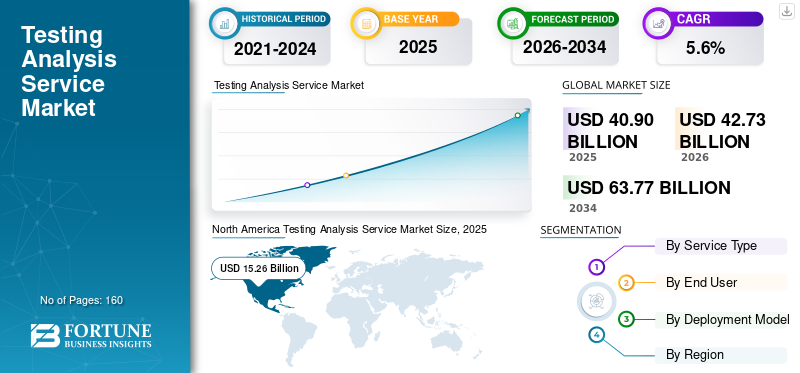
Download Free sample to learn more about this report.
Testing Analysis Service Market Takeaways
 Global Market Size & Forecast
- 2025 Market Size: USD 40.90 billion
- 2026 Market Size: USD 42.73 billion
- 2034 Forecast Market Size: USD 63.77 billion
- CAGR: 5.1% from 2026–2034
 Market Share
- North America dominated the testing analysis service market with a 37.31% share in 2025.
- The automation testing segment is projected to grow at the highest 6.0% CAGR during the forecast period.
- The retail & e-commerce segment is expected to expand at a 5.4% CAGR, supported by increasing digital transformation.
 Key Regional Highlights
North America
North America led the global market with USD 15.26 billion in 2025 and maintained its dominant regional position.
Europe
Europe is projected to reach USD 10.61 billion by 2026, supported by steady demand for software quality assurance services.
Asia Pacific
Asia Pacific is expected to attain USD 11.68 billion by 2026, driven by rapid digital transformation and expanding IT outsourcing.
U.S.
The U.S. testing analysis service market is projected to reach USD 13.06 billion by 2026.
Japan
The Japan market is estimated to reach USD 2.01 billion by 2026, accounting for approximately 4.7% of global revenue.
Read More

TESTING ANALYSIS SERVICE MARKET TRENDS
Rising Enterprise Digital Transformation is a Prominent Market Trend
The accelerating pace of enterprise digital transformation has emerged as a prominent trend in the global market. Organizations across industries are modernizing legacy systems, migrating to cloud-based platforms, and adopting agile and DevOps practices, significantly increasing the need for continuous testing services. As applications become more complex and release cycles shorten, enterprises increasingly rely on specialized testing analysis services to ensure performance, security, and functional reliability.
Governments and industry bodies are also promoting digital adoption across public and private sectors, indirectly increasing demand for testing services. These initiatives are strengthening the role of testing analysis as a critical component of modern software development and deployment.
- For instance, according to the World Economic Forum, accelerating digital transformation initiatives across industries globally are driving rising demand for software quality assurance and testing to support reliability, scalability, and cybersecurity compliance.
Download Free sample to learn more about this report.
MARKET DYNAMICS
MARKET DRIVERS
Rising Application Complexity is Accelerating Market Growth
As enterprise applications continue to develop, the need to provide support within the application is becoming more and more important. Therefore, the complexity within modern software ecosystems will necessitate testing on all environments. Due to these complexities, many organizations are investing in testing analysis services to provide testing support for functional failures, performance bottlenecks, and security vulnerabilities, which is resulting in the need to provide development services to maintain quality and reliability.
Also, owing to an increase in enterprise development, many organizations have begun implementing both agile development models and DevOps models into their development processes, which has resulted in an increased number of software releases. Consequently, there is an increase in the requirement for continuous automated testing, or testing as a service, in order to maintain quality and reliability.
- For example, Microsoft has emphasized that modern cloud-based application architectures require continuous testing across development and production environments to ensure performance stability and security as deployment cycles shorten.
MARKET RESTRAINTS
Shortage of Skilled Testing Professionals to Restrict Market Growth
The shortage of skilled professionals with expertise in advanced testing methodologies poses a significant restraint on market growth. Testing analysis service increasingly require capabilities in automation frameworks, performance engineering, security testing, and AI-driven testing tools, which demand specialized technical expertise. The limited availability of such skilled professionals can delay project timelines and increase service costs.
This talent gap may restrict adoption, particularly among small and mid-sized enterprises that face challenges in accessing high-quality testing expertise, thereby limiting the full market potential.
- For instance, according to a report by the World Economic Forum, global shortages of advanced digital skills, including software testing and quality engineering roles, continue to challenge enterprise technology adoption efforts.
MARKET OPPORTUNITIES
Growing Adoption of Automation and AI-Driven Testing to Create Growth Opportunities
The increasing adoption of automation and AI-driven testing is expected to create significant growth opportunities in the market. Automation testing improves efficiency by reducing manual effort, accelerating testing cycles, and enhancing accuracy. AI-enabled testing tools further support predictive defect detection, test case optimization, and intelligent test execution.
Service providers are increasingly integrating automation and AI capabilities into their testing portfolios to deliver scalable and cost-effective solutions. This shift is enabling enterprises to improve software quality while managing development speed and operational costs.
- For example, Accenture has highlighted the growing role of AI-enabled quality engineering in enabling faster software releases and improving overall application performance across enterprise environments.
Segmentation Analysis
By Service Type
Widespread Application Validation Requirements to Drive Functional Testing Dominance
Based on the service type, the market is divided into functional testing, performance testing, security testing, automation testing, and others.
In 2025, the functional testing segment held the largest share of the market. This dominance is primarily attributed to the fundamental requirement of validating whether applications perform as intended across diverse use cases and user scenarios. Functional testing remains a critical step in software development lifecycles, ensuring business requirements are met before deployment. The growing volume of enterprise applications, frequent software updates, and adoption of agile development practices have reinforced the importance of functional testing across industries. Additionally, functional testing serves as the foundation upon which advanced testing types such as performance and security testing are built, further strengthening its market position.
- For instance, in 2025, Infosys highlighted the continued importance of functional validation as a core component of enterprise quality engineering frameworks, emphasizing its role in ensuring application reliability across digital platforms.
The automation testing segment is anticipated to rise with a CAGR of 6.0% over the forecast period.
To know how our report can help streamline your business, Speak to Analyst
By End User
Continuous Application Development to Strengthen IT & Telecom Segment Growth
Based on end user, the market is segmented into IT & telecom, BFSI, healthcare, retail & e-commerce, and others.
The IT & telecom segment accounted for the highest market share in 2025, driven by continuous application development, network modernization, and rapid adoption of cloud-native technologies. Organizations in this sector operate in highly dynamic environments with frequent software releases, making testing analysis services essential to maintain performance, scalability, and service reliability. Additionally, the expansion of digital services, data centers, and telecommunications infrastructure has increased dependency on comprehensive testing services to support uninterrupted operations. The sector’s early adoption of DevOps and continuous integration practices further reinforces demand for testing analysis services.
- For example, in 2025, IBM emphasized the growing reliance of telecom operators and IT service providers on continuous testing frameworks to support large-scale digital infrastructure modernization and service deployment.
The retail & e-commerce segment is projected to grow at a CAGR of 5.4% over the forecast period.
By Deployment Model
Scalability and Flexibility Advantages to Propel Cloud-Based Deployment Adoption
Based on the deployment model, the market is segmented into cloud-based and on-premises solutions.
In 2025, the cloud-based deployment segment dominated the market, supported by its scalability, flexibility, and cost-efficiency. Cloud-based testing services enable organizations to simulate real-world usage scenarios, scale testing environments on demand, and reduce infrastructure dependency, making them highly attractive across enterprise sizes. The increasing migration of enterprise applications to cloud environments and the growing adoption of SaaS-based platforms have further accelerated demand for cloud-based testing analysis services. These solutions also support geographically distributed testing and faster turnaround times, aligning with modern software development practices.
- For instance, in 2025, Microsoft reiterated that cloud-based testing environments play a crucial role in supporting agile and DevOps-driven application development by enabling scalable and automated testing across distributed teams.
The on-premises segment is projected to grow at a CAGR of 4.8% over the forecast period.
Testing Analysis Services Market Regional Outlook
By geography, the market is categorized into Europe, North America, Asia Pacific, South America, and the Middle East & Africa.
North America
North America Testing Analysis Service Market Size, 2025 (USD Billion) To get more information on the regional analysis of this market, Download Free sample
North America held a dominant position in the market in 2024 and continued to maintain its leading share in 2025, with a market valuation of USD 15.26 billion. The region’s market growth is driven by high enterprise IT spending, early adoption of cloud technologies, and strong demand for advanced testing services across IT, BFSI, and healthcare sectors. The presence of major technology companies and global testing service providers, coupled with continuous innovation in digital platforms, further supports market expansion in the region.
U.S Testing Analysis Services Market
Based on North America’s strong contribution and the U.S. dominance within the region, the U.S. market can be analytically approximated at around USD 13.06 billion in 2026, accounting for a significant global testing analysis service market share. The high adoption of agile development, DevOps practices, and cybersecurity testing is driving sustained demand.
Europe
Europe is projected to register steady growth in the coming years and reach a valuation of USD 10.61 billion by 2026. The market is supported by increasing enterprise focus on software reliability, data protection, and regulatory compliance, particularly across BFSI and public sector applications. Government-backed digitalization programs and enterprise modernization initiatives are contributing to sustained demand for testing analysis services across the region.
U.K Testing Analysis Service Market
The U.K. market in 2026 is estimated at around USD 2.14 billion, representing roughly 5.0% of global revenues.
Germany Testing Analysis Service Market
Germany’s testing analysis service market is projected to reach USD 2.40 billion in 2026, equivalent to around 5.6% of global sales.
Asia Pacific
Asia Pacific is estimated to reach USD 11.68 billion in 2026 and secure its position as one of the fastest-growing regions in the market. Rapid digital transformation, expansion of IT outsourcing services, and increasing adoption of cloud platforms are key growth drivers in the region.
In the region, India and China are both estimated to reach USD 0.14 billion and USD 0.26 billion, respectively in 2026.
Japan Testing Analysis Service Market
The Japan market in 2026 is estimated at around USD 2.01 billion, accounting for roughly 4.7% of global revenue. Strong government-led digital transformation programs and enterprise modernization efforts are supporting market growth.
China Testing Analysis Service Market
China’s market is projected to be one of the largest worldwide, with 2026 revenues estimated at around USD 3.48 billion, representing roughly 8.1% of global market.
India Testing Analysis Service Market
The India market in 2026 is estimated at around USD 2.43 billion, accounting for roughly 5.7% of global market.
South America and Middle East & Africa
The South America and Middle East & Africa regions are expected to witness moderate growth in this market space during the forecast period. The South America market is set to reach a valuation of USD 1.81 billion in 2026 supported by increasing enterprise digitalization and cloud adoption. Government-led digital transformation initiatives and investments in IT infrastructure are driving the Middle East and Africa market.
GCC Testing Analysis Service Market
The GCC market is projected to reach around USD 1.06 billion in 2026, representing roughly 2.5% of global market.
COMPETITIVE LANDSCAPE
Key Industry Players
Focus on Expanding Automation and Digital Quality Engineering Capabilities to Propel Market Progress
The market exhibits a moderately consolidated market structure, with the presence of several large multinational IT service providers alongside specialized testing and quality engineering firms. Leading players such as Accenture, Tata Consultancy Services, Infosys, and Capgemini account for a significant share of the market due to their broad service portfolios, global delivery networks, and strong enterprise client base. The significant position of these companies is supported by continuous investments in automation testing, cloud-based testing platforms, and AI-enabled quality engineering solutions, which are contributing to global testing analysis service market growth.
In response to the changes happening in the cloud testing industry, companies are formulating strategies to differentiate their services by expanding their service portfolios, establishing partnerships with cloud service providers, and developing industry-specific testing services. The use of mergers, acquisitions, and strategic collaborations will also help companies to increase their geographic reach and technological expertise. All of these activities will contribute to continued growth in the cloud-based testing services market.
LIST OF KEY TESTING ANALYSIS SERVICE COMPANIES PROFILED
- Accenture plc (Ireland)
- Tata Consultancy Services Limited (India)
- Infosys Limited (India)
- Capgemini SE (France)
- IBM Corporation (U.S.)
- Cognizant Technology Solutions Corporation (U.S.)
- HCL Technologies Limited (India)
- Wipro Limited (India)
- DXC Technology Company (U.S.)
- Tech Mahindra Limited (India)
KEY INDUSTRY DEVELOPMENTS
- September 2025: OpenAI announced the acquisition of product testing and experimentation platform Statsig to enhance its testing and deployment capabilities. The move underscores growing investment in advanced testing and experimentation tools within modern software development ecosystems.
- August 2025: A Chennai-based software testing startup specializing in AI-driven testing solutions was acquired by U.S.-based VideoDB. The acquisition aims to strengthen automation-led testing capabilities and expand technology-driven testing service offerings.
- June 2025: Witbe announced the launch of its Agentic AI (artificial intelligence) solution focused on intelligent automation and advanced testing capabilities for video and digital services. The solution is designed to enhance real-time monitoring and automated testing efficiency across complex digital environments.
- September 2024: SGS and Bureau Veritas ended discussions regarding a potential merger aimed at creating a large global testing and certification specialist. The development highlights ongoing consolidation interest and competitive dynamics within the broader testing and quality services ecosystem.
- March 2024: Synopsys announced the sale of its software integrity and testing business unit to private equity firms Clearlake Capital and Francisco Partners. The transaction reflects strategic realignment and continued investment interest in software testing and quality assurance solutions.
- November 2023: Xoriant acquired Latvia-based TestDevLab to strengthen its software testing and quality engineering capabilities and expand its presence in the European market. The acquisition supports Xoriant’s strategy to enhance its global testing services portfolio and delivery footprint.
REPORT COVERAGE
Request for Customization to gain extensive market insights.
Report Scope & Segmentation
|
ATTRIBUTE |
DETAILS |
|
Study Period |
2021-2034 |
|
Base Year |
2025 |
|
Estimated Year |
2026 |
|
Forecast Period |
2026-2034 |
|
Historical Period |
2021-2024 |
|
Growth Rate |
CAGR of 5.6% from 2026-2034 |
|
Unit |
Value (USD Billion) |
|
Segmentation |
By Service Type, End User, Deployment Model, and Region |
|
By Service Type |
· Functional Testing · Performance Testing · Security Testing · Automation Testing · Others |
|
By End User |
· IT & Telecom · BFSI · Healthcare · Retail & E-commerce · Others |
|
By Deployment Model |
· Cloud-based · On-premises |
|
By Region |
· North America (By Service Type, End User, Deployment Model, and Country) o U.S. (By Deployment Model) o Canada (By Deployment Model) o Mexico (By Deployment Model) · Europe (By Service Type, End User, Deployment Model, and Country) o Germany (By Deployment Model) o U.K. (By Deployment Model) o France (By Deployment Model) o Italy (By Deployment Model) o Rest of Europe · Asia Pacific (By Service Type, End User, Deployment Model, and Country) o China (By Deployment Model) o Japan (By Deployment Model) o India (By Deployment Model) o South Korea (By Deployment Model) o Rest of Asia Pacific · South America (By Service Type, End User, Deployment Model, and Country) o Brazil (By Deployment Model) o Argentina (By Deployment Model) o Rest of South America · Middle East & Africa (By Service Type, End User, Deployment Model, and Country) o GCC (By Deployment Model) o South Africa (By Deployment Model) o Rest of Middle East & Africa |
Frequently Asked Questions
According to Fortune Business Insights, the global market value stood at USD 40.90 billion in 2025 and is projected to reach USD 63.77 billion by 2034.
In 2025, the market value stood at USD 15.26 billion.
The market is expected to exhibit a CAGR of 5.1% during the forecast period of 2026-2034.
By service type, the functional testing segment is expected to lead the market.
Increasing application complexity and rapid agile/DevOps release cycles are driving strong demand for market.
Accenture, Tata Consultancy Services, Infosys, and Capgemini are the major players in the global market.
North America dominated the market in 2025.



- 2021-2034
- 2025
- 2021-2024
- 160
Get 30-60 hrs Free Customization
Expand Regional and Country Coverage, Segments Analysis, Company Profiles, Competitive Benchmarking, and End-user Insights.











Related Reports
-
US +1 833 909 2966 ( Toll Free )
-
Get In Touch With Us