Textured Soy Protein Market Size, Share & Industry Analysis, By Product Form (Chunks / Granules, Flakes, Powder / Fine TSP, and Slices / Nuggets), By Moisture Form (Dry TSP and Wet / Hydrated TSP), By Type (Conventional and Organic), By End Use (Plant-based Meat & Seafood, Hybrid Meat & Processed Meat, RTE / RTC Foods, Animal Feed & Pet Food, and Others), and Regional Forecast, 2026-2034
 Download Free Sample
(Offer valid till 15th Oct 2026)

Textured Soy Protein Market Size and Future Outlook
 Listen to Audio Version
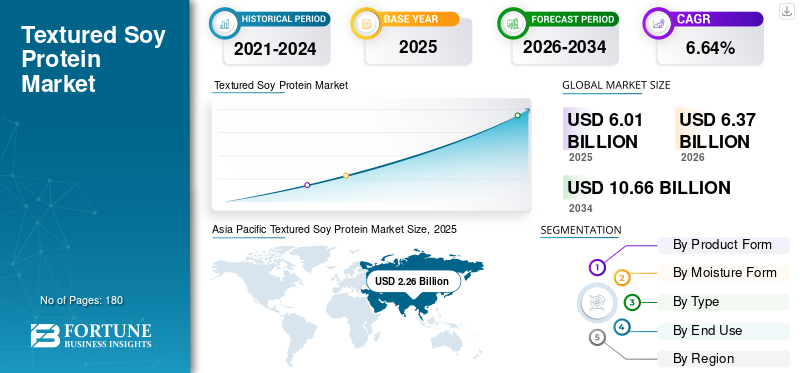
The global textured soy protein market size was valued at USD 6.01 billion in 2025 and is projected to grow from USD 6.37 billion in 2026 to USD 10.66 billion by 2034, exhibiting a CAGR of 6.64% during the forecast period. Asia Pacific dominated the global market with a share of 37.6% in 2025.
Textured Soy Protein (TSP), also known as Textured Vegetable Protein (TVP) is a plant-based protein ingredient made by processing defatted soy flour or soy protein concentrate through extrusion. The extrusion process gives TSP a fibrous, meat-like texture. This helps it absorb water, fats, and flavors, making it useful as a meat substitute or meat extender. Food manufacturers increasingly use TSP to partially replace meat while maintaining taste and texture. Hybrid products are gaining acceptance among flexitarian consumers and help processors manage raw material volatility. The high protein content of textured soy protein is driving its widespread use in nutritionally fortified plant-based and hybrid food products.
Companies such as Cargill, Incorporated, Archer Daniels Midland (ADM), and Ingredion Incorporated among others are some of the key players. New product launches are a key strategy boosting product sales and supporting market growth.
Download Free sample to learn more about this report.
TEXTURED SOY PROTEIN MARKET TRENDS
Growing Usage in Foodservice Industry is a key trend Shaping Up Industry Growth
Hybrid meat products are becoming more popular with consumers, which is leading to rising demand for these ingredients. Suppliers are improving extrusion methods to create better texture without needing extra additives as manufacturers are simplifying their recipes. Growth in foodservice and private-label production is making the B2B market even stronger. These factors make textured soy protein a staple ingredient in mainstream food manufacturing and not just a trend-driven plant-based product.
MARKET DYNAMICS
MARKET DRIVERS
Cost-Efficient Protein Functionality and Scalable Soy Supply Accelerate Industrial Adoption of Textured Soy Protein
Textured soy protein is cost-effective compared to animal meat, as it can be manufactured on a large scale and is widely used in different food products. This increases product appeal for use in hybrid meat products, processed foods, and large-scale catering. The use of this ingredient in food manufacturing also helps food makers improve water retention, texture, and yield, resulting in consistent product quality and better profit margins. As more people choose flexitarian diets instead of strictly vegan ones, the demand for partial meat replacements such as TSP has increased. Soybeans are widely available worldwide, so manufacturers have a steady supply of raw materials and can produce TSP on a large scale, thereby lowering supply-chain risks compared to newer protein sources. The growth of foodservice, quick-service restaurants, and ready-meal production—especially in emerging markets—also keeps B2B demand for textured soy protein strong and is driving the global textured soy protein market growth.
MARKET RESTRAINTS
Consumer Perception Concerns and Rising Competition from Alternative Plant Proteins Limit Pricing Power
Rising consumer concerns regarding soy allergies, hormone content, and genetic modification are increasingly influencing manufacturers' ingredient selection strategies, particularly within premium market segments. In addition, stringent regulatory requirements related to GMO labeling in European countries are driving up operational costs and reducing flexibility for manufacturers. Other alternatives, such as plant proteins similar to pea, fava bean, and wheat, are often observed as cleaner ingredients compared to soy protein. Moreover, Soybean prices fluctuate due to weather or global trade issues, affecting costs and profits. All these factors limit pricing power and slow long-term growth in established markets.
MARKET OPPORTUNITIES
Expansion of Hybrid Meat, Foodservice, and Institutional Foods Unlocks New Volume-Driven Growth Avenues
The textured soy protein market offers several opportunities, including growing consumption of hybrid meat products, growth in foodservice, and increased usage in developing countries. Using TSP as an ingredient helps manufacturers cut costs and attract flexitarian consumers while maintaining good taste. The institutional catering, quick-service restaurant, and ready-to-eat food sectors in the Asia Pacific, the Middle East, and Africa is growing, resulting in an increasing demand for affordable protein ingredients. Custom TSP formats, such as special textures for sausages, nuggets, or minced products, can help suppliers and manufacturers work together more closely. Using more non-GMO and identity-preserved soy helps meet regulatory and clean-label requirements, especially in Europe. In developing regions, government programs focused on food security and nutrition are also creating steady, long-term demand for bulk TSP. The rise of alternative proteins is strengthening the role of textured soy protein as a proven, functional, and cost-effective ingredient within the broader plant-protein landscape.
Download Free sample to learn more about this report.
Segmentation Analysis
By Product Form
Chunks / Granular Textured Soy Protein Leads To High-Yield Formulation Of Plant-Based and Hybrid Meat Products
By product form, the market is sub-segmented into chunks / granules, flakes, powder / fine TSP, and slices / nuggets.
The chunks / granules captured the largest textured soy protein market share in 2025 as they closely resemble minced and diced meat, making them a good fit for plant-based and blended meat products. They absorb water, which helps improve yield, texture, and mouthfeel of burgers, sausages, meatballs, and fillings.
Flakes is another major segment, estimated to register a 6.70% CAGR during the forecast period. They are simpler to process and affordable than chunks, making them a good choice for cost-sensitive uses. As demand for ready-to-eat and convenience foods increases, flakes continue to gain traction as a functional, adaptable protein ingredient.
By End Use
Plant-based Meat & Seafood Accounts for Leading Share as it Enhances Sensory Characteristics of Product Formulation
Based on end use, the market is sub-divided into plant-based meat & seafood, hybrid meat & processed meat, RTE / RTC foods, animal feed & pet food, and others.
Plant-based meat & seafood accounted for the largest market share in 2025. Food manufacturers use TSP because it is easy to scale up production and soy is widely available. As more people choose flexitarian diets around the world, producers use textured soy protein to create plant-based and hybrid products that taste good and are cost-effective.
RTE / RTC foods is another major segment, estimated to depict a 6.22% CAGR during the forecast period. Ready-to-eat and ready-to-cook foods are the second-largest users of textured soy protein. This is a result of high demand for convenient, long lasting, and affordable meal options. Textured soy protein is often used in frozen meals, canned foods, soups, sauces, and fillings since it keeps its texture during processing and reheating.
To know how our report can help streamline your business, Speak to Analyst
By Moisture Form
Dry TSP Holds Majority Market Share Due to Uniform Texture and Consistency
By moisture form, the market is classified into Dry TSP and Wet / Hydrated TSP.
The dry TSP segment led the market in 2025 as it is flexible to use and can be hydrated on-site to get the right texture and consistency. These benefits make dry TSP the major choice for plant-based meat, hybrid meat, ready-to-eat foods, and foodservice products worldwide.
Wet TSP is another major category which is projected to exhibit a CAGR of 5.78% during the forecast period. Wet TSP is especially useful in fresh, chilled, and short-shelf-life products. However, it has a shorter shelf life.
By Type
Conventional Type Accounts for Major Share Owing to Affordability and Availability
By type, the market is split into conventional and organic.
The conventional segment led in 2025 as it is affordable, widely available, and significantly used for manufacturing hybrid meat products, processed foods, and institutional catering.
Organic segment is expected to register a growth rate of 7.08% during the forecast period. Organic textured soy protein accounts for smaller market share but its demand is growing steadily in Europe and other developed countries, where certified organic crops are trusted by the consumers.
Textured Soy Protein Market Regional Outlook
By geography, the market is categorized into Europe, North America, Asia Pacific, South America, and the Middle East & Africa.
Asia Pacific
Asia Pacific Textured Soy Protein Market Size, 2025 (USD Billion)
To get more information on the regional analysis of this market, Download Free sample
Asia Pacific was valued at USD 2.26 billion in 2025 and leads the B2B market for textured soy protein, owing to the strong soy consumption and a growing processed food industry. In Asia Pacific, TSP is used in plant-based meats, traditional soy foods, hybrid meat products, and seasonings. China leads in demand because of its large soy processing industry. Japan and South Korea add value by focusing on premium products and foodservice uses. The region’s demand is also boosted by fast urban growth, more quick-service restaurants, convenience foods, and export-focused manufacturing. Although average selling prices are lower, the large scale of production makes the market focused on high volumes.
India Textured Soy Protein Market
The Indian market in 2025 was around USD 0.19 billion, accounting for roughly 5.70% of global revenues.
China Textured Soy Protein Market
In 2025, China reached around USD 0.91 billion, representing roughly 15.18% of the global textured soy protein market share.
Japan Textured Soy Protein Market
The Japanese market in 2025 reached around USD 0.31 billion, accounting for roughly 5.21% of global revenues.
North America
North America reached USD 1.10 billion in 2025. In North America, the textured soy protein market mainly serves different businesses, primarily relying on the well-developed food processing industry. Significant demand for such ingredients is generated by hybrid meat product manufacturers, foodservice suppliers, ready-meal makers, and not just by retail plant-based food companies. Industrial demand is expected to remain steady in the future as well due to more flexitarian consumers consuming plant-based products. Recent industry initiatives include improving texture and function for specific uses, which keeps North America a steady, high-volume B2B market.
U.S. Textured Soy Protein Market
In 2025, the U.S market captured USD 0.82 billion and is the largest and most developed market for TSP in North America, due to its strong food manufacturing base and wide foodservice networks. TSP is used for manufacturing hybrid meat products, private-label foods, and preparing food to fulfill supply contracts for schools, hospitals, and quick-service restaurants. As U.S. manufacturers are focusing on scalability, consistency, and stable pricing, they are opting for dry TSP for manufacturing. Growing demand for plant-based protein is driving increased adoption of textured soy protein in plant-based and hybrid food formulations.
Europe
Europe reached USD 1.61 billion by 2025 driven by the regulatory frameworks, sustainability objectives, and the increasing prevalence of flexitarian diets. Demand for such products is driven by both plant-based and hybrid meat products, as manufacturers utilize textured soy protein (TSP) to reduce environmental impact while maintaining familiar flavors. Non-GMO and organic TSP are more common in Europe. Private-label production, as well as the development of ready meals and chilled foods, particularly in Western Europe, contributes to market expansion and growth. Rising consumer awareness around nutrition, sustainability, and protein sources is encouraging food manufacturers to incorporate textured soy protein into mainstream food formulations. However, local plant proteins such as pea and fava beans serve as suitable alternatives, leading textured soy protein to be frequently incorporated into blends rather than used exclusively. The market prioritizes consistent quality, traceability, and regulatory compliance, leading to a value-driven, regulated business-to-business sector in Europe.
Germany Textured Soy Protein Market
The market in Germany reached around USD 0.35 billion in 2025, representing roughly 5.77% of global market revenues.
U.K. Textured Soy Protein Market
The U.K. market reached approximately USD 0.28 billion in 2025, equivalent to around 4.66% of global sales.
South America and the Middle East & Africa
Over the forecast period, South America is expected to experience significant growth in this market and achieved a market size of USD 0.48 billion in 2025. South America’s textured soy protein market is shaped primarily by shifting supply chain dynamics, as the region is the world's leading soy producer. The majority of demand is generated from hybrid and processed meat products, where TSP is widely used to boost yield and reduce cost. Brazil and Argentina lead in TSP use as they have large meat-processing industries and ample local soy. However, premium plant-based foods have not gained a foothold, so the market stays focused on bulk, standard dry TSP.
The Middle East & Africa hit USD 0.56 billion in 2025 owing to food security needs, growth in foodservice, and institutional demand. Demand is highest in the GCC region because of its large quick-service restaurant and hospitality sectors. In Africa, growth comes from a rising population and more processed food consumption. As the region relies on imported soy and TSP, prices are higher compared to South America. Yet, demand stays strong since there are few other protein options. Dry TSP is common as it is easier to store and transport. Overall, the MEA market is growing steadily, focused on large volumes and affordability rather than high-end plant-based products.
GCC Countries Textured Soy Protein Market
The GCC market is set to grow at a CAGR of 6.95% during the forecast period driven by TSP’s affordability for hybrid meat products, catering services, and government food programs.
COMPETITIVE LANDSCAPE
Key Industry Players
New Product Launches is a Key Strategy Used By Companies to Differentiate Products
The textured soy protein market is moderately consolidated, with local and regional manufacturing companies competing for higher market share. Large manufacturing companies can compete on price, size, and quality due to strong soy supply and implementation of latest equipment. Companies are manufacturing products at a competitive price, and launching new product lines manufactured with the use of non-GMO soy which are organic approved. Other strategies include mergers and acquisitions to boost market penetration and increase sales. The increasing adoption of plant-based diets is accelerating industrial demand for textured soy protein as a core ingredient in meat and seafood alternatives.
LIST OF TEXTURED SOY PROTEIN COMPANIES PROFILED
- Cargill, Incorporated (U.S.)
- Archer Daniels Midland (ADM) (U.S.)
- Ingredion Incorporated (U.S.)
- Bunge Limited (U.S.)
- Wilmar International (Singapore)
- CHS Inc. (U.S.)
- Fuji Oil Holdings Inc. (Japan)
- Shandong Wonderful Industrial Group (China)
- Gushen Biotechnology Co., Ltd. (China)
- Sonic Biochem Extractions Ltd. (India)
KEY INDUSTRY DEVELOPMENTS
- May 2025: Bunge introduced a new product line of soy protein concentrates at a trade event. This ingredient offered a clean taste, neutral color, and cost-effective solution to the food manufacturers.
- November 2024: ICL Food Specialties and DAIZ Engineering partnered to address taste problems in plant-based meat and seafood applications. The new product named ROVITARIS SprouTx helped to eliminate the beany and bitter notes associated with soy-based ingredients.
- December 2022: Bunge, a global leader in agribusiness, invested USD 550 million and built a fully integrated soy protein concentrate (SPC) and textured soy protein concentrate (TSPC) facility in the U.S.
- December 2022: Royal DSM launched Vertis Textured Pea Canola which is soy-free, gluten-free and dairy-free, helping to make the product appealing to the consumers.
- August 2022: Archer Daniels Midland (ADM) entered a strategic partnership with Benson Hill to expand the company’s proprietary ultra-high soy protein for the North American food ingredients market.
REPORT COVERAGE
Request for Customization to gain extensive market insights.
Report Scope & Segmentation
|
ATTRIBUTE |
DETAILS |
|
Study Period |
2021-2034 |
|
Base Year |
2025 |
|
Estimated Year |
2026 |
|
Forecast Period |
2026-2034 |
|
Historical Period |
2021-2024 |
|
Growth Rate |
CAGR of 6.64% from 2026-2034 |
|
Unit |
Value (USD Billion) |
|
Segmentation |
By Product Form, Moisture Form, Type, End Use, and Region |
|
By Product Form |
· Chunks / Granules · Flakes · Powder / Fine TSP · Slices / Nuggets |
|
By Moisture Form |
· Dry TSP · Wet / Hydrated TSP |
|
By Type |
· Conventional
|
|
By End Use |
· Plant-based Meat & Seafood · Hybrid Meat & Processed Meat · RTE / RTC Foods · Animal Feed & Pet Food · Others |
|
By Region |
North America (By Product Form, Moisture Form, Type, End Use, and Country)
Europe (By Product Form, Moisture Form, Type, End Use, and Country)
Asia Pacific (By Product Form, Moisture Form, Type, End Use, and Country)
South America (By Product Form, Moisture Form, Type, End Use, and Country)
Middle East & Africa (By Product Form, Moisture Form, Type, End Use, and Country)
|
Frequently Asked Questions
Fortune Business Insights says that the global market value stood at USD 6.01 billion in 2025 and is projected to reach USD 10.66 billion by 2034.
In 2025, Asia Pacifics market value stood at USD 2.26 billion.
The market is expected to exhibit a CAGR of 6.64% during the forecast period.
By end use, plant-based meat & seafood segment led the global market in 2025.
Cost-efficient protein functionality and scalable soy supply accelerate industrial adoption of textured soy protein.
Cargill, Incorporated, Archer Daniels Midland (ADM), Ingredion Incorporated and others and others are a few of the players in the textured soy protein market.
Asia Pacific held the largest market share in 2025.
Growing usage in foodservice industry is a key trend shaping up industry growth.



- 2021-2034
- 2025
- 2021-2024
- 180
-
(Offer valid till 15th Oct 2026)
Get 30-60 hrs Free Customization
Expand Regional and Country Coverage, Segments Analysis, Company Profiles, Competitive Benchmarking, and End-user Insights.




















Related Reports
-
US +1 833 909 2966 ( Toll Free )
-
Get In Touch With Us