Thermobaric Munitions Market Size, Share & Russia Ukraine War Analysis, By Explosive Mix (Liquid Mixtures, Solid Mixtures, and Advanced Composites), By Munitions Type (Rockets, Missiles, Aerial Bombs, Artillery Shells, Grenades and Others), By Platform (Man-Portable Weapons, Armored Vehicles, Howitzers, Mortar, Fixed-Wing Aircraft and Others), By Guidance System (Unguided, Laser-Guided, GPS/INS-Guided, Infrared (IR)/Electro-Optical (EO)/TV-Guided, and Others), By Range (Close Range (Below 500m), Short Range (500m - 5km), Medium Range (5km - 70km) and Others), and Regional Forecast, 2026-2034
 Download Free Sample
KEY MARKET INSIGHTS
 Listen to Audio Version
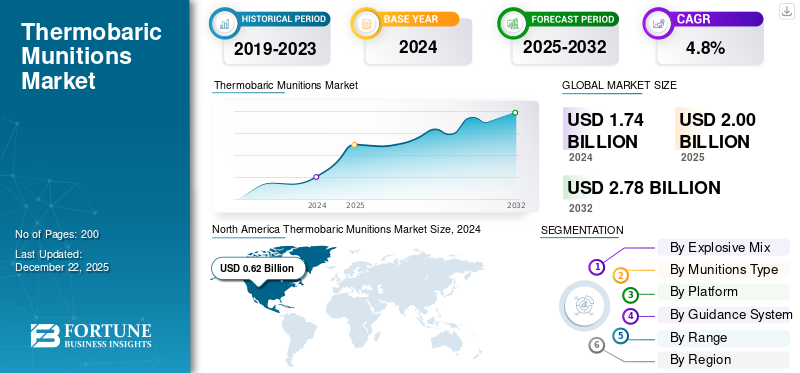
The global thermobaric munitions market size was valued at USD 2.00 billion in 2025 and is projected to grow from USD 2.20 billion in 2026 to USD 2.95 billion by 2034, registering a CAGR of 3.75% over the forecast period. North America dominated the thermobaric munitions market with a market share of 35.60% in 2025.
Thermobaric munitions are weapons that are designed to inflict damage and cause harm through overpressure and thermal effects. They are also called thermobaric bombs, vacuum bombs, or aerosol bombs. Unlike conventional explosives, they are made up of fuel containers with two separate explosive charges. It can be deployed in a rocket or missile as a warhead. Upon impact, an initial explosive charge opens the container, dispersing a fuel mixture into a cloud that can infiltrate unsealed structures. A subsequent charge ignites this cloud, creating a large fireball, a powerful blast wave, and a vacuum that depletes surrounding oxygen.
Download Free sample to learn more about this report.
Key players in the market, such as Rostec, Nammo AS, Norinco, and China Aerospace Science and Industry Corporation (CASIC), are constantly developing advanced weapons with thermobaric warheads. For instance, Rostec manufactures the TBG-7V rocket equipped with a thermobaric fuel explosive blast warhead that is used with the RPG-7 rocket launcher. It is designed to incapacitate enemy personnel in urban or mountainous environments, including those entrenched in bunkers and buildings, by utilizing a combination of intense heat and blast overpressure. Moreover, the market also includes manufacturers, including Armaco JSC and TRAYAL Corporation, that use fuel-air explosive technology in bombs and grenades.
Download Free sample to learn more about this report.
Thermobaric Munitions Market Key Takeaways
 Global Market Size & Forecast
- 2025 Market Size: USD 2.00 billion
- 2026 Market Size: USD 2.20 billion
- 2034 Forecast Market Size: USD 2.95 billion
- CAGR: 3.75% from 2026–2034
 Market Share
- North America dominated the thermobaric munitions market with a 35.60% share in 2025.
- The liquid mixtures segment is projected to account for 72.31% of the global market in 2026.
- The missiles segment is expected to hold a 32.16% market share in 2026.
 Key Regional Highlights
North America
North America accounted for USD 0.71 billion in 2025 and is projected to reach USD 0.78 billion in 2026.
Europe
Europe represented USD 0.57 billion in 2025 and is expected to grow to USD 0.64 billion in 2026.
Asia Pacific
Asia Pacific generated USD 0.42 billion in 2025 and is projected to reach USD 0.46 billion in 2026.
U.S.
The U.S. thermobaric munitions market is projected to reach USD 0.73 billion by 2026.
Japan
The Japan thermobaric munitions market is projected to reach USD 0.06 billion by 2026.
Read More

Russia-Ukraine War Impact
The Russia-Ukraine war has significantly influenced the thermobaric munitions market. As the war situation escalates, the demand for high-impact weaponry such as thermobaric explosives in urban and fortified zones has increased. These weapons are increasingly being used by countries involved in the war, as these weapons are highly effective in the destruction of bunkers and attacking enclosed spaces. Moreover, Russia is widely deploying these munitions to attack enemy personnel and infrastructure. For instance, in May 2025, Russian forces employed drones armed with thermobaric warheads in a mass attack on Ukraine's northeastern city of Kharkiv. The Russian drones carried thermobaric ammunition to generate blast impact and high-temperature clouds.
In addition, countries are dramatically increasing the production of ammunition, including thermobaric weapons. For instance, in October 2024, Ukraine manufactured 25 times more ammunition in the first half of 2024 than in 2022. Moreover, in May 2025, the Ministry of Defence of Ukraine provided authorization for the operational use of the KRAMPUS mobile strike system. The platform is equipped with reactive thermobaric launchers and is designed for both offensive and defensive operations. Therefore, the war has reshaped the market and has increased the overall demand for high explosives such as thermobaric weapons.
Thermobaric Munitions Market Trends
Integration of Thermobaric Warheads in Drone Platforms is a Key Market Trend
Thermobaric weapons are integrated with various platforms such as aircraft, vehicles, motors, and others. There is a rise in the integration of thermobaric warheads into unmanned aerial vehicles (UAVs) and tactical drones. Countries involved in modern warfare and conflicts are increasing the adoption of drones equipped with thermobaric warheads to improve precision and increase damage. The use of thermobaric drones provides an advantage to defense forces and the ability to target fortified structures, bunkers, tunnels, and enclosed enemy positions.
Moreover, countries are investing in the development and adoption of thermobaric unmanned aerial vehicles to obtain high-impact strikes. For instance, in March 2024, Russia deployed an upgraded version of the Geran-2 strike drone in Ukraine, equipped with a thermobaric warhead to enhance strike effectiveness. Conflicts in the regions such as Ukraine, Russia, and Syria are employing thermobaric-equipped drones to attack enemy infrastructure and personnel. For instance, Ukraine is planning to launch FPVs with larger thermobaric warheads against Russian-held buildings and fortifications. The use of thermobaric warheads provides advantages to FPV pilots to effectively target individual soldiers seeking refuge in bunkers and buildings. Thus, such an increase in the use of drones as a flexible and lethal battlefield strategy is expected to increase the demand for thermobaric munitions.
Market Dynamics
Market Drivers
Rise in Geopolitical Tensions and Increase in Demand for Thermobaric Munitions in Urban Warfare to Propel Market Growth
In the recent period, the rapidly changing geopolitical landscape has encouraged the use of advanced weaponry and ammunition systems. Thermobaric weapons are increasingly receiving strategic importance during the rise of geopolitical tensions across the globe. With the rise in defense budget, countries may focus on investment in the production and procurement of thermobaric weapons.
Moreover, tension in regions such as the Middle East, including Israel’s operation in Gaza and persistent instability in Syria & Iraq, are some scenarios which further fuel the demand for such weapons. Thermobaric weapons offer significant overpressure effects in enclosed spaces. They are currently being considered as tactical assets in dense combat zones. In addition, the Indo-China border tensions have also resulted in an increase in defense procurement in the Asia Pacific region. Countries in the region are investing in the research, development & testing of thermobaric ammunition to improve their defense capabilities. For instance, in April 2025, scientists in China tested a new non-nuclear explosive device that works on the principle of thermal decomposition to inflict damage. Thus, rising terrorism threats and increasing geopolitical tension have prompted various countries to adopt high-efficiency munitions, which are expected to drive the demand for thermobaric arms.
Market Restraints
High Development Costs of Advanced Thermobaric Munitions Hinder Market Growth
A significant restraint in the market is the high cost per unit of the thermobaric weapons. Such a high cost is limiting the development, widespread adoption, and procurement of thermobaric weapons. Some nations with less budget prioritize the development of conventional ammunition instead of thermobaric weapons due to their high cost. Thermobaric weapons are more expensive than conventional munitions due to their specialized design and the advanced explosive material used while designing their weapons.
Moreover, the need for precision launchers or platform systems for the efficient use of these weapons is also another factor that is expected to hamper the growth of the market. Therefore, many countries incline toward investing in alternative cost-effective weapons, which is expected to hinder the thermobaric munitions market growth during the forecast period.
Market Opportunities
Increase in Defense Expenditure and Investment in Ammunition to Drive Growth Opportunities
Various countries across the globe are increasing their defense budgets with the aim of modernizing armed forces and enhancing surveillance capabilities. The defense expenditure has seen a significant increase in recent years. For instance, the defense budget reached USD 2.7 trillion in 2024, from USD 2.24 trillion in 2023, with a growth rate of 9.4%. Moreover, countries in the region, such as Asia, the Middle East and North Africa, and Europe, witnessed major budget increases with the necessary response to the escalating geopolitical tensions and security threats.
Surge in the conflicts, territorial disputes, and cross-border tensions occurring across the globe has encouraged governments to start making huge investments in advanced technologies and modernization of ammunition to strengthen national security. For instance, as of March 2024, the European Union Commission announced the allocation of USD 537.2 million to speed up ammunition production with the focus on strengthening the defense industry. Moreover, in 2024, Reliance Infrastructure revealed plans to invest USD 1.19 billion in promoting the production of ammunition and small arms over ten years. Therefore, such increasing defense budgets owing to the geopolitical instability and border tension are expected to present significant opportunities for the growth of the market during the forecast period.
Market Challenges
Strict International Regulations and Humanitarian Concerns Pose a Significant Challenge for Market
Thermobaric bombs are devastating and effective in urban areas or open conditions. They are capable of penetrating bunkers and other underground locations, declining the oxygen supply in air for the enemy troops. Although the weapon is highly effective and precise, the use of such weapons is harshly scrutinized on an international level. They are not unequivocally banned; however, the utilization of weapons that cannot distinguish between civilians and combatants is forbidden by the Geneva Conventions.
Thermobaric weapons also create significant challenges as their use in populated areas exposes civilians to major harm. The adoption of thermobaric weapons is expected to raise ethical concerns and objections. This is anticipated to impact the investment made toward the procurement of thermobaric weapons through various countries’ defense budgets. Therefore, such diplomatic pressures and complexity in the legality of the use of these weapons may create significant challenges for the growth of the market.
Segmentation Analysis
By Explosive Mix
Solid Mixture Segment Held Largest Market Share Due to Ease of Storage & Handling
On the basis of explosive mix, the market is classified into liquid mixtures, solid mixtures, and advanced composites.
The solid mixtures segment held the largest thermobaric munitions market share. The segment dominates the market as there increase in use of solid thermobaric compounds in weapon design owing to their ease of storage & handling. Moreover, the solid mix is widely utilized in various handheld launchers, grenades, and air-dropped munitions. Thermobaric weapons with solid mix contain a stable powdered fuel and oxidizer blend that can be effectively stored for a long period. The AGM-114N Hellfire missile is one of the most prominent tactical weapons manufactured by Lockheed Martin Corporation. Its variant, equipped with a thermobaric warhead, consists of solid fluorinated aluminum powder mixed with polytetrafluoroethylene layered between the charge casing and a PBXN-112 explosive. The Liquid Mixtures segment is projected to reach market by composition, accounting for 72.31% of the global market share in 2026
The advanced composites segment is expected to grow fastest during the forecast period due to an increase in research and development to improve the blast efficiency and thermal output. For instance, DRDO developed explosive composition PBTE 201 for bombs at the High Energy Materials Research Laboratory (HEMRL). The TB formulation PBTE 201 is a composite material in which solid explosive particles are dispersed in a polymer matrix. Such a rise in research & development is expected to boost the growth of the segment.
By Munitions Type
Missiles Segment to Hold Largest Share Due to Integration of Thermobaric Warheads
On the basis of munitions type, the market is classified into rockets, missiles, aerial bombs, artillery shells, grenades, and others. Others consist of recoilless rifle rounds, torpedo/depth charges, mortar rounds, and other munitions.
The missiles segment dominated by delivery platform, holding 32.16% of the market share in 2026. The segment holds the highest share as thermobaric warheads are increasingly integrated into missile systems for creating a destructive effect, causing casualties and damage to infrastructure. Thus, it helps the defense forces to obtain weapons with high-range precision and significant blast effect to destroy enemy troops and infrastructure. Various prominent missiles are converted to thermobaric variants with the installation of a warhead made up of high high-explosive thermobaric mixture.
For instance, 9M133 Kornet is an anti-tank guided missile designed and developed by KBP Instrument Design Bureau, Russia. One of its configurations is equipped with increased range and an improved thermobaric warhead. Moreover, further advancement in the missile due to the increase in demand for precision guided munitions is expected to drive the growth of the segment during the forecast period. For instance, in May 2025, Rostec revealed a significant upgrade carried out with the Kornet-EM anti-tank guided missile system. The upgraded version allows a single crew to remotely operate up to three launchers simultaneously.
The grenades segment is estimated to grow at the fastest CAGR over the forecast period due to an increase in interest in man-portable thermobaric grenades by special forces and urban combat units. For instance, in February 2023, the Ukrainian military was seen using thermobaric grenades RTB-7MA, manufactured in Bulgaria, with Soviet RPG-7 grenade launchers. Growing counter-terrorism and ongoing war in various regions are fueling the development and adoption of thermobaric grenades. For instance, companies such as Balkan NovoTeh are involved in the manufacturing of advanced thermobaric grenades, including the Thermobaric hand grenade TG-1, which is designed to inflict explosive damage to enemy manpower and fortified structures, and armored and lightly armored vehicles.
To know how our report can help streamline your business, Speak to Analyst
By Platform
Armored Vehicles Hold Largest Market Share Due to Their Mobility & Flexibility
On the basis of the platform, the market is classified into man-portable weapons, armored vehicles, howitzers, mortar, fixed-wing aircraft, helicopters, UAVs, and naval vessels.
Armored vehicles segment is projected to reach 26.18% of the market share in 2026 as they provide defense forces with high flexibility with various ammunition systems. Moreover, it offers a stable launch platform as it is mobile and allows quick deployment of multiple ammunition, and the advantage of relocation after launches. Numerous countries are investing heavily in the development of ground-based platforms for launching thermobaric ammunition. For instance, in May 2025, the Ministry of Defense of Ukraine (MOD) authorized the use of KRAMPUS, a domestically developed thermobaric-armed unmanned ground vehicle (UGV). Such developments are expected to boost the demand for armored vehicles for launching thermobaric arms.
The UAVs segment is estimated to be the fastest-growing segment as there is an increase in the need for precision strike and reduced risk. The UAVs as platforms for thermobaric ammunition are effective in destroying enemy infrastructure with minimal collateral damage. Moreover, in urban combat scenarios, UAVs are being preferred as platforms to launch thermobaric munitions as they are highly effective in neutralizing enemy combatants settled in buildings or fortified positions.
By Guidance System
Unguided Segment Leads Market, as It is a Cheaper and Simpler Type of Guidance System
On the basis of guidance system, the market is classified into unguided, laser-guided, GPS/INS-guided, infrared (IR)/Electro-Optical (EO)/TV-Guided, Anti-Radiation (ARM), and wire-guided / SACLOS.
The unguided segment led by guidance type, capturing 39.59% of the market share in 2026 as it is widely established in legacy systems such as rocket-propelled grenades, artillery shells, mortar rounds, and other ammunition. The unguided weapon system is cheaper, simple to manufacture, and extensively used in countries that have limited access to advanced targeting systems. Moreover, unguided systems are deployed in recent urban warfare and low-cost military special force operations. RPO-A Shmel is one of the prominent rocket-propelled thermobaric weapons manufactured by Rostec (Russia), and its guidance system is unguided.
The Infrared/Electro-Optical (IR/EO) guided segment is estimated to be the fastest-growing segment as there is a rise in demand for precision strike capabilities in thermobaric weapons, especially from drones and smart missiles. IR/EO guidance system allows all-weather, day & night targeting, and increased adaptability during warfare. It is helpful to target hidden or moving threats during urban combat.
By Range
Short Range (500m - 5km) Segment Commands Market Due to Its Low Collateral Damage and High Targeted Precision
On the basis of range, the market is classified into close range (below 500m), short range (500m - 5km), medium range (5km - 70km), long range (70km - 300km), and very long range (above 300km).
The short range (500m - 5km) segment dominates the market as there is an increase in need for short range munitions in urban warfare and modern conflicts. Thermobaric weapons are effective in attacking buildings, bunkers, tunnels, and confined spaces, which require short range munitions. Moreover, due to humanitarian laws and regulations, long range thermobaric munitions may be difficult to use as defense forces have less control over their effects. However, short range munitions offer precise targeting, reducing the risk of indiscriminate harm. In addition, short range thermobaric munitions are comparatively cheaper and can be deployed quickly at ground level, which is expected to drive their demand.
The long range (70km - 300km) segment is estimated to be the fastest-growing segment. The long range thermobaric weapons may be adopted rapidly in the future to destroy deeply buried bunkers and strong enemy infrastructure. Moreover, possible integration of thermobaric warheads with other long range missiles is also expected to push the utilization of long range thermobaric munitions.
Thermobaric Munitions Market Regional Outlook
On the basis of region, the market is studied across North America, Europe, Asia Pacific, the Middle East & Africa, and Latin America.
North America
North America Thermobaric Munitions Market Size, 2025 (USD Billion)
To get more information on the regional analysis of this market, Download Free sample
The North America market accounted for USD 0.71 billion in 2025, representing 35.60% of the global industry, and is expected to reach USD 0.78 billion in 2026. North America is a leading region in the ammunition production primarily due to the presence of major defense players such as BAE Systems, Northrop Grumman Corporation, and Lockheed Martin. Moreover, the countries in the region, such as the U.S., are witnessing an increase in defense budget and huge investments in the production of ammunition. For instance, the Pentagon, U.S. DOD, aims to spend USD 30.6 million for the production of missiles and munitions with an increase of 12% as compared to 2023 missile and munitions expenditure. With such a rise in ammunition spending, the country may invest in advanced high-impact, increased precision weapons such as thermobaric munitions. In addition, a rise in defense budget has encouraged countries such as the U.S. to expand stockpiling and modernization of specialized munitions, including fuel-air explosives and thermobaric warheads. The U.S. market is projected to reach USD 0.73 billion by 2026.
Europe
Europe recorded a market size of USD 0.57 billion in 2025, capturing 28.67% of the global market share, and is projected to reach USD 0.64 billion in 2026. Europe is witnessing rapid growth in the market, driven by an increase in defense budget and a rise in demand to improve defense capabilities for war and future conflicts. The countries in the region involved in the current conflict are aiming to increase the procurement of advanced weapons and ammunition. Moreover, Europe is pushing for less reliance on the U.S. and other non-NATO countries for the supply of ammunition. The countries are investing in the development of advanced explosives and a thermobaric launcher system. For instance, in June 2023, the Russian military deployed a thermobaric missile launcher on its own territory. Moreover, in June 2024, the Russian Ministry of Defense announced the launch of ТОS-3 Dragon Thermobaric Rocket Launcher. The UK market is projected to reach USD 0.06 billion by 2026 and the Germany market is projected to reach USD 0.02 billion by 2026.
Asia Pacific
In 2025, Asia Pacific represented USD 0.42 billion, accounting for 20.88% of the worldwide market, and is projected to grow to USD 0.46 billion in 2026. The Asia Pacific region is rapidly emerging as a significant player in the market. Countries in the region are investing in the development of advanced weapon systems to target complex areas on the battlefield. For instance, in February 2025, China's military experts presented the concept of integrating thermobaric warheads in robots. This new technology is being developed as drones equipped with only light weapons may have difficulty destroying targets shielded in fortified buildings or underground bunkers. Developing countries such as India are heavily investing in high lethality, compact weaponry for use in high-altitude warfare and urban combat. The Indian Defense Agencies, such as DRDO, are working on thermobaric variants for rocket launchers such as Pinaka and shoulder-launched weapons. The Japan market is projected to reach USD 0.06 billion by 2026, the China market is projected to reach USD 0.21 billion by 2026, and the India market is projected to reach USD 0.11 billion by 2026.
Middle East & Africa
Middle East & Africa contributed 10.28% to the global market in 2025, with a valuation of USD 0.21 billion, and is projected to reach USD 0.22 billion in 2026. In the Middle East & Africa countries such as Iraq, Syria, Egypt, and others are facing constant insurgencies, urban warfare, and threats. Other countries in the region are increasing their defense budget to make large-scale military purchases, including specialized munitions. Some countries also procure thermobaric warheads through deals with Russia, China, or Western defense contractors. For instance, in 2024, Saudi Arabia showed its interest in procuring Russian rockets with thermobaric warheads, the TOS-1A system (the Russian equivalent of the MLRS) manufactured by Omsktransmash.
Latin America
Countries in the Latin America region, including Mexico and Brazil, are experiencing an increase in defense budgets to invest in advanced weapon systems. The Latin America market was valued at USD 0.09 billion in 2025, capturing 4.57% of global revenue, and is estimated to reach USD 0.1 billion in 2026. For instance, in 2024, Brazil announced that its defense expenditure is expected to increase by 5% to reach USD 23.7 billion. Such a rise in defense budget is expected to boost the growth of the market in the region. Moreover, the countries in Latin America are also focusing on defense co-operation with the U.S. and Russia to provide access to specialized munitions.
Competitive Landscape
Key Market Players
Key Players Focus on Investment in R&D and Strategic Partnerships to Enhance Their Market Presence
The market is highly competitive, driven by a rise in defense budget and an increase in investment in the production and procurement of ammunition. Major defense contractors such as Lockheed Martin and Northrop Grumman dominate the U.S. market as they develop missiles, rockets, and artillery ammunition that can be equipped with thermobaric warheads. Russia’s Rostec, KPB Instrument Design Bureau, and NPO Mashinostroyeniya are key innovators present in the thermobaric weapon development. There is a growing competition to integrate thermobaric warheads into missile and rocket systems. Companies are focused on the development of thermobaric weapons with increased blast radius, weight optimization, and reduced collateral damage. Moreover, R&D funding and government support in the development and adoption of fuel-air explosives are expected to drive the growth of the market.
LIST OF KEY THERMOBARIC MUNITION COMPANIES PROFILED
- Rostec (Russia)
- Nammo AS (Norway)
- Norinco (China)
- China Aerospace Science and Industry Corporation (CASIC) (China)
- Lockheed Martin Corporation (U.S.)
- Armaco JSC (Bulgaria)
- HESA (Iran)
- ARDE (DRDO) (India)
- NPO Mashinostroyeniya (Russia)
- VAZOVSKI MASHINOSTROITELNI ZAVODI EAD (Bulgaria)
- Munitions India Limited (MIL) (India)
- Balkan NovoTeh (Serbia)
- Transmobile Ltd. (Bulgaria)
- Dunarit Corporation (Bulgaria)
- MKE USA (U.S.)
KEY INDUSTRY DEVELOPMENTS
- In August 2024, Russian KBP Instrument Design Bureau announced the launch of the Kh-BPLA guided missile designed for use from unmanned aerial vehicles. Its high-explosive variant weighs 6 kilograms and is equipped with a thermobaric warhead weighing 3.2 kilograms.
- In June 2024, the Russian Ministry of Defense announced the launch of the ТОS-3 Dragon Thermobaric Rocket Launcher. The ТОS-3 will use ammunition from the ТОS-2 with a likely similar range, up to 15 km.
- In April 2024, the U.S. Army provided a contract with a value of USD 483 million to Lockheed Martin for the production of Joint-Air-to-Ground Missiles (JAGM) and HELLFIRE missiles.
- In May 2023, the Iranian Revolutionary Guards (IRGC) Ground Force tested the Fajr-5 missile, a long-range multiple launch rocket system (MLRS), which is equipped with a thermobaric warhead. The warhead uses oxygen from the surrounding environment to create a high-temperature explosion for its operation.
- In February 2023, Munitions India Limited started the large-scale production and supply of 1,000 lb thermobaric bombs.
REPORT COVERAGE
The report provides a detailed analysis of the sector and focuses on important aspects such as key players and various regions. Moreover, the research report offers deep insights into the thermobaric munitions market trends, competitive landscape, market competition, market share, and market status, and highlights key industry developments. Additionally, it encompasses several direct and indirect factors that have contributed to the growth of the market in recent years.
Request for Customization to gain extensive market insights.
Report Scope & Segmentation
|
ATTRIBUTE |
DETAILS |
|
Study Period |
2021-2034 |
|
Base Year |
2025 |
|
Estimated Year |
2026 |
|
Forecast Period |
2026-2034 |
|
Historical Period |
2021-2024 |
|
Unit |
Value (USD Billion) |
|
Growth Rate |
CAGR of 3.75% from 2026 to 2034 |
|
Segmentation
|
By Explosive Mix
|
|
By Munitions Type
|
|
|
By Platform:
|
|
|
By Guidance System
|
|
|
By Range
|
|
|
By Region
|
Frequently Asked Questions
Fortune Business Insights says that the global market was valued at USD 2.00 billion in 2025 and is projected to grow from USD 2.20 billion in 2026 to USD 2.95 billion by 2034
Registering a CAGR of 3.75%, the market will exhibit significant growth during the forecast period.
By munitions type, the missile segment leads the market.
Rostec, Nammo AS, Norinco, China Aerospace Science and Industry Corporation (CASIC), and Lockheed Martin Corporation are some of the leading players in the market.
North America dominates the market in terms of share.
In 2024, the market value stood at USD 0.62 billion.
The key factors driving the market rise in geopolitical tension and an increase in demand for thermobaric munitions.



- 2021-2034
- 2025
- 2021-2024
- 200
Get 30-60 hrs Free Customization
Expand Regional and Country Coverage, Segments Analysis, Company Profiles, Competitive Benchmarking, and End-user Insights.




















Related Reports
-
US +1 833 909 2966 ( Toll Free )
-
Get In Touch With Us