Thermochromic Materials Market Size, Share & Industry Analysis, By Product (Reversible and Irreversible), By Application (Packaging, Printing, Consumer Goods, Textiles & Apparel, and Others), and Regional Forecast, 2026-2034
 Download Free Sample
Thermochromic Materials Market Size and Future Outlook
 Listen to Audio Version
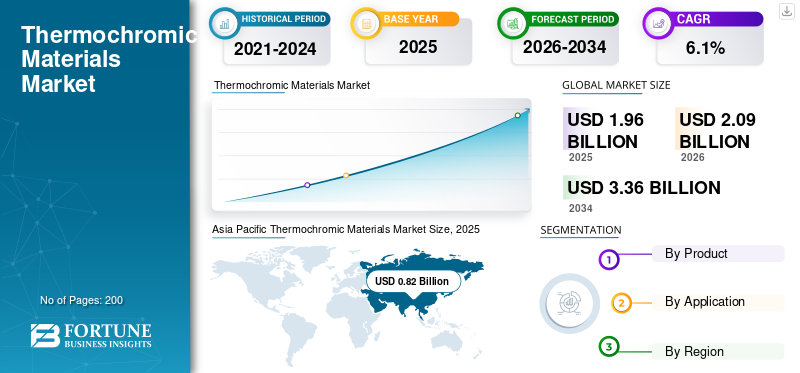
The global thermochromic materials market size was valued at USD 1.96 billion in 2025 and is projected to grow from USD 2.09 billion in 2026 to USD 3.36 billion by 2034, exhibiting a CAGR of 6.1% during the forecast period. Asia Pacific dominated the thermochromic materials market with a market share of 41.83% in 2025.
The market is advancing steadily as industries increasingly adopt smart and interactive features in everyday products. Growing demand for enhanced product visibility, temperature monitoring, and consumer engagement is encouraging wider use across packaging, printing, plastics, and textiles. These materials add functional value by responding to temperature variations, helping brands improve safety, quality assurance, and visual appeal. Expansion in food logistics, pharmaceutical distribution, and organized retail is further driving the market growth.
Key players such as Thermographics, Matsui International, Smarol Industry Co., Ltd., NEW PRISMATIC ENTERPRISE CO., LTD., and SpotSee are strengthening their market position through continuous product innovation, expanded manufacturing capabilities, and reliable global distribution networks.
Download Free sample to learn more about this report.
Thermochromic Materials Market Key Takeaways
 Market Size & Forecast
- 2025 Market Size: USD 1.96 billion
- 2026 Market Size: USD 2.09 billion
- 2034 Forecast Market Size: USD 3.36 billion
- CAGR: 6.1% from 2026-2034
 Market Share
- Asia Pacific dominated the thermochromic materials market with a 41.83% share in 2025.
- The irreversible segment is expected to grow at a CAGR of 4.7% during the forecast period.
- The printing segment is projected to register a CAGR of 5.6% over the forecast period.
 Key Regional Highlights
Asia Pacific
Asia Pacific accounted for USD 0.82 billion in 2025 and is projected to reach USD 0.87 billion in 2026.
North America
North America is expected to reach USD 0.45 billion in 2025, supported by steady demand across packaging and industrial applications.
Europe
Europe is projected to reach USD 0.47 billion in 2025, driven by growing adoption in smart coatings and consumer products.
U.S.
The market reached USD 0.42 billion in 2025, accounting for approximately 92.3% of North American revenues.
Japan
Rising demand for advanced functional materials in packaging, electronics, and automotive applications is supporting market growth.
Read More

THERMOCHROMIC MATERIALS MARKET TRENDS
Rising Adoption of Smart and Interactive Packaging Solutions Drive Market Growth
A prominent driver for the market is the growing demand for smart and interactive packaging. Brands across food and beverage packaging, pharmaceuticals, and consumer goods are increasingly incorporating temperature-responsive elements to enhance product safety, freshness indication, and customer engagement. These materials allow packaging to visually signal temperature changes, helping improve cold-chain monitoring and reducing the risk of product spoilage. Beyond safety, thermochromic effects are also being used to create dynamic visual experiences that strengthen brand differentiation on retail shelves.
- According to the World Health Organization (WHO), an estimated 50% of vaccines are wasted globally each year, partly due to temperature control and logistics failures, highlighting the importance of effective temperature monitoring solutions in pharmaceutical distribution.
MARKET DYNAMICS
MARKET DRIVERS
Expanding Demand for Smart Packaging and Temperature Monitoring Drives Market Growth
The market is strongly driven by the expanding need for smart packaging and reliable temperature monitoring across the food, beverage, and pharmaceutical sectors. As global supply chains become more complex, maintaining product quality during storage and transportation has become increasingly important. Temperature-responsive materials provide a simple visual indication of exposure to heat or cold, helping reduce spoilage risks and improve consumer confidence. Their use in labels, caps, films, and printed packaging supports better quality control without requiring electronic devices.
- According to the FAO, about 14% of global food production is lost between harvest and retail due to supply chain and temperature issues, which drives the use of temperature-responsive materials in packaging to reduce spoilage and improve monitoring.
Download Free sample to learn more about this report.
MARKET RESTRAINTS
High Production Costs and Limited Durability Restrain Market Expansion
The market faces challenges related to relatively high production costs and performance limitations. These materials involve specialized formulations and microencapsulation processes, which increase manufacturing expenses compared to conventional pigments and inks. In addition, thermochromic effects can degrade over time when exposed to prolonged heat, ultraviolet light, or harsh environmental conditions, potentially limiting long-term durability in certain applications. This can restrict their use in outdoor products and cost-sensitive packaging segments where longevity and stability are critical.
- According to the journal Materials (MDPI), leuco dye–based thermochromic systems can suffer from limited light stability and degradation under prolonged UV exposure, which can reduce long-term performance in outdoor applications. This durability limitation can restrain broader adoption in certain environments.
MARKET OPPORTUNITIES
Expansion of Cold-Chain and Pharmaceutical Logistics Creates New Growth Opportunities
The strong opportunities for thermochromic materials market growth is as the global cold-chain and pharmaceutical distribution networks continue to expand. Increasing demand for temperature-sensitive medicines, vaccines, and biologics is driving the need for reliable and easy-to-interpret monitoring solutions during storage and transportation. Temperature-responsive materials provide a simple visual method to indicate exposure to critical thresholds, supporting quality assurance without complex electronic systems. As healthcare access improves in emerging markets and global immunization programs expand, packaging solutions that enhance temperature visibility are gaining importance.
- According to the International Air Transport Association (IATA), pharmaceutical shipments transported by air require strict temperature control throughout the supply chain, which drives the need for reliable temperature-indicating materials in packaging and logistics.
MARKET CHALLENGES
Performance Stability and Environmental Sensitivity Create Market Challenges
The market faces challenges related to maintaining consistent performance under varying environmental conditions. These materials are sensitive to prolonged exposure to heat, ultraviolet light, and moisture, which can gradually reduce color intensity and responsiveness over time. In applications such as outdoor packaging, textiles, and consumer goods, maintaining long-term stability is critical for brand credibility and product reliability. Variations in formulation quality and encapsulation techniques can also affect repeatability and durability, creating hesitation among large-scale industrial users.
- According to Science Direct, leuco dye–based thermochromic systems can experience degradation when exposed to ultraviolet radiation and elevated temperatures, leading to reduced color-change performance over time. This environmental sensitivity creates durability challenges in long-term and outdoor applications.
Segmentation Analysis
By Product
Wide Application Base and Strong Commercial Adoption Support Dominance of Reversible Segment
Based on the product, the market is segmented into reversible and irreversible.
The reversible product segment holds the largest thermochromic materials market share due to its broad applicability and strong demand across packaging, printing, plastics, and textiles. These materials can repeatedly change color in response to temperature fluctuations, making them highly suitable for consumer engagement, freshness indication, and decorative applications. Their ability to revert to the original color state allows for repeated use in everyday products such as beverage labels, promotional printing, molded plastics, and fashion items.
- According to a review published in Materials (MDPI), the leuco dyes segment is the most commonly used thermochromic material in commercial applications, such as inks, plastics, and coatings, supporting the dominant share of reversible products in the market.
The irreversible segment is expected to grow at a CAGR of 4.7% over the forecast period.
By Application
To know how our report can help streamline your business, Speak to Analyst
Strong Demand from Food, Beverage, and Pharma Sector Supports Packaging Segment Leadership
In terms of application, the market is categorized into packaging, printing, consumer goods, textiles & apparel, and others.
The packaging segment holds the largest share of the market, driven by its extensive use in food, beverage, and pharmaceutical products. Temperature-responsive features are increasingly integrated into labels, caps, films, and flexible packaging to indicate freshness and proper storage conditions. High consumption volumes in packaged food, cold-chain logistics, and retail distribution make packaging one of the most significant application areas for the product.
- According to the World Health Organization (WHO), vaccines must be stored within specific temperature ranges to remain effective, supporting the need for temperature-indicating materials in packaging.
The printing segment is expected to grow at a CAGR of 5.6% over the forecast period.
Thermochromic Materials Market Regional Outlook
By region, the market is categorized into North America, Europe, Asia Pacific, Latin America, and the Middle East & Africa.
Asia Pacific
Asia Pacific Thermochromic Materials Market Size, 2025 (USD Billion)
To get more information on the regional analysis of this market, Download Free sample
Asia Pacific held the dominant position in the market in 2025, valued at USD 0.82 billion, and is expected to maintain its leading role in 2026, reaching USD 0.87 billion. The region’s leadership is supported by its strong manufacturing base in specialty pigments, printing inks, and plastics production. High consumption of packaged food and beverages, expanding pharmaceutical distribution networks, and rapid growth in consumer goods manufacturing contribute significantly to demand.
China Thermochromic Materials Market
Based on Asia Pacific’s strong contribution and China’s position as a major manufacturing hub, the China market was valued at USD 0.42 billion in 2025, accounting for approximately 50.9% of regional revenues. The country’s extensive packaging industry, large plastics conversion sector, and established thermochromic pigment production capacity support domestic and export demand.
To know how our report can help streamline your business, Speak to Analyst
North America
North America represents a mature yet steadily growing regional market, projected to reach a valuation of USD 0.45 billion in 2025. Demand is supported by strong adoption of smart packaging solutions, advanced pharmaceutical distribution systems, and organized retail infrastructure. The region benefits from well-established printing, plastics, and specialty coatings industries that integrate temperature-responsive materials into labels, caps, films, and molded products.
U.S. Thermochromic Materials Market
The U.S. market in 2025 reached a valuation of USD 0.42 billion, accounting for approximately 92.3% of regional revenues. Demand is driven by large-scale packaged food consumption, expanding pharmaceutical logistics networks, and strong innovation in specialty printing and labeling applications. The presence of advanced packaging manufacturers, strict compliance standards, and widespread adoption of value-added labeling solutions further support domestic market growth.
Europe
Europe is expected to demonstrate stable growth in the market, reaching a valuation of USD 0.47 billion in 2025. The region’s progress is supported by advanced packaging standards, strict product safety regulations, and strong demand for temperature-sensitive medical devices and food distribution systems. Well-established printing, coatings, and specialty chemical industries enable the integration materials into high-quality labels, inks, and packaging formats.
Germany Thermochromic Materials Market
Germany’s market reached a valuation of USD 0.11 billion in 2025, accounting for approximately 22.9% of regional demand. Growth is driven by the country’s strong packaging, industrial printing, and specialty coatings industries. Advanced manufacturing capabilities and strict compliance standards support the use of temperature-responsive materials in pharmaceutical logistics, food packaging, and industrial monitoring applications.
Italy Thermochromic Materials Market
The Italian market in 2025 was valued at USD 0.059 billion, representing roughly 12.6% of regional revenues. Demand is supported by a well-developed packaging sector, decorative printing industry, and growing use of functional materials in consumer goods. Expansion in food exports, retail packaging, and specialty labeling solutions contributes to steady thermochromic material consumption across the country.
Latin America and Middle East & Africa
Latin America and the Middle East & Africa regions are projected to experience steady growth in the industry during the forecast period. The Latin America market reached a valuation of USD 0.13 billion in 2025, supported by expanding packaged food production, improving pharmaceutical distribution systems, and increasing adoption of temperature-sensitive packaging solutions. The Middle East & Africa market was valued at USD 0.089 billion in 2025, driven by rising healthcare investments, strengthening food safety regulations, and expanding logistics infrastructure. Increasing focus on temperature control in pharmaceutical and perishable food supply chains continues to support material adoption across packaging and labeling applications in both regions.
Brazil Thermochromic Materials Market
The Brazilian market in 2025 was valued at USD 0.056 billion, accounting for approximately 42.4% of Latin America revenues. Demand is supported by strong packaged food production, beverage exports, and expanding pharmaceutical logistics networks. Growth in retail modernization and increasing adoption of value-added labeling solutions continue to support thermochromic material utilization across packaging and consumer goods applications.
COMPETITIVE LANDSCAPE
Key Industry Players
High Capital Intensity and Strategic Asset Management Shape Competition in Market
The market remains moderately consolidated, as large-scale production requires specialized formulation expertise, controlled microencapsulation processes, and consistent quality standards. Investment in advanced manufacturing systems, application testing capabilities, regulatory compliance, and global distribution networks creates meaningful entry barriers for new participants.
Leading companies such as Thermographics, Matsui International, Smarol Industry Co., Ltd., NEW PRISMATIC ENTERPRISE CO., LTD., and SpotSee focus on product innovation, formulation improvement, expanding application support capabilities, and strengthening regional distribution networks to sustain their competitive position.
LIST OF KEY THERMOCHROMIC MATERIALS COMPANIES PROFILED
- Thermographics(U.S.)
- OliKrom (France)
- Matsui International (U.S.)
- Smarol Industry Co., Ltd. (China)
- NEW PRISMATIC ENTERPRISE CO., LTD. (Taiwan)
- Kolortek Co., Ltd. (China)
- Hali Pigment Co., Ltd. (China)
- SpotSee (U.S.)
- TIP Temperature Products (U.S.)
- Advanced Thermal Solutions, Inc. (U.S.)
KEY INDUSTRY DEVELOPMENTS
- April 2025: SpotSee acquired Telatemp Corporation to strengthen its temperature monitoring offering used in temperature-sensitive logistics and regulated cold-chain environments.
- September 2022: OliKrom announced expansion by acquiring a 4,500 m² site adjacent to its production site to scale industrial capabilities and support the industrialization of new breakthrough products.
REPORT COVERAGE
The global market analysis provides an in-depth study of the market size and forecast for all the market segments included in the report. It includes details on the market dynamics and market trends expected to drive the market over the forecast period. It offers information on technological advancements, new product launches, key industry developments, and details on partnerships, mergers, and acquisitions. The market research report also encompasses a detailed competitive landscape with information on the market share and profiles of key operating players.
Request for Customization to gain extensive market insights.
Report Scope & Segmentation
| ATTRIBUTE | DETAILS |
| Study Period | 2021-2034 |
| Base Year | 2025 |
| Estimated Year | 2026 |
| Forecast Period | 2026-2034 |
| Historical Period | 2021-2024 |
| Growth Rate | CAGR of 6.1% from 2026-2034 |
| Unit | Value (USD Billion) Volume (Kiloton) |
| Segmentation | By Product, Application, and Region |
| By Product |
|
| By Application |
|
| By Region |
|
Frequently Asked Questions
Fortune Business Insights says that the global market size was valued at USD 1.96 billion in 2025 and is projected to reach USD 3.36 billion by 2034.
Recording a CAGR of 6.1%, the market is slated to exhibit steady growth during the forecast period.
The packaging application segment led in 2025.
Asia Pacific held the highest market share in 2025.
Expanding adoption of smart packaging and temperature-monitoring solutions across food, beverage, and pharmaceutical supply chains is driving the market growth.



- 2021-2036
- 2025
- 2021-2024
- 200
Get 30-60 hrs Free Customization
Expand Regional and Country Coverage, Segments Analysis, Company Profiles, Competitive Benchmarking, and End-user Insights.


















-
US +1 833 909 2966 ( Toll Free )
-
Get In Touch With Us