Thoracic Outlet Syndrome (TOS) Market Size, Share & Industry Analysis, By Drug Class (Anticoagulants, Thrombolytics, Nonsteroidal Anti-Inflammatory Drugs (NSAIDs), Muscle Relaxants, Corticosteroids, and Others), By Type (Neurogenic TOS, Venous TOS, and Arterial TOS) By Route of Administration (Oral, Parenteral, and Others), By Distribution Channel (Hospital Pharmacies, Drug Stores & Retail Pharmacies, and Online Pharmacies), and Regional Forecast, 2026-2034
 Download Free Sample
KEY MARKET INSIGHTS
 Listen to Audio Version
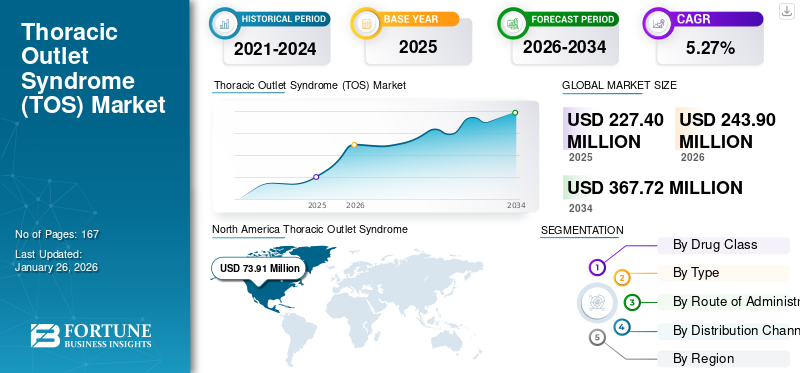
The global thoracic outlet syndrome (TOS) market size was valued at USD 227.4 million in 2025 and is projected to grow from USD 243.9 million in 2026 to USD 367.72 million by 2034, exhibiting a CAGR of 5.27% during the forecast period. North America dominated the thoracic outlet syndrome (TOS) market with a market share of 32.50% in 2025.
The TOS market is witnessing a noteworthy growth trajectory during the forecast period. Thoracic outlet syndrome (TOS) is a group of symptoms of compression of neurovascular structures within the thoracic outlet. TOS is linked to repetitive activities, trauma, and anatomical variations.
The rising prevalence of the disease worldwide and the increasing number of awareness programs are shifting the focus toward early diagnosis and conservative treatment. Thus contributing toward global market growth. Moreover, the launches of off-label generic drugs by the key players is to propel the market growth.
- For instance, in June 2025, Sunshine Biopharma Inc. launched a generic version of Gabapentin, a new generic prescription drug in the therapeutic class of anticonvulsants, which is also an off-label treatment for TOS.
Furthermore, the market encompasses several major players with Bayer AG and Pfizer Inc. at the forefront. A robust portfolio with branded and generic offerings is to support the dominance of these companies in the market.
Download Free sample to learn more about this report.
Thoracic Outlet Syndrome (TOS) Market Key Takeaways
 Global Market Size & Forecast
- 2025 Market Size: USD 227.4 million
- 2026 Market Size: USD 243.9 million
- 2034 Forecast Market Size: USD 367.72 million
- CAGR: 5.27% from 2026–2034
 Market Share
- North America dominated the market with a 32.50% share in 2025.
- Neurogenic TOS held the largest type segment with an 87.6% share in 2025.
- Retail pharmacies & drug stores are projected to hold a 53.2% share in 2025.
 Key Regional Highlights
North America
North America reached USD 73.91 million in 2025, accounting for 32.50% of the global market.
Europe
Europe generated USD 59.12 million in 2025, representing 26.00% of the global market.
Asia Pacific
reached USD 68.22 million in 2025, capturing 30.00% of the global market.
U.S
The market is estimated to reach USD 66.7 million in 2025.
Japan
The market is expected to witness steady growth, supported by improving diagnosis and treatment access.
Read More

MARKET DYNAMICS
MARKET DRIVERS
Increasing Adoption of Pharmacologic Management before Surgery to Propel Market Growth
One of the most prominent driving factors of the market is the increasing preference for medical management before surgical decompression. Thus, physicians are increasingly prescribing drugs to relieve symptoms and delay or even avoid surgery. Thus, drugs become the first line of treatment for symptom management and thus drive the thoracic outlet syndrome (TOS) market growth.
- For instance, in July 2022, as per the report published by Maastricht University, a study comparing surgery versus continued conservative treatment for neurogenic thoracic outlet syndrome was performed. It was found that 50 patients with neurogenic thoracic outlet syndrome (nTOS) were initially given conservative therapy. Such scenarios are driving the market growth.
MARKET RESTRAINTS
Lack of Approved Drugs and Labelled Indications to Restrict Market Growth
All the drugs used for managing the symptoms of TOS are off-label. There are no FDA or EMA-approved drugs for the treatment of thoracic outlet syndrome, which limits the physician’s confidence during treatment and thus hampers the market growth.
MARKET OPPORTUNITIES
Development of Targeted Neuro-Modulatory and Anti-Spasm Agents to Create Lucrative Growth Opportunities
The development of targeted neuro-modulatory and anti-spasm agents for neurogenic thoracic outlet syndrome (nTOS) presents a significant growth opportunity by addressing current treatment limitations. These innovative therapies aim to precisely relax hypertonic muscles and modulate nerve pain more effectively than conventional NSAIDs, muscle relaxants, or neuropathic agents, which often provide limited relief and cause undesirable side effects, by offering targeted therapies, nTOS management, and driving growth during the global thoracic outlet syndrome (TOS) market forecast period.
- For instance, in March 2024, as per the study published in the Muscle & Nerve Journal, a randomized controlled trial was performed, and it was found that the Botox injections were beneficial in treating nTOS in a majority of patients with a relatively low number of adverse effects.
THORACIC OUTLET SYNDROME (TOS) MARKET TRENDS
Increasing Awareness Programs to Support Market Growth
Increasing awareness programs are shaping the thoracic outlet syndrome (TOS) treatment market. These programs help educate both healthcare professionals and patients about the condition's symptoms, diagnosis, and available treatment options.
The programs promote early diagnosis and encourage timely intervention, thus leading toward the adoption of drug treatment over surgical intervention, contributing toward the shift in global market trends.
- For instance, in February 2023, Elliot Hospital Vein and Vascular Care Center started a podcast to increase awareness regarding the TOS and treatment associated with it.
MARKET CHALLENGES
Lack of Standardized Diagnostic Criteria to Challenge Market Growth
The lack of standardized diagnostic criteria is leading to misdiagnosis and thus delaying the initiation of appropriate therapy, thus challenging the market growth potential.
- For instance, in October 2023, a study published by the Department of Radiology, University of Gothenburg, Sweden, in the Frontiers journal, found that over 30.0% of neurogenic TOS cases were initially misdiagnosed, delaying appropriate therapy.
Download Free sample to learn more about this report.
Segmentation Analysis
By Drug Class
Increasing Adoption of NSAIDs to Propel Segmental Growth
On the basis of the segmentation of drug class, the market is classified into anticoagulants, thrombolytics, nonsteroidal anti-inflammatory drugs (NSAIDs), muscle relaxants, corticosteroids, and others.
The nonsteroidal anti-inflammatory drugs (NSAIDs) segment held a dominant portion of the thoracic outlet syndrome (TOS) market share in 2024. The dominant share of the segment is due to the large number of cases associated with neurogenic TOS, and NSAIDs are the first-line therapy for pain and inflammation management.
- For instance, as per the data published by The Johns Hopkins University, neurogenic TOS accounts for 90% of total TOS cases. Thus, this leads to increased adoption of NSAIDs for the treatment of other conditions.
To know how our report can help streamline your business, Speak to Analyst
By Type
Majority of Cases Associated with Neurogenic TOS to Bolster Segment’s Growth
In terms of type, the market is categorized into neurogenic TOS, venous TOS, and arterial TOS.
The neurogenic TOS segment held the maximum portion of the market. In 2025, the segment is anticipated to dominate with an 87.6% share. The majority of cases and the rising prevalence of neurogenic TOS are bolstering the segment’s growth in the market.
- For instance, in October 2022, as per the National Library of Medicine, the incidence of neurogenic thoracic outlet syndrome (nTOS) is estimated to be 2-3 per 100,000 per year, with an estimated prevalence of 10 per 100,000 population. Also, this accounts for around 90-95% of total TOS cases.
The venous TOS segment is expected to grow at a CAGR of 4.67% over the forecast period.
By Route of Administration
Ease of Administration and Wide Availability to Boost Oral Segments' Growth
Based on route of administration, the market is segmented into oral, parenteral, and others.
The oral segment held the dominating position in 2024. By route of administration, the oral segment held the share of 66.3% in 2024. The rising number of cases associated with TOS and majorly neurogenic TOS is leading to an increase in the adoption of oral drugs due to greater convenience and easy availability. Thus making it a preferred choice and contributing toward the segment’s growth.
- For instance, based on the Mayo Clinic’s 2023 treatment guidelines for Thoracic outlet syndrome, NSAIDs, such as ibuprofen or naproxen, are frequently prescribed oral medications that help to decrease inflammation and alleviate pain in patients.
The segment of parenteral is set to flourish with a growth rate of 4.54% across the forecast period.
By Distribution Channels
Increasing Usage of OTC drugs to bolster Drug Store and Retail Pharmacies Segment Growth
Based on distribution channel, the market is segmented into hospital pharmacies, retail pharmacies & drug stores, and online pharmacies.
In 2024, the retail pharmacies & drug stores segment is expected to witness a leading growth trajectory. The segment is set to hold 53.2% share in 2025. These channels have widespread accessibility and robust availability of the commonly used oral medications such as NSAIDs, muscle relaxants, and neuropathic pain agents for treatment.
- For instance, in addition, hospital pharmacies as a distribution channel are projected to grow at a CAGR of 4.67% during the study period.
Thoracic Outlet Syndrome (TOS) Market Regional Outlook Analysis
By region, the market is categorized into Europe, North America, Asia Pacific, Latin America, and the Middle East & Africa.
North America
North America Thoracic Outlet Syndrome (TOS) Market Size, 2025 (USD Million) To get more information on the regional analysis of this market, Download Free sample
The market in North America reached USD 73.91 million in 2025, representing 32.50% of total market revenue, and is projected to reach USD 79.02 million in 2026. North America’s dominance in the market is driven by factors such as advanced healthcare facilities and awareness programs. In 2025, the U.S. market is estimated to reach USD 66.7 million.
The U.S. is expected to dominate the North America region's market, owing to the rising prevalence of thoracic outlet syndrome amongst the athletes and the presence of advanced healthcare facilities for quick diagnosis and treatment.
- For instance, in October 2024, as per the data published by NIH, a study was performed to identify the burden of in-hospital admissions and outcomes of thoracic outlet compression syndrome in the U.S. from 2010 to 2021. It was found that in the 37,174 hospitalizations, 7,397 were for venous TOS, 3,346 were for arterial TOS, and 26,430 were for neurogenic TOS.
Europe and the Asia Pacific
Other regions, such as Europe and the Asia Pacific, are anticipated to witness a notable growth in the coming years. During the forecast period, the Europe contributed approximately USD 59.12 million to the global market in 2025, accounting for 26.00% share, and is expected to reach USD 63.59 million in 2026. This is primarily driven by the increasing incidence of disease and increasing thoracic outlet syndrome (TOS) awareness programs. Backed by these factors, countries including France are expected to record a valuation of USD 9.4 million, Germany to record USD 12.2 million, and the U.K. to record USD 10.4 million in 2025. After Europe, the market in 2025, the Asia Pacific market stood at USD 68.22 million, representing 30.00% of global demand, and is projected to grow to USD 73.65 million in 2026. In the region, India and China are both estimated to reach USD 10.9 and USD 16.7 million each in 2025.
Latin America and the Middle East & Africa
Over the forecast period, the Latin America and the Middle East & Africa regions would witness a moderate growth in this market. The Latin America market accounted for USD 13.87 million in 2025, representing 6.10% of the global industry, and is expected to reach USD 14.7 million in 2026, as its valuation. Increasing usage of OTC and generic medication for the TOS treatment to boost the market growth, but at a slower rate. Middle East & Africa maintained a strong presence in the global market, reaching USD 12.28 million in 2025, accounting for 5.40% share, and is expected to reach USD 12.95 million in 2026. GCC is set to attain the value of USD 5.9 million in 2025.
COMPETITIVE LANDSCAPE
Key Industry Players
Expansion of Product Offering and Strong Research and Development Activities to Maintain Their Position
The global TOS market shows a fragmented structure with a small number of large-sized companies actively operating across the globe. These players offer branded as well as generic off-label drugs across the globe.
Bayer AG and Pfizer Inc. are some of the dominating players in the market. The strong range of products with strategic activities to expand their offering to boost their position in the market.
Apart from this, other prominent players in the market include Bristol Myers Squibb and Takeda Pharmaceutical Company Limited, among other major key players in the market. These key players are focusing on offering branded and generic products for the TOS treatment to enhance their market presence.
LIST OF KEY THORACIC OUTLET SYNDROME (TOS) COMPANIES PROFILED
- Bayer AG (Germany)
- Pfizer Inc. (U.S.)
- Bristol-Myers Squibb Company (U.S.)
- Sun Pharmaceutical Industries Ltd. (India)
- Assertio Therapeutics, Inc. (U.S.)
- Daiichi Sankyo Co., Ltd. (Japan)
- Takeda Pharmaceutical Company Limited (U.S.)
KEY INDUSTRY DEVELOPMENTS
- October 2025: Lupin launched generic rivaroxaban for Oral Suspension, 1 mg/mL, in the U.S.
- August 2025: Sandoz launched generic rivaroxaban in Germany, in new strengths of 10 mg, 15 mg, and 20 mg.
- July 2025: Bristol-Myers Squibb Company, in alliance with Pfizer Inc., announced a new direct-to-patient option for purchasing Eliquis (apixaban) with the help of Eliquis 360 Support.
- August 2024: Pfizer Inc. announced that the U.S. Department of Health and Human Services disclosed the “maximum fair price” (MFP) for ELIQUIS (apixaban).
- July 2019: U.S. FDA approved generic version of Pfizer’s Lyrica (pregabalin).
REPORT COVERAGE
Request for Customization to gain extensive market insights.
Report Scope & Segmentation
| ATTRIBUTE | DETAILS |
| Study Period | 2021-2034 |
| Base Year | 2025 |
| Estimated Year | 2026 |
| Forecast Period | 2026-2034 |
| Historical Period | 2021-2024 |
| Growth Rate | CAGR of 5.27% from 2026-2034 |
| Unit | Value (USD Million) |
| Segmentation |
By Drug Class
By Type
By Route of Administration
By Distribution Channel
By Region · North America (By Drug Class, Type, Route of Administration, Distribution Channel, and Country)
· Europe (By Drug Class, Type, Route of Administration, Distribution Channel, and Country/Sub-region)
· Asia Pacific (By Drug Class, Type, Route of Administration, Distribution Channel, and Country/Sub-region)
· Latin America (By Drug Class, Type, Route of Administration, Distribution Channel, and Country/Sub-region)
· Middle East & Africa (By Drug Class, Type, Route of Administration, Distribution Channel, and Country/Sub-region)
|
Frequently Asked Questions
Fortune Business Insights says that the global market value stood at USD 243.9 million in 2026 and is projected to reach USD 367.72 million by 2034.
In 2025, the market value stood at USD 227.4 million.
The market is expected to exhibit a CAGR of 5.27% during the forecast period.
The NSAIDs segment led the market by type.
The key factors driving the market are the rising number of thoracic outlet syndrome cases and increasing government initiatives, among others.
Bayer AG and Pfizer Inc., are some of the prominent players in the market.
North America dominated the market in 2025.
Increasing focus on conservative therapy than surgery to favor product adoption.



- 2021-2034
- 2025
- 2021-2024
- 167
Get 30-60 hrs Free Customization
Expand Regional and Country Coverage, Segments Analysis, Company Profiles, Competitive Benchmarking, and End-user Insights.













.webp)






Related Reports
-
US +1 833 909 2966 ( Toll Free )
-
Get In Touch With Us