 Download Free Sample



Get a Quote
Receive a tailored pricing based on your needs.
- Choose license type
- Multiple user options
- Custom scope & coverage
- Fast turnaround
"Electrifying your pathway to success through in-depth market research"
 Listen to Audio Version
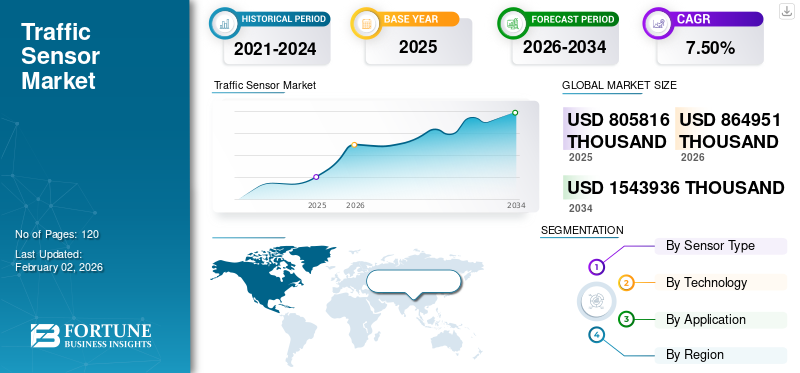
The global traffic sensor market size was valued at USD 8,05,816 thousand in 2025 and is projected to grow from USD 8,64,951 thousand in 2026 to USD 15,43,936 thousand by 2034, exhibiting a CAGR of 7.50% during the forecast period. North America dominated the global market with a share of 34.50% in 2025.
Traffic sensors are intelligent devices that are specially designed to monitor and detect the vehicle speed, movement, volume and overall traffic on roads. These devices are crucial in reducing congestion and improving road safety. They also form an essential part of Intelligent Transportation Systems (ITS), offering real time data for navigation, traffic management and effective urban planning.
The market is growing rapidly owing to the increase in adoption of smart city initiatives, urbanization, and demand for efficient traffic management solutions. Additionally, technological advancements in Internet of Things (IoT), Artificial Intelligence (AI), and wireless communication, enable predictive analytics and automation in traffic systems, thus augmenting market growth.
Few prominent key players operating in the market are TE Connectivity, SICK AG, SWARCO AG, Kapsch TrafficCom AG, Kistler Group and others. These companies are continuously implementing different strategies such as mergers, investments in R&D, partnerships with governments.
Download Free sample to learn more about this report.
 Market Size & Forecast
 Market Share
 Key Regional Highlights
North America
North America accounted for USD 277,773 thousand in 2025 (34.50% share), supported by intelligent transportation systems and smart mobility investments.
Europe
Europe captured 25.40% of the global market in 2025, reaching USD 204,770 thousand, driven by connected transport and road safety initiatives.
Asia Pacific
Asia Pacific reached USD 190,399 thousand in 2025 and is projected to reach USD 209,604 thousand in 2026, driven by urbanization and smart city projects.
U.S.
The market is projected to reach USD 207,960 thousand by 2026, fueled by government investments in smart mobility.
Japan
The Japan market is expected to witness steady growth, driven by increasing adoption of intelligent transportation systems.
Read More

Generative AI is Reshaping Market by Enabling Advanced Predictive Analytics
Generative AI is reforming the market as it allows advanced predictive analytics and real time optimization to improve the traffic management. Through this, it analyses a large amount of datasets from various connected sensors and predicts congestion, optimizes the traffic flow and simulates different scenarios.
Additionally, this also allows for higher accuracy in accident detection, reduces urban traffic jams, and speeds up the response time. Generative AI also facilitates the creation of virtual traffic ecosystems for testing and training without real world disruption.
Rising Urbanization & Traffic Congestion Drives the Market Development
Surging urbanization and increasing traffic congestion are few crucial drivers of traffic sensor market growth. With growing economies and increase in population, the number of vehicles on road is rising, thus leading to reduced congestion and delays.
Such instances tend to create a strong demand for intelligent traffic management systems which are capable of managing, analyzing, and controlling the vehicle flow in real time. Traffic sensor technology play a significant role in addressing these challenges by offering precise data to augment traffic signals, decrease bottlenecks and improve road safety. Hence, growing vehicle density in cities is dynamic leading to a growing need for real time traffic flow monitoring and congestion management.
High Installation & Maintenance Costs Hampers the Market Growth
Increased installation and maintenance costs are a significant restraint for the market growth. Various intrusive technologies such as bending plates and inductive loops need extensive roadworks, including excavation and lane closures that not only disrupt traffic but also increase the project costs.
Moreover, these sensors are highly vulnerable to wear and tear due to ongoing vehicular burden, thus leading to a dynamic replacement and maintenance needs. These operational amount makes it challenging for developing economies and municipalities with limited budgets to adopt such solutions.
Integration with Connected & Autonomous Vehicles (CAVs) Offers Lucrative Market Opportunities
The adoption of traffic sensors with connected and autonomous vehicles offers a beneficial opportunity for the market. With vehicle to everything (V2X) becoming highly significant for autonomous mobility, traffic sensors have developed as an essential enabler as it offers real time vehicle, environment, and road data.
Additionally, this adoption also improves the traffic co-ordination, efficiency and safety, allowing the vehicles to make informed driving decisions. Partnerships among automotive manufacturers, smart infrastructure providers and sensor developers, further strengthens this system.
Introduction of Tariff to Increase the Cost of Sensor Components and Imports
Reciprocal tariffs can significantly impact the market by growing the cost of sensor components and imports, particularly for vendors that are reliant on cross border supply chains. Increase in import duties tend to raise the production and procurement cost, in turn decreasing the profit margins and restricting the price competitiveness.
Additionally, this could also delay the deployment of advanced traffic management systems as various regulatory bodies and private operators tend to face increase in project costs. Numerous vendors could also experience supply chain disruption and long lead time, resulting in slow adoption and innovation in traffic sensors.
Growing Integration of AI & Video Analytics Has Emerged as a Prominent Market Trend
The increasing adoption of AI and video analytics is a prominent trend in the market. Advancements in computer vision and AI algorithms are growingly adopted to enhance incident detection, predictive traffic management, and vehicle diversification management. Such technologies also enable cameras and sensors to analyze data related to video, detect anomalies, identify the traffic patterns in real time and with high accuracy. AI driven analytics also aid in adaptive traffic control systems which automatically adjust the signals based on the traffic flow.
Download Free sample to learn more about this report.
Higher Reliability of Inductive Loop Sensors Boosts Segment Growth
Based on the sensor type, the market is segmented into inductive loop sensors, infrared sensors, bending plate sensors, image sensors, and others.
The inductive loop sensors segment will hold the largest share of the traffic sensor market, contributing USD 281.3 million in revenue and accounting for a 36.88% market share in 2026. This is owing to the long lasting reliability, widespread adoption and accuracy in traffic management systems. Such sensors are embossed below the road surfaces, efficiently detecting the vehicle presence, speed, count and making it crucial for controlling traffic signals at junctures. Moreover, these are also cost effective as compared to the advanced non-intrusive alternatives including video based sensors and radars.
Image sensor segment is expected to grow with a highest CAGR of 9.18% over the forecast period. This is due to increasing investments in smart city projects and AI-driven video analytics.
Increasing Deployment of 2D Sensors across Traffic Management Systems to Drive the Segment Growth
The market is divided into 2D Sensors, 3D Sensors, Radio Frequency Identification (RFID), Global System for Mobile Communication (GSM), based on technology.
Among these, the 2D sensors segment will dominate the market, generating USD 412.6 million in revenue and accounting for a 53.80% market share in 2026. This growth is majorly driven by its ongoing deployment and reliability in general traffic detection across present and legacy Intelligent Transportation Systems (ITS) installations. Moreover, this technology is cost effective predominantly for growing economies and remote areas.
On the other hand, the 3D sensors segment held the highest CAGR of 10.16% in 2024. The segment growth is due to its advanced accuracy and depth perception. This aids in enabling AI based analytics across smart cities, complex traffic management, and autonomous based infrastructure.
High Influx of Traffic Augments the Demand for Traffic Sensors in Traffic Monitoring Application
Based on the application, the market is divided into traffic monitoring, vehicle measurement and profiling, weigh in motion, automated tolling, and others.
Traffic monitoring segment is projected to dominate the market with a share of 40.79% in 2026 with a revenue share of USD 312.3 million. This growth is driven by the significant role played by traffic sensors in traffic management. It also tracks real time traffic flow, and analyses it for enhanced road safety optimization across different highway and urban networks.
Automated tolling is growing rapidly with a CAGR of 9.52% in 2024. This growth is attributed to the growing demand of cashless and electronic toll collection systems by governments and highway operators. This enhances efficiency, reduces overcrowding, and enables unified mobility, thus leading to the segment’s growth.
To know how our report can help streamline your business, Speak to Analyst
Geographically the market is segmented into North America, Europe, Asia Pacific, South America and Middle East & Africa.
North America Traffic Sensor Market Size, 2025 (USD Thousend)
To get more information on the regional analysis of this market, Download Free sample
North America accounted for USD 277773 thousand in 2025, representing 34.50% of the global market share, and is projected to reach USD 293187 thousand in 2026. This is due to its ongoing adoption of intelligent transportation systems and widespread installed base of traffic infrastructure. Additionally, government funding for smart mobility programs majorly in the U.S. drives the regional market growth. The U.S. region is expected to contribute to a share of 2,07,960 thousand in 2026.
The Europe market was valued at USD 204770 thousand in 2025, capturing 25.40% of global revenue, and is estimated to reach USD 218038 thousand in 2026. This is due to large EU funding and permissions for connected and sustainable connected transport. Additionally, rising traffic volumes, preparation for connected vehicles, and safety targets, drives the regional market growth. Countries including the U.K., Germany, and France contribute to the regional market growth with a predictable share of 41,561 thousand, 40,320 thousand in 2026 and USD 33.3 Million by 2025.
In 2025, Asia Pacific held 23.60% of the global market, reaching a valuation of USD 190399 thousand, and is projected to grow to USD 209604 thousand in 2026. This growth is due to augmented urbanization, increasing highway networks, and large-scale smart city projects, in countries including China and India. The Indian and Chinese markets are expected to contribute to a revenue share of 29,861 thousand and 42,485 thousand respectively in 2026.
To know how our report can help streamline your business, Speak to Analyst
The markets of South America and Middle East & Africa contributed approximately USD 74990 thousand to the global market in 2025, accounting for 9.30% share, and is expected to reach USD 81664 thousand in 2026. due to stricter road safety regulations, adoption of advanced sensors, public and private partnerships, urbanization and road safety regulations across the countries. GCC countries are predicted to have a market share of USD 23.3 Million by 2025.
The Latin America region captured 7.20% of the global market in 2025, generating USD 57885 thousand in revenue, and is projected to reach USD 62457 thousand in 2026.
Growing Focus of Key Players on Innovation and New Launches Leads to their Dominating Market Positions
The market includes different large and small firms including TE Connectivity, SICK AG, SWARCO AG, Kapsch, TrafficCom AG, and others. These companies are implementing different key strategies including mergers, collaborations, acquisitions, adoption of new technology, launch of new products and others to sustain the competition.
The global report provides a detailed analysis of the market and focuses on key aspects such as prominent companies, deployment modes, types, and end users of the product. Besides this, it offers insights into the Traffic sensor market trends and highlights key industry developments and market share analysis for key companies. In addition to the aforementioned factors, the report encompasses several factors that have contributed to the growth of the market over recent years.
Request for Customization to gain extensive market insights.
| ATTRIBUTE | DETAILS |
| Study Period | 2021-2034 |
| Base Year | 2025 |
| Estimated Year | 2026 |
| Forecast Period | 2026-2034 |
| Growth Rate | CAGR of 7.50% from 2026-2034 |
| Historical Period | 2021-2024 |
| Unit | Value ( thousand) |
| Segmentation |
By Sensor Type
By Technology
By Application
By Region
|
Fortune Business Insights says that the global market stood at USD 8,05,816 thousand in 2025 and is projected to reach USD 15,43,936 thousand by 2034.
The market is expected to exhibit steady growth at a CAGR of 7.50% during the forecast period.
Rapid Urbanization & Rising Traffic Congestion drives the market growth.
TE Connectivity, SICK AG, SWARCO AG, Kapsch, and TrafficCom AG, are some of the top players in the market.
North America dominated the global market with a share of 34.50% in 2025.
North America was valued at 2,77,773 thosand in 2025.

Get 30-60 hrs Free Customization
Expand Regional and Country Coverage, Segments Analysis, Company Profiles, Competitive Benchmarking, and End-user Insights.




















Get In Touch With Us
US +1 833 909 2966 ( Toll Free )
Receive a tailored pricing based on your needs.
Discuss your questions with our industry experts.
Have questions? Get quick answers before you purchase.

