Trigger Sprayers Market Size, Share & Industry Analysis, By Product Type (Standard and Chemical-Resistant), By Material (Polypropylene (PP), Polyethylene (PE), Polystyrene (PS), and Others), By Neck Size (20/410, 24/410, 28/400, 28/410, and Others), By Application (Cosmetics & Personal Care, Food & Beverages, Cleansing & Disinfectant Products, Auto Car, Garden Products, and Others), and Regional Forecast, 2026-2034
 Download Free Sample
KEY MARKET INSIGHTS
 Listen to Audio Version
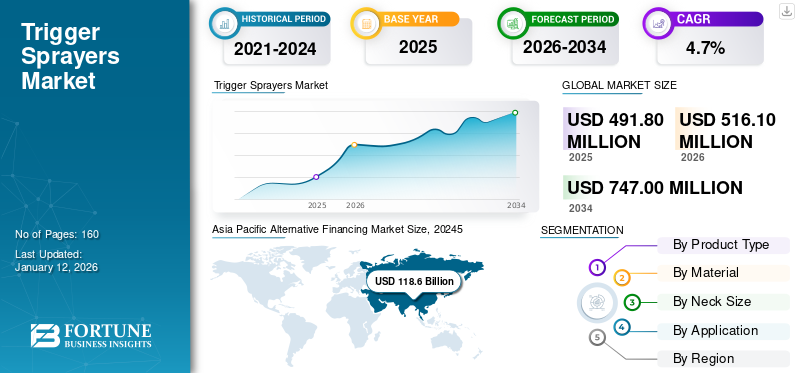
The global trigger sprayers market size was valued at USD 491.8 million in 2025. The market is projected to grow from USD 516.1 million in 2026 to USD 747 million by 2034, exhibiting a CAGR of 4.7% during the forecast period. Asia Pacific dominated the trigger sprayers market with a market share of 24.1% in 2025.
Trigger sprayers are constructed from long-lasting plastics and are intended to provide precise and uniform spray patterns, hence are the vital parts in domestic, industrial, and business environments. The market covers dispensing and distribution of dispensing devices that are widely applied to dispense liquids like cleaning agents, disinfectants, garden supplies, and personal care products. ThesThey are appreciated for their convenience in use, fine spray control, and universality for application in a wide range of areas. The industry will continue to develop with more focus on sustainability, design innovation, and incorporation of intelligent technologies to drive user experience and product performance. The manufacturers are inclined toward creating environmentally friendly materials and ergonomic products that satisfy the growing consumer need for convenience and eco-friendliness.
The major players in the market are companies like AFA Dispensing Group B.V., Silgan Holdings Inc., and Berry Global Inc., which dominate through innovation, wide product offerings, and international distribution channels.
Download Free sample to learn more about this report.
Trigger Sprayers Market Key Takeaways
 Market Size & Forecast
- 2025 Market Size: USD 491.8 million
- 2026 Market Size: USD 516.1 million
- 2034 Forecast Market Size: USD 747.0 million
- CAGR: 4.70% from 2026–2034
 Market Share
- Asia Pacific dominated the market with a 24.10% share in 2025.
- The Standard product type segment is projected to lead the market with a 70.26% share in 2026.
- The Polypropylene (PP) segment is projected to dominate the market with a 40.77% share in 2026.
 Key Regional Highlights
Asia Pacific
Asia Pacific recorded USD 118.6 million in 2025 and is expected to grow to USD 125.2 million in 2026.
North America
North America reached USD 180.7 million in 2025 and is projected to grow to USD 189.9 million in 2026.
Europe
Europe generated USD 135.8 million in 2025 and is projected to reach USD 142.0 million in 2026.
U.S.
U.S. market is projected to reach USD 144.3 million by 2026.
Japan
Japan market is projected to reach USD 18.9 million by 2026.
Read More

IMPACT OF TARIFFS ON THE MARKET
Tariffs to Drive Up Production Costs and Disrupt Supply Chains, Undermining Competitiveness in the Market
Tariffs in a reciprocal pattern across nations have been known to heavily influence the market through cost pressures and distortions in supply chains globally. Most manufacturers rely on imported raw materials like polypropylene, polyethylene, metal parts, and packaging materials, which can become costly with import duties. This not only increases the cost of production but can also result in increased lead times and inventory problems. Exporters of trigger sprayers or whose business depends on cross-border trade risk being less competitive in overseas markets if retaliatory tariffs are enforced, especially within core regions like North America, Europe, and Asia Pacific. Smaller producers with limited flexibility in their sourcing are most susceptible, as they could find it hard to absorb higher costs or switch to substitute suppliers. In the long run, ongoing trade tensions may prompt local sourcing and regional manufacturing initiatives, but such modifications take time and capital.
MARKET DYNAMICS
Trigger Sprayers Market Trends
Adoption of Smart Packaging Technologies is Driving Increased Market Share by Improving Functionality and User Experience
The growing use of smart packaging technologies is boosting product functionality and consumer engagement in the trigger sprayers market. Manufacturers are looking into innovations like pre-compression sprayers and dosage control systems, which keep spray output consistent and help reduce waste. These advanced dispensing solutions are becoming more popular in industries such as automotive, personal care, and industrial cleaning, where precision and effectiveness really matter. This blend of functional and digital elements shows a wider trend toward smart packaging solutions that help brands stand out and improve the consumer experience. As companies aim to improve product performance and strengthen consumer relationships, adding smart and valuable features is likely to play a key role in the trigger sprayers market growth across various industries.
Download Free sample to learn more about this report.
Market Drivers
Increased Focus on Hygiene and Eco-Consciousness Drives Demand in the Market
The focus on cleanliness and hygiene has really picked up the pace, especially after the COVID-19 pandemic. This has led to a big jump in demand for household cleaning products, which in turn is boosting the market growth. People are more aware of health standards now and are looking for effective ways to clean. Trigger sprayers are popular because they are easy to use and allow for precise dispensing of disinfectants and cleaners. Consumers want products that not only clean well but are also safe for the environment. This has pushed manufacturers to create sprayers that are user friendly and made from recycled materials or designed to be recyclable. Programs from organizations like the Environmental Protection Agency, such as Safer Choice, support this shift by promoting safe cleaning practices. As surveys show that cleaning frequency is on the rise, the demand for these products remains strong. In response, manufacturers are putting money into innovations like adjustable nozzles, features that prevent clogging, and ergonomic designs to keep up with what consumers need. All of these factors make trigger sprayers essential tools in the household cleaning market.
Market Restraints
Increasing Sustainability Pressure Restrains Market Growth
Consumers are looking for eco-friendly products, and with agencies like the Environmental Protection Agency (EPA) and the European Union stepping up regulations, the industry is seeing some big changes. Manufacturers now have to use sustainable materials and follow eco-friendly production methods. This shift usually means making a significant investment in research and development, and it often requires changes in how things are made. Smaller manufacturers might find this tough, especially since they often have limited financial and technical resources. Furthermore, using sustainable materials can lead to a significant rise in production costs, which could be passed on to consumers. If shoppers aren’t willing to pay extra for eco-friendly options, the market for sustainable trigger sprayers might not grow as much as expected. Overall, these sustainability demands can really impact cost efficiency, product development, and long-term growth in the market.
Market Opportunities
Rapid Urbanization and Incomes in Emerging Economies to Create Market Opportunities
The market is set to grow significantly as it expands into emerging markets, especially in developing regions where urbanization is happening quickly and disposable incomes are on the rise. As more people move to cities, there is a greater need for effective cleaning and gardening solutions. At the same time, rising incomes in places like Asia, Africa, and Latin America are allowing consumers to spend more on home improvement and lifestyle products. The growing middle class population in these regions is increasingly focused on quality and convenience when it comes to household and gardening items. Government initiatives that support urban development, homeownership, and sustainable practices are also boosting this trend. Policies that encourage green urban environments and ecofriendly practices, along with backing from organizations like the Food and Agriculture Organization, are promoting the use of tools that fit with sustainable solutions. Because of this, companies that enter these markets strategically adjust their products to meet local needs are in a great position leverage the rising demand for trigger sprayers.
SEGMENTATION ANALYSIS
By Product Type
Standard Type to Dominate Due to Their Versatility, Cost-Effectiveness, and Broad Application Range
The market is segmented by product type into standard and chemical-resistant.
Product type segment is largely dominated by the standard category by holding the maximum market share and is also expected to hold the maximum CAGR throughout the forecast period. The standard segment will account for 70.26% market share in 2026. This leadership is an indicator of the broad product and application versatility. They are used from household cleaners to personal care products, recognized for their design, affordability, and dependable performance. Although the chemical-resistant division also has its niche within the market, it is aimed at certain industries that demand strength and resistance to chemicals. However, its overall share and growth trajectory are expected to remain lower than those of the standard product category.
By Material
Polypropylene Leads the Market Due to Its Strength and Chemical Resistance
The market is segmented, by material into polypropylene (PP), polyethylene (PE) polystyrene, polystyrene (PS), and others.
Polypropylene (PP) has the highest trigger sprayers market share and is projected to increase at the fastest rate in the next few years. Its popularity is due to the fact that it is strong, lightweight, and chemical-resistant, making it perfect for a variety of applications, particularly household and industrial cleaning products. The Polypropylene (PP) segment is expected to lead the market, contributing 40.77% globally in 2026.
Polyethylene (PE) is also widely utilized because of its durability and flexibility, which causes it to be utilized in sprayers that should be able to bear frequent usage. Though it has less market share compared to PP, it is still a significant material for the sector.
Polystyrene (PS) is often less utilized but is used in specific parts that demand stiffness or clarity.
The others category consists of newer products such as recycled plastics and bio-based alternatives, and their demand is increasing as environmental responsibility takes center stage. The alternatives are projected to witness consistent growth as consumers and manufacturers become more interested in green alternatives.
By Neck Size
28/410 Neck Size Leads the Market Owing to Its Broad Compatibility with Standard Bottles in Household and Industrial Applications
The market is segmented, by neck size into 20/410, 24/410, 28/400, 28/410, and others.
The 28/410 segment will account for 37.78% market share in 2026, because it is generally used in industrial and household applications, with a high degree of compatibility across various bottles and containers. Its standardization and versatility render it the most widely accepted size in different end-use industries.
20/410 is expected to have the highest compound annual growth rate due to its growing application in small packaging sizes, especially in personal care and specialty cleaning applications where smaller bottles are desired.
24/410 is also popular, finding a middle ground between small and functional, and is commonly used in mid-range packaging. While 28/400 is a bit less common than 28/410, it still plays a key role in certain applications that need a tighter or more secure fit.
The others designation encompasses less typical sizes that accommodate specialized applications or customized packaging requirements. With packaging trends persisting in their evolution, particularly in consumer segments, demand for diverse neck sizes will continue to be strong.
To know how our report can help streamline your business, Speak to Analyst
By Application
Cosmetics and Personal Care Segment Sees Rapid Growth, Fueled by Demand for Convenient and Precise Dispensing in Skincare and Grooming Products
The market is segmented by application into cosmetics & personal care, food & beverages, cleansing & disinfectant products, auto car, garden products, and others.
Cosmetics and personal care is expected to witness the highest compound annual growth rate, supported by growing consumer interest in skincare, haircare, and personal grooming products, many of which require precise and convenient dispensing formats.
The cleansing and disinfectant products segment is expected to account for 31.06% of the market in 2026, driven by strong demand for household and industrial cleaning solutions, especially in the wake of heightened hygiene awareness. Trigger sprayers are widely used in this segment for their ease of use and effective product distribution.
Food and beverages use trigger sprayers for specific applications such as oil, vinegar, or flavor sprays, though this segment holds a smaller share due to limited product compatibility.
Auto care is a steady segment, with demand for these sprayers in car cleaning and detailing products.
Garden products also contribute to market growth, with these sprayers used for fertilizers, pesticides, and watering solutions in both residential and commercial settings.
The others category includes niche and emerging applications where customized spray solutions are needed.
TRIGGER SPRAYERS MARKET REGIONAL OUTLOOK
By region, the market is studied across North America, Asia Pacific, Europe, Middle East & Africa, and South America.
North America
North America leads the market in terms of revenue, due to strong home care and personal care industry and consumers who prefer convenient packaging solutions. North America accounted for USD 180.7 million in 2025, representing 36.80% of the global market share, and is projected to reach USD 189.9 million in 2026. People in this region are quite aware of the products available, and there is a solid retail infrastructure. Plus, there is a ongoing innovation in dispensing technologies, especially in the U.S. Trends towards sustainability and demand for eco friendly packaging are pushing manufacturers to create more recyclable and reusable sprayer designs.
To know how our report can help streamline your business, Speak to Analyst
The U.S. leads the market in North America because of its well-established consumer goods industry, robust retail distribution networks, and high need for household, auto, and industrial cleaning items. Consumer demand for convenient, long-lasting, and ergonomically favorable sprayers for widespread applications is driving the market development. Sustainability is becoming increasingly important, with growing demand for recyclable products and refillable packaging prompting innovative action from manufacturers. With major global companies, advanced manufacturing facilities, and ongoing product development, the U.S. continues to hold a strong position in the market. The U.S. market is valued at USD 144.3 billion by 2026.
Asia Pacific
Asia Pacific Alternative Financing Market Size, 2025 (USD Billion)
To get more information on the regional analysis of this market, Download Free sample
In 2025, Asia Pacific held 24.10% of the global market, reaching a valuation of USD 118.6 million, and is projected to grow to USD 125.2 million in 2026. Asia Pacific is poised to progress at the highest CAGR in the market, driven by urbanization, increasing disposable incomes, and growing consumer good industries in nations like China, India, and Southeast Asia. Rising demand for domestic cleaning items, along with increased awareness of sanitation and hygiene, is strongly enhancing the demand for trigger sprayers. Local production capacity and price competitiveness are also helping regional players expand rapidly and fulfill domestic as well as export demand.The Japan market is valued at USD 18.9 billion by 2026, the China market is valued at USD 47.7 billion by 2026, and the India market is valued at USD 20.9 billion by 2026.
South America
South America has a growing market, with most of the demand coming from Brazil and Argentina. This market is driven by a rising middle class, an increasing urban population, and more people using cleaning products and agricultural chemicals at home. While economic ups and downs and different regulations in each country can create challenges, there are still plenty of opportunities for both international and local manufacturers, especially through product adaptation and cost-effective solutions.
Europe
The Europe market was valued at USD 135.8 million in 2025, capturing 27.60% of global revenue, and is estimated to reach USD 142 million in 2026. Europe offers a mature but continually developing market, influenced by strict environmental regulations and increasing consumer interest in environmentally friendly and ergonomic products. The region boasts a high concentration of regional and global manufacturers, with intense concentration on industrial and institutional cleaning uses. Circular economy practices and rising use of refill packaging in nations such as Germany, France, and Netherlands are the major drivers of marketgrowth in the region. The UK market is valued at USD 19.1 billion by 2026, and the Germany market is valued at USD 29.3 billion by 2026.
Middle East & Africa
Middle East & Africa contributed approximately USD 17.9 million to the global market in 2025, accounting for 3.60% share, and is expected to reach USD 18.6 million in 2026. In the Middle East & Africa, the market shows moderate growth potential. This is backed by more investments in residential and commercial infrastructure, along with a slow shift in consumer habits towards modern cleaning and personal care products. Gulf nations reflect stronger demand due to stronger purchasing power and retail penetration, whereas Sub Saharan regions are experiencing growing interest as people become more aware of hygiene and cleanliness. Dependence on imports and restricted domestic production continue to remain key obstacle for several countries in the region.
Latin America
The Latin America region captured 7.90% of the global market in 2025, generating USD 38.7 million in revenue, and is projected to reach USD 40.4 million in 2026.
COMPETITVE LANDSCAPE
KEY INDUSTRY PLAYERS
Rising Demand For Quality And Sustainability Is Driving Consolidation And Innovation In The Fragmented Market
The global market continues to be extremely fragmented, with unorganized players still holding a large chunk of supply, especially in price-sensitive markets in the Asia Pacific, South America, and parts of Eastern Europe. Nonetheless, the organized segment comprising mid-sized regional players is gradually gaining traction on the account of increasing demand for uniform quality, regulatory adherence, and sustainability credentials, especially from multinational FMCG firms. Multinational packaging and dispensing producers are increasingly distinguishing themselves through product innovation, premiumization (ergonomics, aesthetics, and performance), and integrated supply chain capability. Strategic partnerships and acquisitions have added to market consolidation in recent years, with bigger players increasing global reach and optimizing production efficiency. Furthermore, the move towards greener and refillable pack formats is causing retail and brand owners to prefer suppliers that possess the capabilities of advanced design and materials innovation.
Major Players in the Trigger Sprayers Market
AFA Dispensing Group B.V., Berry Global Group, Inc., Guala Dispensing S.p.A., Mitani Valve Co., Ltd., and Silgan Holdings Inc. are the key market players. These 5 players occupies around 15-20% of the market share.
Long List of Companies Studied
- AFA Dispensing Group B.V. (Netherlands)
- Berry Global Inc. (U.S.)
- L. Smith Company (U.S.)
- Canyon Europe Ltd. (U.K.)
- Frapak Packaging (Netherlands)
- Guala Dispensing (Italy)
- Impact Products, LLC (U.S.)
- Mitani Valve Co., Ltd. (Japan)
- MJS Packaging (U.S.)
- Rieke Packaging Systems (U.S.)
- RPC Group (U.K.)
- Silgan Dispensing Systems (U.S.)
- Sonoco Products Company (U.S.)
- Tolco Corporation (U.S.)
- TriMas Corporation (U.S.)
- Xilong Packaging Co., Ltd. (China)
- Yoshino Kogyosho Co., Ltd. (Japan)
- YUYAO SHUNLONG SPRAYER & TECH. CO., LTD (China)
- Zhongshan Luencheong Dispensing Pump Ltd. (China)
KEY INDUSTRY DEVELOPMENTS
- October 2024: Silgan Holdings Inc. acquired Weener Plastics Holdings B.V., a premier global maker of specialty dispensing solutions. The move is strategic as it expands Silgan's global footprint and fortifies its position in dispensing systems and specialty closures.
- September 2024: APackaging Group (APG) launched the APG 880151, a trigger sprayer with complete special-order color range. It has ergonomic design features such as angled housing, accurate nozzles (including foaming), and a 0.9 cc dosage for comfortable and easy use.
- June 2024: Berry Global launched a new removable trigger sprayer specifically designed for use in refillable package applications. The item includes 29% post-consumer recycled plastic and reduces weight by 18% as compared to traditional market options.
- April 2023: Tirrit introduced a fully recyclable TR343 sprayer with adjustable nozzles and child-resistant features, meeting performance and safety expectations in the household sector.
- June 2022: Silgan Dispensing, a global industry leader in the manufacturing and distribution of high-quality pumps and sprayers for the home, health, and beauty markets, is delighted to announce its newest addition, the SP05TM R trigger sprayer, created with innovative LifeCycleTM Technology.
REPORT COVERAGE
The report provides a detailed market analysis and focuses on key aspects such as leading companies, product types, material, neck size, and leading applications of the product. Besides, the report offers insights into the market trends and highlights key industry developments. In addition to the factors above, the report encompasses several factors that contributed to the growth of the market in recent years.
Request for Customization to gain extensive market insights.
REPORT SCOPE & SEGMENTATION
|
ATTRIBUTE |
DETAILS |
|
Study Period |
2021-2034 |
|
Base Year |
2025 |
|
Estimated Year |
2026 |
|
Forecast Period |
2026-2034 |
|
Historical Period |
2021-2024 |
|
Growth Rate |
CAGR of 4.7% from 2026 to 2034 |
|
Unit |
Value (USD Million) |
|
Segmentation |
By Product Type
By Material
By Neck Size
By Application
By Region
|
|
Companies Profiled in the Report |
AFA Dispensing Group B.V. (Netherlands), Berry Global Group, Inc. (U.S.), Frapak (Netherlands), Guala Dispensing (Italy), Mitani Valve Co., Ltd. (Japan), MJS Packaging (U.S.), Silgan Holdings Inc. (U.S.), Tolco Corporation (U.S.), TriMas Corporation (U.S.), YUYAO SHUNLONG SPRAYER & TECH.CO.,LTD (China), Yoshino Kogyosho Co., Ltd. (Japan), and Zhongshan Luencheong Dispensing Pump Ltd. (China) |
Frequently Asked Questions
The market is projected to reach USD 747 million by 2034.
In 2025, the market was valued at USD 491.8 million.
The market is projected to grow at a CAGR of 4.7% during the forecast period.
The standard product type segment leads the market.
Increased focus on hygiene and eco-consciousness is a key factor driving the growth of the market.
AFA Dispensing Group B.V., Berry Global Group, Inc., Guala Dispensing S.p.A., Mitani Valve Co., Ltd., Silgan Holdings Inc., and TriMas Corporation are the top players in the market.
North America is expected to hold the highest market share.
By application, the cosmetics & personal care is expected to grow with a highest CAGR during the forecast period.



- 2021-2034
- 2025
- 2021-2024
- 160
Get 30-60 hrs Free Customization
Expand Regional and Country Coverage, Segments Analysis, Company Profiles, Competitive Benchmarking, and End-user Insights.















Related Reports
-
US +1 833 909 2966 ( Toll Free )
-
Get In Touch With Us