Truck Refrigeration Unit Market Size, Share & Industry Analysis, By Technology (Diesel TRUs, Electric TRUs (eTRUs), Hybrid TRUs, and Cryogenic TRUs), By Sales Channel (Factory-fit and Retrofits), By Vehicle Type (LCV, MCV, and HCV), By Mount Location (Front-mount, Roof-mount, and Under-mount), By End-User Industry (Food & Beverage Logistics, Pharmaceutical & Healthcare, Chemicals, Floriculture & Agricultural Exports, and Retail & E-commerce Grocery), and Regional Forecast, 2026-2034
 Download Free Sample
(Offer valid till 15th Oct 2026)

Truck Refrigeration Unit Market Size and Future Outlook
 Listen to Audio Version
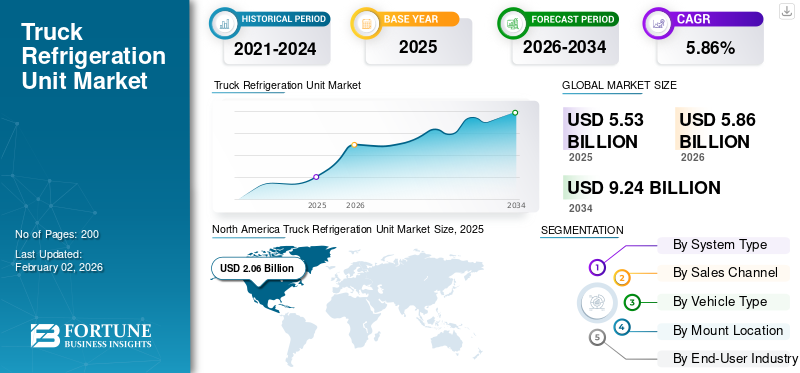
The global truck refrigeration unit market size was valued at USD 7.24 billion in 2025. The market is projected to grow from USD 7.72 billion in 2026 to USD 12.78 billion by 2034, exhibiting a CAGR of 6.5% during the forecast period. North America dominated the truck refrigeration unit market with a market share of 35.35% in 2025.
A truck refrigeration unit (TRU) is a temperature-control system installed on refrigerated trucks, vans, or trailers to preserve food, pharmaceuticals, and other temperature-sensitive cargo during transit through mechanical, electric, hybrid, or cryogenic refrigeration systems and monitoring technologies.
Global market growth is driven by rising demand for refrigerated transportation, expanding frozen food and food deliveries, stricter food safety requirements, pharmaceutical cold chain logistics growth, and greater movement of temperature-sensitive products. Urbanization, organized retail, e-commerce grocery, and investment in connected, energy-efficient transport refrigeration systems further strengthen market demand. Carrier Transicold and Thermo King are leading players in the truck refrigeration unit industry, supported by broad product portfolios and service networks. Mitsubishi Heavy Industries, Denso, Daikin, and Hwasung Thermo also compete globally. Key player strategies increasingly emphasize the electric-driven transport refrigeration compressors unit, advanced temperature control, telematics, low-emission operation, and lifecycle efficiency.
Download Free sample to learn more about this report.
TRUCK REFRIGERATION UNIT MARKET TRENDS
Low-GWP Refrigerants and Hybrid Decarbonization Strategies Reshape Market Trends
Fleet operators are increasingly adopting low-GWP refrigerants alongside efficient electric-drive architectures to reduce lifecycle emissions without immediately replacing every diesel-powered refrigeration unit. This trend favors systems combining lower refrigerant impact, improved heat-exchanger efficiency, variable-speed control, and compatibility with renewable fuels or electric standby. Manufacturers are therefore competing on total carbon reduction rather than tailpipe emissions alone, accelerating product redesign, premium positioning, and replacement demand globally.
In September 2025, Carrier Transicold’s low-GWP Vector HE 19 received the Truck & Trailer Welt CoolChamp award for advancing sustainable transport refrigeration.
MARKET DYNAMICS
MARKET DRIVERS
Download Free sample to learn more about this report.
Healthcare Cold-Chain Expansion Accelerates Demand for Precision TRUs
Expansion of pharmaceutical, biotechnology, and clinical-trial logistics is increasing demand for validated refrigerated transportation with precise temperature control, traceability, and rapid intervention capabilities. Unlike conventional food distribution, these shipments often require narrow temperature ranges, documented chain of custody, backup protection, and qualified refrigerated transport equipment, supporting premium TRU configurations and connected monitoring services. This is especially important for regional distribution from healthcare hubs to hospitals, laboratories, and patients. In turn, driving the truck refrigeration unit market growth.
In May 2025, FedEx received IATA CEIV Pharma corporate certification and reported operating more than 130 cold-chain facilities globally.
MARKET RESTRAINTS
High Electrification Costs and Depot Readiness Restrain Fleet Conversion
Electric TRU adoption remains constrained by higher initial equipment costs, depot electrical upgrades, battery sizing, charging schedules, and uncertainty over whether available energy can cover refrigeration loads throughout variable routes. Fleets must evaluate ambient temperature, door openings, cargo set points, dwell time, and return-to-base charging before deployment, making procurement more complex than replacing a diesel unit. Smaller operators may postpone investment without incentives, financing support, or proven utilization economics. In October 2024, NACFE’s first transport-refrigeration report identified both operating and cost barriers to wider eTRU adoption.
MARKET OPPORTUNITIES
Solar and Axle-Powered Refrigeration Opens New Zero-Emission Opportunities
Solar-assisted battery refrigeration and axle-generated electricity create an opportunity to decarbonize trailers without relying solely on large depot chargers or tractor batteries. These systems can harvest energy during operation, extend battery runtime, reduce diesel consumption, and support quieter deliveries in urban areas. The strongest commercial potential lies in predictable regional routes, thermal management solutions, foodservice distribution, and fleets with sufficient trailer dwell time for efficient charging. In November 2024, DFDS placed ten Sunswap Endurance battery-and-solar transport refrigeration units into commercial operation, demonstrating fleet deployment beyond limited technical trials.
MARKET CHALLENGES
Specialized Technician Shortages Challenge Service Reliability and Technology Adoption
The transition toward electric systems, digital controls, and alternative refrigerants increases the technical skills required to install, diagnose, and service modern TRUs. Insufficient technician availability can lengthen repair times, restrict geographic service coverage, increase fleet downtime, and discourage buyers from adopting unfamiliar technologies. The problem is particularly significant as refrigerated cargo cannot tolerate prolonged equipment failure, making rapid field support essential. In April 2025, the International Institute of Refrigeration reported that the refrigeration industry employed approximately 12 million people globally but faced a severe shortage of skilled technicians and installers.
Segmentation Analysis
By Technology
Established Fleet Base and Long-Haul Reliability Sustained Diesel TRUs Segment Growth
Based on technology, the market is segmented into diesel TRUs, electric TRUs (eTRUs), hybrid TRUs, and cryogenic TRUs.
The diesel TRUs segment dominated the truck refrigeration unit market share in 2025, accounting for 76.38% of revenue. Their leadership reflects the large installed base of diesel-powered refrigerated trucks, dependable long-haul performance, widespread refueling infrastructure, mature maintenance networks, and lower initial costs than electric alternatives. Demand remains strong across food, pharmaceutical, and cross-border cold-chain operations. In February 2025, Carrier launched the semi-electric Vector S 15, delivering diesel-mode performance with 20% lower fuel consumption.
The Electric TRUs (eTRUs) segment is projected to grow at a CAGR of 14.6% during 2026-2034, making it the fastest-growing technology. Growth reflects zero-emission regulations, quieter operation, lower maintenance, and fleet decarbonization. In March 2025, Hireco ordered Sunswap Endurance units.
By Sales Channel
OEM Integration and Factory Calibration Advanced Factory-fit Segment Growth
Based on sales channel, the market is bifurcated into factory-fit and retrofits.
The factory-fit segment held the largest market share in 2025 and are projected to grow at the fastest CAGR of 7.1% during 2026-2034. OEM integration, certified installation, bundled warranties, optimized power management, and lower commissioning risk support growth. Buyers prefer refrigerated vehicles with factory-calibrated TRUs and telematics. In November 2025, Schmitz Cargobull introduced its S.KO COOL trailer with the S.CU dc90 unit and TrailerConnect fitted ex works.
The retrofits segment is projected to grow at a CAGR of 4.4% during 2026-2034, remaining the second-largest channel. Demand reflects fleet-life extension and lower replacement capex. In November 2025, Carrier showcased its [R]eCool electric retrofit solution for existing Vector units.
By Vehicle Type
Long-Haul Capacity and Large Payload Requirements Led to HCVs Segment Growth
Based on vehicle type, the market is classified into LCV, MCV, and HCV.
The HCV segment dominated the market in 2025, accounting for 36.1% of revenue. Growth is supported by large payload capacity, long-haul food distribution logistics, cross-border frozen cargo movement, and demand from meat, dairy, seafood, and pharmaceutical logistics. Fleet operators favor HCVs for fewer trips, multi-temperature trailer configurations, and reliable highway performance. In April 2025, Carrier introduced the all-electric Vector 8200 and next-generation Vector eCool for refrigerated trailers.
The LCV segment is projected to grow at a CAGR of 8.4% during 2026-2034, making it the fastest-growing vehicle type. Urban deliveries, e-commerce grocery, pharmaceuticals, and electrification favor refrigerated vehicles under commercial vehicle refrigeration. In 2025, MHI highlighted its TEK series for last-mile transport.
To know how our report can help streamline your business, Speak to Analyst
By Mount Location
High Cooling Capacity and Long-Haul Operations Sustained Front-mount Segment Growth
Based on mount location, the market is segregated into front-mount, roof-mount, and under-mount.
The front-mount segment dominated the market in 2025. Its leadership reflects broad use on rigid trucks and trailers requiring high cooling capacity, strong airflow, rapid temperature recovery, and dependable long-haul operation. Front-mounted systems also provide easier external servicing, and compatibility with large insulated bodies. In March 2026, Thermo King commercially launched E-Volution for 7.5-26-tonne rigid trucks, demonstrating continued investment in high-capacity truck refrigeration platforms.
The roof-mount segment is projected to grow at a CAGR of 8.7% during 2026-2034, making it the fastest-growing mount location. Compact vans, urban delivery fleets, and space-efficient installations support adoption. In June 2025, Huabon reported an order for 25 rooftop van refrigeration units.
By End-User Industry
Continuous Perishable Distribution and Temperature Compliance Boosted Food & Beverage Logistics Segment Growth
Based on end-user industry, the market is segmented into food & beverage logistics, pharmaceutical & healthcare, chemicals, floriculture & agricultural exports, and retail & e-commerce grocery.
The food & beverage logistics segment dominated the market in 2025. Its position is supported by the continuous movement of frozen food, dairy, meat, seafood, produce, and prepared meals through retail, foodservice, and distribution networks. High delivery frequency, strict temperature requirements, and large refrigerated fleets sustain TRU utilization. In May 2024, Sysco reported nearly 120 electric vehicles across four countries while serving approximately 725,000 customer locations.
The pharmaceutical & healthcare segment is projected to grow at a CAGR of 8.7% during 2026-2034, making it the fastest-growing end user. In April 2025, DHL announced USD 2 billion healthcare-logistics investment, including temperature-controlled vehicles, pharma hubs, and expanded cold-chain capacity.
TRUCK REFRIGERATION UNIT MARKET REGIONAL OUTLOOK
By geography, the market is categorized into Europe, North America, Asia Pacific, South America & South Africa, and the Middle East & North Africa.
NORTH AMERICA
North America Truck Refrigeration Unit Market Size, 2025 (USD Billion)
To get more information on the regional analysis of this market, Download Free sample
North America is a dominant region and is projected to maintain steady growth in the global market, supported by mature cold-chain infrastructure, high refrigerated fleet utilization, and strong demand from food, pharmaceutical, retail, and logistics operators. Replacement of aging diesel units, adoption of electric standby systems, and stricter emissions requirements are encouraging technology upgrades. The region also benefits from dense dealer networks, advanced telematics, and integrated truck-trailer manufacturing. Cross-border movement of perishable goods transportation across the U.S., Canada, and Mexico further supports demand for reliable long-haul and multi-temperature refrigeration systems.
U.S. TRUCK REFRIGERATION UNIT MARKET
The U.S. market is estimated to reach USD 1.89 billion in 2026, supported by a large reefer fleet, mature cold-storage infrastructure, and high foodservice and pharmaceutical distribution volumes. Replacement demand, CARB-related compliance, electric standby adoption, telematics, and nationwide service coverage continue to support equipment upgrades and stable market expansion.
EUROPE
Europe is expected to record consistent growth in the market, supported by strict environmental regulations, cross-border food distribution, and high demand for ATP-compliant refrigerated vehicles. Fleet operators are investing in low-GWP refrigerants, electric standby systems, quieter urban-delivery units, and connected temperature monitoring. Mature cold-storage infrastructure and strong pharmaceutical logistics support replacement-led demand across major freight corridors. Germany, France, the U.K., Italy, Spain, and the Netherlands remain important markets owing to strong food processing, retail, logistics, and temperature-sensitive export activity across integrated regional corridors.
U.K. TRUCK REFRIGERATION UNIT MARKET
The U.K. market is projected to reach USD 0.37 billion in 2026, supported by grocery retail, foodservice distribution, pharmaceutical logistics, and dense urban delivery activity. Demand increasingly favors low-noise, low-emission, and telematics-enabled systems as fleets respond to clean-air policies, energy costs, and tighter temperature-control requirements across national distribution networks.
GERMANY TRUCK REFRIGERATION UNIT MARKET
Germany accounts for approximately 28.1% of the European market in 2026, supported by its large commercial-vehicle base, strong food-processing sector, pharmaceutical manufacturing, and central logistics position. High cross-border freight volumes and strict environmental standards support demand for ATP-compliant, low-GWP, electric standby, and connected refrigeration systems across major freight corridors.
ASIA PACIFIC
Asia Pacific is projected to have the highest growth rate in the market, supported by rapid cold-chain infrastructure development, urbanization, organized retail, pharmaceutical distribution, and e-commerce grocery growth. China contributes substantial regional demand, while India expands from a lower installed base. Japan, South Korea, and Australia emphasize high-efficiency, reliable, and connected systems. Regional demand spans cost-effective diesel units and advanced electric TRUs, with growth supported by refrigerated fleet additions, government-backed infrastructure programs, food exports, and increasing movement of temperature-sensitive healthcare products across expanding logistics networks.
CHINA TRUCK REFRIGERATION UNIT MARKET
China accounts for approximately 43.2% of the Asia Pacific market in 2026, supported by the region’s largest cold-chain network, high food distribution volumes, and rapid refrigerated fleet expansion. Government-backed logistics modernization, rising low-emission refrigerated truck sales, and strong domestic manufacturing support adoption across food, pharmaceuticals, and e-commerce grocery delivery.
INDIA TRUCK REFRIGERATION UNIT MARKET
India is expected to register a CAGR of 11.4% during the forecast period, supported by cold-chain infrastructure gaps, government-backed projects, organized retail, food processing, dairy, pharmaceuticals, and agricultural distribution. Growth is concentrated in new reefer trucks additions, first-mile produce movement, urban delivery, and temperature-controlled transportation between production clusters, warehouses, and consumption centers.
JAPAN TRUCK REFRIGERATION UNIT MARKET
Japan’s market is estimated to reach USD 0.29 billion in 2026, supported by advanced food distribution, strict quality standards, dense urban logistics, and a mature commercial-vehicle fleet. Buyers prioritize compact, energy-efficient, low-noise, and highly reliable systems, with growing interest in electric TRUs, telematics, and multi-temperature solutions for retail and healthcare deliveries.
MIDDLE EAST & NORTH AFRICA
Middle East & North Africa is expected to show steady growth in the market, supported by food import dependence, high ambient temperatures, logistics-hub development, and stricter food-safety requirements. The UAE and Saudi Arabia continue investing in cold storage logistics, distribution centers, and digitally monitored refrigerated transport. Fleet buyers prioritize robust transport cooling systems capacity, service reliability, and temperature visibility under extreme conditions. Growth is also supported by hospitality, pharmaceutical logistics, retail expansion, and cross-border food distribution, although limited local manufacturing sustains reliance on imported units and spare parts.
UAE TRUCK REFRIGERATION UNIT MARKET
The UAE accounts for approximately 25.1% of the Middle-East & North Africa market in 2026, supported by food import dependence, major port infrastructure, regional re-export activity, and modern retail logistics. Jebel Ali, Dubai, and Abu Dhabi strengthen demand for climate-resilient TRUs, real-time monitoring, and refrigerated fleets serving food, hospitality, and pharmaceutical distribution.
SOUTH AMERICA & SOUTH AFRICA
South America & South Africa are projected to expand steadily in the market, supported by meat, poultry, dairy, seafood, fruit, vegetable, and pharmaceutical logistics. Brazil, Argentina, Chile, Peru, and South Africa contribute through export-oriented agricultural and food supply chains. Demand is shaped by long transport distances, uneven cold-chain coverage, and the need to reduce spoilage. Growth increasingly favors efficient diesel, hybrid, and compact urban TRUs, although financing constraints, imported components, and fragmented service networks can slow equipment replacement across inland corridors and ports.
SOUTH AFRICA TRUCK REFRIGERATION UNIT MARKET
South Africa is projected to grow at a CAGR of 4.2% during the forecast period, supported by organized retail, meat and dairy distribution, horticultural exports, pharmaceuticals, and regional logistics links. Demand favors durable, serviceable units capable of long-distance operation, while urban food delivery and supermarket networks gradually increase adoption of compact, energy-efficient truck refrigeration units.
COMPETITIVE LANDSCAPE
Key Industry Players
Electrification, Connected Monitoring, and Service Network Expansion by Key Players to Expand Market Share
The global truck refrigeration unit market is moderately consolidated, with Carrier Transicold and Thermo King holding strong positions through broad product portfolios, installed-base advantages, and extensive dealer networks. Mitsubishi Heavy Industries, Daikin, Denso, Hwasung Thermo, and Schmitz Cargobull-linked solutions intensify regional competition through compact electric units, integrated trailer systems, and cost-focused offerings. Competitive differentiation increasingly centers on electric and hybrid refrigeration, low-GWP refrigerants, multi-temperature capability, telematics, remote diagnostics, predictive maintenance, and lifecycle service contracts. To gain an edge, manufacturers are expanding authorized service coverage, localizing assembly, strengthening body-builder partnerships, and offering financing, fleet monitoring, and retrofit pathways. Digital platforms are also shifting competition from equipment-only sales toward recurring connected-service revenue across mature and emerging refrigerated transport markets globally.
In July 2025, Carrier Transicold upgraded its Lynx Fleet platform with enhanced analytics, remote diagnostics, sensor support, and API integration for connected TRUs and fleet-management systems.
LIST OF KEY TRUCK REFRIGERATION UNIT COMPANIES PROFILED IN REPORT
- Carrier Transicold (U.S.)
- Daikin Industries (Japan)
- DENSO Corporation (Japan)
- Trane Technologies (U.S.)
- Wabash National Corporation (U.S.)
- Great Dane LLC (U.S.)
- Utility Trailer Manufacturing Company (U.S.)
- Mitsubishi Heavy Industries Thermal Systems (Japan)
- Hwasung Thermo Co., Ltd. (South Korea)
- Webasto Group (Germany)
- Kingtec Group Company Limited (China)
- Rivacold srl (Italy)
- Kerstner GmbH (Germany)
- Hultsteins AB (Sweden)
- Schmitz Cargobull AG (Germany)
KEY INDUSTRY DEVELOPMENTS
- July 2026: Carrier Transicold launched Fleet Refresh, enabling refrigerated fleets to replace aging trailer TRUs without purchasing new trailers. The North American program covers single- and multi-temperature models, retains usable trailer components, and includes Lynx Fleet telematics, BluEdge service coverage, and dealer-managed removal and installation to extend asset life economically.
- June 2026: TIP Group and Sunswap expanded their U.K. partnership by offering reefer trailers equipped with Endurance electric TRUs through trials and long-term leases. TIP reported 100% uptime during the preceding year, while the leasing structure reduced upfront capital requirements and included maintenance, support, and detailed operational-performance reporting for fleets.
- May 2026: James Hall & Co., the SPAR wholesaler and distributor for northern England, placed a second order for Sunswap Endurance electric TRUs, increasing its fleet total to eight. The systems support three-temperature, double-deck operations, produce zero direct emissions, and serve multi-drop routes covering approximately 100,000 kilometres annually in commercial service.
- May 2026: Trane Technologies acquired Transport-Kalte-Vertrieb, Germany’s largest independent Thermo King and Frigoblock dealer, and renamed it Thermo King Deutschland. The Ulm-based business brings 55 years of regional experience in TRU sales, installation, accessories, maintenance, telematics, and aftersales support, strengthening coverage across southern Germany and wider Europe and Middle East & Africa markets for customers.
- April 2026: Sunswap entered Spain through a partnership with refrigerated-trailer manufacturer SOR Iberica, part of Reefer Group. The agreement gives Spanish operators direct access to trials and purchases of Endurance electric TRUs. At the same time, logistics company Carreras, operating more than 1,000 vehicles across Spain and Portugal, prepares an initial deployment.
REPORT COVERAGE
The global truck refrigeration unit market analysis provides an in-depth study of market size & forecast by all the market segments included in the report. It includes details on the market dynamics and market trends expected to drive the market during the forecast period. It offers information on the technological advancements, new product launches, key industry developments, and details on partnerships, mergers & acquisitions. The market forecasts a detailed competitive landscape with information on the market share, growing opportunities, and profiles of key operating players.
Request for Customization to gain extensive market insights.
Report Scope & Segmentation
| ATTRIBUTE | DETAILS |
| Study Period | 2021-2034 |
| Base Year | 2025 |
| Estimated Year | 2026 |
| Forecast Period | 2026-2034 |
| Historical Period | 2021-2024 |
| Growth Rate | CAGR of 6.5% from 2026-2034 |
| Unit | Value (USD Billion) |
| Segmentation | By Technology, By Sales Channel, By Vehicle Type, By Mount Location, By End-User Industry, and By Region |
| By Technology |
|
| By Sales Channel |
|
| By Vehicle Type |
|
| By Mount Location |
|
| By End-User Industry |
|
| By Region |
|
Frequently Asked Questions
Fortune Business Insights says that the global market value stood at USD 7.24 billion in 2025 and is projected to reach USD 12.78 billion by 2034.
The market is expected to exhibit a CAGR of 6.5% during the forecast period.
The diesel TRUs segment led the market by technology.
Expansion of temperature-sensitive freight is the key factor driving the market.
Top players in market include Carrier Transicold (U.S.), Thermo King (U.S.), Daikin Industries (Japan), and Zanotti (Italy).
North America hold the largest share in the market.
Major factors expected to favor product adoption are the rising demand for fresh, frozen, and processed foods, which drives demand for cold logistics.



- 2021-2034
- 2025
- 2021-2024
- 200
-
(Offer valid till 15th Oct 2026)
Get 30-60 hrs Free Customization
Expand Regional and Country Coverage, Segments Analysis, Company Profiles, Competitive Benchmarking, and End-user Insights.




















-
US +1 833 909 2966 ( Toll Free )
-
Get In Touch With Us