Two-wheeler Anti-lock Braking System (ABS) Market Size, Share & Industry Analysis, By Technology (Single Channel and Dual Channel), By Propulsion (ICE and Electric), By Engine Displacement (Upto 150 cc, Above 150 to 500 cc, and Above 500 cc), By Type (Motorcycle and Scooter), and Regional Forecast, 2026-2034
 Download Free Sample
(Offer valid till 15th Oct 2026)

TWO-WHEELER ANTI-LOCK BRAKING SYSTEM (ABS) MARKET SIZE AND FUTURE OUTLOOK
 Listen to Audio Version
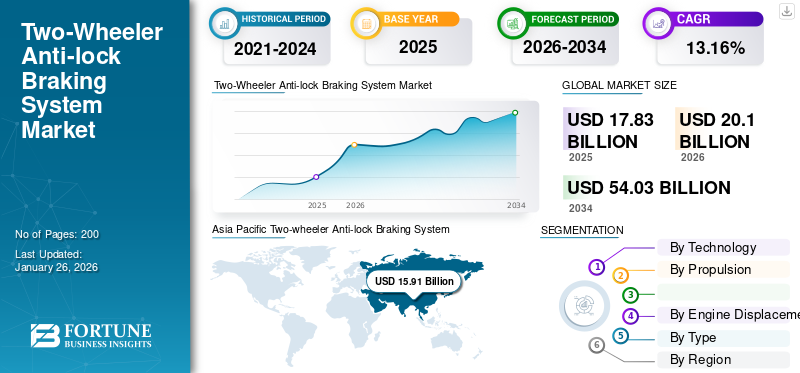
The global two-wheeler anti-lock braking system market size was valued at USD 17.83 billion in 2025 and is projected to grow from USD 20.10 billion in 2026 to USD 54.03 billion by 2034, exhibiting a CAGR of 13.16% during the forecast period. Asia Pacific dominated the two-wheeler ABS market with a market share of 89.15% in 2025.
The two-wheeler anti-lock braking system industry has been experiencing significant growth in recent years, driven by a combination of regulatory mandates, increasing awareness of road safety, and advancements in braking technology. ABS, which prevents wheel lock-up during sudden braking, has become a critical safety feature for motorcycles and scooters, particularly in regions with high traffic density and challenging road conditions. Governments and regulatory bodies across the globe have been pushing for the adoption of ABS in two-wheelers to reduce accidents and fatalities.
For instance, the European Union made ABS mandatory for all new motorcycles above 125 cc in 2016, and similar regulations have been implemented in countries such as India, where ABS is now compulsory for two-wheelers above 150 cc. These regulatory measures have significantly boosted the demand for ABS in the two-wheeler industry.
Another key factor contributing to the market growth is the rising consumer awareness regarding vehicle safety. As riders become more informed about the benefits of ABS in preventing skidding and maintaining control during emergency braking, the demand for two-wheelers equipped with this technology has surged. Additionally, the increasing popularity of high-performance motorcycles and premium scooters, which often come with advanced safety features, has further propelled the market. Manufacturers are also focusing on integrating lightweight and cost-effective ABS systems to cater to a broader range of consumers, including those in emerging markets where affordability is a critical factor.
Moreover, the COVID-19 pandemic significantly impacted the global motorcycle industry, disrupting production, supply chains, and consumer demand. Factory closures led to a shortage of semiconductors and general supply chain issues, which increased prices for electronics, energy, and raw materials. However, the industry began to adapt, and a gradual recovery occurred as consumers shifted toward personal mobility solutions. As the motorcycle industry is growing, the two wheeler anti-lock braking system (ABS) market is also anticipated to grow simultaneously.
Download Free sample to learn more about this report.
Two-Wheeler Anti-lock Braking System Market Key Takeaways
 Global Market Size & Forecast
- 2025 Market Size: USD 17.83 billion
- 2026 Market Size: USD 20.10 billion
- 2034 Forecast Market Size: USD 54.03 billion
- CAGR: 13.16% from 2026–2034
 Market Share
- Asia Pacific dominated the market with an 89.15% share in 2025.
- Dual Channel segment is projected to dominate with a 61.80% share in 2026.
- Motorcycle segment is projected to lead with a 72.24% share in 2026.
 Key Regional Highlights
North America
The market reached USD 0.08 billion in 2025 and is projected to reach USD 0.09 billion in 2026.
Asia Pacific
The market reached USD 15.91 billion in 2025 and is projected to reach USD 17.92 billion in 2026.
Europe
The market reached USD 0.36 billion in 2025 and is projected to reach USD 0.41 billion in 2026.
U.S.
The market reached USD 0.05 billion in 2025.
Japan
The market is projected to reach USD 0.53 billion by 2026.
Read More

TWO-WHEELER ANTI-LOCK BRAKING SYSTEM (ABS) MARKET TRENDS
Integration of Advanced Sensor Technologies is Propelling Market Growth
One of the latest trends contributing to the two-wheeler anti-lock braking system (ABS) market growth is the integration of advanced sensor technologies. Modern ABS systems are increasingly incorporating high-precision sensors, such as Inertial Measurement Units (IMUs) and wheel speed sensors, to enhance braking performance and safety. These sensors provide real-time data on wheel speed, lean angle, and acceleration, allowing the ABS to adapt to different riding conditions dynamically. For instance, IMUs enable cornering ABS, which ensures optimal braking even when the motorcycle is leaning during a turn.
This trend is driven by the growing demand for safer and more responsive braking systems, especially in high-performance motorcycles and urban commuter bikes. As sensor technology continues to evolve, ABS systems are becoming more sophisticated, offering riders greater control and stability in diverse riding scenarios.
Download Free sample to learn more about this report.
MARKET DYNAMICS
MARKET DRIVERS
Demand for Dual-Channel ABS in Entry-Level and Commuter Segments is Driving Market Growth
Another significant trend in the two-wheeler Anti-lock Braking System (ABS) market is the increasing adoption of dual-channel ABS in entry-level and commuter motorcycles. Traditionally, dual-channel ABS (which controls both front and rear wheels independently) was reserved for premium and high-performance bikes. However, due to stricter safety regulations and heightened consumer awareness, manufacturers are now offering dual-channel ABS as a standard feature in mid-range and entry-level models.
This trend is particularly prominent in regions such as Europe and India, where regulatory bodies have mandated ABS for two-wheelers above a certain engine capacity. Dual-channel ABS provides superior braking performance compared to single-channel systems, as it prevents wheel lock-up on both wheels, reducing the risk of skidding and accidents. This shift is making advanced safety features more accessible to a broader range of riders, contributing to overall road safety.
MARKET RESTRAINTS
High Cost of ABS-Equipped Motorcycles, Especially Dual Channel to Affect Buying Decision of Middle-Class Consumers
The high cost of motorcycles equipped with Anti-lock Braking Systems (ABS) is likely to significantly influence the purchasing decisions of middle-class consumers. For this demographic, affordability and value for money are critical factors when making significant purchases such as a motorcycle. While ABS technology enhances safety by preventing wheel lock-up during sudden braking, the additional cost associated with these systems can make ABS-equipped motorcycles less accessible to middle-class buyers, who often have tighter budgets.
Many consumers in this segment may prioritize lower upfront costs over advanced safety features, especially in regions where price sensitivity is high. As a result, they may opt for non-ABS models or delay their purchase altogether, potentially compromising on safety for financial reasons. This dynamic underscores the need for manufacturers and policymakers to explore ways to make ABS technology more affordable and accessible to a broader range of consumers.
MARKET OPPORTUNITIES
Expansion of Electric Two-Wheelers to Provide Ample Opportunities within the Market
The expansion of electric two-wheelers, including scooters and motorcycles, presents significant opportunities for manufacturers of Anti-lock Braking Systems due to the increasing demand for safety and performance in this growing market segment. As electric vehicles (EVs) gain traction, they are often equipped with advanced safety features to appeal to environmentally conscious consumers seeking the latest technology. ABS, which prevents wheel lock-up during braking, enhances the safety of these vehicles, particularly vital given the higher speeds and often heavier batteries of electric models.
The integration of ABS in electric two-wheelers not only improves braking efficiency and stability but also optimizes the overall riding experience, making them more attractive to a diverse consumer base. Moreover, as regulations increasingly mandate safety features in new vehicles, electric two-wheeler manufacturers recognize ABS as a critical component to ensure compliance and bolster brand reputation. Consequently, ABS manufacturers have a unique opportunity to innovate and develop tailored braking solutions that cater specifically to the unique dynamics and performance requirements of electric two-wheelers, thereby carving a niche in a rapidly evolving market.
MARKET CHALLENGES
Compatibility Issue with the Existing Fleet Of Vehicles.
Compatibility issues represent a significant challenge in the Anti-lock Braking System (ABS) market, particularly when it comes to retrofitting ABS systems onto existing two-wheeler models. Many older motorcycles and scooters were not originally designed with electronic braking technology in mind, resulting in structural and design constraints that complicate the installation of modern ABS systems. Manufacturers and aftermarket service providers face hurdles such as the need to modify brake components, electrical systems, and overall vehicle architecture to accommodate ABS, which can be both complex and costly.
Additionally, some older models may lack the necessary instrumentation or sensing capabilities to support ABS functionality, further complicating retrofitting efforts. As a consequence, the market for ABS-equipped two-wheelers may remain limited to new models, while existing vehicle owners—who might be inclined to enhance their safety features—are left unserved. This situation not only restricts the overall market potential for ABS technologies but also underscores the importance of developing innovative, adaptable solutions that can bridge the gap between modern safety standards and traditional two-wheeler designs.
SEGMENTATION ANALYSIS
By Technology
Dual Channel Segment to Dominate Market Owing to Increasing Demand for Advance Breaking System within Two Wheelers
Based on technology, the market is segmented into single channel and dual channel.
The dual channel segment is is projected to dominate the two-wheeler ABS market, accounting for 61.80% of the global market share in 2026. Dual channel ABS operates by independently controlling the braking force on the front and rear wheels, providing better stability and control during braking maneuvers. This system is particularly beneficial for a wide range of vehicles, including motorcycles and passenger cars, as it significantly reduces the risk of wheel lock-up and skidding during sudden stops.
As consumers increasingly prioritize safety and advanced technological features in their vehicles, the demand for dual channel ABS is expected to rise. Furthermore, stringent government regulations and safety standards are pushing manufacturers to adopt advanced braking technologies, reinforcing the dual channel segment’s market leadership. With ongoing innovations and enhancements in ABS technology, the dual channel segment is well-positioned to capture a significant share of the market in the coming years.
The single channel segment is anticipated to experience significant growth in the Anti-lock Braking System (ABS) market, driven by its cost-effectiveness and suitability for specific vehicle types. Single channel ABS primarily focuses on controlling braking on one axle, typically the rear, making it an attractive option for smaller vehicles and budget-conscious consumers. This system is particularly popular in entry-level motorcycles. The segment held the dominant market share by 61% in 2024.
By Propulsion
Increase in ICE Motorcycle Fleet across Different Regions is Anticipated to Boost Segment Growth
Based on propulsion, the market is segregated into ICE and electric.
The ICE segment dominated the two-wheeler ABS market in 2024 as more consumers opt for ICE motorcycles due to their affordability, performance, and range, the demand for advanced safety features, such as ABS, is also on the rise. These motorcycles are commonly used for daily commuting, recreational riding, and transportation, making safety a critical concern for riders. With the growing awareness of road safety and the increasing incidence of accidents involving two-wheelers, manufacturers are prioritizing the integration of ABS to enhance rider safety and stability during braking.
Additionally, government regulations and safety standards in many countries are pushing for the mandatory installation of ABS in new motorcycle models, further driving the market's growth. As the ICE motorcycle fleet expands, so too does the need for enhanced braking systems, positioning the two-wheeler Anti-lock Braking System (ABS) market for substantial growth in the coming years. The segment is expected to dominate the market share of 76.3% in 2025.
The electric segment is also gaining significant growth as the buyers are environmentally conscious and seek sustainable transportation options. is expected to lead the market, contributing 65.34% globally in 2026. Electric motorcycles are gaining popularity due to their lower emissions and reduced operating costs. This shift toward electric mobility is accompanied by a growing emphasis on safety features, making ABS an essential component for electric two-wheelers. According to IEA, around 1.3 million electric two-wheelers were sold in India and Southeast Asia in 2023, accounting for 5% and 3% of total sales, respectively. The sales of electric motorcycles have witnessed significant growth in 2021, just after the COVID-19 pandemic.

Source: International Energy Agency
By Engine Displacement
Above 150 to 500 cc Segment Dominated Market Driven by Consumer Preferences and Performance Capabilities
Based on engine displacement, the market is segregated into upto 150 cc, above 150 to 500 cc, and above 500 cc.
The above 150 to 500 cc segment accounting for 47.99% of the global market share in 2026. Motorcycles in this category are often favored for their balance of power, agility, and fuel efficiency, making them ideal for both urban commuting and recreational riding. As riders increasingly seek bikes that offer enhanced performance and safety features, manufacturers are responding by equipping more models in this segment with advanced ABS technology. The rise in safety awareness among consumers, coupled with stringent regulations in various regions mandating the inclusion of ABS in this displacement range, further propels its market dominance.
Additionally, this segment attracts a diverse demographic, including novice riders and experienced motorcyclists, amplifying the demand for reliable braking systems. As motorcycle manufacturers continue to innovate and prioritize rider safety, the 150cc to 500cc segment is well-positioned to lead the ABS market, ensuring that safety features keep pace with the growing popularity of these mid-range motorcycles. The segment is expected to dominate the market share of 46% in 2025.
While the above 150 to 500 cc segment dominates the market, both the upto 150 cc and above 500 cc segments are poised for significant growth. Upto 150 cc segment is anticipated to exhibit a CAGR of 9.80% during the forecast period. Factors such as regulatory requirements, increased safety awareness, and consumer demand for performance and safety features will play crucial roles in driving the adoption of ABS across all motorcycle categories. The upto 150 cc segment primarily caters to urban commuters, who prioritize affordability, fuel efficiency, and ease of maneuverability.
As cities become more congested, lightweight and economical motorcycles are increasingly favored. The above 500 cc segment includes high-performance and premium motorcycles, which often come equipped with advanced safety features, including ABS, as standard. Enthusiasts and experienced riders typically seek out these features for improved handling and safety at higher speeds.
To know how our report can help streamline your business, Speak to Analyst
By Type
Motorcycle Segment To Dominate, Driven By Increasing Technological Advancements
Based on type, the market is segregated into motorcycle and scooter.
The motorcycle segment is is projected to dominate by vehicle type, accounting for 72.24% of the global market share in 2026 reflecting a growing emphasis on safety and enhanced performance in two-wheeled vehicles. As motorcycle manufacturers increasingly equip their models with advanced safety features, the adoption of ABS has become a critical consideration for both manufacturers and consumers. The integration of ABS not only improves braking efficiency and stability during sudden stops but also reduces the risk of accidents, which aligns with the rising consumer demand for safer riding experiences. Additionally, regulatory standards in various regions are mandating the inclusion of ABS in new motorcycle models, further driving its market penetration. This combined push for safety innovations and compliance with regulatory requirements positions the motorcycle segment as a key player in the overall anti-lock braking system market. This segment is anticipated to capture 73.20% of the market share in 2025.
The scooter segment is also expected to experience a CAGR of 10.70% during the forecast period in the anti-lock braking system (ABS) market. As the demand for scooters rises due to their convenience and fuel efficiency, manufacturers are increasingly integrating ABS to enhance safety features. This trend aligns with growing consumer awareness of the importance of safety in two-wheeled transportation, as well as regulatory pressures to incorporate advanced braking technologies. Consequently, the scooter segment is poised to contribute significantly to the overall expansion of the ABS market.
TWO-WHEELER ANTI-LOCK BRAKING SYSTEM (ABS) MARKET REGIONAL OUTLOOK
Based on the region, the market is segmented into North America, Europe, Asia Pacific and Rest of the World.
Asia Pacific
Asia Pacific Two-wheeler Anti-lock Braking System (ABS) Market Size, 2025 (USD Billion)
To get more information on the regional analysis of this market, Download Free sample
Asia Pacific Holds Highest Market Share Owing to Increase in Demand and Fleet of Motorcycles
Asia Pacific recorded a market size of USD 15.91 billion in 2025, capturing 89.15% of the global market share, and is projected to reach USD 17.92 billion in 2026. Asia Pacific holds the highest the two-wheeler Anti-Lock Braking System (ABS) market share, primarily driven by a robust increase in demand and a growing fleet of motorcycles. Asia Pacific accounted for USD 15.91 billion in 2025. Countries such as India, China, and Indonesia are leading this growth due to rising urbanization, increasing disposable incomes, and a growing preference for two-wheelers as a cost-effective and efficient mode of transportation. For instance, according to the Indian Automobile Manufacturers (SIAM) report, the Indian motorcycle market exceeded 17.9 million units annually in 2024.
The Indian motorcycle market alone is expected to grow at a CAGR of around 8% from 2023 to 2028, significantly boosting the demand for safety features, such as ABS, as manufacturers respond to consumer safety concerns and regulatory mandates. Additionally, the implementation of safety regulations in various countries, such as India's requirement for ABS on bikes above 125 cc starting in 2019, has further accelerated the adoption of this technology. Collectively, these factors make the Asia Pacific region a critical player in the ABS market, underscoring its potential for continued growth and innovation in motorcycle safety features. The Japan market is projected to reach USD 0.53 billion by 2026, the China market is projected to reach USD 1.33 billion by 2026, and the India market is projected to reach USD 0.74 billion by 2026.
North America and Europe
The Anti-Lock Braking System market is projected to witness substantial growth in North America and Europe in the coming years, driven by increasing vehicle safety regulations, rising consumer awareness about road safety, and the growing adoption of advanced automotive technologies.
In 2025, North America generated USD 0.08 billion, contributing 0.46% to global market revenue, and is projected to grow to USD 0.09 billion in 2026. In North America, stringent government mandates aimed at reducing road accidents and fatalities are pushing automakers to integrate ABS as a standard feature in vehicles. The U.S. market size is expected to be USD 0.05 billion in 2025.
Similarly, in Europe, the presence of strict safety standards, such as those set by the European Union, is accelerating the adoption of ABS across passenger and commercial vehicles. The Europe market accounted for USD 0.36 billion in 2025, representing 2.06% of the global industry, and is expected to reach USD 0.41 billion in 2026. The UK market is projected to reach USD 0.99 billion by 2026 and the Germany market is projected to reach USD 0.80 billion by 2026.
The Rest of the World market was valued at USD 1.48 billion in 2025, capturing 8.30% of global revenue, and is estimated to reach USD 1.67 billion in 2026, and the second-fastest CAGR of 14% during the forecast period.
COMPETITIVE LANDSCAPE
KEY INDUSTRY PLAYERS
Continental AG to Lead Market with Advancements in R&D and Continuous Innovation
Continental AG is a renowned, innovation-driven global technology company dedicated to shaping the future of mobility and making transportation safer, more efficient, and more comfortable. Continental AG is a pioneer in automotive braking technology. The company has been at the forefront of developing advanced braking systems, integrating ABS with other safety technologies such as Electronic Stability Control (ESC) and Autonomous Emergency Braking (AEB).
The Anti-lock Braking System (ABS) market is considered moderately fragmented, with a mix of global market players, regional manufacturers, and niche suppliers competing in the industry. While a few major companies, such as Bosch, Continental AG, ZF Friedrichshafen, and Aisin Seiki, dominate a significant portion of the market due to their technological expertise, extensive R&D capabilities, and strong partnerships with automakers, there are also numerous smaller players and regional manufacturers that cater to specific markets or vehicle segments.
LIST OF KEY TWO-WHEELER ANTI-LOCK BRAKING SYSTEM (ABS) COMPANIES PROFILED:
- Continental AG (Germany)
- Bosch (Germany)
- ZF Friedrichshafen AG (Germany)
- Brembo (Italy)
- Hitachi Astemo, Ltd. (Nissin Kogyo) (Japan)
- Bajaj Auto (India)
- TVS Motor Company (India)
- Honda (Japan)
- Aisin Seiki (Japan)
- Mando Corporation (South Korea)
KEY INDUSTRY DEVELOPMENTS
- August 2024: The 2025 Yamaha YZF-R15, tailored for the Indonesian market, retains its trusted 155cc single-cylinder engine with VVT (Variable Valve Timing), delivering 18.1 bhp and 14.2 Nm of torque. The bike is equipped with a mono shock rear suspension and inverted telescopic front forks for improved handling and stability. Additionally, it comes with dual-channel ABS and disc brakes on both wheels, ensuring enhanced safety and control for riders. This combination of performance, comfort, and advanced features solidifies the YZF-R15 as a top choice in the sportbike segment.
- May 2024: The CFMoto 450CL-C bobber launched in Europe, combining classic styling with modern technology. The bike features all-LED lighting, a sleek TFT display, and dual-channel ABS, ensuring both enhanced safety and advanced rider information. With its blend of retro design and contemporary features, the 450CL-C is set to appeal to motorcycle enthusiasts across the region.
- February 2024: The Royal Enfield Shotgun 650 launched in the European market. This stylish motorcycle is equipped with disc brakes on both the front and rear wheels, complemented by dual-channel ABS, ensuring reliable and confident stopping power in all riding conditions. With its blend of classic design and modern safety features, the Shotgun 650 is set to make a strong impression among European riders.
- January 2023: Continental India launched a new single-channel ABS (anti-lock braking system) for two-wheelers in the second half of 2023. This innovative solution will be available for sub-125cc motorcycles, catering to the growing demand for enhanced safety features in smaller engine segments. The introduction of this technology underscores Continental's commitment to improving road safety for riders across India.
- November 2022: Bosch India and Ultraviolette Automotive Pvt. Ltd joined forces to introduce India’s first high-performance electric motorcycle, the F77, equipped with dual-channel ABS. This collaboration aims to enhance rider safety on Indian roads, marking a significant milestone in the country’s electric two-wheeler segment. By integrating Bosch’s advanced safety technology, the F77 sets a new standard for electric motorcycles, emphasizing both performance and safety.
REPORT COVERAGE
The market report provides detailed market analysis and focuses on key aspects such as leading companies, services, and product applications. Besides this, it offers insights into the market trends and highlights vital industry developments. In addition to the factors above, it encompasses several factors that have contributed to the market's growth over recent years.
Request for Customization to gain extensive market insights.
REPORT SCOPE & SEGMENTATION
|
ATTRIBUTE |
DETAILS |
|
Study Period |
2021-2034 |
|
Base Year |
2025 |
|
Estimated Year |
2026 |
|
Forecast Period |
2026-2034 |
|
Historical Period |
2021-2024 |
|
Growth Rate |
CAGR of 13.16% from 2026 to 2034 |
|
Unit |
Volume (Units) and Value (USD Billion) |
|
Segmentation |
By Technology
|
|
By Propulsion
|
|
|
By Engine Displacement
|
|
|
By Type
|
|
|
By Geography
|
Frequently Asked Questions
The global two-wheeler anti-lock braking system (ABS) market size is projected to grow from USD 20.10 billion in 2026 to USD 54.03 billion by 2034
The market is expected to register a growth rate of (CAGR) 13.16% during the forecast period.
An increase in demand for motorcycles and a shift toward electric two-wheelers is anticipated to boost the ABS market growth.
Asia Pacific leads the global market.
China leads the ABS market.


- 2021-2034
- 2025
- 2021-2024
- 200
-
(Offer valid till 15th Oct 2026)
Get 30-60 hrs Free Customization
Expand Regional and Country Coverage, Segments Analysis, Company Profiles, Competitive Benchmarking, and End-user Insights.




















Related Reports
-
US +1 833 909 2966 ( Toll Free )
-
Get In Touch With Us