Autonomous Emergency Braking (AEB) System Market Size, Share & Industry Analysis, By Vehicle Type (Passenger Vehicles, Commercial Vehicles), By System (Low Speed AEB, High Speed AEB), By Technology (Crash Imminent Braking, Dynamic Brake Support), and Regional Forecasts, 2026-2034
 Download Free Sample
(Offer valid till 15th Oct 2026)

AEB SYSTEM CURRENT & FORECAST MARKET ANALYSIS
 Listen to Audio Version
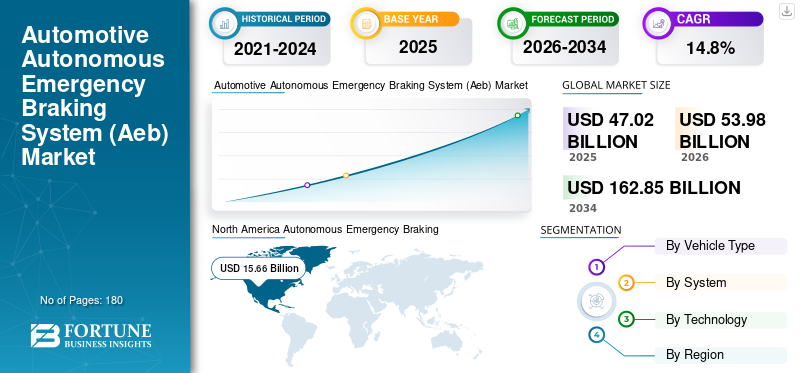
The global automotive autonomous emergency braking system market size was estimated at USD 47.02 billion in 2025 and is projected to reach USD 53.98 billion in 2026 to USD 162.85 billion by 2034, growing at a CAGR of 14.80% from 2026 to 2034. North America dominated the automotive autonomous emergency braking system market with a market share of 33.30% in 2025.
AEB system market is anticipated to grow at a healthy rate owing to the increasing demand for advanced vehicles with high-end safety features. Governments and regulatory bodies worldwide have been pushing for enhanced vehicle safety standards. These systems are considered a crucial safety feature, leading to increased adoption by automotive manufacturers. The automotive autonomous emergency braking system market in the U.S. is projected to grow significantly, reaching an estimated value of USD 20.61 Billion 2030.
With a greater focus on road safety and technological advancements, consumers are becoming more aware of the benefits of these systems. As a result, there is a growing demand for vehicles equipped with this safety feature. Governments worldwide are implementing regulations and safety standards that encourage or require the inclusion of these systems in vehicles.
AEB system helps identify the possible collision that is about to occur and responds through autonomously brake activation to slow down a vehicle prior to impact to avoid collision. This system is designed to detect potential collisions with objects or pedestrians and automatically apply the brakes to prevent or mitigate the impact.
Download Free sample to learn more about this report.
Automotive Autonomous Emergency Braking System Market Key Takeaways
 Market Size & Forecast
- 2025 Market Size: USD 47.02 billion
- 2026 Market Size: USD 53.98 billion
- 2034 Forecast Market Size: USD 162.85 billion
- CAGR: 14.80% from 2026–2034
 Market Share
- North America dominated the automotive autonomous emergency braking system market with a 33.30% share in 2025.
- The passenger vehicles segment is expected to grow at a CAGR of 15.4% during the forecast period.
- The low-speed AEB segment dominated the market in 2025.
 Key Regional Highlights
North America
North America led the market with a valuation of USD 15.66 billion in 2025 and is projected to reach USD 17.98 billion in 2026.
Asia Pacific
Asia Pacific is expected to witness strong growth due to increasing integration of AEB systems by automotive OEMs.
Europe
Europe remains a significant market driven by stringent vehicle safety regulations and advanced driver-assistance technologies.
U.S.
Rising adoption of advanced vehicle safety systems continues to support market expansion.
Japan
Growing focus on automotive safety innovations and intelligent mobility solutions is driving market demand.
Read More

AUTOMOTIVE AUTONOMOUS EMERGENCY BRAKING SYSTEM MARKET TRENDS
Extensive R&D Investment by Market Players for the Development of Advanced AEB System is Anticipated to Boost Market Growth
Autonomous emergency braking (AEB) system market is at a drastic surge due to the growing road safety demand. Market players in the automotive industry have invested heavily in Research & Development (R&D) to advance AEB systems. R&D efforts are focused on enhancing the capabilities and effectiveness of emergency braking systems, improving their performance, and expanding their applicability. Automotive manufacturers and technology companies are investing in developing advanced sensors such as radar, LIDAR, and cameras. R&D efforts are directed toward improving the advanced braking system's ability to detect and recognize various objects, including vehicles, pedestrians, cyclists, and stationary obstacles. This involves developing more sophisticated algorithms and machine learning techniques to analyze sensor data and make faster and more accurate decisions. By investing in R&D, market players aim to improve advanced braking systems' effectiveness, reliability, and overall performance. These advancements increase consumer confidence, meet regulatory requirements, and further drive the adoption of advanced braking systems technologies in the market.
Download Free sample to learn more about this report.
GROWTH DRIVERS: WHAT’S FUELING THE AEB SYSTEM MARKET EXPANSION?
Increasing Awareness Related to Road Safety is Anticipated to Boost Market Growth
The safety of people has become an utmost priority owing to increasing congestion and road traffic, which gave rise to various telematics solutions. Enhancing Advanced Driver Assistance Systems (ADAS) features in vehicles is one of the significant factors driving market growth. An increase in awareness of safety features is a significant driver of the autonomous emergency braking (AEB) system market growth. The rising awareness and concern about road safety among consumers, regulatory bodies, and automobile manufacturers have led to a greater emphasis on integrating advanced safety technologies such as emergency braking systems into vehicles. Consumers are increasingly prioritizing safety features when purchasing vehicles. With a greater understanding of the potential risks on the road, they seek vehicles equipped with advanced safety technologies such as emergency braking systems. The demand for safer vehicles drives the adoption of advanced braking systems and contributes to market growth. Independent organizations, such as Euro NCAP (European New Car Assessment Program) and Insurance Institute for Highway Safety (IIHS), conduct safety tests and provide vehicle safety ratings. A high safety rating, which often considers the presence of advanced braking systems, instills consumer trust and further boosts demand for vehicles equipped with such safety features. Road safety initiatives by international organizations, such as the World Health Organization, have gained significant attention. These initiatives create awareness about the importance of safety technologies and encourage governments and manufacturers to invest and promote the adoption of advanced safety systems such as AEB.
MARKET CHALLENGES: BARRIERS TO WIDESPREAD AEB SYSTEM ADOPTION
High Initial Cost May Restrain the Adoption of Autonomous Emergency Braking
AEB systems involve advanced sensor technologies, complex algorithms, and integration with other safety systems, which can increase the manufacturing costs of vehicles. The higher costs associated with advanced braking systems can be a deterrent for some consumers, particularly in price-sensitive markets, leading to slower adoption and autonomous emergency braking (AEB) system market growth. The additional costs associated with integrating emergency braking systems into vehicles can increase the overall price of the vehicles. This can affect affordability for some consumers, particularly in price-sensitive markets or when purchasing entry-level vehicles. Higher upfront costs may deter certain buyers from opting for vehicles with advanced braking systems, slowing autonomous emergency braking (AEB) system market growth. Retrofitting existing vehicles with AEB systems can be technically challenging and expensive. Retrofitting typically requires significant modifications to the vehicle's electrical and braking systems, which may not be feasible or cost-effective for older vehicles. The retrofitting process can also vary depending on the make and model of the vehicle, limiting the retrofit market and hindering the widespread adoption of advanced braking systems.
SEGMENTATION ANALYSIS
By Vehicle Type Analysis
Passenger Vehicle Segment Dominates the Market Owing to Growing Safety Awareness and Rise in Number of Road Accidents
Based on vehicle type, the market is segmented into passenger vehicles and commercial vehicles.
The passenger vehicles segment dominates the autonomous emergency braking (AEB) system market and is expected to grow at a CAGR of 15.4% during the forecast period. Consumer awareness and safety concerns have risen significantly, prompting a greater demand for vehicles with advanced safety technologies. The emergency braking systems are highly regarded for their ability to detect potential collisions and automatically apply brakes, reducing the risk of accidents and mitigating their severity. The increasing demand for passenger cars with enhanced safety features has fueled the adoption of advanced braking systems. Also, insurance companies recognize the safety benefits of these systems and may offer incentives, discounts, or reduced premiums for vehicles equipped with such safety features. This provides a financial incentive for consumers to choose passenger vehicles with these systems, contributing to the increased demand.
The commercial vehicles segment's growth is also propelling AEB systems' growth. Governments and regulatory bodies have been implementing safety regulations for commercial vehicles. These regulations often emphasize the importance of advanced safety technologies, including braking systems. Commercial vehicle operators are required to comply with these regulations, which has led to a higher demand for commercial vehicles equipped with AEB systems.
By System Analysis
To know how our report can help streamline your business, Speak to Analyst
Increasing Demand for Low Speed Segment is Anticipated to Boost Market Growth
Based on system, the autonomous emergency braking (AEB) system market is divided into low speed and high speed AEB.
The low speed AEB segment dominated the market in 2025. The demand for low speed Advanced emergency braking systems has been increasing due to their effectiveness in preventing collisions and reducing the severity of accidents in low-speed scenarios. Low-speed AEB systems are highly beneficial for parking and maneuvering in tight spaces. During low-speed maneuvers, these systems can detect obstacles, such as walls, other vehicles, or pedestrians, and automatically apply the brakes to prevent collisions. The demand for low-speed braking systems is driven by the desire to improve safety and reduce the risk of accidents during parking and maneuvering.
The demand for high speed AEB systems is predicted to grow during the forecast period. High-speed collisions can have severe consequences, and there is a growing emphasis on improving highway safety. High-speed braking systems are designed to detect and respond to potential collisions at higher speeds, including rear-end collisions or lane departure incidents on highways. The demand for high-speed braking systems is driven by the aspiration to reduce the severity and frequency of highway accidents.
By Technology Analysis
Growing Need for Enhanced Safety while Braking Supports the DBS Segment
Based on technology, the autonomous emergency braking (AEB) system market is divided into crash imminent braking and dynamic brake support. The dynamic brake support segment is expected to grow over the forecast period. DBS systems can improve the overall braking performance of vehicles by providing additional braking force or optimizing the brake distribution between the wheels. This helps to reduce braking distances and improve the vehicle's stability during emergency braking or challenging driving conditions. The demand for DBS systems arises from the desire for enhanced safety and control over the braking process.
The demand for crash imminent braking is also surging as vehicle safety technology advances and consumers prioritize collision avoidance features. Crash Imminent Braking systems, also known as Pre-Crash Braking or Forward Collision Warning with Automatic Emergency Braking, are designed to detect an imminent collision and automatically apply the vehicle's brakes to prevent or mitigate the impact.
REGIONAL ANALYSIS
North America Autonomous Emergency Braking (AEB) Market Size, 2025 (USD Billion)
To get more information on the regional analysis of this market, Download Free sample
North America
North America Holds the Highest Market Share Owing to Increasing Awareness Regarding Road Safety among Vehicle Buyers
North America dominated the market with a valuation of USD 15.66 billion in 2025 and USD 17.98 billion in 2026. The North American market witnessed significant demand in recent years and is expected to continue growing. There is a growing concern for road safety in North America, focusing on reducing the number and severity of accidents. Advanced braking systems are critical safety features that can help prevent or mitigate collisions. The increasing awareness and demand for road safety contributes to the demand for autonomous emergency braking (AEB) systems.
Moreover, consumer awareness of the benefits of emergency braking systems has been increasing in North America. Safety-conscious consumers prioritize vehicles with advanced safety technologies, including emergency braking systems as they offer an extra layer of protection. The growing consumer preference for advanced braking systems contributes to the product demand. The ever increasing demand for vehicles and rising awareness regarding safety features are boosting the growth of autonomous emergency braking (AEB) system in North America.
Asia Pacific
Further, the demand for advanced braking systems is anticipated to grow in the Asia Pacific AEB System Market. Original Equipment Manufacturers (OEMs) in Asia Pacific are increasingly integrating emergency braking systems into their vehicle models. They recognize the demand for advanced safety features and aim to differentiate their vehicles by offering emergency braking as a standard or optional feature. autonomous emergency braking (AEB) system market competition among OEMs further drives the region's demand for advanced braking systems.
KEY INDUSTRY PLAYERS
Robert Bosch GmbH is in Dominating Position due to its Diverse Portfolio and Offerings
Robert Bosch GmbH continues to lead the global AEB System Market. Rising partnerships and acquisitions with tier 1 & tier 2 companies in the Asia Pacific region are strengthening the company’s global market position. Development of advanced components amid partnership with key companies is responsible for the dominance of Bosch.
LIST OF KEY COMPANIES PROFILED:
- Robert Bosch GmbH (Germany)
- Continental AG (Germany)
- ZF Friedrichshafen AG (Germany)
- Delphi Automotive LLP (U.K.)
- Hyundai Mobis (South Korea)
- Aisin Seiki Co. Ltd (Japan)
- Hitachi Automotive System Ltd. (Japan)
- Mando Corporation (South Korea)
- Netradyne (India)
- Valeo S.A. (France)
KEY INDUSTRY DEVELOPMENTS
- May 2023: Tesla updated automatic its emergency braking with the ability to operate in reverse driving mode. This new functionality is expected to improve the driver and passenger safety during reverse driving.
- October 2022: ZF’s Commercial Vehicle, one of the leading auto components manufacturers, showcased separately on two heavy-duty trucks its “OnGuardMax” autonomous emergency braking system and electric power steering feature (adjustable), soon launching in North America.
- August 2022: The Insurance Institute for Highway Safety presented a novel nighttime test for Autonomous Emergency Braking systems. Four models, including the Ford Mustang Mach-E and Nissan Pathfinder received the uppermost superior rating. Other vehicles, including the Nissan Altima and Toyota Tacoma received no credit.
- February 2022: The largest ship Wonder of the Seas is the first ship to feature the novel ABB Ability Marine Braking Assistance System. Designed for smooth and safe emergency stops, the ABS results from the partnership between the supplier and owner, Royal Caribbean Group.
- December 2019: Oculii and Infineon collaborated to develop radar software solutions that enhance performance and affordability for various levels of automotive applications. This radar software will be effective in automotive emergency braking.
REPORT COVERAGE
Request for Customization to gain extensive market insights.
The report provides a detailed AEB System Market analysis and focuses on key aspects such as leading companies, services, and product applications. Besides this, the report offers insights into the market trends and highlights vital industry developments. In addition to the factors above, the report encompasses several factors that have contributed to the AEB System Market growth in recent years.
REPORT SCOPE & SEGMENTATION
|
ATTRIBUTE |
DETAILS |
|
Study Period |
2021-2034 |
|
Base Year |
2025 |
|
Estimated Year |
2026 |
|
Forecast Period |
2026-2034 |
|
Historical Period |
2021-2024 |
|
Growth Rate |
CAGR of 14.8% from 2026 to 2034 |
|
Unit |
Value (USD Billion) |
|
Segmentation |
By Vehicle Type
|
|
By System
|
|
|
By Technology
|
|
|
By Geography
|
Frequently Asked Questions
Fortune Business Insights states that global market was valued at USD 47.02 billion in 2025 and is projected to reach USD 162.85 billion in 2034.
The market is expected to register a CAGR of 14.8% during the forecast period.
Growing awareness regarding road safety is expected to drive the market growth.
North America dominated the automotive autonomous emergency braking system market with a market share of 33.30% in 2025.



- 2021-2034
- 2025
- 2021-2024
- 180
-
(Offer valid till 15th Oct 2026)
Get 30-60 hrs Free Customization
Expand Regional and Country Coverage, Segments Analysis, Company Profiles, Competitive Benchmarking, and End-user Insights.




















Related Reports
-
US +1 833 909 2966 ( Toll Free )
-
Get In Touch With Us