Two-wheeler Lighting Market Size, Share & Industry Analysis, By Location (Front, Rear, and Others), By Type (Halogen, LED, and Others), By Distribution Channel (OEM and Aftermarket), By Two-wheeler Type (Scooter, Motorcycle, and Moped), and Regional Forecast, 2026-2034
 Download Free Sample
(Offer valid till 15th Oct 2026)

Two-wheeler Lighting Market Size and Industry Overview
 Listen to Audio Version
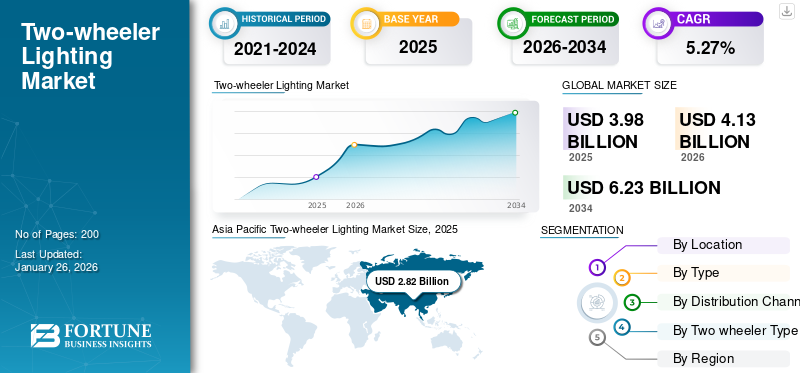
The global two-wheeler lighting market size was valued at USD 3.98 billion in 2025 and is projected to grow from USD 4.13 billion in 2026 to USD 6.23 billion by 2034 exhibiting a CAGR of 5.27% during the forecast period. Asia Pacific dominated the global market with a share of 70.96% in 2025.
The primary function of two-wheeler lighting is twofold: to illuminate the rider's path and to enhance their visibility to other road users. This includes cars, trucks, pedestrians, cyclists, and even animals. By effectively lighting the road ahead, riders can identify potential hazards such as potholes and debris and reactively turn vehicles in time for safety. Moreover, being highly visible reduces the risk of being overlooked by other drivers, particularly in low-light situations such as dawn, dusk, or inclement weather. Key players in the market include Lumax, FIEM Industries Ltd., Oracle, OSRAM, Varroc, and Uno Minda, which compete in the development of new products and pricing.
Increasing disposable income is a critical driver for the two-wheeler lighting market. As consumers' disposable income increases, they are more likely to invest in a premium two-wheeler equipped with advanced lighting systems. Additionally, consumers are willing to upgrade their existing two-wheelers with advanced lighting solutions, such as LED headlights and daytime running lights, to improve their safety and visibility on the road.
Download Free sample to learn more about this report.
Download Free sample to learn more about this report.
Two-wheeler Lighting Market Key Takeaways
 Market Size & Forecast
- 2025 Market Size: USD 3.98 billion
- 2026 Market Size: USD 4.13 billion
- 2034 Forecast Market Size: USD 6.23 billion
- CAGR: 5.27% from 2026–2034
 Market Share
- Asia Pacific dominated the two-wheeler lighting market with a 70.96% share in 2025.
- The front lighting segment held a 54.23% market share in 2026.
- The halogen lighting segment accounted for a 68.76% market share in 2026.
 Key Regional Highlights
Asia Pacific
Asia Pacific led the global market with USD 2.82 billion in revenue and a 70.96% share in 2025.
Europe
Europe accounted for USD 0.37 billion and 9.19% of the global market in 2025.
North America
North America led the market with USD 3,260.08 billion in 2025, supported by strong institutional capital and deal activity.
U.S.
The two-wheeler lighting market is projected to reach USD 0.19 billion in 2026, supported by vehicle sales growth and safety regulations.
Japan
The two-wheeler lighting market is projected to reach USD 0.03 billion in 2026.
Read More

Market Dynamics
Market Drivers
Increasing Safety Concerns and Supportive Government Regulations to Augment Market Growth
One of the primary market drivers for the two-wheeler lighting industry is the growing concern for road safety. Two-wheeler vehicles, such as motorcycles and scooters, are often involved in accidents due to poor visibility, particularly during nighttime driving. As a result, there is a growing demand for advanced lighting systems that can improve the visibility of two-wheelers on the road. This has led to the development of innovative lighting solutions, such as LED headlights and daytime running lights, which are becoming increasingly popular in the market.
Government regulations are another significant factor for the two-wheeler lighting industry. Governments around the world are implementing stricter safety standards for two-wheeler vehicles, which has led to an increased demand for advanced lighting systems. For example, the European Union has mandated that all new motorcycles sold in the EU must be equipped with daytime running lights from 2026 onwards. This regulation is expected to drive the two-wheeler lighting market demand for daytime running lights.
Market Restraints
Fluctuations in Raw Material Prices May Hamper Market Growth Over Forecast Period
The manufacturing of lighting components relies on various raw materials, including rare earth elements, plastics, and metals. Volatility in their prices, driven by global economic conditions, geopolitical events, and supply chain disruptions, directly impacts the production cost. These fluctuations can squeeze profit margins for manufacturers, forcing them to either absorb the cost increase or pass it on to consumers, potentially dampening demand.
Market Opportunities
LED Lighting Solutions and Connected Lighting Solutions to Support Market Growth
LED lights are rapidly becoming the dominant technology in the two-wheeler market. Opportunities exist in developing and manufacturing high-performance, energy-efficient, and cost-effective LED headlamps, taillights, turn signals, and DRLs. Companies can also focus on integrating LED lighting with advanced features such as adaptive lighting and cornering lights. With the increasing integration of connectivity in two-wheelers, there is a growing demand for connected lighting systems that can communicate with the vehicle's central control unit and other devices. This opens up opportunities for developing features such as automatic emergency braking lights, adaptive cruise control lighting, and lighting-based safety alerts.
Market Challenges
Aftermarket Challenges and Customization Trends Demand for Two-wheeler Lighting
The two-wheeler aftermarket represents a significant market opportunity for lighting manufacturers. Owners often seek to upgrade their existing lighting systems for improved performance, aesthetics, or safety. However, the aftermarket is characterized by a fragmented landscape, with a wide range of suppliers, varying quality standards, and a lack of standardization. Furthermore, the growing trend of vehicle customization presents a challenge. Owners increasingly demand unique and personalized lighting solutions, requiring manufacturers to offer a wider range of products and design options. This necessitates a shift toward more flexible and customizable manufacturing processes and a greater focus on design and branding.
Two-wheeler Lighting Market Trends
Rise of Electric Two-Wheelers and Impact on Advanced Lighting Technology
The burgeoning electric two-wheeler market is intrinsically linked to the evolution of lighting technology. Electric Vehicles (EVs) require efficient lighting systems to minimize battery drain and maximize range. LEDs are the obvious choice here, providing the necessary illumination with minimal power consumption.
Moreover, the integration of Advanced Driver-Assistance Systems (ADAS) in electric two-wheelers is driving innovation in lighting design. Adaptive motorcycle headlights, which adjust their beam pattern based on speed and road conditions, are becoming increasingly common in high-end electric models. These systems enhance safety by providing optimal illumination in various driving scenarios.
Segmentation Analysis
By Location
Growing Demand for Safety Features to Drive Demand for Front Two-wheeler Lighting
On the basis of location, the market has been divided into front, rear, and others.
The front segment is projected to captured a dominant market with a share of 54.23% in 2026. As road accidents involving two-wheelers continue to rise, the demand for advanced safety features has become more critical. High-quality headlights play a vital role in ensuring the safety of riders, particularly in low-light conditions or at night. As a result, Original Equipment Manufacturers (OEMs) are increasingly incorporating advanced headlight systems in their two-wheeler offerings, driving the growth of the headlight segment in the two-wheeler lighting market.
The rear segment is expected to grow at a considerable CAGR during the forecast period. The rapid evolution of lighting technology has paved the way for innovative and efficient tail light solutions in the two-wheeler market. The introduction of LED and OLED (Organic Light Emitting Diode) technology has led to the development of tail lights that are brighter, more durable, and energy-efficient compared to traditional incandescent bulbs. Moreover, these advanced lighting solutions offer greater design flexibility, enabling manufacturers to create tail lights with unique shapes, patterns, and customizable color options. As a result, the increasing adoption of cutting-edge lighting technology in two-wheeler tail lights is expected to drive two-wheeler lighting market growth.
To know how our report can help streamline your business, Speak to Analyst
By Type
Halogen Lighting Leads Owing to its Affordability over its Counterparts
Based on type, the market is categorized into halogen, LED, and others.
The halogen segment is poised to captured the majority of the market with a share of 68.76% in 2026. In price-sensitive markets, cost remains a paramount consideration for both manufacturers and consumers. Halogen lights offer a significantly lower initial cost compared to LED and Xenon alternatives. This affordability makes halogen a particularly attractive option for two-wheeler manufacturers, allowing them to maintain competitive pricing, particularly in entry-level and mid-range models. In emerging economies, where two-wheelers are a primary mode of transportation for a large segment of the population, this price advantage is a crucial factor in driving Halogen's continued adoption.
The LED segment is expected to grow at a rapid CAGR during the forecast period. LEDs offer unprecedented design flexibility, allowing manufacturers to create innovative and visually striking lighting solutions. Their small size and adaptability enable the integration of unique lighting signatures, enhancing the aesthetic appeal of two-wheelers and contributing to brand differentiation. Complex shapes, intricate patterns, and dynamic lighting effects are all possible with LEDs, enabling designers to push the boundaries of creativity and create visually compelling designs that capture the attention of consumers. This design flexibility allows manufacturers to tailor lighting systems to specific models and target audiences, further driving the adoption of LED technology.
By Distribution Channel
OEM’s Gain Prominent Share Bolstered by Stringent Safety Regulations and Standards
Based on distribution channel, the market is categorized into OEM and aftermarket.
The OEM segment is projected to accounted for the largest two-wheeler lighting market with a share of 75.54% in 2026. One of the most significant drivers of growth in the OEM lighting market is the increasing emphasis on safety regulations worldwide. Governments and regulatory bodies are implementing stricter guidelines for two-wheeler lighting, mandating features such as Automatic Headlight On (AHO), Daytime Running Lights (DRLs), and improved visibility in low-light conditions. These regulations directly impact OEMs, forcing them to incorporate advanced and compliant lighting systems into their vehicles. This, in turn, drives demand for high-quality lighting solutions from OEM suppliers who can meet these rigorous standards.
The aftermarket segment is expected to capture a considerable market share during the forecast period. Two-wheeler owners are increasingly seeking customization options to make their vehicles stand out from the crowd. Aftermarket lighting products, such as LED lights, HID kits, and auxiliary lights, offer a wide range of customization options, from color temperature to beam patterns. This trend is driving the growth of the aftermarket distribution channel, as it provides a platform for manufacturers and suppliers to offer innovative and unique lighting solutions.
By Two-wheeler Type
Motorcycle is the Leading Two-Wheeler Type with Amplified Demand from Emerging Economies
Based on two-wheeler type, the market is divided into scooter, motorcycle, and moped.
The motorcycle segment accounted for the largest share with a 58.83% in 2026. The motorcycle market is booming in emerging economies across Asia Pacific, Latin America, and Africa. These regions often face challenges related to infrastructure, traffic congestion, and affordability, making motorcycles a practical and cost-effective mode of transportation. As disposable incomes rise in these countries, so does the demand for motorcycles, including models equipped with advanced lighting features.
The scooter segment is expected to capture a considerable market share during the forecast period. The burgeoning electric scooter market is presenting a significant growth opportunity for the lighting industry. Electric scooters, with their reliance on battery power, benefit significantly from the energy efficiency of LEDs. The adoption of LED lighting helps to maximize battery range, a crucial factor for electric scooter adoption. As the electric scooter market continues to expand, the demand for corresponding LED lighting systems will surge, further fueling market growth.
Two-wheeler Lighting Market Regional Outlook
North America
Asia Pacific Two-wheeler Lighting Market Size, 2025 (USD Billion)
To get more information on the regional analysis of this market, Download Free sample
The North America market accounted for USD 0.21 billion in 2025, representing 5.28% of the global industry, and is expected to reach USD 0.21 billion in 2026. Beyond technological integrations, the consumer landscape is shifting toward a preference for customization and personalization in two-wheeler accessories, including lighting. More riders are seeking options that not only serve a functional purpose but also reflect their style. This trend has spurred manufacturers to offer a wide assortment of lighting products—from neon under glows to customizable LED accents—allowing riders to express their individuality.
The U.S. two-wheeler lighting market is poised for continued growth, driven by a confluence of factors including increasing vehicle sales, stringent safety regulations, technological advancements, and the growing demand for personalization. As the market matures, we can expect to witness further innovation in lighting technology, with a focus on improving safety, efficiency, and aesthetics. Manufacturers that can effectively address these evolving needs will be well-positioned to succeed in this dynamic and expanding market. The U.S. market is projected to valued at USD 0.19 billion by 2026.
Europe
Europe recorded a market size of USD 0.37 billion in 2025, capturing 9.19% of the global market share, and is projected to reach USD 0.38 billion in 2026. Safety regulations in Europe have become increasingly stringent, particularly regarding vehicle visibility. Directives such as the UNECE regulations set high standards for headlight performance, taillight intensity, and the mandatory inclusion of features like Daytime Running Lights (DRLs) on many new models. These regulations are designed to reduce accidents by making motorcycles, scooters, and even some bicycles more conspicuous to other road users, especially in varying light conditions. The UK market is projected to valued at USD 0.03 billion by 2026, and the Germany market is anticipated to valued at USD 0.07 billion by 2026.
Asia Pacific
In 2025, Asia Pacific represented USD 2.82 billion, accounting for 70.96% of the worldwide market, and is projected to grow to USD 2.94 billion in 2026. Asia Pacific is expected to dominate the market and grow at the highest CAGR over the forecast period. Asia Pacific dominated the global market in 2025, with a market size of USD 2.82 billion. Rising disposable incomes and rapid urbanization in emerging APAC economies such as India, Indonesia, Vietnam, and the Philippines have led to a substantial increase in two-wheeler ownership. As more people enter the middle class, they can afford personal transportation, and two-wheelers often represent an accessible and practical solution to navigating increasingly congested urban environments. Each new two-wheeler sold adds to the demand for OEM lighting components, and the growing fleet of vehicles naturally drives the aftermarket demand for replacements and upgrades over time. The Japan market is projected to valued at USD 0.03 billion by 2026, the China market is valued at USD 0.81 billion by 2026, and the India market is projected to valued at USD 1.03 billion by 2026.
Rest of World
In 2025, Rest of the World held 14.56% of the global market, reaching a valuation of USD 0.58 billion, and is projected to grow to USD 0.6 billion in 2026. The rest of the world is expected to grow at a rapid CAGR during the forecast period. The two-wheeler market in Latin America and MEA has expanded significantly, propelled by shifting consumer preferences. In urban areas, where traffic congestion is an increasing issue, two-wheelers are often considered as a practical alternative to cars. Motorcycles and scooters not only navigate through heavy traffic with ease but also provide economical solutions for commuting.
Competitive Landscape
Key Market Players
The global two-wheeler lighting market is competitive. Large, established companies are major players that offer comprehensive solutions, product launches, strong R&D capabilities, and established relationships with major global two-wheeler manufacturers (OEMs). Companies with a strong presence in specific geographic markets, particularly in high-volume two-wheeler production regions such as India, Southeast Asia, and China. These players often have strong cost competitiveness, a deep understanding of local market needs, and close ties with domestic OEMs. They compete fiercely on price, localization, and supply chain efficiency.
List of Key Two-wheeler Lighting Companies Profiled
- Lumax (India)
- FIEM Industries Ltd. (India)
- Koito Manufacturing Co., Ltd. (Japan)
- Varroc (India)
- Oracle Lighting (U.S.)
- Osram GmbH (Germany)
- Koninklijke Philips N.V. (Netherlands)
- Rizoma Srl (Italy)
- Uno Minda (India)
- NEOLITE ZKW Lightings Pvt. Ltd. (India)
Key Industry Developments
- September 2024 – Koito Manufacturing Co., Ltd. announced that it is going to invest USD 234 million to expand the production capacity of its automotive lighting business in Mexico and Brazil.
- March 2023 – FIEM Industries Ltd. signed a MoU with Gogoro India for the expansion of its product portfolio in the two-wheeler EV segment.
- June 2022 – J.W. Speaker Corporation introduced the Model 93 5-in-1 functional, drop-in replacement headlight for buses, RVs, tractors, motorcycles, specialty vehicles, and other vehicles. The multi-function Model 93 combines high beam, low beam, front position, turn signal, and Daytime Running Light (DRL) performance in a stylish design surrounded by durable die-cast aluminum housing with a sealed integrated connector.
- April 2022 – Plastic Omnium agreed to buy the European and North American lighting units of Varroc Engineering for USD 634 million.
- December 2019 – Koito Manufacturing Co., Ltd. completed the acquisition of India Japan Lighting Pvt. Ltd. to boost the company’s profitability in the Indian market.
Investment Analysis and Opportunities
Technological Advancements to Generate Opportunities for Market Growth
Traditional halogen lamps are gradually being replaced by Light-Emitting Diodes (LEDs) and, to a lesser extent, Xenon lamps. LEDs offer numerous advantages, including significantly higher energy efficiency, longer lifespan, improved light intensity, and greater design flexibility. The increasing affordability of LEDs, coupled with their superior performance characteristics, is accelerating their adoption in two-wheeler lighting systems. Furthermore, ongoing research and development efforts are focused on developing even more advanced lighting technologies, such as adaptive lighting systems that adjust beam patterns based on riding conditions and advanced projection technologies that improve visibility in adverse weather. These innovations are attracting investment and driving the technological evolution of the market.
Report Coverage
The two-wheeler lighting market research report analyzes the market in-depth and highlights crucial aspects such as prominent companies, segmentation, competitive landscape, and technology adoption. Besides this, the market research report provides insights into the market trends and highlights significant industry developments. In addition to the aspects mentioned earlier, the report encompasses several factors contributing to the market growth over recent years.
Request for Customization to gain extensive market insights.
Report Scope & Segmentation
|
ATTRIBUTE |
DETAILS |
|
Study Period |
2021-2034 |
|
Base Year |
2025 |
|
Estimated Year |
2026 |
|
Forecast Period |
2026-2034 |
|
Historical Period |
2021-2024 |
|
Growth Rate |
CAGR of 5.27% from 2026 to 2034 |
|
Unit |
Value (USD Billion) |
|
Segmentation |
By Location
By Type
By Distribution Channel
By Two-wheeler Type
By Region
|
Frequently Asked Questions
Fortune Business Insights says that the market size was USD 4.13 billion in 2026 and is anticipated to reach USD 6.23 billion by 2034.
The market will exhibit a CAGR of 5.27% over the forecast period (2026-2034).
By type, the halogen segment is predicted to dominate the market during the forecast period (2026-2034).
Increasing safety concerns and supportive government regulations to augment the market growth.
Leading companies include Lumax, FIEM Industries Ltd., Oracle, OSRAM, Varroc, and Uno Minda.
Asia Pacific held the largest share of the global market in 2025.


- 2021-2034
- 2025
- 2021-2024
- 200
-
(Offer valid till 15th Oct 2026)
Get 30-60 hrs Free Customization
Expand Regional and Country Coverage, Segments Analysis, Company Profiles, Competitive Benchmarking, and End-user Insights.




















-
US +1 833 909 2966 ( Toll Free )
-
Get In Touch With Us