Two-Wheeler Starter Motor Market Size, Share & Industry Analysis, By Two-wheeler Type (Motorcycles, Scooters, and Mopeds), By Sales Channel (OEM and Aftermarket), By Engine Capacity (Below 125cc, 126cc–250cc, and Above 250cc), By Product Type (Conventional Electric Starter Motor, Brushless ACG Starter Motor, Smart Motor Generator, and Start-Stop Compatible Starter Motor), By Component (Armature, Solenoid, Clutch, Brushes, and Others), and Regional Forecast, 2026–2034
 Download Free Sample
(Offer valid till 30th Sep 2026)

Two-Wheeler Starter Motor Market Size and Future Outlook
 Listen to Audio Version
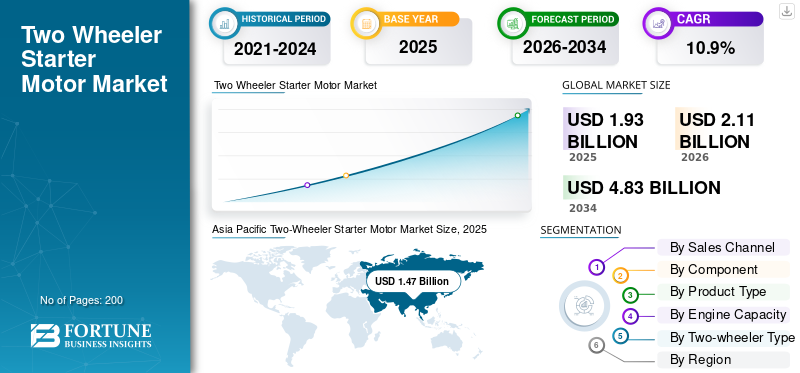
The global two-wheeler starter motor market size was valued at USD 1.93 billion in 2025. The market is projected to grow from USD 2.11 billion in 2026 to USD 4.83 billion by 2034, exhibiting a CAGR of 10.9% during the forecast period. Asia Pacific dominated the two wheeler starter motor market with a market share of 76.16% in 2025.
A two wheeler starter motor is an electric device that initiates engine operation in motorcycles, scooters, and mopeds by converting battery power into mechanical rotation. Rising two-wheeler production, electric start systems, start-stop systems, premium motorcycles, and demand for advanced, durable, efficient starter technologies drive market growth.
Major players in the global market include Denso Corporation, Mitsuba Corporation, Robert Bosch GmbH, Hitachi Astemo, Mahle GmbH, Valeo SA, and Mitsubishi Electric. They compete through lightweight starter motor design, electric starter motor efficiency, integrated starter generator systems, start stop compatibility, durability, and innovations in starter motor technologies.
Download Free sample to learn more about this report.
TWO-WHEELER STARTER MOTOR MARKET TRENDS
Lightweight and High-Efficiency Starter Motor Design Gains Momentum
One of the key market trends is the growing emphasis on lightweight, compact, and high-efficiency starter motor design. OEMs are reducing vehicle weight to improve fuel economy, battery performance, and ride comfort. Starter motor suppliers are using improved magnetic materials, better winding designs, and durable housings to increase efficiency while reducing size. These innovations in starter motor technologies are especially relevant for scooters, premium motorcycles, and start stop systems, where performance, packaging flexibility, and lower power consumption are critical purchase factors.
- In May 2026, Honda unveiled the 27YM CRF450R with a redesigned starter system that is 500g lighter, uses a 4-axis configuration, and includes a smaller one-way clutch, improving weight efficiency and compact starter motor design.
Integrated Starter Generator Adoption Supports Quieter Ignition
Integrated starter generator systems are emerging as an important trend as OEMs seek smoother, quieter, and more fuel-efficient ignition solutions. These systems combine starting and power generation functions, reducing mechanical complexity and improving rider comfort. Their use is expanding in premium scooters, hybrid-assist models, and vehicles with start-stop systems. While electric starter motors dominate the current market share, integrated starter generator technology is expected to gain stronger demand due to noise reduction, efficiency benefits, and advanced vehicle architecture requirements.
- In July 2026, Yamaha patented a hybrid maxi-scooter using an internal combustion engine, battery pack, and two electric motors. One motor supports EV drive and regeneration, while another acts as a starter-generator, highlighting cleaner powertrain development.
MARKET DYNAMICS
MARKET DRIVERS
Download Free sample to learn more about this report.
Rising Two-Wheeler Production Drives Market Growth
The two-wheeler starter motor market growth is strongly driven by rising motorcycle and scooter production in Asia Pacific, where two-wheelers remain a primary mobility option. Growing urban traffic, affordable ownership costs, and improving commuter income are increasing sales of entry-level and mid-range motorcycles. As OEMs standardize electric start systems across more models, demand for electric starter motor units continues to rise. This directly supports replacement volumes, OEM supply contracts, and wider adoption of durable starter motor design.
Shift Toward Electric Start Systems to Enhance User Convenience Fuels Market Growth
The market is driven by consumer demand for convenient, reliable, and low-maintenance ignition systems. Kick-start mechanisms are gradually becoming less preferred as riders expect smoother operation, especially in scooters, commuter bikes, and premium motorcycles. Electric start systems enhance usability for daily riders and support better vehicle positioning by OEMs. As manufacturers integrate compact starter motors with improved battery compatibility, the role in the two wheeler starter motor ecosystem becomes more important across internal combustion engine platforms.
MARKET RESTRAINTS
Raw Material Price Volatility Limits Market Expansion
The market faces restraint from fluctuating prices of copper, steel, magnets, aluminum, and electronic components used in starter motors. Since two-wheelers are highly price-sensitive, especially in emerging markets, sharp input cost increases can pressure supplier margins and OEM procurement strategies. Manufacturers may find it difficult to pass higher costs to customers without affecting affordability. This creates challenges in maintaining consistent quality, durability, and competitive pricing, particularly for low-cost commuter motorcycles and scooters sold in high-volume markets.
MARKET OPPORTUNITIES
Adoption of Hybrid Two Wheelers Opens New Design Scope
The adoption of hybrid two-wheelers creates opportunities for starter motor suppliers to diversify into motor-assist, compact drive, and integrated power-management components. Although hybrid two-wheelers do not use conventional internal combustion engine starter motors, their rise increases demand for advanced motor technologies, lightweight electrical systems, and efficient power electronics. Suppliers with expertise in electric starter motor manufacturing can adapt capabilities toward integrated starter generator systems, auxiliary motors, and next-generation mobility components for eco-friendly vehicle platforms.
- In January 2026, Honda highlighted its two-motor hybrid-electric powertrain, featuring an electric generator motor that also supports starter functions. The system improves efficiency, lowers emissions, and supports automatic engine restart after idle-stop, strengthening demand for advanced starter-generator technologies.
Premium Motorcycles Create Demand for Advanced Starter Systems
Premium and sports motorcycles offer strong opportunities for suppliers as these vehicles require higher torque, faster response, better durability, and refined ignition performance. Riders in this segment value smoother starts, lower vibration, and reliable operation across varied riding conditions. This creates demand for advanced starter motors, high-efficiency units, and start-stop compatible systems. OEMs can use improved starter technologies to differentiate models, while suppliers such as Bosch, Denso, Mitsuba, Valeo, and Mitsubishi Electric can target higher-value contracts.
- In February 2024, MV Agusta discussed its limited-edition LXP Orioli adventure motorcycle, featuring a 931cc triple engine, 173,000 development miles, and a new starter system with a different starter motor and stronger starter clutch to improve reliability.
MARKET CHALLENGES
Balancing Durability, Efficiency, and Affordability Remains Difficult
A major market challenge is designing starter motors that are efficient, durable, compact, and affordable at the same time. Two-wheelers operate across harsh conditions, including heat, dust, vibration, frequent stop-start riding, and inconsistent maintenance. Suppliers must improve performance without significantly raising costs for OEMs or aftermarket buyers. This is difficult in mass-market motorcycles and scooters, where pricing pressure is strong. The challenge becomes greater as start stop systems and integrated starter generator technologies require more complex engineering.
Segmentation Analysis
By Sales Channel
OEM Segment Led Market Due to Rising Two-Wheeler Production
Based on the sales channel, the market is segmented into OEM and aftermarket.
The OEM segment dominated the market in 2025 due to rising two-wheeler production, increasing factory-fitment of electric starter motor systems, and wider integration of start stop systems in motorcycles and scooters. OEMs prefer advanced starter motor design to improve ignition reliability, durability, and vehicle efficiency, supporting steady demand from manufacturers across Asia Pacific, Europe, and other high-volume markets.
The aftermarket segment is projected to grow at the fastest CAGR of 11.7% over the forecast period. Growth is supported by expanding two-wheeler parc, frequent starter replacement needs, aging internal combustion engine fleets, and rising consumer demand for affordable repair and maintenance solutions.
- In October 2025, Ark Racing announced its upcoming BSA A65 Starter Motor Kit, developed and manufactured for Birmingham Small Arms motorcycle unit engines, expanding its motorcycle starter motor kits after the Triumph T120/T140 kit and supporting classic bike electrification upgrades.
By Component
High Starter Load Requirements and Core Motor Function Fueled Armature Segment Growth
Based on component, the market is segmented into armature, solenoid, clutch, brushes, and others.
The armature segment dominated the market in 2025 due to its central role in converting electrical energy into mechanical rotation within the electric starter motor. Rising two-wheeler production, frequent use of electric start systems, and demand for durable starter motor design support strong armature demand across motorcycles, scooters, and internal combustion engine platforms.
Clutch is projected to be the fastest-growing segment with a CAGR of 12.9% over the forecast period. Growth is supported by increasing start-stop systems, higher ignition cycles, premium motorcycles, and demand for smoother torque transfer, durability, and reliable starter engagement.
By Product Type
Mass-Market Fitment and Proven Reliability Boosted Conventional Electric Starter Motor Segment Growth
Based on product type, the market is segmented into conventional electric starter motor, brushless ACG starter motor, smart motor generator, and start-stop compatible starter motor.
The conventional electric starter motor segment dominated the market in 2025 due to its wide fitment across commuter motorcycles, scooters, and internal combustion engine two-wheelers. Its cost efficiency, simple starter motor design, established supply base, and compatibility with mass-market electric start systems support strong OEM and aftermarket demand.
- In June 2026, Moto Guzzi patented a V-twin hybrid motorcycle powertrain featuring a large electric motor for hybrid drive and generation, while retaining a separate conventional starter motor to enable seamless engine starting during electric operation.
Start-stop compatible starter motor is projected to be the fastest-growing segment with a CAGR of 13.8% over the forecast period. Stricter emission norms, fuel-efficiency targets, frequent ignition cycles, and growing adoption of start-stop systems in premium and urban mobility two-wheelers support growth.
To know how our report can help streamline your business, Speak to Analyst
By Engine Capacity
High Commuter Demand and Mass-Market Production Augmented Below 125cc Segment Growth
Based on engine capacity, the market is segmented into below 125cc, 126cc–250cc, and above 250cc.
The below 125cc segment dominated the market in 2025 due to strong demand for commuter motorcycles, scooters, and mopeds across price-sensitive markets. These vehicles rely heavily on cost-effective electric starter motor systems, supported by high production volumes, dense urban usage, fuel efficiency needs, and widespread internal combustion engine adoption in Asia Pacific.
126cc–250cc is projected to be the fastest-growing segment with a CAGR of 12.2% over the forecast period. Growth is supported by rising demand for premium commuter bikes, sports motorcycles, improved ignition reliability, and demand for advanced starter systems in mid-capacity two-wheelers.
By Two-wheeler Type
Large Installed Base and Daily Commuting Needs Boosted Motorcycles Segment Growth
Based on two-wheeler type, the market is segmented into motorcycles, scooters, and mopeds.
The motorcycle segment dominated the market in 2025 due to high production volumes, a large installed base, and strong commuter demand across Asia Pacific, Latin America, and Africa. Motorcycles widely use electric starter motor systems for reliable ignition, while rising mid-capacity models, internal combustion engine penetration, and routine replacement demand continue supporting OEM and aftermarket starter motor sales.
- In October 2023, BMW launched the 2024 M 1000 XR with a 201 hp inline-four engine and an 800W starter. Its starter motor is integrated on top of the housing behind the cylinders, supporting compact high-performance engine packaging.
Scooters is projected to be the fastest-growing segment with a CAGR of 11.7% over the forecast period. Growth is supported by rising urban mobility demand, increasing women riders, convenient automatic transmission, expanding electric start systems, and stronger adoption of scooters for daily commuting.
Two-Wheeler Starter Motor Market Regional Outlook
By geography, the market is categorized into Asia Pacific, North America, Europe, South America, and the Middle East & Africa.
Asia Pacific
Asia Pacific Two-Wheeler Starter Motor Market Size, 2025 (USD Billion)
To get more information on the regional analysis of this market, Download Free sample
Asia Pacific dominates the global two-wheeler starter motor market share and is also the fastest-growing region with a CAGR of 11.4% during 2026-2034. Growth is driven by high two-wheeler production, large commuter motorcycle and scooter fleets, and strong consumer demand for affordable electric start systems. Countries such as India, China, Indonesia, Vietnam, and Thailand support large OEM volumes and aftermarket replacement demand. Rising urbanization, internal combustion engine vehicle sales, adoption of electric two-wheelers, and demand for advanced starter technologies strengthen regional expansion.
- In December 2025, Honda’s new V4 engine patents revealed redesigned oil passages feeding the stator, starter motor, water pump, and clutch. The simplified lubrication layout aims to reduce friction, improve packaging, and support lighter, performance-focused motorcycle engine development.
China Two-Wheeler Starter Motor Market
The China market in 2026 is estimated at around USD 0.27 billion, accounting for roughly 12.8% of global revenues. Expansion is supported by large OEM production and electric start adoption.
Indonesia Two-Wheeler Starter Motor Market
The Indonesia market in 2026 is estimated at around USD 0.24 billion, accounting for roughly 11.4% of global revenues. Momentum comes from fastest-growing scooter adoption and urban commuting.
India Two-Wheeler Starter Motor Market
The India market in 2026 is estimated at around USD 0.56 billion, accounting for roughly 26.5% of global revenues. Demand is driven by commuter motorcycles, scooters, and replacement needs.
North America
North America held the smallest market share in 2025. Growth is supported by rising demand for premium motorcycles, recreational bikes, scooters, and high-quality replacement starter components. The region benefits from strong consumer preference for reliable ignition systems, advanced electric starter motor units, and durable starter motor design. Increasing adoption of electric start systems in performance motorcycles, touring bikes, and urban scooters supports steady OEM and aftermarket demand, while established service networks further strengthen replacement and upgrade opportunities across the regional market.
- In January 2026, Harley-Davidson revealed 13 new and updated motorcycles, including trike models with a new reverse system powered by the engine starter motor, replacing the separate electric reverse motor and supporting improved packaging in touring applications.
U.S. Two-Wheeler Starter Motor Market
The U.S. market in 2026 is estimated at around USD 0.02 billion, accounting for roughly 1.1% of global revenues. Revenue growth is supported by premium motorcycles and replacement demand.
Europe
Europe is the fourth-largest market in 2025. Premium motorcycles, urban scooters, emission-focused mobility policies, and rising demand for efficient electric start systems drive growth. The region is witnessing greater use of lightweight starter motor design, start stop systems, and eco-friendly technologies across modern two-wheelers. Strong aftermarket service networks, higher adoption of advanced ignition components, and consumer preference for refined vehicle performance support market expansion across Germany, France, Italy, Spain, and the U.K.
Italy Two-Wheeler Starter Motor Market
The Italy market in 2026 is estimated at around USD 0.02 billion, accounting for roughly 1.0% of global revenues. Uptake is supported by scooters, premium motorcycles, and aftermarket servicing.
South America
South America is the third-largest market. Growth is supported by rising motorcycle use for daily commuting, delivery services, and affordable personal mobility across Brazil, Argentina, and neighboring markets. The region has strong demand for electric starter motor replacements due to high vehicle utilization, expanding two-wheeler parc, and growing preference for convenient ignition systems. Increasing scooter and motorcycle penetration, developing repair networks, and rising aftermarket availability of starter components continue to support regional demand.
Brazil Two-Wheeler Starter Motor Market
The Brazil market in 2026 is estimated at around USD 0.07 billion, accounting for roughly 3.4% of global revenues. Market development is driven by commuting motorcycles and delivery fleets.
Middle East & Africa
The Middle East & Africa is the second-largest region, expected to grow with a CAGR of 10.5% during 2026–2034. Growth is driven by increasing two-wheeler use for low-cost mobility, delivery operations, and commercial transport in African countries, along with premium motorcycle demand in Gulf markets. Harsh operating conditions support demand for durable starter systems, while expanding urban mobility and rising availability of affordable motorcycles strengthen OEM and aftermarket opportunities. Growing use of electric start systems in commuter motorcycles further supports regional market growth.
Turkey Two-Wheeler Starter Motor Market
The Turkey market in 2026 is estimated at around USD 0.02 billion, accounting for roughly 1.1% of global revenues. Adoption is supported by urban mobility, scooters, and affordable motorcycles.
COMPETITIVE LANDSCAPE
Key Industry Players
Lightweight Design, Electric Start Systems, and OEM Partnerships Define Competitive Landscape
The global two-wheeler starter motor market is moderately fragmented, with global component suppliers and regional manufacturers competing on cost, durability, efficiency, and OEM relationships. Key players such as Denso Corporation, Mitsuba Corporation, Bosch Limited, Hitachi Astemo, Mahle GmbH, Valeo SA, and Mitsubishi Electric compete through lightweight starter motor design, integrated starter generator systems, start stop compatibility, and electric starter motor efficiency. To gain an edge, companies are focusing on localized manufacturing, aftermarket distribution, material optimization, and innovations in starter motor technologies for motorcycles, scooters, and electric two-wheelers.
LIST OF KEY TWO-WHEELER STARTER MOTOR COMPANIES PROFILED
- Denso Corporation (Japan)
- Mitsuba Corporation (Japan)
- Robert Bosch GmbH (Germany)
- Hitachi Astemo, Ltd. (Japan)
- Valeo SA (France)
- MAHLE GmbH (Germany)
- SEG Automotive (Germany)
- Mitsubishi Electric Corporation (Japan)
- Lucas TVS Limited (India)
- Prestolite Electric (U.S.)
- WAI Global (U.S.)
- AS-PL Sp. z o.o. (Poland)
- Victory Industrial Corporation (Taiwan)
- Arrowhead Engineered Products (U.S.)
- DB Electrical (U.S.)
KEY INDUSTRY DEVELOPMENTS
- August 2025: Dayco outlined start-stop engine technology, highlighting how belt starter generators combine starter motor and alternator functions. The system enables faster, quieter starts and requires specialized belts and self-tensioning solutions for reliable start-stop performance.
- May 2025: TRS Motorcycles introduced 2025 TRRS Gold models with fuel injection and carburettor options, adding an improved electric starter system with a new starter motor and machined support to enhance reliability and robustness.
- April 2025: SEG Automotive celebrated 111 years of starter motor development, highlighting advances from early electric starter motors to modern start-stop systems, remanufactured aftermarket solutions, and specialized starter motor components supporting reliability, fuel savings, and circular economy goals.
- February 2025: Yamaha unveiled the XMax SPHEV hybrid scooter concept with an internal combustion engine and two electric motors. The concept highlights hybrid development, including starter-motor generator learnings from Yamaha RayZR and Fascino mild-hybrid scooters.
- February 2025: Yamaha launched the 2025 WR250F with major engine updates, including a new starter motor and ignition coil. The model also features revised ECU settings, reduced weight, improved ergonomics, and smoother throttle delivery for enduro performance.
- December 2024: Suzuki unveiled its remaining 2025 motorcycle lineup, including the SV650 ABS with Easy Start System, where the ECM operates the starter motor automatically after a brief button press, improving convenience and reducing rider effort.
- July 2024: Honda detailed the 2025 CBR1000RR-R Fireblade SP, highlighting a compact engine-starting layout where the starter motor transmits rotation through the primary driven gear, reducing engine width and supporting high-performance motorcycle packaging.
REPORT COVERAGE
The global two-wheeler starter motor market analysis provides an in-depth study of the market size & forecast by all the market segments included in the market report. It includes details on the market dynamics and trends expected to drive the market over the forecast period. It offers information on technological advancements, new product launches, key automotive industry developments, and details on partnerships, mergers, and acquisitions. The market report scope also encompasses a detailed competitive landscape with information on the market share and profiles of key operating players.
Request for Customization to gain extensive market insights.
Report Scope & Segmentation
| ATTRIBUTE | DETAILS |
| Study Period | 2021-2034 |
| Base Year | 2025 |
| Estimated Year | 2026 |
| Forecast Period | 2026-2034 |
| Historical Period | 2021-2024 |
| Growth Rate | CAGR of 10.9% from 2026 to 2034 |
| Unit | Value (USD Billion) and Volume (Units) |
| Segmentation | By Sales Channel, By Component, By Product Type, By Engine Capacity, By Two-wheeler Type, and By Region |
| By Sales Channel |
|
| By Component |
|
| By Product Type |
|
| By Engine Capacity |
|
| By Two-wheeler Type |
|
| By Region |
|
Frequently Asked Questions
Fortune Business Insights says that the global market value stood at USD 1.93 billion in 2025 and is projected to reach USD 4.83 billion by 2034.
In 2025, the Asia Pacific market value stood at USD 1.47 billion.
The market is expected to exhibit a CAGR of 10.9% during the forecast period of 2026-2034.
The conventional electric starter motor segment led the market by product type.
Rising two-wheeler production drives market growth.
Major players in the global market include Denso Corporation, Mitsuba Corporation, Robert Bosch GmbH, Hitachi Astemo, Mahle GmbH, Valeo SA, and Mitsubishi Electric.
Asia Pacific holds the largest share of the market.



- 2021-2034
- 2025
- 2021-2024
- 200
-
(Offer valid till 30th Sep 2026)
Get 30-60 hrs Free Customization
Expand Regional and Country Coverage, Segments Analysis, Company Profiles, Competitive Benchmarking, and End-user Insights.




















Related Reports
-
US +1 833 909 2966 ( Toll Free )
-
Get In Touch With Us