Umbilical Vessel Catheters Market Size, Share & Industry Analysis, By Product Type (Umbilical Venous Catheters (UVCs) and Umbilical Arterial Catheters (UACs)), By Material (Polyurethane, Silicone, and Others), By Lumen (Single Lumen, Double Lumen, and Triple Lumen), By End User (Hospitals, Specialty Clinics, and Others), and Regional Forecast, 2026-2034
 Download Free Sample
Umbilical Vessel Catheters Market Size and Future Outlook
 Listen to Audio Version
The global umbilical vessel catheters market size was valued at USD 1.51 billion in 2025 and is projected to grow from USD 1.60 billion in 2026 to USD 2.46 billion by 2034, exhibiting a CAGR of 5.5% during the forecast period. North America dominated the global umbilical vessel catheters market with a market share of 41.06% in 2025.
Umbilical vessel catheters are flexible, sterile tubes used to deliver medications/fluids, draw blood, and monitor hemodynamics, placed through a newborn’s umbilical stump. The increasing prevalence of preterm births, rising NICU admissions, and the expansion of healthcare infrastructure are resulting in a growing adoption rate of these devices in the market. The increasing awareness about innovative devices is also supporting the adoption rate for these products, thereby boosting the demand for umbilical vessel catheters in the market.
- For instance, according to the data published by THE LANCET, an estimated 13.4 million newborn babies were born preterm in 2020 globally.
Furthermore, the rising incorporation of technological advancements in these products by major players, such as Medline Industries, LP, and Cardinal Health, is further supporting demand for these products in the market.
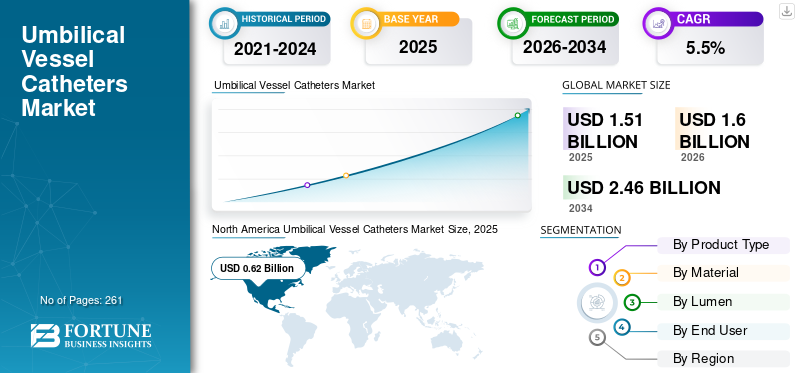
Download Free sample to learn more about this report.
UMBILICAL VESSEL CATHETERS MARKET KEY TAKEAWAYS
 Global Market Size & Forecast
- 2025 Market Size: USD 1.51 billion
- 2026 Market Size: USD 1.60 billion
- 2034 Forecast Market Size: USD 2.46 billion
- CAGR: 5.50% from 2026–2034
 Market Share
- North America dominated the market with a 41.06% share in 2025.
- The Polyurethane segment accounted for the largest market share of 56.00% in 2025.
- The Hospitals segment is expected to hold the largest market share of 82.20% in 2026.
 Key Regional Highlights
North America
The market reached USD 0.62 billion in 2025 and is projected to remain the leading regional market through 2026.
Europe
The market is projected to reach USD 0.43 billion by 2026, growing at a 4.30% CAGR, supported by increasing R&D investments and the launch of innovative umbilical vessel catheter products.
Asia Pacific
The market is projected to reach USD 0.37 billion by 2026, driven by expanding hospital infrastructure, improving healthcare access, and increasing adoption of neonatal care devices across India, China, and South Korea.
U.S.
The market is projected to reach USD 0.59 billion by 2026.
Japan
The market is projected to reach USD 0.06 billion by 2026.
Read More

Umbilical Vessel Catheters Market Trends
Technological Advancements in Umbilical Vessel Catheters are a Key Market Trend
The growing technological advancements are rapidly reshaping umbilical vessel catheters from standard NICU lines into more developed, safety-focused devices, especially by improving placement confidence, infection prevention, and workflow efficiency. This, along with an increasing focus on product innovations in catheter coatings, biocompatible materials, and securement, aims to reduce infection and thrombosis risks.
The integration of antimicrobial strategies into catheter construction, along with the adoption of ultrasound/POCUS-guided placement pathways, further reduces reliance on repeated radiographs and line adjustments. Moreover, neonatal units are focusing on sampling practices with closed-circuit blood draw approaches for arterial/umbilical lines to help minimize contamination risk from frequent sampling, fueling the demand for closed systems.
- In February 2024, NHS Trusts adopted a new umbilical catheter, which includes the AgION antimicrobial system, proven to reduce potentially fatal catheter-related bloodstream infections (CRBSIs) in pre-term NICU patients.
Download Free sample to learn more about this report.
Market Dynamics
Market Drivers
Increasing Number of Preterm Births to Fuel Market Growth
The growing prevalence of preterm births is supporting the demand for umbilical vessel catheters as prematurity is closely linked with frequent lab monitoring, early-life intensive care, and rapid initiation of intravenous therapy. Preterm and critically ill babies often require stable access after delivery for parenteral nutrition, antibiotics, vasoactive drugs, transfusions, and repeated sampling, which is boosting the adoption rate of these products in the market.
- For instance, according to data published by the Centers for Disease Control & Prevention (CDC), the percentage of infants admitted to a neonatal intensive care unit (NICU) rose from 8.7% in 2016 to 9.8% in 2023 in the U.S.
This, along with improvement in survival among neonates and standardization around reliable vascular access pathways and monitoring protocols, is resulting in growing demand for umbilical catheters. Therefore, the clinical dependence, along with continued admissions in the NICU department, is supporting the consistent procedure volumes and repeated purchasing of catheters and accessories, thereby contributing to the global umbilical vessel catheters market growth.
Other Prominent Drivers
- Training initiatives and standardized protocols promoting consistent use of UVCs in NICUs.
Market Restraints
High Cost of Advanced Devices to Hamper Market Growth
The growing admissions to NICUs are supporting the addition of premium features, including enhanced radiopacity for more apparent tip confirmation, antimicrobial integration, and safer materials. However, the higher acquisition cost of advanced umbilical vessel catheters can hamper the adoption, especially where procurement is driven by cost-sensitive tenders and strict accessories budgets.
Advanced umbilical catheters are considered high-volume devices used alongside multiple neonatal disposables, which makes it challenging for small hospitals and clinics to adopt these devices in the market. Therefore, high cost is resulting in slower adoption of advanced products, uneven uptake by region, and longer tender timelines, ultimately limiting the market growth.
- For instance, according to the statistics published by Bound Tree Medical, the cost of an Argyle umbilical vessel catheter is USD 779.99.
Market Opportunities
Expansion of Healthcare Network is Creating New Growth Opportunities
There is a rapid expansion of healthcare facilities in developing nations, such as India, Mexico, and others. The growing NICU admissions, rising preterm births, and expansion of hospital infrastructure, particularly maternity clinics and NICUs, are subsequently supporting the adoption of umbilical vessel catheters in healthcare facilities.
This, along with the tightening of referral pathways, has moved high-risk deliveries and unstable neonates faster into equipped centers, further driving higher procedure volumes and increasing consistent procurement of neonatal vascular access products.
- According to 2024 data published by Bliss, about 1 in 7 babies are admitted to the neonatal unit each year in the U.K.
Market Challenges
Limited Healthcare Access in Developing Nations to Limit Market Growth
There is a growing demand for umbilical vessel catheters among the patient population. However, limited availability of innovative products, limited healthcare expenditure, coupled with an inadequate reimbursement framework, particularly in emerging nations, are resulting in reduced access to healthcare facilities among the patient population.
Furthermore, a limited number of clinical facilities, a reduced number of NICU beds, among others, are some of the crucial factors, resulting in delayed admissions among the patient population, especially in developing nations, such as India, Brazil, among others.
- For instance, according to 2018 statistics published by HealthWorld, there are only 18,000 NICU beds available in India.
Other Prominent Challenges
- Infection risks, catheter-related bloodstream infections (CRBSI), and thrombosis concerns influence clinical guidelines.
- Increasing regulatory scrutiny and requirement for clinical evidence and post-market surveillance.
- Competition from alternative vascular access methods (peripheral IV, PICC lines) in select clinical scenarios.
- Supply chain and sterilization compliance for single-use devices.
SEGMENTATION ANALYSIS
By Product Type
Increasing Number of Preterm Births Led to Umbilical Venous Catheters Segment Dominance
Based on the product type, the market is classified into umbilical venous catheters (UVCs) and umbilical arterial catheters (UACs).
The umbilical venous catheters (UVCs) segment held the largest revenue share in 2025. The growth is driven by the increasing prevalence of preterm births, leading to greater adoption of these catheters globally. This, coupled with the increasing emphasis of prominent players on launching novel products, is further anticipated to support segment growth.
- For instance, according to 2025 statistics published by Springer Network, the number of preterm births is around 3.5 million in India.
The umbilical arterial catheters (UACs) segment is expected to grow at a CAGR of 5.7% over the forecast period.
To know how our report can help streamline your business, Speak to Analyst
By Material
Increasing Advantages of Polyurethane Led to Its Dominance
Based on material, the market is segmented into polyurethane, silicone, and others.
The polyurethane segment dominated the global market in 2025. By material, the polyurethane segment accounted for 56.0% in 2025. The growth is owing to the growing benefits of polyurethane, such as accurate tip advancement and adequate stiffness, among others, which is resulting in an increasing demand for polyurethane products, thereby supporting the adoption rate of these products in the market.
- For instance, according to a study published by MDPI, it was highlighted that polyurethane is one of the most widely used polymers in intravascular catheter manufacturing, owing to its balance of flexibility, strength, and radiopacity compatibility.
The silicone segment is set to flourish with a growth rate of 5.2% across the forecast period.
By Lumen
Single Lumen Segment Led Due to Its Several Benefits
Based on lumen, the market is segmented into single lumen, double lumen, and triple lumen.
The single lumen segment dominated the global market in 2025. By lumen, the single lumen segment held the share of 43.7% in 2025. The growth is due to the increasing prevalence of preterm births and the growing awareness of the benefits of single-lumen devices, among other factors. The rising adoption of single lumen products globally is fueling segmental growth.
- For instance, according to the neonatal clinical guidelines, single-lumen umbilical catheters are considered standard, with multi-lumen devices reserved for select cases where multiple simultaneous infusions are unavoidable.
The double lumen segment is set to flourish with a growth rate of 5.4% across the forecast period.
By End User
Increasing Number of Hospitals Led to Segmental Dominance
Based on end user, the market is divided into hospitals, specialty clinics, and others.
The hospitals segment dominated the market in 2025. The increasing number of NICU admissions, rising development of hospital networks, and the growing number of hospitals, among others, are some of the prominent factors contributing to the growth of the segment in the market. Furthermore, the segment is set to hold an 82.2% share in 2026.
- For instance, according to 2023 statistics published by Interweave Textiles, there are about 1,148 hospitals in the U.K.
The specialty clinics segment is projected to grow at a 4.9% CAGR during the forecast period.
Umbilical Vessel Catheters Market Regional Outlook
Based on region, the market has been studied across North America, Europe, Asia Pacific, Latin America, and the Middle East & Africa.
North America
North America Umbilical Vessel Catheters Market Size, 2025 (USD Billion)
To get more information on the regional analysis of this market, Download Free sample
North America held the dominant share in 2024, valued at USD 0.58 billion, and also took the leading share in 2025 with USD 0.62 billion. The growing prevalence of neonatal intensive care unit (NICU) admissions, the rising preterm birth rate, advanced hospital infrastructure, and substantial technological advancements in devices, among others, are some of the factors supporting the segment's growth in the market.
- For instance, according to 2024 statistics published by the American Hospital Association (AHA), there are about 6,093 hospitals in the U.S.
U.S. Umbilical Vessel Catheters Market
Based on North America’s strong contribution and the U.S. dominance within the region, the U.S. market can be analytically approximated at around USD 0.59 billion in 2026, accounting for roughly 36.9% of global sales.
Europe
Europe is projected to record a growth rate of 4.3% in the coming years, which is the second highest among all regions, and reach a valuation of USD 0.43 billion by 2026. The growing focus of key players on R&D to launch novel products is likely to support market growth.
U.K. Umbilical Vessel Catheters Market
The U.K. market in 2026 is estimated at around USD 0.16 billion, representing roughly 4.7% of global revenues.
Germany Umbilical Vessel Catheters Market
Germany’s market is projected to reach approximately USD 0.08 billion in 2026, equivalent to around 5.0% of global sales.
Asia Pacific
Asia Pacific is estimated to reach USD 0.37 billion in 2026 and secure the position of the third-largest region in the market. The fastest growth in hospital infrastructure, driven by population size, growing healthcare access in Asia Pacific countries, including South Korea, India, among others, is expected to support the growth of the market. In the region, India and China are both estimated to reach USD 0.07 billion and USD 0.12 billion, respectively, in 2026.
Japan Umbilical Vessel Catheters Market
The Japan market in 2026 is estimated at around USD 0.06 billion, accounting for roughly 3.8% of global revenues. Japan has historically reported a relatively high prevalence of preterm births, with a significant adoption rate of these devices in the market.
China Umbilical Vessel Catheters Market
China’s market is projected to be one of the largest worldwide, with 2026 revenues estimated at around USD 0.12 billion, representing roughly 7.5% of global sales.
India Umbilical Vessel Catheters Market
The India market size in 2026 is estimated at around USD 0.07 billion, accounting for roughly 4.2% of global revenues.
Latin America and Middle East & Africa
The Latin America and Middle East & Africa regions are expected to witness moderate growth in this market space during the forecast period. The Latin America market is set to reach a valuation of USD 0.09 billion in 2026. The growth is due to the gradual growth tied to public healthcare investment and adequate reimbursement policies in these regions. In the Middle East & Africa, the GCC is set to reach a value of USD 0.03 billion in 2026.
South Africa Umbilical Vessel Catheters Market
The South Africa market is projected to reach around USD 0.01 billion in 2026, representing roughly 0.8% of global revenues.
Competitive Landscape
Key Industry Players
Growing Expansion of Logistics Center by Key Players to Support Their Dominance
A robust and diversified product portfolio, along with a significant focus on inorganic growth strategies globally, is one of the crucial factors supporting the dominance of these companies in the market. Cardinal Health and Vygon SA are major companies in the market. Moreover, the growing focus of key companies on the expansion of logistics centers is likely to strengthen their presence, which is expected to support the global umbilical vessel catheters market share.
- For instance, in September 2025, Cardinal Health showcased its newly operational Consumer Health Logistics Center to efficiently distribute over-the-counter medications, treatments, and diagnostic solutions to a network of more than 20 forward distribution centers serving customers nationwide.
Other key players, including Medline Industries LP., and others, are also growing in the market, primarily due to their increasing focus on product launches to strengthen their presence in the market.
List of Key Umbilical Vessel Catheter Companies Profiled
- Cardinal Health (U.S.)
- Vygon SA (France)
- Medline Industries LP. (U.S.)
- Utah Medical Products, Inc. (U.S.)
- Sterimed Group (India)
- ANGIPLAST PRIVATE LIMITED (India)
- SURETECH MEDICAL (India)
- Neotech Products (U.S.)
- MHPL India (India)
- GPC Medical Ltd. (India)
KEY INDUSTRY DEVELOPMENTS
- July 2025: Haolang Technology launched an advanced Umbilical Venous Catheter (UVC) system to provide safer and more precise vascular access for preterm and critically ill newborns.
- January 2025: GPC Medical Ltd., organized a conference at the Dubai World Trade Centre with an aim to strengthen its brand presence.
- October 2024: Cardinal Health opened its new distribution center in Boylston, Massachusetts, supporting its U.S. Medical Products and Distribution business.
- August 2024: Laborie Medical Technologies Corp. acquired Novonate, Inc., including neonatal catheter securement technology used with umbilical catheters. This helped the company in strengthening its neonatal and umbilical vascular access product portfolio.
- August 2024: Cardinal Health opened a new distribution center in Walton Hills, Ohio, supporting its U.S. Medical Products and Distribution business.
- February 2024: Vygon SA’s Expert Umbilical catheter, incorporating AgION antimicrobial technology to reduce catheter-related bloodstream infections (CRBSIs) in preterm infants, began being used by around 60 NHS Trusts across the U.K., contributing to improved infection protection and shorter hospital stays in NICUs.
- March 2022: Vygon acquired Macatt Medica, a Peruvian distribution company, with an aim to strengthen its presence in South America.
REPORT COVERAGE
The report provides a detailed global umbilical vessel catheters market analysis and focuses on key aspects such as leading companies and market segments, including product type, material, lumen, and end user. Besides this, the global report offers insights into the market growth trends and highlights key industry developments. In addition to the aforementioned factors, the report encompasses several factors that have contributed to the growth and advancement of the market over recent years.
Request for Customization to gain extensive market insights.
Report Scope & Segmentation
| ATTRIBUTE | DETAILS |
| Study Period | 2021-2034 |
| Base Year | 2025 |
| Estimated Year | 2026 |
| Forecast Period | 2026-2034 |
| Historical Period | 2021-2024 |
| Growth Rate | CAGR of 5.5% from 2026-2034 |
| Unit | Value (USD Billion) |
| Segmentation | By Product Type, Material, Lumen, End User, and Region |
| By Product Type |
|
| By Material |
|
| By Lumen |
|
| By End User |
|
| By Region |
|
Frequently Asked Questions
Fortune Business Insights says that the global market size was USD 1.51 billion in 2025 and is projected to reach USD 2.46 billion by 2034.
In 2025, the North America regional market value stood at USD 0.62 billion.
Growing at a CAGR of 5.5%, the market will exhibit steady growth over the forecast period (2026-2034).
By product type, the umbilical venous catheters (UVCs) segment led the market.
The introduction of novel umbilical vessel catheters is one of the major factors driving the market's growth.
Cardinal Health and Vygon SA are the major players in the global market.
North America dominated the market share in 2025.
North America dominated the market share in 2025.



- 2021-2034
- 2025
- 2021-2024
- 261
Get 30-60 hrs Free Customization
Expand Regional and Country Coverage, Segments Analysis, Company Profiles, Competitive Benchmarking, and End-user Insights.













.webp)






-
US +1 833 909 2966 ( Toll Free )
-
Get In Touch With Us