Unmanned Marine Vehicles Market Size, Share & Industry Analysis, By Platform (Unmanned Surface Vehicles, Unmanned Underwater Vehicles & Hybrid/Multi-Domain Marine), By System Component (Vehicle Platform, Payloads & Sensors, Autonomy & Software, Command, Control & Communication), By Mode of Operation (Remote, Semi-Autonomous & Fully Autonomous), By Propulsion/Power (Battery-Electric, Diesel/Hybrid-Electric, Renewable, Fuel Cell), By Application (Mine Countermeasures, Maritime Surveillance, Anti-Submarine Warfare), By End User (Naval Forces, Offshore Oil), and Regional Forecast, 2026-2034
 Download Free Sample
Unmanned Marine Vehicles Market Size and Future Outlook
 Listen to Audio Version
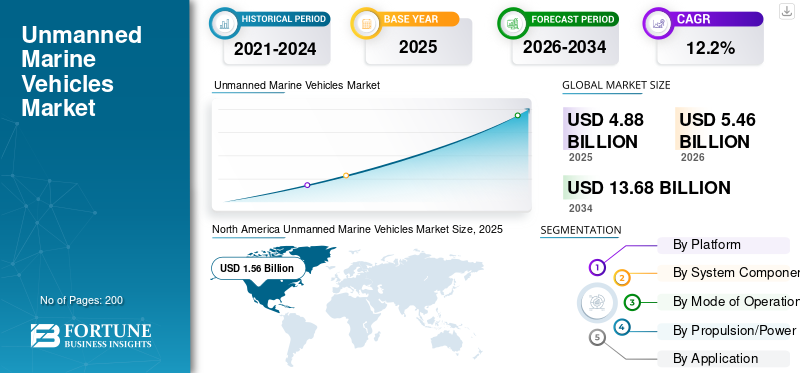
The unmanned marine vehicles market size was valued at USD 4.88 billion in 2025 and is projected to grow from USD 5.46 billion in 2026 to USD 13.68 billion by 2034, exhibiting a CAGR of 12.2% during the forecast period. North America dominated the unmanned marine vehicles market with a market share of 31.97% in 2025.
Unmanned marine vehicles are uncrewed platforms used on or under the water surface for defense, commercial, security, and research missions. The global market covers Unmanned Surface Vehicles (USVs), Unmanned Underwater Vehicles (UUVs), Remotely Operated Vehicles (ROVs), Autonomous Underwater Vehicles (AUVs), and hybrid systems used for maritime domain awareness, data collection, and offshore inspection, environmental monitoring, mine countermeasures, and port security. Market growth is being driven by naval modernization programs, increasing demand for autonomous systems that can operate in high-risk waters, and wider use in commercial application areas.
Key players in the market include Kongsberg Maritime, HII, Teledyne Marine, Anduril Industries, and Ocean Aero. These companies are strengthening the market through advanced UUVs, USVs, autonomy software, sensors, payload integration, and lifecycle support.
Download Free sample to learn more about this report.
Unmanned Marine Vehicles Market Key Takeways
 Global Market Size & Forecast
- 2025 Market Size: USD 4.88 billion
- 2026 Market Size: USD 5.46 billion
- 2034 Forecast Market Size: USD 13.68 billion
- CAGR: 12.2% from 2026–2034
 Market Share
- North America dominated the unmanned marine vehicles market with a 31.97% share in 2025.
- The Unmanned Underwater Vehicles (UUVs) segment held the largest market share in 2025.
- The Vehicle Platform segment accounted for the largest market share in 2025.
 Key Regional Highlights
North America
North America Led the global market, supported by advanced naval procurement, strong technology capabilities, and a well-established supplier ecosystem.
Europe
Europe Registered the second-fastest growth, driven by naval modernization, seabed infrastructure protection, and maritime surveillance initiatives.
Asia Pacific
Asia Pacific Expected to witness the highest CAGR of 14.1% during the forecast period, fueled by naval modernization and increasing investments in autonomous maritime systems.
U.S.
U.S. The market was valued at approximately USD 1.42 billion in 2025, supported by significant defense and maritime security investments.
Japan
Japan Growing investments in unmanned maritime technologies and undersea security are expected to support steady market expansion.
Read More

UNMANNED MARINE VEHICLES MARKET TRENDS
Expansion of Autonomous Undersea Platforms Supports Market Growth
The global market is moving toward larger, longer-endurance, and mission-ready autonomous undersea platforms. Navies are no longer viewing unmanned underwater vehicles only as survey or test assets; they are increasingly being positioned for maritime domain awareness, undersea ISR, seabed security, mine countermeasures, and distributed maritime operations. This trend is strengthening demand for autonomous systems that can operate with lower crew dependency, carry advanced sensors, support data collection, and extend naval reach in contested waters.
MARKET DYNAMICS
MARKET DRIVERS
Download Free sample to learn more about this report.
Naval Mine Countermeasure Modernization Drives Market Growth
Naval modernization programs are emerging as one of the strongest drivers for the global unmanned marine vehicles market growth, as navies are shifting mine hunting, seabed surveillance, and maritime domain awareness missions from crewed vessels. Unmanned underwater vehicles and unmanned surface vehicles are increasingly being used to reduce crew exposure, improve data collection, and support maritime operations in shallow, congested, or contested waters. This is strengthening demand for autonomous systems that can operate with advanced sensors, launch-and-recovery systems, and mission software across both defense and commercial application areas.
In April 2025, the U.K. Defence Equipment & Support issued a preliminary market engagement notice for the Mine Hunting Capability Block 2 procurement. The notice covered up to 24 uncrewed underwater vehicles and 8 launch and recovery systems for mine hunting and seabed surveillance, with an estimated value of approximately USD 160.00 million excluding VAT.
MARKET RESTRAINTS
Regulatory and Liability Uncertainty Restrains Market Growth
Regulatory uncertainty remains a major restraint for the global market, particularly for autonomous systems that are capable of operating beyond direct human control. While unmanned surface vehicles and unmanned underwater vehicles are already being used for maritime domain awareness, data collection, port security, offshore inspection, and naval missions, broader commercial use is still dependent on more precise rules for remote operators, collision liability, cybersecurity, search and rescue, certification, and liability.
MARKET OPPORTUNITIES
Critical Undersea Infrastructure Protection Creates Market Opportunity
Protection of undersea cables, pipelines, offshore energy assets, and port-linked seabed infrastructure is creating a strong opportunity for the global market. Governments and operators increasingly need persistent maritime domain awareness, underwater inspection, data collection, and rapid incident verification without relying only on crewed vessels or divers. This opens a wider demand for UUVs, USVs, seabed sensors, autonomous inspection payloads, and hybrid platforms that can support maritime operations across defense and commercial application areas.
MARKET CHALLENGES
Communication Reliability and Cybersecurity Gaps Challenge Market Growth
Communication reliability is one of the key challenges for the global market as the USVs and the UUVs are transitioning from controlled trials to operational maritime operations. Surface systems are heavily dependent on satellite, RF, and shore-based links. Underwater platforms are constrained by acoustic communication constraints, signal delay, lower bandwidth, and difficult navigation conditions. These challenges are further compounded when autonomous systems that can operate in teams require real-time data acquisition, payload control, and secure command links. For defense users, it’s not just about whether the vehicle can complete a mission but whether it can stay connected, withstand interference, and remain cyber secure in contested waters.
Impact of Ongoing Conflicts
Surging Need for Maritime Domain Awareness Due to Russia-Ukraine and Middle East Conflicts Accelerates Market Growth
The Russia-Ukraine war, Red Sea crisis, and wider Middle East conflicts are reshaping how navies and maritime agencies view unmanned marine vehicles. The conflict environment has increased the need for maritime domain awareness, port protection, mine countermeasures, seabed surveillance, and rapid data collection without placing crewed platforms at higher risk. In the European market analysis, the Russia-Ukraine conflict has strengthened demand for UUVs and USVs for Black Sea, Baltic Sea, and critical undersea infrastructure monitoring. In the Middle East & Africa, the Red Sea and Gulf security situation is pushing buyers toward autonomous systems that can operate in high-risk maritime corridors, support persistent surveillance, and improve response time during disrupted maritime operations.
In December 2023, the U.S. Department of Defense announced Operation Prosperity Guardian, a multinational maritime security mission to protect commercial vessels in the Red Sea after repeated Houthi drone and missile attacks.
Segmentation Analysis
By Platform
Unmanned Underwater Vehicles (UUVs) Dominated Market Due to Strong Undersea Mission Demand
By platform, the market is categorized into Unmanned Surface Vehicles (USVs), Unmanned Underwater Vehicles (UUVs), and hybrid/multi-domain marine vehicles.
Unmanned Underwater Vehicles (UUVs) dominated the global market in 2025, as the highest-value maritime missions are increasingly shifting below the surface. The segment consists of Autonomous Underwater Vehicles (AUVs), Remotely Operated Vehicles (ROVs), Underwater Gliders, Mine-Disposal/Expendable UUVs, and Large / Extra-Large UUVs. Navies, offshore operators, and research agencies use UUVs for mine countermeasures, seabed surveillance, underwater ISR, offshore asset inspection, hydrographic survey, and environmental monitoring. Compared with surface-only platforms, UUVs offer stronger mission relevance in contested or hard-to-access waters, where data collection, stealth, endurance, and reduced crew exposure are critical.
The hybrid/multi-domain marine vehicles segment is expected to grow at the highest CAGR of 19.1% over the forecast period. The hybrid/multi-domain marine vehicles segment consists of Surface-Underwater Hybrid Vehicles and USV-UAV / USV-UUV Teaming Systems.
To know how our report can help streamline your business, Speak to Analyst
By System Component
Vehicle Platform Segment Led Market Due to High Platform Procurement and Integration Cost
On the basis of system component, the market is classified into vehicle platform, payloads & sensors, autonomy & software, command, control & communication, launch & recovery systems, and services & lifecycle support.
The vehicle platform segment dominated the global unmanned marine vehicles market share in 2025, as the base vehicle remains the highest cost and capability layer in any UMV program. Whether the system is an unmanned surface vehicle or an unmanned underwater vehicle, the integrator first invests in the hull, propulsion, power system, navigation architecture, endurance capability, payload bay, and mission-ready onboard electronics before adding software, sensors, and lifecycle services. This makes vehicle platforms the largest revenue contributor, mainly as navies and maritime agencies procure larger UUVs, long-endurance USVs, and modular platforms for mine countermeasures, maritime domain awareness, offshore inspection, and undersea surveillance missions.
In September 2025, Australia announced a USD 1.10 billion investment to build dozens of Ghost Shark long-range autonomous underwater vehicles for the Royal Australian Navy.
The autonomy & software segment is expected to show the fastest growth, registering a CAGR of 16.7% over the forecast period.
By Mode of Operation
Remotely Operated Segment Commanded Market Due to Established ROV Use in Inspection and Intervention
By mode of operation, the market is classified into remotely operated, semi-autonomous/supervised autonomy, and fully autonomous.
The remotely operated segment held the majority share of the global market in 2025 as ROVs remain the most proven option for underwater inspection, intervention, repair support, and real-time operator-controlled missions. Remotely operated systems are still relied upon by offshore oil & gas operators, research institutions, naval users, and port authorities where direct human control is required for manipulation, visual inspection, sample collection, subsea maintenance, and safety-critical data collection. Autonomous systems are becoming more popular, but a large installed base exists for remotely operated vehicles, since this provides the operator with more confidence in complex underwater environments.
The fully autonomous segment is expected to show the fastest growth, registering a CAGR of 18.6% over the forecast period.
By Propulsion/Power Source
Battery-Electric Segment Led Market Due to Its Wide Use Across AUVs and Compact UUVs
On the basis of propulsion/power source, the market is classified into battery-electric, diesel/hybrid-electric, renewable/energy harvesting, fuel cell/advanced power, and tethered power.
The battery-electric segment was the most dominant in the global market in 2025, as it is the ideal power source for small and medium unmanned underwater vehicles, AUVs, underwater gliders, mine-disposal systems, and compact unmanned surface vehicles. Battery-electric propulsion supports quiet operation, lower maintenance, easier deployment, and mission flexibility, which makes it well-suited for mine countermeasures, hydrographic survey, data collection, environmental monitoring, offshore inspection, and maritime domain awareness. For larger and longer-endurance vehicles, diesel/hybrid and fuel-cell systems are important. However, battery-electric platforms still have the largest installed base, as they are used extensively across both defense and commercial application missions.
The fuel cell/advanced power segment is expected to show the fastest growth, registering a CAGR of 19.7% over the forecast period.
By Application
Mine Countermeasures (MCM) Segment Dominated Market Due to Rising Mine Warfare Modernization
By application, the market is further divided into Mine Countermeasures (MCM), ISR & maritime surveillance, anti-submarine warfare & seabed warfare, hydrographic survey & seabed mapping, offshore energy inspection, ocean science & environmental monitoring, port, harbor & coastal security, logistics & payload delivery, and search & rescue/emergency response.
The Mine Countermeasures (MCM) segment dominated the global market in 2025, as navies are substituting crew-intensive mine hunting with unmanned, modular, and stand-off mission systems. Unmanned underwater vehicles and unmanned surface vehicles are increasingly used for mine detection, classification, identification, and seabed surveillance, allowing naval forces to reduce crew exposure while improving data collection in shallow, contested, or infrastructure-heavy waters.
The anti-submarine warfare & seabed warfare segment is expected to show the fastest market growth, registering a CAGR of 16.0% over the forecast period.
By End User
Naval Forces Segment Dominated Market Due to High Defense Procurement and Undersea Mission Demand
Based on end user, the market is segmented into naval forces, offshore oil & gas operators, defense contractors & system integrators, and others.
The naval forces segment dominated the global market in 2025 and is anticipated to grow at the fastest pace during the forecast period. This is due to the fact that most high-value and demanding UMVs are associated with defense missions such as mine countermeasures, undersea ISR, seabed surveillance, anti-submarine warfare support, maritime domain awareness, and distributed maritime operations. To reduce crew exposure, extend sensing coverage, and operate in shallow, contested, or high-threat waters where crewed platforms are costly or vulnerable, navies are turning to unmanned UUVs and USVs.
The defense contractors & system integrators segment is expected to show the second fastest market growth, registering a CAGR of 12.8% over the forecast period.
Unmanned Marine Vehicles Market Regional Outlook
North America Takes the Lead in Market Due to Strong U.S. Naval Procurement and Industrial Base
By geography, the market is categorized into North America, Europe, Asia Pacific, and the Rest of the World.
North America
North America Unmanned Marine Vehicles Market Size, 2025 (USD Billion)
To get more information on the regional analysis of this market, Download Free sample
North America holds the largest market share and is anticipated to grow at a CAGR of 11.2% over the forecast period. The region consists of a mix of naval procurement, technology maturity, testing infrastructure, and supplier capability, resulting in region dominance. The region also benefits from a deep ecosystem of unmanned underwater vehicles, unmanned surface vehicles, autonomy software, payload integration, and lifecycle support providers. This gives North America a stronger position than other regions, as unmanned platforms are already moving from experimental use into operational defense and maritime security programs.
U.S. Unmanned Marine Vehicles Market
Based on the strong contribution of North America to the market and the dominance of the U.S. within the region, the U.S. market stood at around USD 1.42 billion in 2025, growing at a CAGR of 10.9%.
Europe
The market in Europe is anticipated to grow at the second-fastest pace, registering a CAGR of 12.4% during the forecast period. The market is driven by modernization of mine countermeasures, seabed infrastructure protection, offshore energy inspection, and increased naval surveillance requirements in the North Sea, Baltic Sea, Mediterranean, and Black Sea. The region is more weighted toward UUVs as European navies are increasingly utilizing UUVs for mine hunting, seabed mapping, underwater ISR, and critical infrastructure monitoring. The Russia-Ukraine conflict has also changed the regional security mindset, with countries such as the U.K., France, Germany, Norway, and other NATO members viewing maritime domain awareness as a strategic priority, not a routine naval function.
France Unmanned Marine Vehicles Market
The market in France reached approximately USD 0.25 billion in 2025, equivalent to around 17.65% of Europe's revenues.
Asia Pacific
Asia Pacific is anticipated to grow at the highest CAGR of 14.1% over the forecast period. The market is supported by naval modernization programs, island-chain surveillance, undersea security, mine countermeasures, and offshore infrastructure monitoring. China, India, Japan, South Korea, and Australia are investing in unmanned surface vehicles, unmanned underwater vehicles, and hybrid systems to strengthen maritime operations across contested waters and large exclusive economic zones. The region is also moving quickly toward autonomous systems that can operate for longer missions, collect data in difficult sea conditions, and support defense as well as commercial application areas such as hydrographic survey, offshore inspection, and environmental monitoring.
China Unmanned Marine Vehicles Market
The Chinese market revenues stood at around USD 0.42 billion in 2025, representing roughly 35.70% of Asia Pacific sales.
India Unmanned Marine Vehicles Market
The Indian market in 2025 stood at around USD 0.16 billion, accounting for roughly 13.20% of Asia Pacific revenues.
Rest of the World
The Rest of the World (Middle East & Africa and Latin America) holds a comparatively smaller market share but is expected to grow at a 10.2% CAGR during the forecast period. In the Middle East & Africa, demand is supported by Gulf and Red Sea maritime security, offshore oil & gas protection, port surveillance, coastal monitoring, and naval base security. Latin America is driven by offshore inspection, hydrographic survey, port security, fisheries protection, and coastal law enforcement needs.
Latin America Unmanned Marine Vehicles Market
The market in Latin America reached around USD 0.25 billion, accounting for roughly 35.20% of Rest of the World revenues, in 2025.
Middle East & Africa Unmanned Marine Vehicles Market
The Middle East & Africa market stood at around USD 0.46 billion in 2025 and is expected to reach USD 1.18 billion by 2034.
COMPETITIVE LANDSCAPE
Key Industry Players
Key Players Shift Focus from Standalone Drones to Fully Integrated Autonomous Systems
The global unmanned marine vehicles market is led by players such as Kongsberg Maritime, HII, Teledyne Marine, Anduril Industries, Atlas Elektronik, and Ocean Aero. Competition is moving beyond standalone platforms toward integrated systems covering UUVs, USVs, payloads, autonomy software, launch-and-recovery systems, and lifecycle support.
Key companies are driving market growth through naval contracts, product upgrades, and mission-ready autonomous systems that can operate in complex maritime operations. HII’s REMUS/Lionfish portfolio supports U.S. Undersea programs, Kongsberg’s HUGIN family remains strong in UUV missions, and Anduril’s Ghost Shark highlights the shift toward larger autonomous undersea platforms. European players such as Saab, Thales, Exail, and Atlas Elektronik remain active in mine countermeasures, seabed surveillance, and maritime domain awareness solutions.
LIST OF KEY UNMANNED MARINE VEHICLE COMPANIES PROFILED
- Kongsberg Maritime AS (Norway)
- Huntington Ingalls Industries, Inc. (U.S.)
- Teledyne Technologies Incorporated (U.S.)
- Anduril Industries, Inc. (U.S.)
- L3Harris Technologies, Inc. (U.S.)
- Saab AB (Sweden)
- Thales S.A. (France)
- Exail SAS (France)
- ATLAS ELEKTRONIK GmbH (Germany)
- General Dynamics Mission Systems, Inc. (U.S.)
- Elbit Systems Ltd. (Israel)
- Ocean Aero, Inc. (U.S.)
KEY INDUSTRY DEVELOPMENTS
- September 2025: Australia announced a USD 1.10 billion investment to build dozens of Ghost Shark long-range autonomous underwater vehicles with Anduril Australia. The first vehicles are expected to be delivered to the Royal Australian Navy from January 2026 under a five-year contract.
- April 2025: K. Defence Equipment & Support issued a preliminary market engagement notice for the MHC Block 2 Uncrewed Underwater Vehicles procurement, covering up to 24 UUVs and 8 Launch and Recovery Systems for mine hunting and seabed surveillance. The estimated value was about USD 156.25 million excluding VAT.
- February 2025: The U.S. Navy awarded Bollinger Shipyards an MCM Unmanned Surface Vehicle Advanced Material Order valued at USD 7.70 million to procure items needed to improve the MCM USV based on operational testing findings.
- February 2025: The U.S. Navy awarded Raytheon Technologies a Minehunt Payload Delivery System production contract valued at USD 18.30 million to produce 5 units, with deliveries expected by the end of FY2026.
- February 2025: The U.S. Navy awarded Textron Systems a Minesweep Payload Delivery System production contract valued at USD 12.10 million to produce 4 units, with delivery expected in early FY2027.
- January 2025: NATO launched Baltic Sentry to strengthen the protection of undersea cables and critical infrastructure in the Baltic Sea. The mission includes frigates, maritime patrol aircraft, and naval drones, reinforcing demand for unmanned maritime surveillance and seabed-security systems.
- May 2024: DARPA announced that Northrop Grumman’s Manta Ray uncrewed underwater vehicle completed full-scale in-water testing off Southern California. The program demonstrated modular transport, field assembly, and long-duration UUV capability.
- October 2023: HII’s Mission Technologies division received a U.S. Navy contract worth more than USD 347.00 million for the Lionfish Small Unmanned Undersea Vehicle program. The contract included an initial build of 9 SUUVs and could expand to as many as 200 vehicles over five years.
REPORT COVERAGE
The global unmanned marine vehicles market analysis provides an in-depth study of market size, market segmentation, company profiling & forecast by all the market segments included in the report. It includes details on the market dynamics and trends that are expected to drive the market during the forecast period. It offers information on the technological advancements, new product launches, key industry experts’ developments, and details on strategic partnerships, mergers & acquisitions. The market research report also encompasses a detailed competitive landscape with information on the market share and profiles of key players.
Request for Customization to gain extensive market insights.
Report Scope & Segmentation
| ATTRIBUTE | DETAILS |
| Study Period | 2021-2034 |
| Base Year | 2025 |
| Estimated Year | 2026 |
| Forecast Period | 2026-2034 |
| Historical Period | 2021-2024 |
| Growth Rate | CAGR of 12.2% from 2026 to 2034 |
| Unit | Value (USD Billion) |
|
Segmentation |
By Platform
|
|
By System Component
|
|
|
By Mode of Operation
|
|
|
By Propulsion/Power Source
|
|
|
By Application
|
|
|
By End User
|
|
|
By Region
|
Frequently Asked Questions
Fortune Business Insights says that the global market value stood at USD 5.46 billion in 2026 and is projected to reach USD 13.68 billion by 2034.
In 2025, the North America market value stood at USD 1.56 billion.
The market is expected to exhibit a CAGR of 12.2% during the forecast period.
Unmanned Underwater Vehicles (UUVs) led the market by platform.
Naval mine countermeasure modernization drives market growth.
Key players in the market include Kongsberg Maritime AS, Huntington Ingalls Industries, Inc., Teledyne Technologies Incorporated, and Anduril Industries, Inc.
North America dominated the market.



- 2021-2034
- 2025
- 2021-2024
- 200
Get 30-60 hrs Free Customization
Expand Regional and Country Coverage, Segments Analysis, Company Profiles, Competitive Benchmarking, and End-user Insights.




















-
US +1 833 909 2966 ( Toll Free )
-
Get In Touch With Us