Upcycled Fashion Market Size, Share & Industry Analysis, By Type (Apparel, Accessories, Footwear, and Others), By End-Use (Women, Men, Unisex, and Others), Distribution Channel (Offline and Online), and Regional Forecast, 2026-2034
 Download Free Sample
(Offer valid till 15th Oct 2026)

Upcycled Fashion Market Size and Industry Overview
 Listen to Audio Version
The global upcycled fashion market size was valued at USD 8.98 billion in 2025 and is projected to grow from USD 9.78 billion in 2026 to USD 19.47 billion by 2034, exhibiting a CAGR of 8.99% over the forecast period. Asia Pacific dominated the upcycled fashion market with a market share of 29.11% in 2025.
Upcycling is the process of transforming used and discarded items into new products with higher market value. Upcycled clothing uses unwanted and wasteful textiles, clothing scraps from textile factories, and deadstock of garments to create new products, such as designer apparel, accessories, and footwear, among others. In recycled clothing, there is often a mix-match approach with many types of fabrics repurposed into clothing. Thus, new items are refashioned from a combination of waste materials. The repurposed clothing market has witnessed healthy growth for the past few years, driven by the aim to reduce the fashion industry’s environmental impact, increasing consumer consciousness regarding the impact of their choices, and the desire for unique, sustainable clothing.
Upcycled clothing is not just about waste reduction, but also a revolutionary approach that redefines the lifecycle of garments, transforming outdated or unused textiles into stylish and trendy pieces. This practice has allowed for constant evolution in fashion items, catering to individuals’ desire for novelty and self-expression without leaving additional negative traces of fast fashion clothing.
The COVID-19 pandemic caused unprecedented disruptions across industries, and the fashion industry wasn’t an exception to it. The negative impact was brought about by a sharp decline in spending power and customer consumption patterns, which resulted in overstocking in warehouses. The global value of excess inventory for the spring/summer 2020 season ranged between USD 140 and 160 billion, which is more than double the normal value. This forced many players to reinvent themselves to manage excess stock and find a solution with upcycling.
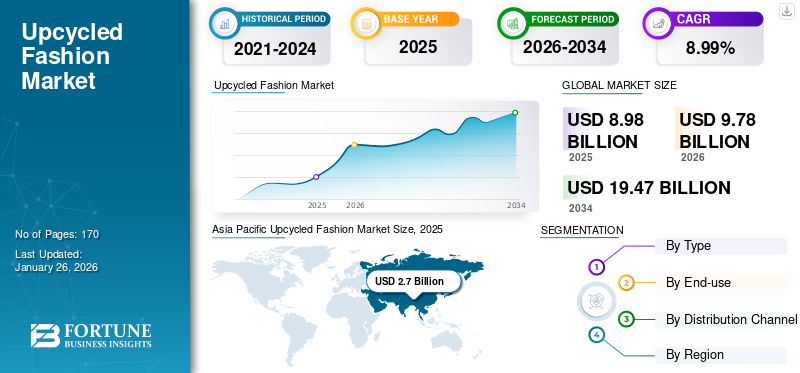
Download Free sample to learn more about this report.
Upcycled Fashion Market key takeaways
 Market Size & Forecast
- 2025 Market Size: USD 8.98 billion
- 2026 Market Size: USD 9.78 billion
- 2034 Forecast Market Size: USD 19.47 billion
- CAGR: 8.99% from 2026-2034
 Market Share
- Asia Pacific dominated the upcycled fashion market with a 29.11% share in 2025.
- The apparel segment is projected to account for a 69.35% share in 2026.
- The women segment is projected to hold a 44.19% share in 2026.
 Key Regional Highlights
North America
North America reached USD 3.11 billion in 2025 and is projected to grow to USD 3.37 billion in 2026.
Asia Pacific
Asia Pacific accounted for USD 2.61 billion in 2025 and is expected to reach USD 2.87 billion in 2026.
Europe
Europe recorded USD 2.70 billion in 2025 and is expected to register the second-fastest CAGR of 9.49% during the forecast period.
U.S.
The upcycled fashion market is projected to reach USD 2.81 billion in 2026.
Japan
The upcycled fashion market is projected to reach USD 0.29 billion in 2026.
Read More

Upcycled Fashion Market Trends
Increased Transparency, Ethical Manufacturing, and Integration of Technology
Consumers are becoming increasingly interested in knowing and understanding where their clothes come from, what they are made of, and how. Brands are responding by being more transparent about their supply chains and implementing ethical manufacturing practices. This is driven by consumer willingness to pay more for eco-friendly and sustainable upcycled clothing. Furthermore, the use of data and Artificial Intelligence (AI) is helping brands enhance their sustainability. AI is used to design digital samples, predict fashion trends, and provide virtual fitting rooms, reducing waste and improving customer satisfaction levels.
Download Free sample to learn more about this report.
Upcycled Fashion Market Growth Factors
Alarming Impact of Textile Waste
One of the primary drivers for the rise of reused clothing is the alarming impact of textile waste. The fashion industry is infamous for its high levels of waste and pollution, with millions of tons of clothing ending up in landfills every year. The Ellen MacArthur Foundation, a U.K.-based charity promoting circular economy, cited that over USD 500 billion is lost each year owing to clothing underutilization. Also, the survey conducted by the foundation stated that the average American is said to dump about 37kg/81 pounds of clothes every year. At the same time, it further mentioned that around 85% of the garments produced end up in landfills or get burned. Upcycling addresses this concern by giving new life to discarded garments, thereby reducing waste and conserving resources.
Rise in Demand for Sustainable Fashion
Consumer demand for sustainable and ethical fashion has surged in the last couple of years, particularly among younger generations. These consumers prioritize eco-friendly practices and are drawn to the creativity and individuality that recycled clothing offers. Every upcycled piece is often one-of-a-kind, fulfilling the desire for personalized and unique fashion. Additionally, designers and brands are increasingly incorporating upcycling into their business models. For instance, Loro Piana, Italian Maison offering high-quality textiles, recently launched a new sustainable collection, “Loro”-Re-Cashmere for all, which includes signature pieces made from a mixture of recycled and new, undyed cashmere. This collection circularly uses existing waste materials, creating ageless and genderless pieces and signifying the luxury industry’s commitment to the responsible use of resources.
Moreover, upcycled fashion items support a circular economy by extending the life cycle of waste materials and products. This approach minimizes the need for new raw materials and reduces the overall carbon emission of the fashion industry.
RESTRAINING FACTORS
Higher Costs Associated with Upcycled Fashion
The upcycled fashion industry, while beneficial in many ways, does have certain downsides of its own. These disadvantages include the potential for higher costs due to the labor-intensive nature of crafting unique items, limited scalability for large-scale production resulting in a higher price of items, and sometimes, difficulty in sourcing suitable raw materials for high-quality upcycled products. Besides, upcycled fashion can sometimes compromise on quality and durability as it often uses waste materials. Therefore, the final product might not last as long as new items made from fresh fabrics. Furthermore, the upcycled items can sometimes be perceived as less desirable or inferior to new ones. Overcoming the stigma associated with repurposed or second-hand items stands as a significant marketing challenge. Moreover, designers are constrained by the materials available to them, which can limit creativity and result in a less diverse range of products. These aspects are likely to hamper the upcycled fashion market growth.
Upcycled Fashion Market Segmentation Analysis
By Type Analysis
Diverse Collection of Clothing Items to Lead Growth of Apparel Segment
By type, the market is divided into apparel, accessories, footwear, and others.
The apparel segment is likely projected to hold the majority of the market share during the forecast period with a share of 69.35% in 2026. Also, consumers are becoming more aware of their choices and seeking sustainable fashion alternatives for clothing, leading to the growth of the apparel category.
Meanwhile, the accessories segment is forecasted to record the fastest CAGR. This segment includes handbags & wallets, gloves, scrunchies, scarves, braided hairbands, brooches, and others. Many brands are coming forward and engaging in innovative upcycling, finding creative ways to repurpose materials. For instance, in November 2021, Ferragamo, the renowned Italian luxury fashion house, revealed a limited edition capsule collection called Icon-up. The collection comprised 300 pieces showcasing women’s shoes and belts, all upcycled from the brand's extensive inventory. Furthermore, this carefully curated collection featured elegantly adorning upcycled ballerinas, iconic printed scarves, and charming bows crafted from the fabric. Also, each product in this exclusive collection was packaged in reusable dust bags, which were also made from existing fabrics.
To know how our report can help streamline your business, Speak to Analyst
By End-use Analysis
High Desire for Innovative and Unique Clothing to Lead to Growth of Women’s Category
By end-use, the market is segmented into men, women, unisex, and others.
The women segment is projected to dominate the market with a share of 44.19% in 2026, contributing to the largest revenue and share. Women enjoy the process of shopping for clothes and revising their wardrobes as it allows them to express themselves and their creativity. It also enables them to be an active participant in the fashion industry. Women tend to be excited about trying on different looks and have more aesthetic freedom to choose from a variety of clothing, accessories, and cosmetics. Thus, the wide availability of fashion products and their appetite for fashion contributes to higher revenue generation by the women’s segment.
Meanwhile, the men’s segment is anticipated to record the fastest CAGR of 10.01% over the forecast period. Primary factors contributing to the growth of the segment include the growing interest of men in fashion. Modern men, especially the younger generation, are paying more attention to their appearance, and therefore, retailers, too, have shifted their responsiveness toward menswear. Better lifestyles and cultural trends surrounding male interest in fashion have resulted in increased willingness among men to spend more on their appearance. Furthermore, the growing influence of social media platforms and inspiration from celebrities and sports personnel are encouraging men to shop more, which, in turn, is likely to supplement the segment’s growth.
By Distribution Channel
Convenience Brought by Online Channels to Boost Growth of Online Distribution Channels
Based on distribution channel, the market is segmented into online and offline.
The online distribution platform segment is projected to grow significantly with the fastest CAGR owing to an increase in the number of smartphone users and rising penetration of internet. The segment is expected to capture 64.3% of the market share in 2025. Widespread usage of e-commerce channels, ease of use, accessibility to a wide range of collections from the comfort of home, rapid deliveries, and offers & sale discounts provided by e-commerce retailers are some of the few aspects boosting the growth of the segment. Moreover, brands promote their products online via popular personalities or influencers, which further stimulate the segment’s growth.
Meanwhile, the offline distribution channel segment is anticipated to accounted for the largest share of the market with a share of 64.13% in 2026. The segment is expected to showcase a CAGR of 9.69% during the forecast period. Brick-and-mortar stores, specialty stores, and designer showrooms offer consumers access to a wide variety of product ranges and free trials. Additionally, a more personalized shopping experience and knowledgeable staff who can assist at offline stores contribute to the segment’s growth.
REGIONAL INSIGHTS
Geographically, the market is divided into North America, South America, Europe, Asia Pacific, and the Middle East & Africa.
Europe
Asia Pacific Upcycled Fashion Market Size, 2025 (USD Billion)
To get more information on the regional analysis of this market, Download Free sample
Europe held the largest share in 2025 in terms of revenue and is expected to maintain its leading position in the market. Europe is anticipated to account for the second-highest market size of USD 2.7 billion in 2025, exhibiting the second-fastest growing CAGR of 9.49% during the forecast period. The regional market’s growth is driven by government initiatives to promote a digital circular economy, stringent regulations imposed by authoritative bodies of different countries to address environmental impact concerns, and alarming levels of carbon emissions. Consequently, favorable policies are present for brands that work toward sustainability, which supports the regional market’s growth. For instance, the U.K. government launched an R&D project, National Interdisciplinary Circular Economy Research on Circular Economy. The project has an investment of USD 32 million for the period of 2021-2025. These ongoing R&D projects and investments around upcycled fashion are playing a vital role in driving the European market’s growth. The UK upcycled fashion market is projected to reach USD 0.40 billion by 2026, while the Germany upcycled fashion market is projected to reach USD 0.53 billion by 2026.
Asia Pacific
To know how our report can help streamline your business, Speak to Analyst
The Asia Pacific market is expected to record the fastest CAGR during the forecast period of 2026-2034. Asia Pacific contributed approximately USD 2.61 billion to the global market in 2025, accounting for 29.11% share, and is expected to reach USD 2.87 billion in 2026. The growth of the region is likely to be driven by growing government incentives and favorable policies to reduce carbon emissions of businesses. Developing countries, such as India and China are displaying enormous interest in meeting resource efficiency and circular economy strategies, which is projected to supplement the regional market’s growth. The Japan upcycled fashion market is projected to reach USD 0.29 billion by 2026, the China upcycled fashion market is projected to reach USD 0.80 billion by 2026, and the India upcycled fashion market is projected to reach USD 0.71 billion by 2026.
North America
In North America, upcycled fashion is gaining strong momentum as consumers increasingly prioritize sustainability and waste reduction. North America held the largest regional market with a value of USD 3.11 billion in 2025, and in 2026 the market value stood at USD 3.37 billion. Growing awareness of circular fashion and eco-friendly practices has led both independent designers and established brands to experiment with repurposed textiles. Younger demographics, especially Gen Z, are driving demand through social media trends and thrifting culture. Retailers are responding with dedicated upcycled collections and collaborations with artisans. The region also benefits from advanced recycling infrastructure, making material sourcing more efficient. However, scalability and price sensitivity remain challenges. Overall, upcycling is moving from niche to mainstream, supported by both cultural and regulatory pushes. The U.S. upcycled fashion market is projected to reach USD 2.81 billion by 2026.
South America and Middle East & Africa
In South America and the Middle East & Africa, upcycled fashion is emerging as a creative and sustainable response to growing concerns over textile waste and fast fashion. In 2025, South America represented USD 0.68 billion, accounting for 5.67% of the worldwide market, and is projected to grow to USD 0.71 billion in 2026. In South America, local artisans and small brands emphasize cultural identity and craftsmanship, while in MEA, African designers often repurpose fabrics and secondhand imports into affordable garments, and Gulf markets are slowly adopting eco-conscious upcycled collections. The Middle East & Africa region captured 1.82% of the global market in 2025, generating USD 0.16 billion in revenue, and is projected to reach USD 0.17 billion in 2026. Across both regions, younger consumers and social media are fueling awareness, positioning upcycling as both a lifestyle choice and cultural expression. Limited infrastructure, high costs, and low consumer awareness still pose barriers, but community-led initiatives, start-ups, and digital platforms are helping overcome these challenges. As sustainability gains momentum, upcycled fashion is steadily moving from niche to recognized practice, offering opportunities for innovation and local value creation in the regions. The UAE market size is expected to hit USD 16.54 million in 2025.
KEY INDUSTRY PLAYERS
Government Auxiliary Activities to Strengthen Competition Amongst Market Players
The upcycled fashion market is consolidated in nature. Market players are undertaking sustainable practices and maintaining transparency with their customers regarding their manufacturing processes and where their materials are sourced from. This is increasing consumers’ confidence about their choices. Additionally, brands are leveraging government schemes, including various grants, tax breaks, subsidies, and regulatory support, which is serving as a strong catalyst for companies seeking to adopt circular economy principles. Additionally, rising mergers and acquisitions among players is expected to reinforce market dynamics. For instance, in October 2022, La Bouche Rouge, a French clean beauty brand, entered an innovative collaboration with Gianvito Rossi, an Italian luxury shoe and accessories brand. Under this collaborative partnership, a limited edition collection featuring upcycled leather cases for two exclusive lip shades were launched. These lip shades include Gianvito Red: Satin - Bright Bluish Red and Gianvito Pink: Balm - Nude Pink.
LIST OF TOP UPCYCLED FASHION COMPANIES:
- Ferragamo (Italy)
- La Bouche Rouge (France)
- Hublot (Switzerland)
- Rothy's (U.S.)
- Todd Snyder (U.S.)
- Lumene (U.S.)
- Patagonia (U.S.)
- Eileen Fisher (U.S.)
- Beyond Retro (U.K.)
- TOAST (U.K.)
Key Industry Developments:
- April 2024: Eileen Fisher, designer, manufacturer, and supplier of fashionable clothing, and upcycled fashion launched a collection of gently worn clothing that have been overdyed with natural indigo by botanical colors.
- November 2023: Fashion giant Patagonia partnered with social impact company, United Repair Centre London (URC London) to launch a new clothing repair centre in London. The centre employs and trains people who have challenges finding employment, such as refugees.
- July 2023: Patagonia, outdoor clothing company, launched new online returns portal to promote a circular fashion economy among both the general public and the industry.
- October 2022: Italian luxury footwear specialist Gianvito Rossi and French eco-luxury beauty brand La Bouche Rouge teamed up to launch a limited-edition capsule. Under this collaboration, La Bouche Rouge’s refillable lipstick cases are made available in silver leather and dusky pink, using offcuts from Gianvito Rossi’s permanent collection of leather shoes. This collaboration redefines fashion, beauty, and sustainability.
- November 2021: Salvatore Ferragamo, one of the most pronounced Italian luxury houses, launched a 300-piece collection of upcycled shoes and accessories named Icon-Up. Each of the items from the collection has been crafted with repurposed luxury materials and products while maintaining local production, heritage, and Made In Italy hallmarks that are signature to the brand.
REPORT COVERAGE
The report provides a detailed analysis of the market and focuses on key aspects, such as competitive landscape, services, and leading product types. Besides this, it offers market insights and highlights key industry developments. In addition to the aforementioned factors, the report encompasses several factors that have contributed to the growth of the market in recent years.
Request for Customization to gain extensive market insights.
Report Scope & Segmentation
|
ATTRIBUTE |
DETAILS |
|
Study Period |
2021-2034 |
|
Base Year |
2025 |
|
Estimated Year |
2026 |
|
Forecast Period |
2026-2034 |
|
Historical Period |
2021-2024 |
|
Growth Rate |
CAGR of 8.99% from 2026 to 2034 |
|
Unit |
Value (USD Million) |
|
Segmentation
|
By Type
|
|
By End-use
|
|
|
By Distribution Channel
|
|
|
By Region
|
Frequently Asked Questions
According to Fortune Business Insights, the global upcycled fashion market size was valued at USD 8.98 billion in 2025. It is projected to grow from USD 9.78 billion in 2026 to USD 19.47 billion by 2034.
Recording a CAGR of 8.99% the market will exhibit a steady growth rate during the forecast period.
Upcycled fashion refers to the practice of transforming discarded clothing, textiles, and scraps into new garments or accessories. Unlike recycling, upcycling adds value by repurposing waste materials into higher-quality, stylish, and unique fashion items, promoting sustainability and reducing landfill waste.
Upcycled fashion helps reduce textile waste, minimizes the need for virgin materials, and lowers carbon emissions. It extends the lifecycle of clothing and combats the environmental impact of fast fashion by reducing pollution, overproduction, and landfill overflow.
Asia Pacific dominated the global upcycled fashion market in 2025, accounting for 29.11% of the market share, driven by sustainable development policies, rising consumer awareness, and growing fashion industry investments in countries like India and China.
Key trends include AI-assisted design, digital fitting rooms, ethical manufacturing, and increased transparency in supply chains. Consumers are seeking personalized and traceable fashion choices that align with their eco-conscious values.
Leading companies include Ferragamo, Patagonia, La Bouche Rouge, Beyond Retro, Eileen Fisher, and Rothys. These brands focus on reusing textiles, launching limited-edition capsule collections, and integrating circular economy principles into their production.



- 2021-2034
- 2025
- 2021-2024
- 170
-
(Offer valid till 15th Oct 2026)
Get 30-60 hrs Free Customization
Expand Regional and Country Coverage, Segments Analysis, Company Profiles, Competitive Benchmarking, and End-user Insights.



















Related Reports
-
US +1 833 909 2966 ( Toll Free )
-
Get In Touch With Us