Utility Terrain Vehicle Market Size, Share & Industry Analysis, By Propulsion Type (ICE (Below 400 CC, 400–800 CC and Above 800 CC) and Electric (Up to 50 kW and Above 50 kW)), By End-Use Industry (Construction, Agriculture, Industrial Facilities, Warehouses & Logistics, Hotels & Resorts, Corporate, Medical & Educational Campuses, and Parks, Campgrounds & Recreational Facilities), By Seating Capacity (2-Seater UTVs, 4-Seater UTVs, and 6-Seater), By Drive Type (2-Wheel Drive (2WD) and 4-Wheel Drive (4WD / AWD)), and Regional Forecast, 2026-2034
 Download Free Sample
(Offer valid till 30th Sep 2026)

Utility Terrain Vehicle Market Size and Future Outlook
 Listen to Audio Version
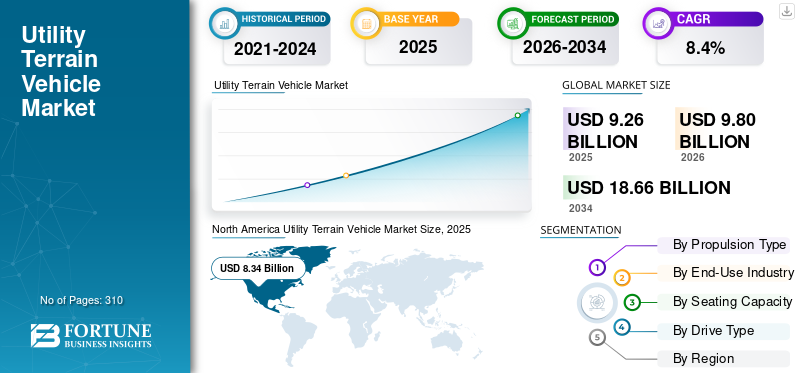
The global utility terrain vehicle market size was valued at USD 9.26 billion in 2025. The market is projected to grow from USD 9.80 billion in 2026 to USD 18.66 billion by 2034, exhibiting a CAGR of 8.4% during the forecast period. North America dominated the utility terrain vehicle market with a market share of 90.06% in 2025.
The global Utility Terrain Vehicle (UTV) market refers to production, distribution, and sale of multi-purpose off-road vehicles designed for both work and recreational use. These vehicles are widely utilized across agriculture, construction, military, and outdoor sports. The market encompasses OEMs, aftermarket components, and technological advancements, driven by increasing demand for durable, high-performance vehicles capable of operating across diverse terrains and conditions.
Key drivers in the market include rising demand for off-road recreational activities, increasing adoption in agriculture and construction, and growing defense applications. Technological advancements, such as improved safety features and electric UTVs, along with higher disposable incomes and expanding rural infrastructure, further support market growth.
Major players in the market include Polaris Inc., Yamaha Motor Co., Ltd., Kawasaki Heavy Industries, Kubota Corporation, BRP Inc., and Honda Motor Co., Ltd., competing through product innovation, enhanced durability, electric UTV development, advanced safety features, and expanding applications across agriculture, defense, and recreational sectors.
Download Free sample to learn more about this report.
Utility Terrain Vehicle Market Key Takeaways
 Global Market Size & Forecast
- 2025 Market Size: USD 9.26 billion
- 2026 Market Size: USD 9.80 billion
- 2034 Forecast Market Size: USD 18.66 billion
- CAGR: 8.4% from 2026–2034
 Market Share
- North America dominated the market with a 90.06% share in 2025.
- The 2-Seater UTVs segment held the largest market share in 2025.
- The Electric segment is projected to grow at a CAGR of 13.6% during the forecast period.
 Key Regional Highlights
Asia Pacific
The region is projected to register the fastest growth, driven by increasing adoption in agriculture, industrial applications, and tourism.
North America
Strong demand from recreational activities, agriculture, and industrial applications continues to drive market growth.
Europe
Rising adoption of electric and low-emission UTVs, supported by stringent environmental regulations, is fueling market expansion.
U.S.
U.S. market is projected to reach USD 7.39 billion by 2026.
Japan
Growing mechanization and increasing demand for utility vehicles are expected to support market growth.
Read More

UTILITY TERRAIN VEHICLE MARKET TRENDS
Product Innovation Focused on Safety, Comfort & Customization to Support Market Growth
Manufacturers are increasingly focusing on enhanced safety features due to rising accident concerns and regulatory pressure. Features such as rollover protection structures (ROPS), seat belts, enclosed cabins, and advanced braking systems are becoming standard. The U.S. Consumer Product Safety Commission (CPSC) emphasizes safety improvements in off-road vehicles to reduce injuries.
Comfort enhancements such as climate-controlled cabins, improved suspension systems, and ergonomic seating are gaining importance, especially for long-duration usage in commercial settings.
Customization is another key trend, with users demanding application-specific modifications such as cargo beds, sprayers, snow plows, and utility attachments. OEMs are offering modular designs that allow easy configuration based on end-use requirements. Integration of digital features such as display panels, connectivity, and telematics is also increasing. This trend reflects a shift toward premiumization and user-centric design, enabling manufacturers to differentiate products and target diverse end-use industries.
MARKET DYNAMICS
MARKET DRIVERS
Download Free sample to learn more about this report.
Increasing Demand for Multi-Purpose Off-Road Vehicles to Drive Market Growth
Utility Terrain Vehicles (UTVs) are increasingly valued for multi-functionality across agriculture, forestry, defense, and recreation, reducing the need for multiple specialized vehicles. Their ability to switch between cargo transport, towing, and passenger mobility makes them cost-efficient assets. Governments and industries are adopting UTVs for remote-area accessibility and disaster response. For example, UTVs were used during wildfire management in the U.S. due to their ability to navigate rugged terrains where trucks cannot operate. Overall, the shift toward versatile, cost-efficient, and terrain-adaptive mobility solutions is a major factor driving the utility terrain vehicle market growth.
MARKET RESTRAINTS
Stringent Regulations & Safety Concerns May Hamper Market Growth
Safety concerns surrounding UTV usage are a major restraint, particularly due to high accident rates associated with off-road vehicles. The U.S. Consumer Product Safety Commission (CPSC) reported over 3,000 deaths related to off-road vehicles (including side-by-sides/UTVs) between 2018 and 2020, highlighting safety risks.
UTV rollovers are one of the most common causes of injuries due to high center of gravity and uneven terrain usage, leading regulators to impose stricter safety requirements such as roll cages and seat belts. Governments globally are tightening regulations on vehicle classification, licensing, and permissible usage areas, limiting UTV adoption on public roads and in urban environments.
MARKET OPPORTUNITIES
Electrification of UTVs Presents New Opportunities for Market Growth
The shift toward electrification presents a major opportunity as industries and governments push for low-emission and sustainable mobility solutions. Electric UTVs are gaining traction in agriculture, campuses, tourism, and industrial facilities due to lower noise, reduced maintenance, and zero tailpipe emissions.
Regulations restricting emissions in protected areas (national parks, eco-tourism zones) are accelerating. For example, the U.S. National Park Service promotes low-emission vehicles to reduce environmental impact, supporting the adoption of electric UTVs.
MARKET CHALLENGES
Maintenance & Operating Challenges May Affect Market Growth
UTVs are designed for rugged environments, which leads to high wear and tear, increasing maintenance frequency and costs compared to standard vehicles. Components such as suspension systems, tires, and drivetrain parts are subject to extreme stress due to uneven terrains, mud, and water exposure, resulting in frequent replacements. Maintenance costs can be particularly high in remote areas where the availability of spare parts and skilled technicians is limited, especially in developing regions. Overall, high maintenance requirements, operational costs, and infrastructure limitations pose a significant restraint to UTV market growth.
Segmentation Analysis
By Propulsion Type
Established Infrastructure and Operational Reliability to Drive ICE Segment Dominance
Based on propulsion type, the market is divided into ICE (Below 400 CC, 400–800 CC and Above 800 CC) and electric (Up to 50 kW and Above 50 kW).
The ICE segment dominates the global market, supported by widespread availability, established infrastructure, and strong demand across agriculture, construction, and recreational applications. High reliability, longer range, and lower upfront costs compared to electric alternatives further strengthen adoption, particularly in developing regions where charging infrastructure remains limited and operational efficiency is prioritized for diverse end-use scenarios.
The electric segment is estimated to grow at a 13.6% CAGR over the forecast period, driven by increasing environmental regulations, rising fuel costs, and growing adoption of sustainable mobility solutions.
By End-Use Industry
Parks, Campgrounds & Recreational Facilities Dominate Market Due to Rising Outdoor Recreation and Expanding Tourism Infrastructure
In terms of end-use industry, the market is categorized into construction, agriculture, industrial facilities, warehouses & logistics, hotels & resorts, corporate, medical & educational campuses, and parks, campgrounds & recreational facilities.
Parks, campgrounds & recreational facilities hold the largest utility terrain vehicle market share, driven by rising outdoor recreational activities and increasing consumer spending on adventure tourism. Growing popularity of off-road experiences, national parks, and campground tourism has significantly boosted demand for UTVs, particularly in North America and Europe, where recreational infrastructure is well developed and continuously expanding.
The hotels & resorts segment is estimated to grow at a 11.4% CAGR over the forecast period, driven by increasing adoption of UTVs for guest mobility, property maintenance, and luxury resort experiences.
By Seating Capacity
Strong Recreational Demand and Maneuverability Advantages to Drive 2-Seater UTVs Segment Dominance
Based on seating capacity, the market is segmented into 2-Seater UTVs, 4-Seater UTVs, and 6-Seater.
2-Seater UTVs hold the largest share in the market, driven by strong demand from recreational users and light utility applications. Compact design, lower cost, and superior maneuverability make 2-seater UTVs ideal for off-road activities, trail riding, and small-scale operations, particularly in regions with established recreational infrastructure and outdoor tourism industries.
The 6-Seater segment is driven by expanding use in large-scale operations and group mobility needs. Growing adoption in resorts, campuses, and industrial sites is contributing to consistent demand for higher-capacity UTVs.
To know how our report can help streamline your business, Speak to Analyst
By Drive Type
Superior Off-Road Capability and Versatile Application Demand to Drive 4-Wheel Drive (4WD/AWD) Segment Dominance
Based on drive type, the market is segmented into 2-Wheel Drive (2WD) and 4-Wheel Drive (4WD/AWD).
The 4-Wheel Drive (4WD/AWD) dominates the market due to superior off-road capability, enhanced traction, and better performance across rugged terrains. Increasing demand from agriculture, construction, and recreational applications is driving adoption, as users prioritize durability and reliability in challenging environments, particularly in regions with diverse terrain conditions and heavy-duty usage requirements.
The 2WD segment is witnessing steady growth and will grow at a 7.2% CAGR over the forecast period, supported by its cost-effectiveness and suitability for light-duty applications. These vehicles are primarily used in controlled environments such as farms, campuses, and industrial facilities where terrain conditions are less demanding, making them a practical choice for operational efficiency and affordability.
Utility Terrain Vehicle Market Regional Outlook
By geography, the market is categorized into Europe, North America, Asia Pacific, Latin America and the Middle East & Africa.
North America
North America Utility Terrain Vehicle Market Size, 2025 (USD Billion)
To get more information on the regional analysis of this market, Download Free sample
North America holds the largest share in the market, driven by strong demand from recreational activities, agriculture, and industrial applications. High consumer spending on outdoor leisure, well-established off-road infrastructure, and the presence of leading OEMs significantly contribute to market dominance across the region. The segment benefits from a mature market ecosystem and strong dealer networks. High adoption across recreational and utility applications continues to support stable demand and long-term growth in the region.
U.S. Utility Terrain Vehicle Market
The U.S. market in 2026 is estimated at around USD 7.39 billion, accounting for a significant share of global revenues. Growth is fueled by strong recreational demand, extensive off-road infrastructure, and rising adoption across agriculture, defense, and outdoor utility applications.
Europe
Europe is witnessing strong growth due to increasing demand for electric and low-emission UTVs, supported by stringent environmental regulations. Growth in recreational activities, tourism, and agricultural applications is further driving adoption, particularly in countries with developed outdoor and farming sectors. The segment benefits from regulatory support for sustainable mobility and increasing demand for advanced vehicles. Rising use in tourism and agriculture is contributing to consistent growth across the region.
U.K. Utility Terrain Vehicle Market
The U.K. market in 2026 is estimated at around USD 0.11 billion, accounting for a smaller share of global revenues. Growth is supported by increasing use in agriculture, estate management, and expanding interest in outdoor recreational and sporting activities.
Asia Pacific
Asia Pacific is estimated to grow at the fastest-growing CAGR over the forecast period, driven by increasing adoption in agriculture, industrial applications, and expanding tourism activities. Rapid economic growth, rising mechanization in farming, and improving infrastructure are contributing to growing demand for UTVs across emerging economies such as China and India. The segment is driven by increasing investments in agriculture and infrastructure development. Growing awareness and adoption of utility vehicles in emerging markets are supporting strong growth across the region.
China Utility Terrain Vehicle Market
The Chinese market in 2026 is estimated at around USD 0.07 billion, accounting for a modest share of global revenues. Growth is driven by expanding industrial applications, rising mechanization in agriculture, and increasing demand for cost-effective utility vehicles.
Latin America
The Latin America region is witnessing steady growth in the market, driven by increasing adoption across agriculture, mining, and construction sectors. UTVs are widely used for material transport, field operations, and accessing difficult terrains, making them essential for improving operational efficiency. Expanding industrial and infrastructure activities, particularly in Brazil and Argentina, are further supporting demand. Additionally, growing awareness of mechanization in agriculture and rising investments in mining operations are contributing to market expansion.
Middle East & Africa
The Middle East & Africa region is experiencing moderate growth in the UTV market, supported by increasing adoption across tourism, desert recreation, and industrial applications such as oil & gas, mining, and construction. Countries such as the UAE, Saudi Arabia, and South Africa are witnessing rising demand due to expanding adventure tourism, including desert safaris and off-road recreational activities. Additionally, government initiatives to promote tourism and diversify economies, particularly in the Gulf region, are further fueling UTV adoption. The presence of vast desert landscapes and rugged terrains makes UTVs a preferred choice for both commercial operators and recreational users.
COMPETITIVE LANDSCAPE
Key Industry Players
Innovation, Strategic Expansion, and Technological Advancements Intensifying Market Competition
The global utility terrain vehicle market is highly competitive, characterized by the presence of established players such as Polaris Inc., Yamaha Motor Co., Ltd., Kawasaki Heavy Industries, BRP Inc., Kubota Corporation, and Honda Motor Co., Ltd. These companies focus on continuous product innovation, including the development of electric UTVs, enhanced safety features, and improved durability to strengthen their market position. Strategic initiatives such as mergers, partnerships, and geographic expansion are commonly adopted to enhance distribution networks and customer reach. Additionally, strong brand recognition and extensive dealer networks provide key players with a competitive advantage.
Companies are increasingly investing in advanced technologies such as telematics, automation, and digital integration to improve vehicle performance and user experience. Customization and application-specific product offerings are also gaining importance, as manufacturers aim to cater to diverse end-use sectors, including agriculture, defense, and recreation. Emerging players are entering the market with cost-competitive solutions, intensifying competition, particularly in price-sensitive regions. Overall, the market is evolving with a strong emphasis on innovation, sustainability, and expanding application areas to maintain long-term growth and competitiveness.
LIST OF KEY UTILITY TERRAIN VEHICLE COMPANIES PROFILED
- Polaris Inc. (U.S.)
- BRP Inc. (Canada)
- Yamaha Motor Co., Ltd. (Japan)
- Kawasaki Heavy Industries Ltd. (Japan)
- Honda Motor Co., Ltd. (Japan)
- Textron Inc. (U.S.)
- Kubota Corporation (Japan)
- Deere & Company (U.S.)
- CFMOTO Powersports (China)
- Hisun Motors Corp. (China)
- Segway Powersports (China)
- American LandMaster (U.S.)
- Massimo Motor (U.S.)
- Cushman (U.S.)
- Club Car (U.S.)
- Can-Am (BRP) (Canada)
- The Toro Company (U.S.)
KEY INDUSTRY DEVELOPMENTS
- April 2026: Polaris announced a multi-year partnership with Cleetus McFarland. The release explicitly ties the deal to Polaris Off-Road and says the partnership will create content, experiences, and events for his community. Polaris’ off-road lineup named in the release includes RANGER, RZR, and XPEDITION.
- February 2026: Synchrony and Polaris said they had renewed their financing partnership, extending a relationship that has supported Polaris customers and dealers for nearly 20 years. Synchrony said the program covers vehicles, parts, accessories, gear, and protection products through Polaris’ dealer network.
- September 2025: Yamaha Motor Corp., USA, launched its 2026 Side-by-Side lineup, highlighting the Wolverine RMAX4 1000. Designed for rugged terrains, the lineup emphasizes capability, comfort, and reliability for both recreational and family use. Manufactured at Yamaha’s Newnan, Georgia, facility, the models are assembled in the U.S. for global distribution. The new range reinforces Yamaha’s commitment to durable, high-performance off-road vehicles built for diverse environments and demanding applications.
- August 2025: Can-Am introduced the next-generation 2026 Defender, marking a significant overhaul of its utility and recreational side-by-side lineup. The updated model enhances capability, versatility, and reliability through a comprehensive redesign. Built as a durable workhorse, it strengthens Can-Am’s position in the market by delivering improved performance and functionality, catering to both professional and recreational users seeking efficient and dependable off-road solutions.
- April 2025: Sheffield Financial and Polaris announced they had extended their retail financing partnership on a multi-year basis. Sheffield says the relationship began in 2009 and that the renewal covers Polaris dealers nationwide with installment financing, digital prequalification tools, and dealer support.
- November 2024: Polaris Inc. announced the partnership with Call of Duty, introducing RZR Pro R 4 in Season 01 of Call of Duty Warzone. As the Official Off-Road Vehicle Partner of Call of Duty, Polaris is merging its passion for outdoor adventure with the thrilling world of gaming. Polaris has collaborated with Call of Duty since the Polaris RZR Pro R made its official debut earlier this year in Season 04 of Call of Duty: Modern Warfare III and Call of Duty Warzone.
- April 2023: Polaris announced the first shipment of the all-electric RANGER XP Kinetic. Polaris stated that the vehicle was engineered through its exclusive 10-year partnership with Zero Motorcycles, making this one of the most strategically important tech partnerships in the utility side-by-side segment, as it directly underpins Polaris’ electric UTV offering.
REPORT COVERAGE
The global utility terrain vehicle market analysis provides an in-depth study of the market size & forecast by all the segments included in the report. It includes details on the market dynamics and market trends expected to drive the market over the forecast period. It offers information on the technological advancements, new product launches, key industry developments, and details on partnerships, mergers & acquisitions. The market research report also encompasses a detailed competitive landscape, including market share and profiles of key operating players.
Request for Customization to gain extensive market insights.
Report Scope & Segmentation
| ATTRIBUTE | DETAILS |
| Study Period | 2021-2034 |
| Base Year | 2025 |
| Estimated Year | 2026 |
| Forecast Period | 2026-2034 |
| Historical Period | 2021-2024 |
| Growth Rate | CAGR of 8.4% from 2026-2034 |
| Unit | Value (USD Billion) and Volume (Unit) |
| Segmentation | By Propulsion Type, By End-Use Industry, By Seating Capacity, By Drive Type, and By Region |
| By Propulsion Type |
|
| By End-Use Industry |
|
| By Seating Capacity |
|
| By Drive Type |
|
| By Region |
|
Frequently Asked Questions
Fortune Business Insights says that the global market value stood at USD 9.26 billion in 2025 and is projected to reach USD 18.66 billion by 2034.
In 2025, the market value in North America stood at USD 8.34 billion.
The market is expected to exhibit a CAGR of 8.4% during the forecast period of 2026-2034
The ICE segment leads the market by propulsion type.
Increasing demand for multi-purpose off-road vehicles is driving market growth.
North America dominated the market in 2025.



- 2021-2034
- 2025
- 2021-2024
- 310
-
(Offer valid till 30th Sep 2026)
Get 30-60 hrs Free Customization
Expand Regional and Country Coverage, Segments Analysis, Company Profiles, Competitive Benchmarking, and End-user Insights.




















Related Reports
-
US +1 833 909 2966 ( Toll Free )
-
Get In Touch With Us