Electric Utility Vehicle Market Size, Share & Industry Analysis, By Vehicle Type (ATVs, Golf Cart, Commercial Utility Vehicle, and Shuttle Carts), By Application (Golf Courses, Industrial Facilities, Recreation, Hotels & Resort, and Others (Agriculture, Corporate & Medical, Airport etc.)), By Battery Type (Lithium-Ion and Lead-Acid), By Range (Above 120 Km and Below 120 Km), and Regional Forecast, 2026–2034
 Download Free Sample
(Offer valid till 30th Sep 2026)

Electric Utility Vehicle Market Size and Regional Outlook
 Listen to Audio Version
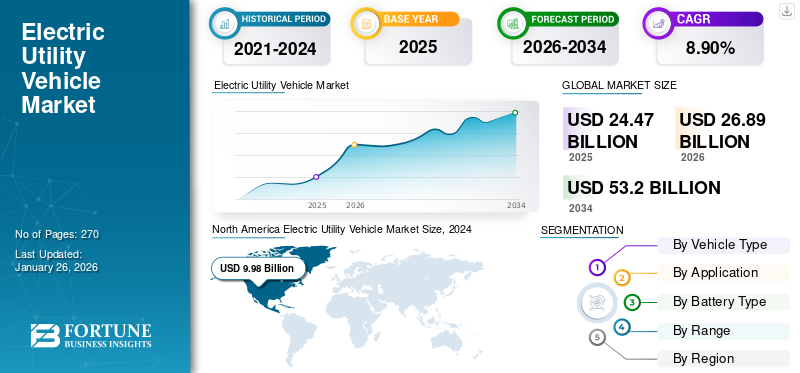
The global electric utility vehicle market size was valued at USD 24.47 billion in 2025. The market is expected to grow from USD 26.89 billion in 2026 to USD 53.20 billion by 2034, exhibiting a CAGR of 8.90% during the forecast period. North America dominated the global market with a share of 44.72% in 2025.
The electric utility vehicle market refers to the sector involved in the development, production, distribution, and utilization of electric vehicles specifically designed for utility, recreational activity, and commercial purposes. These vehicles are primarily used for tasks such as transporting goods, providing services, or facilitating various industrial and municipal operations. They are powered by electric batteries, which can include high-capacity batteries, lithium-ion, and lead acid batteries with quick charging systems, or battery swap systems. The global market is projected to grow significantly, driven by increased demand for low-emission vehicles, advancements in battery technology, and supportive government regulations aimed at reducing vehicular emissions.
The market is led by key players such as Club Car, Textron Specialized Vehicles, and The Toro Company. These companies focus on producing efficient, low-emission vehicles for industrial, recreational, and agricultural applications. The competitive edge is driven by advancements in battery technology and companies catering to government regulations promoting green energy solutions.
The COVID-19 pandemic had a massive impact on the electric utility vehicle market, influencing both demand and supply dynamics. The initial phase of the pandemic led to significant disruptions across the automotive industry. Lockdowns and mobility restrictions resulted in a sharp decline in vehicle sales globally. The pandemic prompted manufacturers to innovate their sales strategies. Traditional dealership models faced challenges due to social distancing measures, leading automakers to explore online sales channels.
Download Free sample to learn more about this report.
Electric Utility Vehicle Market Key Takeaways
 Global Market Size & Forecast
- 2025 Market Size: USD 24.47 billion
- 2026 Market Size: USD 26.89 billion
- 2034 Forecast Market Size: USD 53.20 billion
- CAGR: 8.90% from 2026–2034
 Market Share
- North America dominated the market with a 44.72% share in 2025.
- Commercial utility vehicles are projected to lead with a 50.53% share in 2026.
- Lithium-ion batteries are expected to dominate with a 74.06% share in 2026.
 Key Regional Highlights
North America
Valued at USD 10.95 billion in 2025, driven by strong EV adoption and government incentives.
Asia Pacific
Expected to reach USD 8.90 billion in 2026, supported by expanding charging infrastructure.
Europe
Valued at USD 3.63 billion in 2025, fueled by green manufacturing and EV policies.
U.S.
The market is projected to reach USD 6.03 billion by 2026.
Japan
The market is projected to reach USD 1.97 billion by 2026.
Read More

MARKET DYNAMICS
Market Drivers:
Rising E-commerce to Propel Market Expansion
The rapid growth of urbanization and e-commerce are significant trends that are expected to fuel the electric utility vehicle market growth during the forecast period. The surge in e-commerce has drastically increased the demand for efficient delivery services. With the exponential growth in online shopping, particularly post-pandemic, the need for reliable and eco-friendly delivery vehicles is increasing. E-commerce companies and consumers are focusing on electric vehicles. Retailers are adopting electric utility vehicles to enhance their sustainability efforts and meet customer demand for greener delivery solutions. However, manufacturers are focusing mainly on new vehicle launches for commercial use.
For instance, in March 2023, Club Car introduced its latest street-legal electric vehicle, the Club Car Urban LSV and XR. These vehicles are now available through the companies' commercial distributor networks in North America. The new Urban platform expands Club Car’s leading electric vehicle portfolio, which has been prominent in commercial markets for decades. The new Club Car Urban brings a unique utility vehicle solution that addresses the needs of large campuses, last-mile delivery, municipalities, and hospitality spaces.
Download Free sample to learn more about this report.
Market Restraints:
High Initial Costs May Restrain Market Growth
High initial costs may restrain the market for electric utility vehicles. Electric utility vehicles are generally more expensive than their internal combustion engine counterparts due to the high cost of batteries and advanced technologies. A crucial component of EUV’s cost is its battery. Lithium-ion batteries used in EVs are expensive due to the materials and technologies required for their production. EUVs often incorporate advanced technologies for efficiency, safety, and connectivity, such as electric drivetrain, regenerative braking systems, and smart sensors, adding overall cost to the vehicle.
Market Challenges:
Limited Charging Infrastructure, Battery Limitations, and Limited Model Availability Significantly Challenge Market Growth
Insufficient charging stations and slow charging speeds make it difficult for businesses to rely on EUVs, especially in remote or less developed areas. Battery limitations, such as reduced range and long charging times, contribute to range anxiety, limiting their suitability for long-haul or heavy-duty applications. Additionally, the limited availability of EUV models, especially in industries such as construction or agriculture, restricts market growth. The lack of versatile, customized options means businesses may hesitate to switch from traditional vehicles, as current electric models may not meet their operational needs or perform at the same level as internal combustion engine alternatives.
Market Opportunities:
Corporate Sustainability Goals Propel Market Demand
Corporate sustainability goals have become one of the primary driving forces behind the growth of the Electric Utility Vehicle (EUV) market, as businesses across various industries face increasing pressure to adopt greener and more sustainable practices. As corporations seek to enhance their environmental responsibility, reduce their carbon footprints, and meet regulatory standards, EUVs are emerging as a key solution in fleet management.
For instance, in November 2024, Wakefield Business Improvement District (BID) made a major move to boost the city’s environmental and cleanliness initiatives by acquiring a state-of-the-art Alke Electric Vehicle (EV) from ePowerTrucks. This adaptable vehicle is equipped with a cage body for efficient waste collection and a built-in pressure washer to address grime, graffiti, and other tough street stains. The zero-emission EV supports Wakefield BID’s sustainability goals, providing an eco-friendly solution for keeping the city’s public areas clean and well-maintained.
Electric Utility Vehicle Market Trends
Advancements in Battery Technology and Increasing Charging Infrastructure to Fuel Market Growth
Innovations in battery technology and electric drivetrains are enhancing the performance and efficiency of electric utility vehicles. The cost of lithium ion batteries has significantly decreased over the past few years, making electric vehicles more affordable. For instance, battery prices fell from approximately USD 1,150 per kWh in 2010 to around USD 139 per kWh in 2023, which is another contributing factor to the market’s growth.
Advances in charging technologies, including charging stations and battery swap systems, are addressing range anxiety and making electric utility vehicles more viable for various applications. For instance, in June 2023, Polaris announced that it had been selected to receive a USD 700,000 grant to develop and maintain an off-road trail charging network in Michigan's Upper Peninsula. Four electric vehicle charging stations are installed on state-designated ORV trails in the woods of Ontonagon County. The four chargers are deployed in Ontonagon, White Pine, Bergland, and Greenland.
Segmentation Analysis
By Vehicle Type
Commercial Utility Vehicle Segment Leads due to Increasing Adoption of EUVs by Delivery Services
By vehicle type, the market is classified into ATVs, golf cart, commercial utility vehicle, and shuttle carts.
The commercial utility vehicle market segment depicted the highest electric utility vehicle market share by 50.53% in 2026 and is slated to lead during the forecast period. The segment’s growth is attributed to the increasing adoption of EUVs by municipal services, delivery services, and utility services. EUVs are well-suited for urban environments where they offer the advantage of regenerative braking and reduced emissions.
The ATVs segment holds the second-largest share of the market due to growing recreational activities such as off-roading, hunting, and adventure sports. For instance, in February 2024, Sand Sports Expo announced that the company would organize one of the world’s biggest ATV, UTV, sand rails dune, and dirt sports expos for three days in California.
To know how our report can help streamline your business, Speak to Analyst
By Application
Industrial Facilities Segment Dominates due to its Operational Efficiency
Based on application, the market is classified into golf courses, industrial facilities, recreation, hotels & resort, and others (agriculture, corporate & medical, airport, etc.).
The industrial facilities segment is expected to hold the maximum market share by 43.87% in 2026, attributed to its operational efficiency. EUVs are versatile and suitable for indoor and outdoor applications in industrial settings. This versatility makes them ideal for tasks such as material handling, transportation of goods, and personnel movement. Many EUVs are designed to be compact and highly maneuverable, making them perfect for navigating. Generally, they have lower operating costs compared to Internal Combustion Engine (ICE) vehicles due to cheaper fuel and lower maintenance costs.
In December 2024, Alke unveiled the new 2025 ATX4 electric vehicle range. The new generation of ATX vehicles, alongside the ATX 3 range, features an enhanced platform that combines high safety with extreme modularity. Its adaptable design allows fleet managers to tailor the vehicle to specific needs, with hundreds of fitting options. Suitable for sectors such as logistics, urban maintenance, industry, and agriculture, the ATX can be configured for tasks such as waste collection with features such as a compactor and bin lift. Alkè also offers additional accessories, such as dropside bodies and closed cargo areas, with three platform sizes (150 cm, 200 cm, and 250 cm) for maximum customization.
The golf courses segment held a significant market share in 2024. The segment is expected to show CAGR of 9.70% during forecast period, attributed to the rising demand for golf related activities and the increasing technological advancement by manufacturers to fulfill customers’ needs. In March 2023, Club Car revealed Club Car CRU, a street-legal lifestyle vehicle that will disrupt the Low-speed Vehicle (LSV) market for consumers. CRU develops Club Car’s leading electric vehicle portfolio into a new, innovative category of Neighborhood Electric Vehicles (NEV). NEVs are designed to offer consumers a more fun and sustainable option for short trips.
By Battery Type
High Energy Density and Efficiency Drives Lithium Ion Segment Expansion
Based on battery type, the market is categorized into lithium-ion and lead-acid.
The lithium-ion segment is expected to hold the maximum share of the market by 74.06% in 2026, due to its high energy density and efficiency. Lithium-ion batteries are known for their high energy density, which allows them to store more energy in a smaller and lighter package compared to lead-acid batteries. This translates into longer operational times and greater ranges for electric utility vehicles on a single charge, making them particularly suitable for commercial applications where efficiency and productivity are paramount.
In September 2024, The National Golf Centre at Woodhall Spa selected Club Car, a global leader in small-wheel, zero-emissions electric vehicles, to supply its first fleet of golf cars. This decision represented a significant shift for the Lincolnshire venue, which had historically not permitted buggies on its prestigious courses, the Bracken and the newly-renovated Hotchkin, ranked 58th best in the world. The Centre introduced 12 Club Car Tempos, equipped with lithium-ion batteries and advanced connected technology.
The lead-acid segment is expected to attain a strong CAGR of 9.30% during the forecast period and holds the second-largest market share due to its affordability and availability. Lead-acid batteries are generally more affordable than lithium-ion batteries, making them an attractive option for cost-sensitive applications. Their lower initial purchase price allows businesses, particularly small and medium enterprises, to invest in EUVs without incurring significant upfront costs.
By Range
Advancements in Battery Technology to Impel Above 120 Km Segment Expansion
Based on range, the market is segmented into above 120 km and below 120 km.
The above 120 km segment is projected to hold the maximum share of the market by 65.81% in 2026, owing to advancements in battery technology. Improvements in battery technology have made it feasible for manufacturers to produce electric utility vehicles with higher ranges without significantly increasing the vehicle's weight, driving market growth.
The below 120 km range segment anticipated to hold a considerable CAGR of 9.30% during the forecast timeframe, attributed to its lower upfront cost. Vehicles with a range below 120 km are typically equipped with smaller batteries, which are less expensive. This makes these vehicles more affordable for businessmen and municipalities to minimize initial capital expenditure. In March 2024, Star EV introduced the Star Capella, a high-performance electric vehicle offering an impressive 45+ mile range, lithium battery, a 5-year battery warranty, enhanced ride comfort, superior acceleration, and low maintenance.
Market Regional Outlook
By region, the market is studied across Europe, Asia Pacific, North America, and the rest of the world.
North America Electric Utility Vehicle Market Size, 2025 (USD Billion)
To get more information on the regional analysis of this market, Download Free sample
North America
North America recorded a market size of USD 10.95 billion in 2025, capturing 44.72% of the global market share, and is projected to reach USD 12.06 billion in 2026. The region has witnessed a robust demand for electric utility All-terrain Vehicles (ATVs) and Utility Task Vehicles (UTVs), driven by their applications in industries such as agriculture, construction, and logistics. The increasing adoption of electric utility vehicles for both commercial and recreational purposes enhances the market share in the region.
The U.S. market is estimated to hit USD 6.03 billion in 2026. This country held the largest market share of 49.5% in 2024. Federal and state-level incentives for electric vehicle adoption, such as tax rebates and subsidies, encourage businesses and consumers to invest in electric utility vehicles. These incentives help reduce the initial purchase cost, making electric utility vehicles more accessible. This drives the demand for the market in the country.
Asia Pacific
Asia Pacific is anticipated to hold the second-largest share of the market valued at USD 8.90 billion in 2026, with a strong CAGR of 10.00% over the upcoming year. The rapid development of charging infrastructure across the region is facilitating the adoption of electric utility vehicles. As charging stations become more widely available, consumers and businesses are more likely to invest in electric vehicles, understanding that they will have access to the necessary facilities for recharging. The International Energy Agency reports that over 600,000 public slow charging points were installed worldwide in 2022, with 360,000 of them located in China. This increased the total number of slow chargers in China to over 1 million. By the end of 2022, China accounted for more than half of the world’s total global public slow chargers. The market in China is estimated to account for USD 3.52 billion, followed by Japan projected to hit USD 1.97 billion and India to likely stand at USD 1.06 billion in 2026.
Europe
In 2025, Europe represented USD 3.63 billion, accounting for 14.85% of the worldwide market, and is projected to grow to USD 3.95 billion in 2026. European countries have implemented various policies and regulations to promote the adoption of electric vehicles, including utility vehicles. These measures include emission reduction targets, tax incentives, and subsidies for EV purchases. In Europe, green manufacturing initiatives and the European Green Deal are major drivers for the adoption of electric utility vehicles in industrial facilities. The EU has set ambitious goals for achieving carbon neutrality by 2050 and businesses are under pressure to transition to sustainable practices. Electric industrial vehicles help reduce carbon emissions and environmental impact in manufacturing and logistics operations, which propels the growth of the market in the region. The market in Germany is estimated for USD 1.09 billion, followed by U.K. projected to hit USD 0.75 billion in 2026 and France will likely reach USD 0.51 billion in 2025.
Rest of the World
The market in Rest of the World reached USD 1.84 billion in 2025, representing 7.53% of total market revenue, and is projected to reach USD 1.98 billion in 2026 attributed to rising companies' focus on reducing their carbon footprint, leading to higher adoption of electric fleets. Emerging countries are increasingly adopting electric vehicles as an alternative to high fuel costs. In Brazil, Argentina, and other countries, businesses and governments are seeking cost-effective transportation solutions, making electric utility vehicles an attractive option for fleet operators, which fuels the growth of the market in the region.
Competitive Landscape
KEY INDUSTRY PLAYERS
Key Companies Focusing on Affordable Solutions to Tap into Diverse Markets
The electric utility vehicle market is rapidly expanding, driven by the demand for sustainable, cost-effective transportation solutions in sectors such as last-mile delivery, micro-distribution, agriculture, hospitality, and municipalities. Key players in the market comprise both established companies and newer entrants focusing on specialized electric vehicles. Large established market players such as CLUB CAR, Textron Specialized Vehicles, and The Toro Company dominate the market with broad product offerings, including utility and off-road vehicles. These companies benefit from extensive dealer networks and a global presence, permitting them to tap into diverse markets. Their vehicles are highly reliable and often feature advanced technology, though their Electric Vehicle (EV) offerings are typically in the higher-end, heavy-duty categories.
List of Key Electric Utility Vehicle Companies Profiled:
- Addax Motors (Belgium)
- Alke (Italy)
- American Landmaster (U.S.)
- CLUB CAR (U.S.)
- Columbia Vehicle Group Inc. (U.S.)
- HISUN Motors (China)
- Marshell Green Power (China)
- Star EV Corporation (U.S.)
- Textron Specialized Vehicles Inc. (Georgia)
- John Deere (U.S.)
- Yamaha Motors (Japan)
- Toro Company (U.S.)
- Hyster-Yale, Inc (U.S.)
- Polaris Inc (U.S.)
KEY INDUSTRY DEVELOPMENTS:
- June 2024: Kandi Technologies Group, Inc. introduced its enhanced 10K high-clearance electric UTV, a sophisticated upgrade designed for better off-road performance. Building on the popular 10K model, it features an extended swing arm, widened wheelbase, and airbag shock absorbers, increasing ground clearance and stability. This model is ideal for navigating tough terrains such as potholes and muddy roads.
- May 2024: Addax Motors introduced new body configurations for its vehicles, including a right-hand drive option tailored for customers in the U.K. The redesigned Cargo utility vehicles now feature roller shutters that open smoothly and French doors that provide elegant, wide access, blending functionality with sophistication. Additionally, the company unveiled fully revamped Tipper/Flatbed vehicles, offering enhanced versatility and performance.
- March 2024: Columbia introduced the Payloader PRO, a vehicle designed for both work and comfort. Ideal for industrial and commercial environments, the Payloader PRO enhances the Payloader lineup with unmatched versatility, reliability, and modern features. Featuring a redesigned coil-over-shock front suspension, it offers a smooth ride without sacrificing towing or cargo capacity. The Payloader PRO comes in two versions: standard duty with a 2,000 lb payload capacity and 6,500 lb towing capacity, and heavy-duty with a 3,000 lb payload capacity and 10,000 lb towing capacity. It also includes AC Drive as a standard feature, providing the torque needed to tackle hills and inclines effortlessly.
- February 2024: Polaris launched an electric version of its heavy-duty Pro XD utility vehicle for applications in construction, equipment rental, and industry. The Pro XD Kinetic vehicle, a heavier-duty version of its Ranger electric utility truck, uses a 14.9kWh Lithium-Ion battery to provide 140lb-ft (190Nm) of instant torque and has the ability to tow up to 2,500lbs (1,133kg) and haul up to 1,250lbs (566kg). It has a range of up to 45 miles (72.4km) on a single charge.
- July 2023: Tesla introduced an electric ATV for children in China. It features a 500-watt motor and a 288 Wh battery, offers a top speed of 16 km/h (10 mph), and has a limited range. This miniature version of the Cyberquad provides young riders with a fun and safe off-road experience, mirroring the design of its larger counterpart.
- June 2023: E-Z GO introduced the new street-legal Liberty LSV and a newly updated model of its Freedom RXV, which couples a stylish new look with a comfortable ride. The Liberty LSV is the industry's ultimate luxury street-legal vehicle.
- May 2023: ICON launched a new product line, ICON ECO, providing economical golf carts for recreation and family adventures. The company would provide two models, which include a 4-seater lift and a 4-seater non-lifted.
- November 2022: Rohnel Motors introduced a lineup of electric ATVs in India, offering models such as Raven, Beast, Zeus, Ranger, and Patriot. These eco-friendly vehicles offer varying power outputs and cater to riders of all skill levels. They feature high power, low noise, and ease of operation and can be conveniently recharged at any standard electric outlet, ensuring a hassle-free riding experience.
REPORT COVERAGE
The utility vehicle market research report provides a detailed market analysis and focuses on key aspects such as leading market participants, competitive landscape, and type. Besides this, it includes insights into the market trends and highlights key industry developments. In addition to the factors above, the report encompasses several factors that have contributed to the market's growth in recent years.
Request for Customization to gain extensive market insights.
REPORT SCOPE & SEGMENTATION
|
ATTRIBUTE |
DETAILS |
|
Study Period |
2021-2034 |
|
Base Year |
2025 |
|
Estimated Year |
2026 |
|
Forecast Period |
2026-2034 |
|
Historical Period |
2021-2024 |
|
Growth Rate |
CAGR of 8.90% from 2026 to 2034 |
|
Unit |
Value (USD Billion) & Volume (Unit) |
|
Segmentation
|
By Vehicle Type
|
|
By Application
|
|
|
By Battery type
|
|
|
By Range
|
|
|
By Region
|
Frequently Asked Questions
As per the Fortune Business Insights study, the market was valued at USD 24.47 billion in 2025.
The market is poised to grow at a CAGR of 8.90% during the forecast period (2026-2034).
By vehicle type, the commercial utility vehicle segment captures the largest share due to the increased adoption of EUVs by utility services globally.
The market size in North America stood at USD 10.95 billion in 2025.
Large established manufacturers such as CLUB CAR, Textron Specialized Vehicles, and The Toro Company dominate the electric utility vehicle market.
North America held the largest share of the market in 2025.



- 2021-2034
- 2025
- 2021-2024
- 270
-
(Offer valid till 30th Sep 2026)
Get 30-60 hrs Free Customization
Expand Regional and Country Coverage, Segments Analysis, Company Profiles, Competitive Benchmarking, and End-user Insights.




















-
US +1 833 909 2966 ( Toll Free )
-
Get In Touch With Us