UV Disinfection Equipment Market Size, Share & Industry Analysis, By Component (UV Lamps, Reactor Chambers, Controller Units, Quartz Sleeves, and Others), By Application (Water & Wastewater Treatment, Air Disinfection, Surface Disinfection, Food & Beverage Disinfection, and Others), and Regional Forecast, 2026-2034
 Download Free Sample
UV Disinfection Equipment Market Size and Future Outlook
 Listen to Audio Version
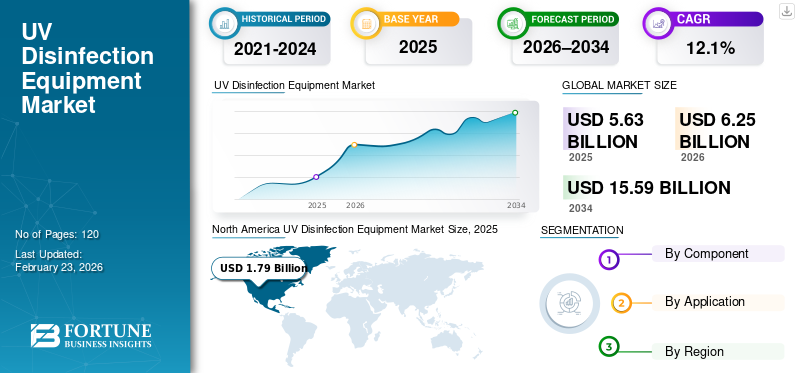
The global UV disinfection equipment market size was valued at USD 5.63 billion in 2025 and is projected to grow from USD 6.25 billion in 2026 to USD 15.59 billion by 2034, exhibiting a CAGR of 12.1% during the forecast period. North America dominated the UV disinfection equipment market with a market share of 31.79% in 2025.
The market is witnessing steady growth, supported by the increasing use of UV lights as an effective and environmentally friendly solution for eliminating harmful microorganisms across water, air, and surface applications. UV disinfection equipment plays a critical role in the disinfection process by inactivating bacteria, viruses, and other pathogens without the use of chemicals. The rising demand for UV disinfection equipment is driven by growing awareness of public health, stricter water quality regulations, and increasing adoption of non-chemical treatment technologies across municipal, industrial, and commercial sectors. Continuous advancements in UV system design and efficiency are further supporting wider market adoption. Key industry players such as Xylem, Trojan Technologies, and Halma are actively expanding their UV product portfolios and application-specific solutions to strengthen market presence and address evolving disinfection requirements.
Download Free sample to learn more about this report.
UV Disinfection Equipment Market Key Takeaways
 Global Market Size & Forecast
- 2025 Market Size: USD 5.63 billion
- 2026 Market Size: USD 6.25 billion
- 2034 Forecast Market Size: USD 15.59 billion
- CAGR: 12.10% from 2026–2034
 Market Share
- North America dominated the market with a 31.79% share in 2025.
- UV Lamps segment held the largest market share in 2025.
- Water & Wastewater Treatment segment held the largest market share in 2025.
 Key Regional Highlights
North America
The market reached USD 1.79 billion in 2025, driven by advanced water treatment infrastructure.
Asia Pacific
The market is projected to reach USD 1.77 billion by 2026, driven by expanding municipal water infrastructure.
Europe
The market is projected to reach USD 1.63 billion by 2026, supported by strict environmental regulations.
U.S.
The market is estimated to reach USD 1.70 billion by 2026, driven by municipal water treatment projects.
Japan
The market is estimated to reach USD 0.31 billion by 2026, supported by investments in advanced water treatment systems.
Read More

UV DISINFECTION EQUIPMENT MARKET TRENDS
Increasing Adoption of UV-Based Solutions for Water and Air Treatment is a Key Market Trend
The market is witnessing a strong trend toward the adoption of non-chemical disinfection technologies across water, air, and surface treatment applications. UV systems are increasingly preferred due to their ability to inactivate microorganisms without altering taste, odor, or chemical composition. Growing implementation of UV disinfection technologies in municipal water treatment plants, HVAC systems, healthcare facilities, and food processing environments is reinforcing market expansion. In addition, advancements in UV-C lamp efficiency, LED-based UV systems, and smart monitoring capabilities are enhancing system performance and reliability.
- For instance, Signify has continued expanding its UV-C product portfolio for air and surface disinfection applications across commercial and public infrastructure settings.
Download Free sample to learn more about this report.
MARKET DYNAMICS
MARKET DRIVERS
Rising Demand for Safe Drinking Water and Improved Sanitation Standards Driving Market Growth
The rising demand for safe drinking water and stricter sanitation standards across municipalities and industries are driving the use of UV disinfection equipment. Governments and regulatory bodies are increasingly promoting advanced water treatment technologies to address waterborne diseases and contamination risks. Industrial sectors such as food and beverage, pharmaceuticals, and healthcare are also adopting UV systems to comply with hygiene and safety regulations. These factors are driving consistent investments in UV-based disinfection infrastructure worldwide.
- For example, Trojan Technologies has highlighted growing global adoption of UV systems in municipal water and wastewater treatment
MARKET RESTRAINTS
High Initial Installation Costs and Maintenance Requirements Limit Wider Adoption
The high initial costs of installation and the associated expense of ongoing, long-term maintenance of UV Disinfection Systems are a barrier to the growth of this market, especially in cost-conscious areas. Additionally, the associated costs of components, such as ultraviolet lamps/bulbs, quartz sleeves, and UV Disinfection Control Units, lead to a generally high initial investment in capital and periodically replaceable component costs (i.e. UV Lamps, Quartz Sleeves) at a much later time for capital investment in UV Disinfection Technologies. Additionally, due to the need for regularly scheduled maintenance of UV Disinfection Systems, (i.e. Regularly scheduled UV Lamp replacement and physically cleaning the inside and outside of UV Disinfection Systems), many small on-site facilities, as well as developing nations, may not adopt UV Disinfection Technologies due to the ongoing capital maintenance cost of the UV Disinfection Systems. As a result, the limited availability of Conventional Chemical Disinfection Technologies at a not necessarily affordable cost will significantly slow-down the penetration of UV Disinfection Technologies in many areas.
- For instance, municipal utilities in emerging economies often continue to rely on chlorination due to lower initial investment requirements.
MARKET OPPORTUNITIES
Expansion of UV LED Technology and Smart Disinfection Systems Creates Growth Opportunities
The development of UV LED technology and smart disinfection system innovations will offer additional opportunities for the growth of this market. Compared to Conventional Mercury-Lamps and/or UV Bulbs, UV LED's have a longer life, less energy consumption, and are designed for many different system designs due to their small physical size. Moreover, the incorporation of sensors, automation, and real-time performance monitoring will facilitate Predictive Maintenance and the Optimization of System Performance, providing additional new growth opportunities in healthcare, commercial buildings, transportation, and point-of-use water treatment applications.
- For example, Seoul Viosys has been advancing UV LED solutions to support next-generation disinfection systems across multiple end-use sectors.
Segmentation Analysis
By Component
UV Lamps Hold Largest Share Due to Core Role in Disinfection Systems
Based on the component, the market is divided into UV lamps, reactor chambers, controller units, quartz sleeves, and others.
In 2025, the UV lamps segment accounted for the highest UV disinfection equipment market share. UV lamps are the primary disinfection element, responsible for generating UV-C radiation required to inactivate microorganisms in water, air, and surface treatment applications. Their widespread adoption across municipal, industrial, and commercial installations, along with periodic replacement requirements, drives sustained demand. Continuous improvements in lamp efficiency and output are further reinforcing their dominant position in the market.
- For example, Signify continues to expand its UV-C lamp portfolio for water, air, and surface disinfection applications across multiple end-use sectors.
The controller units segment is anticipated to rise with a CAGR of 13.0% over the forecast period.
To know how our report can help streamline your business, Speak to Analyst
By Application
Water and Wastewater Treatment Dominates Driven by Regulatory and Public Health Requirements
Based on the application, the market is segmented into water & wastewater treatment, air disinfection, surface disinfection, food & beverage disinfection, and others.
In 2025, the water and wastewater treatment segment held the largest market share. Municipal utilities and industrial facilities increasingly deploy UV disinfection systems to meet stringent water quality standards and address concerns related to chemical disinfectants. UV technology is widely adopted in drinking water and wastewater treatment due to its effectiveness against pathogens and minimal environmental impact. Ongoing investments in water infrastructure and sanitation projects continue to support strong demand within this segment.
- For instance, Trojan Technologies has highlighted the growing global deployment of UV disinfection systems in municipal water and wastewater treatment plants.
The air disinfection segment is projected to grow at a CAGR of 13.0% over the forecast period.
UV Disinfection Equipment Market Regional Outlook
By region, the market is categorized into Europe, North America, Asia Pacific, South America, and the Middle East & Africa.
North America
North America UV Disinfection Equipment Market Size, 2025 (USD Billion)
To get more information on the regional analysis of this market, Download Free sample
North America held a dominant position in the market in 2024 and continued to maintain its leading share in 2025, with a market valuation of USD 1.79 billion. Market growth in the region is supported by widespread adoption of advanced water and wastewater treatment technologies, strong regulatory frameworks for drinking water safety, and high awareness of non-chemical disinfection solutions. The presence of established manufacturers and continued investments in infrastructure modernization further reinforce North America’s leadership.
U.S. UV Disinfection Equipment Market
Based on North America’s strong contribution and the dominance of the U.S. within the region, the U.S. market is analytically estimated at around USD 1.70 billion in 2026. The country’s dominance is driven by large-scale municipal water treatment projects and growing adoption of UV systems in healthcare, commercial, and industrial facilities.
Europe
Europe recorded a market valuation of USD 1.63 billion in 2026. The regional UV disinfection equipment market growth is supported by strict environmental regulations, strong emphasis on public health, and increasing investments in sustainable water treatment technologies. Many countries continue to adopt UV disinfection systems across municipal water treatment, food processing, and healthcare applications. The region’s focus on reducing chemical usage and improving water quality standards supports steady market growth.
U.K. UV Disinfection Equipment Market
The U.K. market in 2026 is estimated at around USD 0.22 billion, representing roughly 3.6% of global revenues.
Germany UV Disinfection Equipment Market
Germany’s market is projected to reach USD 0.36 billion in 2026, equivalent to around 5.7% of global sales.
Asia Pacific
Asia Pacific is expected to reach a market valuation of USD 1.77 billion in 2026, emerging as the fastest-growing region in the market. Rapid growth is driven by rapid urbanization, expanding municipal water infrastructure, and rising awareness of waterborne disease prevention. Countries such as China, India, and Japan are increasingly investing in advanced water and wastewater treatment systems, supporting growing demand for UV disinfection equipment across public and industrial sectors.
Japan UV Disinfection Equipment Market
The Japan market in 2026 is estimated at around USD 0.31 billion, accounting for roughly 4.9% of global revenue.
China UV Disinfection Equipment Market
The China market in 2026 is estimated at around USD 0.67 billion, accounting for roughly 10.8% of the global market.
India UV Disinfection Equipment Market
The India market in 2026 is estimated at around USD 0.18 billion, accounting for roughly 2.9% of the global market.
South America and Middle East & Africa
South America and the Middle East & Africa regions are expected to witness moderate growth in this market space during the forecast period. South America is projected to reach a market valuation of USD 0.42 billion in 2026. Market growth is supported by gradual improvements in water treatment infrastructure and rising focus on sanitation and public health initiatives. The Middle East & Africa market is expected to reach a valuation of USD 0.45 billion in 2026. Increasing investments in water desalination, wastewater reuse, and public health infrastructure are supporting adoption of UV disinfection systems, especially in GCC countries and selected African markets.
GCC UV Disinfection Equipment Market
The GCC market is projected to reach around USD 0.02 billion in 2026, representing roughly 3.1% of the global market.
COMPETITIVE LANDSCAPE
Key Industry Players
Focus on Advanced UV Technologies and Application-Specific Solutions to Strengthen Market Position
The UV germicidal system marketplace has significant consolidation, with several global companies producing light and water treatment systems, and specialized UV System manufacturers. Major producers of Water Germicidal systems; Xylem, Trojan Technologies and Halma plc, are all established competitors with significant market shares. Purchasing these companies will enable utilities to offer UV systems for Water and Wastewater Treatment, air, surface disinfection and food & beverage production. There continues to be a huge focus on increasing the efficiency of UV Systems, the expansion into UV LED based Solutions and the integration of smart monitoring and controls into applications amongst market participants. The investment in application specific UV systems and long-term service offerings will continue to differentiate competitors and retain customers.
LIST OF KEY UV DISINFECTION EQUIPMENT COMPANIES PROFILED
- Atlantic Ultraviolet Corporation (U.S.)
- Atlantium Technologies (Israel)
- Hönle AG (Germany)
- Halma plc (U.K.)
- Industrie De Nora S.p.A. (Italy)
- Kuraray Co., Ltd. (Japan)
- Nichia Corporation (Japan)
- Severn Trent Services (U.K.)
- Trojan Technologies Group (Canada)
- Xylem (U.S.)
KEY INDUSTRY DEVELOPMENTS
- December 2025: Curio Water formed a strategic partnership with UV Guard to enhance its offering of UV disinfection systems for drinking and wastewater treatment in the U.K. water industry.
- July 2024: UV Smart began advanced discussions to launch its UV-C disinfection technology in U.K. hospitals following successful trials, marking expanded deployment of clinical UV disinfection solutions.
- April 2023: Nuvonic launched as the first company to offer a comprehensive range of UV-based solutions for water, surface, and air disinfection, combining multiple UV technology brands under one platform.
- March 2023: AquiSense Technologies launched the PearlAqua Deca 30C UV-C LED system achieving over 99.99 % pathogen reduction, expanding advanced UV disinfection solutions with high efficiency and compact design.
- January 2023: Applied UV and Puro Lighting completed a merger to strengthen market position and offer integrated UV disinfection solutions, reflecting consolidation in the industry.
REPORT COVERAGE
Request for Customization to gain extensive market insights.
Report Scope & Segmentation
|
ATTRIBUTE |
DETAILS |
|
Study Period |
2021-2034 |
|
Base Year |
2025 |
|
Estimated Year |
2026 |
|
Forecast Period |
2026-2034 |
|
Historical Period |
2021-2024 |
|
Growth Rate |
CAGR of 12.1% from 2026-2034 |
|
Unit |
Value (USD Billion) |
|
Segmentation |
By Component, Application, and Region |
|
By Component |
|
|
By Application |
|
|
By Region |
|
Frequently Asked Questions
According to Fortune Business Insights, the global market value stood at USD 5.63 billion in 2025 and is projected to reach USD 15.59 billion by 2034.
In 2025, the market value stood at USD 1.79 billion.
The market is expected to exhibit a CAGR of 12.1% during the forecast period.
By component, the UV lamps segment is expected to lead the market.
The market is driven by the growing demand for safe drinking water and the adoption of stricter sanitation and hygiene standards across municipal and industrial sectors.
Xylem, Trojan Technologies, and Halma plc are the major players in the global market.
North America dominated the market in 2025.



- 2021-2034
- 2025
- 2021-2024
- 120
Get 30-60 hrs Free Customization
Expand Regional and Country Coverage, Segments Analysis, Company Profiles, Competitive Benchmarking, and End-user Insights.





Related Reports
-
US +1 833 909 2966 ( Toll Free )
-
Get In Touch With Us