Water and Wastewater Treatment Equipment Market Size, Share & Industry Analysis, By Service Type (Functional Testing, Performance Testing, Security Testing, Automation Testing, Others, By End User (IT & Telecom, BFSI, Healthcare, Retail & E-commerce, and Others), By Deployment Model (Cloud-based and On-premises), and Regional Forecast, 2026 - 2034
 Download Free Sample
KEY MARKET INSIGHTS
 Listen to Audio Version
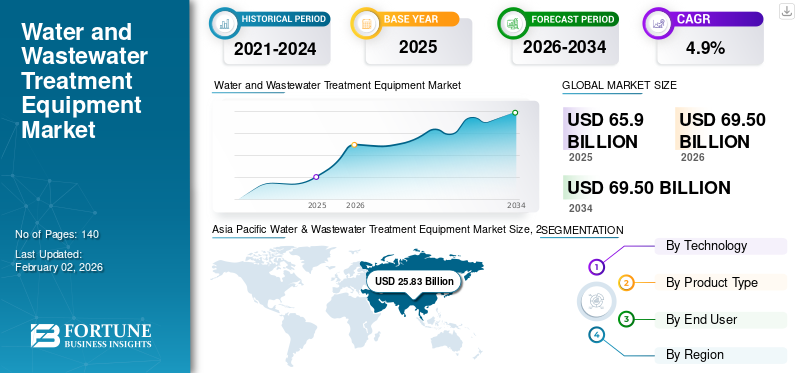
The global water and wastewater treatment equipment market size was valued at USD 65.90 Billion in 2025. The market is projected to grow from USD 69.50 Billion in 2026 to USD 101.77 Billion by 2034, exhibiting a CAGR of 4.9% during the forecast period. Asia Pacific dominated the global water and wastewater treatment equipment market with a share of 39.19% in 2025.
The global market is witnessing steady growth, driven by rising freshwater scarcity, rapid urbanization and increasing investments in water infrastructure development. Water and wastewater treatment equipment play a critical role in treating raw water and wastewater to meet regulatory standards for safe consumption, industrial reuse and environmental discharge. Increasing population growth, industrial expansion and tightening environmental regulations are compelling governments and industries to upgrade existing treatment facilities and install advanced treatment systems.
Moreover, the rising acceptance of automation coupled with monitoring and control technologies as well as water-efficient treatment processes is also fueling the expansion of the market. Veolia Environnement S.A., SUEZ Group, Xylem Inc. and Ecolab Inc. are some of the leading companies that have been putting money into filtration innovation, digital water management platforms and modular treatment systems for better efficiency and sustainability. The market trend of eco-friendly and efficient technology adoption is expected to be accelerated by these companies' investments and innovations.
- For instance, in March 2025, Veolia Environnement S.A. announced new investments to expand its advanced water treatment solutions portfolio, focusing on digital monitoring and energy-efficient treatment systems to support municipal and industrial water infrastructure projects globally.
Download Free sample to learn more about this report.
Water and Wastewater Treatment Equipment MARKET KEY TAKEAWAYS
 Market Size & Forecast
- 2025 Market Size: USD 65.90 Billion
- 2026 Market Size: USD 69.50 Billion
- 2034 Forecast Market Size: USD 101.77 Billion
- CAGR: 4.9% from 2026–2034
 Market Share
- Asia Pacific dominated the water and wastewater treatment equipment market with a 39.19% share in 2025.
- The secondary treatment segment held the largest technology market share in 2025.
- The water treatment equipment segment accounted for the largest product type market share in 2025.
 Key Regional Highlights
North American
North America is supported by strong infrastructure modernization and strict environmental regulations.
Europe
Europe is witnessing steady growth driven by sustainable water management and wastewater reuse initiatives.
Asia Pacific
Asia Pacific led the global market and is expected to register the highest CAGR during the forecast period.
U.S.
The market is projected to reach USD 12.92 billion in 2026.
Japan
The market is projected to reach USD 5.09 billion in 2026.
Read More

WATER AND WASTEWATER TREATMENT EQUIPMENT MARKET TRENDS
Rising Adoption of Smart and Energy-Efficient Treatment Systems is a Prominent Market Trend
A main trend in the worldwide market is the rising uptake of smart, automated and energy-efficient water treatment systems. Companies from the water sector and industries are installing digital sensors, conducting real-time monitoring, and using AI-based process optimization tools to make their operations more efficient and to consume less energy. Predictive maintenance, enhanced process control and meeting high environmental standards are some of the benefits offered by the adoption of these technologies.
In addition to this, the global water industry is progressively getting more focused on water reuse and circular water economy models, which in turn is pushing the demand for sophisticated treatment technologies such as membrane filtration and tertiary treatment. Therefore, the trend is going to be stronger market adoption particularly in the areas where water supply is less.
- For instance, in January 2025, Xylem Inc. expanded its smart water solutions portfolio by launching digital platforms designed to optimize treatment plant performance through real-time analytics and remote monitoring.
Download Free sample to learn more about this report.
MARKET DYNAMICS
MARKET DRIVERS
Increasing Water Scarcity and Stringent Environmental Regulations to Drive Market Growth
Rising water scarcity and tightening environmental regulations are major factors driving the water and wastewater treatment equipment market growth. Governments across the globe are enforcing strict discharge norms and water quality standards to reduce pollution and protect ecosystems. These regulations compel municipalities and industries to upgrade or install advanced treatment equipment.
In parallel, rapid industrialization and urban population growth have increased wastewater generation, creating strong demand for efficient treatment solutions. Combined, these factors are accelerating investments in modern water infrastructure and driving market expansion.
- For instance, in 2024, the European Commission strengthened wastewater discharge regulations under its revised Urban Wastewater Treatment Directive, driving increased adoption of advanced treatment equipment across municipal facilities.
MARKET RESTRAINTS
High Capital and Maintenance Costs to Restrict Market Growth
The market growth is considerably restrained by the high initial capital investment and continuous maintenance costs related to advanced treatment equipment. The establishment of large-scale plants for treatment necessitates not only the availability of huge financial resources but also the recruitment of skilled labor and the acceptance of long project timelines that may restrict the use of such facilities in developing areas.
Moreover, complicated operations and energy-draining processes can escalate the lifecycle costs thereby causing budgeting problems for small towns and industrial players.
- For example, in August 2024, a report by the World Bank highlighted that high infrastructure and operational costs remain a key challenge for wastewater treatment project implementation in low- and middle-income countries.
MARKET OPPORTUNITIES
Growing Focus on Water Reuse and Desalination to Offer Market Growth Opportunities
The market is set to witness substantial growth due to the increasing emphasis on water reclamation, recycling, and desalination. With rising water scarcity issues, industries and urban areas are opting for sophisticated technology to treat waste water properly and utilize it for non-drinking purposes and industrial applications.
Moreover, the installation of reverse osmosis plants in dry areas and places that do not have enough water supply is what mainly driving the market for treatment equipment that are highly advanced. Technological innovations that are capable of cutting down power usage as well as making the treatment process faster and more effective will be opening doors to new market opportunities.
- For instance, in February 2025, Saudi Arabia’s Ministry of Environment, Water and Agriculture announced new investments in water reuse and desalination projects, boosting demand for advanced treatment equipment.
Segmentation Analysis
By Technology
Secondary Treatment Leads Market Due to High Adoption in Municipal Systems
Based on technology, the market is segmented into primary treatment, secondary treatment, and tertiary treatment.
The secondary treatment segment has largest share of the market and this is due to its main biological treatment stage in almost all the municipal and industrial wastewater facilities. The operation's capability to cut down organic load and at the same time fulfill the regulatory discharge requirements has led to the segment's widespread adoption in the treatment plants.
- In 2024, SUEZ Group secured multiple municipal contracts to upgrade secondary biological treatment systems, highlighting the continued dominance of this technology segment.
The tertiary treatment segment is anticipated to grow at the highest CAGR of 6.0% over the forecast period.
By Product Type
Water Treatment Equipment Dominates Due to Rising Demand for Clean Drinking Water
Based on product type, the market is segmented into water treatment equipment and wastewater treatment equipment.
The water treatment equipment segment holds the highest market share due to increasing demand for safe and clean drinking water across urban and rural populations. Rising investments in potable water infrastructure and stringent water quality standards have reinforced the adoption of advanced water treatment systems globally.
- In 2025, Xylem Inc. announced the expansion of its advanced drinking water treatment solutions portfolio to support large municipal projects, reinforcing strong demand for water treatment equipment worldwide.
The wastewater treatment equipment segment is projected to grow at the highest CAGR of 5.3% during the forecast period.
To know how our report can help streamline your business, Speak to Analyst
By End User
Municipal Segment Dominates Owing to Large-Scale Infrastructure Investments
Based on end user, the market is segmented into municipal and industrial.
The municipal sector has the largest water and wastewater treatment equipment market share mainly due to its heavy investments in public water supply and waste management infrastructure. Besides, public-private partnerships connecting the acquisition of clean water and the enhancement of urban treatment plants are still the major drivers of the sector's supremacy.
- In 2025, Veolia Environnement S.A. partnered with multiple city governments to modernize municipal water treatment plants, reflecting sustained demand from the municipal sector.
The industrial segment is expected to record the highest CAGR of 5.5% during the forecast period.
Water and Wastewater Treatment Equipment Market Regional Outlook
By geography, the market is categorized into North America, Europe, Asia Pacific, Middle East & Africa, and South America.
North America
Asia Pacific Water & Wastewater Treatment Equipment Market Size, 2025 (USD Billion) To get more information on the regional analysis of this market, Download Free sample
North America possesses a major share in the global water and wastewater treatment equipment industry owing to the presence of an effective water infrastructure, very strict environmental regulations, and strong government support for the modernization of infrastructure. The increasing investments in the upgrading of old treatment facilities as well as the rising adoption of smart water management solutions are the two main factors driving steady market growth. The region also reaps the benefits of being a source of strong technological innovation and the early application of advanced treatment systems.
U.S Water and Wastewater Treatment Equipment Market
The estimation for the U.S. market will be nearly USD 12.92 billion in 2026, which is equal to around 18.6% of worldwide revenues, and this is mainly supported by federal infrastructure funding programs and municipal and industrial water treatment upgrades investment growing.
Europe
Europe water and wastewater treatment equipment market size is mature and steadily growing, supported by stringent environmental directives, strong regulatory enforcement and a growing focus on sustainable water management practices. Countries across the region are investing in advanced wastewater treatment technologies to meet tightening discharge norms and support water reuse and recycling initiatives. The emphasis on energy-efficient and low-emission treatment solutions further strengthens market adoption.
U.K. Water and Wastewater Treatment Equipment Market
The U.K. water and wastewater treatment equipment market in 2026 reached USD 2.61 billion, representing approximately 3.8% of global market revenues. Market growth is supported by increasing investments in wastewater infrastructure upgrades, stricter discharge regulations, and ongoing initiatives to improve water quality and reduce pollution across municipal treatment facilities.
Germany Water and Wastewater Treatment Equipment Market
The German market is expected to be worth USD 2.71 Bn in 2026, which would mean its global share would be almost 3.9%, and the main factors for this development are industrial wastewater treatment demand and strict adherence to EU environmental regulations, among others.
Asia Pacific
Asia Pacific dominates the global market for water and wastewater treatment equipment and is also expected to record the highest CAGR during the forecast period. Rapid urbanization, population growth, industrial expansion, and increasing government investments in water infrastructure are key drivers. Large-scale municipal projects, rising awareness regarding water pollution, and growing adoption of advanced treatment technologies across emerging economies continue to fuel regional growth.
Japan Water and Wastewater Treatment Equipment Market
The market for water and wastewater treatment equipment in Japan in 2026 is expected to be about USD 5.09 billion, representing approximately 7.3% of total global sales. The market development is backed by strict regulatory control, revamping of outdated infrastructure, and progressive as well as energy-efficient technologies getting more widely employed.
China Water and Wastewater Treatment Equipment Market
China’s market is estimated at around USD 9.27 billion in 2026, accounting for approximately 13.3% of global revenues, supported by extensive government-led water pollution control and urban wastewater treatment initiatives.
India Water and Wastewater Treatment Equipment Market
For India, the estimation is that the market will be worth USD 5.52 Bn in 2026, which will be almost 7.9% of global revenues. The market is mainly supported by government programs for clean water and sanitation, as well as the quick upgrading of urban infrastructure.
South America and Middle East & Africa
The Middle East & Africa and South America regions are expected to witness moderate growth during the forecast period. In these regions, increasing investments in municipal water infrastructure, desalination projects and wastewater reuse initiatives are supporting market expansion. Government-led water security programs, particularly in water-scarce areas, are accelerating adoption of advanced treatment equipment, while gradual industrialization further contributes to demand growth.
GCC Water and Wastewater Treatment Equipment Market
The GCC market is projected to reach around USD 3.84 billion in 2026, accounting for approximately 5.5% of global revenues, driven by large-scale desalination projects and national water security and reuse initiatives.
COMPETITIVE LANDSCAPE
Key Industry Players
Focus on Infrastructure Expansion and Technological Innovation to Strengthen Market Position
The water and wastewater treatment equipment market is moderately consolidated, with major players focusing on technological innovation, strategic partnerships, and infrastructure expansion. Companies are investing in digital water platforms, energy-efficient treatment technologies, and modular systems to enhance operational efficiency and regulatory compliance.
LIST OF KEY WATER AND WASTEWATER TREATMENT EQUIPMENT COMPANIES PROFILED
- Veolia Environnement S.A. (France)
- SUEZ Group (France)
- Xylem Inc. (U.S.)
- Ecolab Inc. (U.S.)
- Pentair plc (Ireland)
- Aquatech International (U.S.)
- Doosan Enerbility (South Korea)
- Toshiba Infrastructure Systems (Japan)
- Kurita Water Industries Ltd. (Japan)
- Hitachi Zosen Corporation (Japan)
KEY INDUSTRY DEVELOPMENTS
- July 2025: Veolia Environnement S.A. achieved the goal of taking over the remaining 30% stake in Water Technologies and Solutions (WTS) for USD 1.75 billion, which means that the whole operations future is under Veolia and is expected to set a new standard in the water treatment market globally with cost savings of USD 700 million by 2027.
- August 2025: Pentair plc announced a definitive agreement to acquire Hydra-Stop LLC for approximately USD 290 million, expanding its specialty valve and water infrastructure solutions portfolio to support municipalities and service providers in critical water management applications.
- July 2025: SUEZ Group launched a biogas production facility at the Seine Aval wastewater treatment plant in collaboration with SIAAP (Greater Paris Sanitation Authority), which is a landmark in the development of up-to-date and eco-friendly wastewater management solutions.
- June 2025: SUEZ Group obtained a new contract to renovate municipal water production and distribution facilities in the city of Kochi, India, which shows the company's presence and its expansion in both water and wastewater treatment in developing markets.
- May 2025: Veolia Environnement S.A. announced it would take over the Water Technologies and Solutions (WT&S) company in a USD 1.75 billion deal, in addition to acquiring new global contracts, which has allowed the company to enhance its capabilities of providing modern water treatment technology all over the world.
- January 2025: SUEZ Group entered into a Memorandum of Understanding with the Angolan government to enhance water services in the province of Luanda, which is indicative of the company's strategy to expand its service delivery and treatment infrastructure in Africa.
REPORT COVERAGE
Request for Customization to gain extensive market insights.
Report Scope & Segmentation
|
ATTRIBUTE |
DETAILS |
|
Study Period |
2021-2034 |
|
Base Year |
2025 |
|
Estimated Year |
2026 |
|
Forecast Period |
2026-2034 |
|
Historical Period |
2021-2024 |
|
Growth Rate |
CAGR of 4.9% from 2026-2034 |
|
Unit |
Value (USD Billion) |
|
Segmentation |
By Technology, Product Type, End User, and Region |
|
By Technology |
· Primary Treatment · Secondary Treatment · Tertiary Treatment |
|
By Product Type |
· Water Treatment Equipment · Wastewater Treatment Equipment |
|
By End User |
· Municipal · Industrial |
|
By Region |
· North America (By Technology, Product Type, End User, and Country) o U.S. (By Product Type) o Canada (By Product Type) o Mexico (By Product Type) · Europe (By Technology, Product Type, End User, and Country) o Germany (By Product Type) o U.K. (By Product Type) o France (By Product Type) o Italy (By Product Type) o Spain (By Product Type) o Rest of Europe · Asia Pacific (By Technology, Product Type, End User, and Country) o China (By Product Type) o Japan (By Product Type) o India (By Product Type) o South Korea (By Product Type) o Rest of Asia Pacific · South America (By Technology, Product Type, End User, and Country) o Brazil (By Product Type) o Argentina (By Product Type) o Rest of South America · Middle East & Africa (By Technology, Product Type, End User, and Country) o GCC (By Product Type) o South Africa (By Product Type) o Rest of Middle East & Africa |
Frequently Asked Questions
According to Fortune Business Insights, the global market value stood at USD 65.90 billion in 2025 and is projected to reach USD 101.77 billion by 2034.
In 2025, the market value stood at USD 25.83 billion.
The market is expected to exhibit a CAGR of 4.9% during the forecast period of 2026-2034.
By technology type, the secondary treatment segment is expected to lead the market.
The market is driven by stringent environmental regulations and water scarcity.
Veolia Environnement S.A., SUEZ Group, Xylem Inc., and Ecolab Inc. are the major players in the global market.
Asia Pacific dominated the market in 2025.


- 2021-2034
- 2025
- 2021-2024
- 140
Get 30-60 hrs Free Customization
Expand Regional and Country Coverage, Segments Analysis, Company Profiles, Competitive Benchmarking, and End-user Insights.





Related Reports
-
US +1 833 909 2966 ( Toll Free )
-
Get In Touch With Us