Value Based Healthcare Service Market Size, Share & Industry Analysis By Model Type (Pay-for-Performance, Shared Savings, Shared Risk, Bundled / Episode-Based Payment, and Others), By Payer (Private and Public), By Care Delivery Setting (Hospitals & Integrated Health Systems, Physician Groups, Accountable Care Organizations, and Others), and Regional Forecast, 2026-2034
 Download Free Sample
Value Based Healthcare Service Market Size and Future Outlook
 Listen to Audio Version
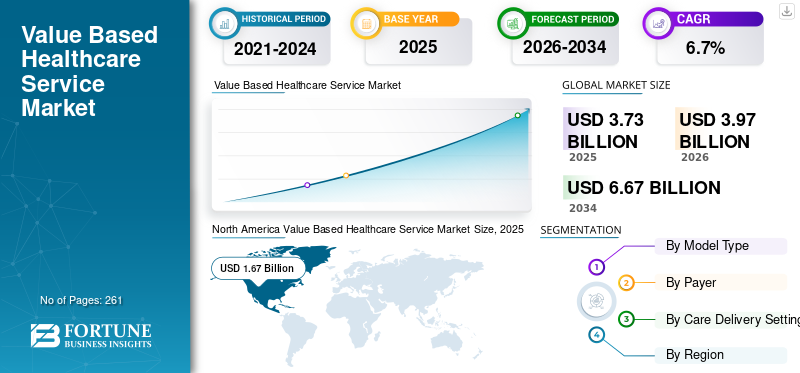
The value based healthcare service market size was valued at USD 3.73 billion in 2025 and is projected to grow from USD 3.97 billion in 2026 to USD 6.67 billion by 2034, exhibiting a CAGR of 6.7% during the forecast period. North America dominated the value based healthcare service market with a market share of 44.77% in 2025.
Value based healthcare services refer to a healthcare model where healthcare providers are compensated based on patient health outcomes. The increasing prevalence of chronic diseases, development of healthcare infrastructure, and rising adoption of digital health and automation are resulting in a growing adoption of these services in the market. The rising offering of value-based care among the healthcare providers is further fueling the adoption of these services in the market.
- For instance, according to 2024 statistics published by the Centers for Disease Control & Prevention (CDC), about 1 in 20 adults aged 20 and older have coronary artery disease in the U.S.
Furthermore, the rising focus on the provision of value based care support among companies, including Aledade and Agilon Health, among others, is further contributing to the demand for these services in the market.
Download Free sample to learn more about this report.
Value Based Healthcare Service Market Key Takeaways
 Global Market Size & Forecast
- 2025 Market Size: USD 3.73 billion
- 2026 Market Size: USD 3.97 billion
- 2034 Forecast Market Size: USD 6.67 billion
- CAGR: 6.7% from 2026–2034
 Market Share
- North America dominated the value based healthcare service market with a 44.77% share in 2025.
- The shared savings segment is projected to grow at a CAGR of 6.6% during the forecast period.
- The private segment is expected to register a CAGR of 7.1% during the forecast period.
 Key Regional Highlights
North America
North America was valued at USD 1.67 billion in 2025, maintaining its leading position in the global market.
Asia Pacific
Asia Pacific is estimated to reach USD 0.90 billion in 2026, securing the position as the third-largest regional market.
Europe
Europe is projected to reach USD 0.96 billion in 2026, growing at a CAGR of 5.8% during the forecast period.
U.S.
The country continues to lead the North American market with widespread adoption of value-based care models.
Japan
The market is estimated to reach USD 0.20 billion in 2026, accounting for roughly 5.1% of global revenues.
Read More

Value Based Healthcare Service Market Trends
Increasing Adoption of Artificial Intelligence and Predictive Analytics is a Prominent Market Trend
The incorporation of automation, artificial intelligence, and predictive analytics is emerging as a major trend in the market. These services require payers, providers, and service partners to continuously identify high-risk populations, monitor patient outcomes, close care gaps, minimize avoidable utilization, and manage total cost of care. Artificial intelligence-enabled workflows help these objectives by enabling predictive patient modeling, automated claims review, risk stratification, prior authorization support, provider performance analytics, and personalized care management. Additionally, predictive analytics is increasingly being adopted to forecast cost trends, improve performance under shared-savings, bundled-payment, and risk-based reimbursement models.
- For instance, according to 2024 data published by Becker’s Healthcare, it was reported that AI and automation technologies could enable payers to achieve 13-25% on administrative costs, 5-11% on medical costs, and increase revenues by 3-12%.
Market Dynamics
Market Drivers
Download Free sample to learn more about this report.
Increasing Burden of Chronic Diseases to Drive Market Growth
The growing prevalence of chronic conditions, including diabetes, cancer, chronic respiratory diseases, and others, is resulting in rising demand for innovative and cost effective treatment solutions among patients. Value-based healthcare services help providers and payers through population health management, risk stratification, care-gap closure, patient engagement, remote monitoring, and performance analytics.
- For instance, according to 2024 data published by the World Health Organization (WHO), approximately 197,090 clinical trials were conducted in the U.S.
This, along with rising focus toward improving quality care, expansion of cloud-based payer platforms, and automation technologies, is further driving the adoption of these services in the market. Therefore, the factors above, along with the rising focus on offering novel value based care support among the providers, are further likely to drive value based healthcare service market growth.
Market Restraints
Cybersecurity Risks and Data Privacy to Limit the Market Growth
The increasing reliance on claims analytics, digital platforms, electronic health records, population health management tools, remote patient monitoring tools, and AI-enabled software is increasing data privacy and cybersecurity risks in the global market. Value-based care setups require sharing of sensitive financial, clinical, claims, and patient-reported information among providers, payers, technology vendors, and care management service partners. Additionally, concerns over patient consent, interoperability, data ownership, and cross-border data transfer may further limit the adoption of these service platforms, especially among smaller organizations and providers with limited cybersecurity infrastructure, thereby hindering market growth.
- For instance, according to the statistics published by The HIPAA Journal, the Office for Civil Rights (OCR) data breach portal showed 725 data breaches of 500 or more records in 2024.
Market Opportunities
Expansion in Emerging Countries to Create Lucrative Opportunities
The emerging healthcare settings are working to expand insurance coverage, improve healthcare quality, strengthen primary care, and minimize out-of-pocket spending. These conditions create strong potential for service providers offering population health management, care coordination, claims analytics, risk stratification, quality reporting, digital patient engagement, and payer-provider performance management. There is an increasing demand for value-based care models as they improve access, minimizes hospitalizations, manage chronic disease populations, and align provider payments with patient outcomes. Additionally, the growing expansion of healthcare infrastructure and healthcare expenditure is contributing to the establishment of a developed value based services model, especially in emerging countries including India, Brazil, and others.
- According to 2025 statistics published by the International Trade Administration, healthcare expenditure is around USD 135.0 billion in Brazil.
Market Challenges
Inadequate Reimbursement Framework to Limit Market Growth
Insufficient reimbursement policies in emerging countries remain a key challenge for the global market. The reimbursement coverage often remains limited to pilot programs, selected disease areas, or specific payer-provider setups. Variations in reimbursement policies create uncertainty for service providers and value-based care service companies, as they must adapt their platforms, reporting tools, analytics, care management workflows, and contract-performance models to different reimbursement and regulatory environments.
Various insurance schemes cover only selected procedures, medicines, hospitals, or population groups, resulting in limited formal payer-managed transactions, thereby limiting market growth.
- For instance, according to data published by the American Medical Association, 82.8% of physicians reported that their practice received some fee-for-service payments in 2024.
SEGMENTATION ANALYSIS
By Model Type
Increasing Implementation of Novel Programs Led to Pay-for-Performance Segment Dominance
Based on the model type, the market is classified into pay-for-performance, shared savings, shared risk, bundled / episode-based payment, and others.
To know how our report can help streamline your business, Speak to Analyst
The pay-for-performance segment held the largest value based healthcare service market share in 2025. The growth is owing to its easier implementation and other benefits, resulting in growing adoption of pay-for-performance model type among providers, hospitals, physician groups, and accountable care organizations. This, along with the growing focus toward innovative programs to support the model, is further expected to contribute to the segment growth.
- For instance, according to 2026 data published by Centers for Medicare & Medicaid Services (CMS), there is an ongoing development for Hospital Value-Based Purchasing (VBP) Program to structure Medicare’s payment system that reward providers for the quality of care provide among patients. This program adjusts payments to hospitals under the Inpatient Prospective Payment System (IPPS), based on the quality of care delivered.
The shared savings segment is expected to grow at a CAGR of 6.6% over the forecast period.
By Payer
Increasing Participation of ACOs in Medicare Program Led to Public Payer Segment Dominance
Based on the payer, the market is bifurcated into private and public.
The public segment dominated the market in 2025. The advantages of public health insurance, increasing adoption through government-led models, and growing participation of providers, including ACOs in Medicare, are resulting in growing adoption of these services, further contributing to the segmental growth in the market. Additionally, the segment is set to hold a 59.9% share in 2026.
- For instance, according to 2024 data published by the Centers for Medicare & Medicaid Services (CMS), it was reported that a total of 480 Accountable Care Organizations (ACOs) participated in the Medicare Shared Savings Program.
In addition, the private is projected to grow at a 7.1% CAGR during the forecast period.
By Care Delivery Setting
Increasing Number of Hospitals Led to Hospitals & Integrated Health Systems Segment’s Dominance
Based on the care delivery setting, the market is segmented into hospitals & integrated health systems, physician groups, accountable care organizations, and others.
The hospitals & integrated health systems segment dominated the market in 2025. The growing prevalence of chronic conditions, increasing adoption of value based care services, and growing number of hospital settings are resulting in increased penetration of these services, further contributing to the segment’s growth. Furthermore, the segment is set to hold a 45.7% share in 2026.
- For instance, according to 2026 data published by the American Hospital Association (AHA), there are about 6,100 hospitals in the U.S.
In addition, the physician groups segment is projected to grow at a 7.1% CAGR during the forecast period.
Value Based Healthcare Service Market Regional Outlook
Based on region, the market has been studied across North America, Europe, Asia Pacific, Latin America, and the Middle East & Africa.
North America
North America Value Based Healthcare Service Market Size, 2025 (USD Billion)
To get more information on the regional analysis of this market, Download Free sample
The North America market held a dominant share in 2024, valued at USD 1.58 billion, and also took the leading share in 2025 with USD 1.67 billion. The rising medicare and medicaid spending, growing adoption rate of value based healthcare services, suring number of insurance payers and providers, are some of the factors contributing to the regional market growth.
- For instance, according to 2025 data published by the Centers for Medicare & Medicaid Services (CMS), Medicaid spending grew 6.6% to USD 931.7 billion in 2024, or 18% of total national healthcare expenditure in the U.S.
U.S. Value Based Healthcare Service Market
Based on North America’s strong contribution, the U.S. market can be analytically approximated at around USD 1.58 billion in 2026, accounting for roughly 39.9% of global sales.
Europe
Europe is projected to record a growth rate of 5.8% in the coming years, which is the second highest among all regions, and reach a valuation of USD 0.96 billion by 2026. The growing demand for innovative value based healthcare services, and increased focus toward improving quality of care among the providers is likely to support the market growth.
U.K. Value Based Healthcare Service Market
The U.K. market in 2026 is estimated at around USD 0.18 billion, representing roughly 4.5% of global revenues.
Germany Value Based Healthcare Service Market
Germany market is projected to reach approximately USD 0.20 billion in 2026, equivalent to around 5.0% of global sales.
Asia Pacific
Asia Pacific is estimated to reach USD 0.90 billion in 2026 and secure the position of the third-largest region in the market. The growing adoption of digital tools and improved data analytics is likely to support the growth of the market.
Japan Value Based Healthcare Service Market
The Japan market in 2026 is estimated at around USD 0.20 billion, accounting for roughly 5.1% of global revenues. Japan is expected to grow due to the expansion of healthcare infrastructure and rising adoption of these services in the market.
China Value Based Healthcare Service Market
China market is projected to be one of the largest worldwide, with 2026 revenues estimated at around USD 0.23 billion, representing roughly 5.7% of global sales.
India Value Based Healthcare Service Market
The India market in 2026 is estimated at around USD 0.14 billion, accounting for roughly 3.4% of global revenues.
Latin America and Middle East & Africa
The Latin America and Middle East & Africa regions are expected to witness moderate growth in this market space during the forecast period. The Latin America market is set to reach a valuation of USD 0.19 billion in 2026. The growth is due to increasing demand for high-quality care among patients and the advancements in the healthcare system in the region. The Middle East & Africa region is also anticipated to grow due to the development in the model type, including pay for performance and improved care plans in the market. In the Middle East & Africa, the GCC is set to reach a value of USD 0.08 billion in 2026.
South Africa Value Based Healthcare Service Market
The South Africa market is projected to reach around USD 0.03 billion in 2026, representing roughly 0.7% of global revenues.
Competitive Landscape
Key Industry Players
Increasing Number of Partnerships Among Other Companies to Support Increased Market Competition
A robust and diversified services portfolio, along with a significant emphasis on inorganic growth strategies globally, is one of the major factors contributing to the dominance of key companies in the market. Aledade and Agilon Health are major companies in the market. Furthermore, the growing focus of key companies on partnerships with other companies is likely to strengthen their presence.
- For instance, in August 2022, Elevance Health, one of the nation’s health companies, partnered with Aledade, an innovative primary care physician enablement company that helps enhance the consumer experience and health outcomes for those seeking services from independent primary care practices.
Other key players, including Privia Health and others, are also growing in the market, primarily due to their increasing focus on expanding services to strengthen their presence in the market.
List of Key Value Based Healthcare Service Companies Profiled
- Optum, Inc. (U.S.)
- Aledade (U.S.)
- Agilon Health (U.S.)
- Privia Health (U.S.)
- Guidehealth (U.S.)
- Wellvana (U.S.)
- Pearl Health, Inc. (U.S.)
- Vytalize (U.S.)
- Health Catalyst (U.S.)
- Navvis (U.S.)
KEY INDUSTRY DEVELOPMENTS
- February 2026: Aledade, a physician‑led, national leader in value‑based care, added more than 700 primary care organizations including independent practices, clinics, community health centers and systems to its network.
- July 2025: Astrana Health, Inc., a physician-centric, technology-enabled healthcare company empowering providers to deliver accessible, high-quality, and high-value care, acquired Prospect Health.
- July 2025: Nordic Capital acquired healthcare analytics company Arcadia Solutions to leverage artificial intelligence’s potential to improve healthcare and save money.
- January 2025: Virginia Care Partners, a large collaborative physician network affiliated with HCA Virginia, and Pearl Health, a provider of physician enablement and risk management technology and services, announced their partnership to increase access to innovative value-based care models for primary care providers in the Richmond metropolitan area.
- October 2024: Henry Ford Health launched a new subsidiary dedicated to advancing population health. The new non-profit company, Populance, supports doctors, hospitals, and health plans by providing value-based care services designed to improve health care outcomes and enhance the patient experience while lowering the total cost of care.
- April 2024: Tufts Medicine, an integrated health system in Massachusetts, and Navvis, a population health company, announced an exclusive partnership, driving a transformative shift in healthcare delivery through the acceleration of value-based care.
- June 2019: Aledade announced the creation of 5 new Accountable Care Organizations (ACOs). The five new ACOs are part of a group of 16 ACOs that have applied to start in Medicare's Pathways to Success Program that started on July 1. The newly formed ACOs are in North Carolina, Kansas, Alabama, Louisiana, and Pennsylvania.
REPORT COVERAGE
The report provides a detailed value based healthcare service market analysis and focuses on key aspects such as leading companies and market segmentation, including model type, payer, and care delivery setting. Besides this, the global report offers insights into the market growth trends and highlights key industry developments. In addition to the aforementioned factors, the report encompasses several factors that have contributed to the growth and advancement of the market over recent years.
Request for Customization to gain extensive market insights.
Report Scope & Segmentation
| ATTRIBUTE | DETAILS |
| Study Period | 2021-2034 |
| Base Year | 2025 |
| Estimated Year | 2026 |
| Forecast Period | 2026-2034 |
| Historical Period | 2021-2024 |
| Growth Rate | CAGR of 6.7% from 2026-2034 |
| Unit | Value (USD Billion) |
| Segmentation | By Model Type, Payer, Care Delivery Setting, and Region |
| By Model Type |
|
| By Payer |
|
| By Care Delivery Setting |
|
| By Region |
|
Frequently Asked Questions
Fortune Business Insights says that the global market size was USD 3.73 billion in 2025 and is projected to reach USD 6.67 billion by 2034.
In 2025, the North America regional market value stood at USD 1.67 billion.
Growing at a CAGR of 6.7%, the market will exhibit steady growth over the forecast period (2026-2034).
By model type, the shared savings segment is the leading in the market.
The introduction of novel value based healthcare services is driving the market growth.
Aledade and Agilon Health are the major players in the market.
North America held the highest share in the market .
The growing demand of value based healthcare services and increased expansion of health insurance networks, are some of the key factors anticipated to boost the adoption of these services globally.



- 2021-2034
- 2025
- 2021-2024
- 261
Get 30-60 hrs Free Customization
Expand Regional and Country Coverage, Segments Analysis, Company Profiles, Competitive Benchmarking, and End-user Insights.













.webp)






-
US +1 833 909 2966 ( Toll Free )
-
Get In Touch With Us