Ventilated Seats Market Size, Share & Industry Analysis By Vehicle Type (Hatchback/Sedan, SUVs, and LCVs), By Propulsion (ICE, Hybrid, and Electric), By End-user (OEM and Aftermarket), By Fan Type (Axial and Radial), By Technology (Active and Passive), By Seat Position (Front and Rear), By Component (Fans, Control Modules, and Others), and Regional Forecast, 2026-2034
 Download Free Sample
(Offer valid till 15th Oct 2026)

KEY MARKET INSIGHTS
 Listen to Audio Version
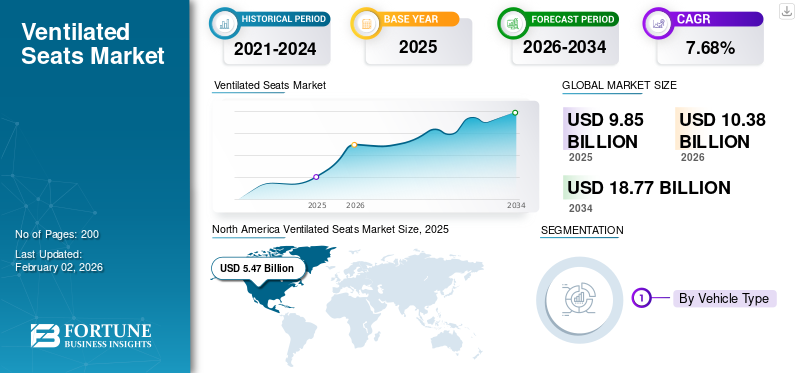
The global ventilated seats market size was valued at USD 9.85 billion in 2025 and is projected to grow from USD 10.38 billion in 2026 to USD 18.77 billion by 2034, exhibiting a CAGR of 7.68% during the forecast period. North America dominated the ventilated seats market with a market share of 55.52% in 2025.
Ventilated seats are advanced automotive seating systems designed to improve comfort by circulating air through perforations in the seat surface. Using built-in fans or cooling elements, they draw heat and moisture away from the occupant’s body, reducing discomfort during hot weather or extended drives. Common in premium and mid-range vehicles, ventilated seats enhance climate control, prevent perspiration buildup, and contribute to a more comfortable and enjoyable driving experience.
The market is driven by rising consumer demand for enhanced in-vehicle comfort, especially in hot and humid regions. The growing adoption of premium features in mid-range vehicles, advancements in automotive climate control technology, and increasing disposable incomes further boost demand. Additionally, the heightened focus on luxury, driver well-being, and differentiation among automakers fuel market expansion. Regulatory trends promoting ergonomic seating also support the integration of seat ventilation system across diverse vehicle segments globally.
Key players in the market include Adient, Lear, and Faurecia, among others. These companies focus on innovation, sustainability, and OEM partnerships to dominate the ventilated seats market. They invest heavily in R&D activities for energy-efficient, lightweight, and smart climate control solutions, catering to both luxury and mass market vehicles. Strategies include expanding global manufacturing footprints, integrating advanced materials, and leveraging collaborations with automakers to offer customizable designs, ensuring competitive differentiation, and meeting growing demand for comfort, ergonomics, and premium in-vehicle experiences worldwide.
Download Free sample to learn more about this report.
Download Free sample to learn more about this report.
Ventilated Seats Market Key Takeaways
 Global Market Size & Forecast
- 2025 Market Size: USD 9.85 billion
- 2026 Market Size: USD 10.38 billion
- 2034 Forecast Market Size: USD 18.77 billion
- CAGR: 7.68% from 2026–2034
 Market Share
- North America dominated the ventilated seats market with a 55.52% share in 2025.
- SUVs segment is projected to lead with a 70.01% market share in 2026.
- OEM segment is projected to account for 67.61% of the market in 2026.
 Key Regional Highlights
North America
North America led the market with a 55.52% share in 2025.
Europe
Europe is expected to witness strong growth, supported by rising EV adoption and premium vehicle demand.
Asia Pacific
Asia Pacific is projected to expand steadily, driven by growing SUV and electric vehicle production.
U.S.
Strong demand for premium vehicles is driving ventilated seat adoption.
Japan
Rising production of advanced vehicles is supporting market growth.
Read More

Market Dynamics
Market Drivers
Rising Demand for Comfort and Luxury Drives Market Growth
Modern consumers increasingly expect premium features that enhance driving comfort, even in mid-range vehicles. Ventilated seats, by circulating air through perforations, help regulate body temperature, reduce perspiration, and improve overall travel experience, particularly in hot climates. Automakers use them as a key differentiator to attract buyers seeking luxury features without necessarily purchasing high-end models. As disposal incomes rise globally, more customers can afford vehicles with advanced comfort features, boosting adoption rates. This trend spans both conventional and electric vehicles, reinforcing steady market growth over the forecast period. In April 2025, according to a survey conducted by Park+ Research Labs, a digital survey platform of India, around 78% of the 6,000 car owners surveyed opted for ventilated seats as a must-have feature, putting behind sunroofs, ADAS, and larger infotainment systems.
Market Restraints
High Cost of Integration Hampers Market Growth
Systems such as ventilated seats require specialized components such as high-quality perforated upholstery, built-in fans or blowers, control modules, and intricate wiring, all of which increase production expenses. For automakers, adding ventilation system raises vehicle prices, making them less viable in cost-sensitive or entry-level segments. This limits their deployment primarily in premium and mid range vehicles. Additionally, higher retail prices can deter buyers in emerging markets where affordability is a major barrier preventing widespread penetration across the global market.
Market Opportunities
Expansion in Mid-Range Vehicles Provides Market Opportunity
Expanding the availability into mid-range vehicles offers a major market opportunity by broadening the customer base beyond premium buyers. As manufacturing costs decline through material innovation and streamlined production, automakers can offer this feature in more affordable models without significant price hikes. Mid-range vehicle buyers, increasingly seeking luxury-like comfort, are likely to embrace seat ventilation as a value-added feature. This move also helps brands differentiate in a highly competitive segment, attract aspirational customers, and boost overall sales volumes. Widespread adoption in mid-tier models can accelerate market penetration, especially in regions with rising disposable incomes and the growing demand for comfort-oriented vehicles, driving the ventilated seats market growth over the forecast period.
In August 2025, Maruti Suzuki introduced the Grand Vitara Phantom Blaq Edition, a limited-run SUV celebrating ten years of its NEXA premium channel. Based on the Strong Hybrid Alpha+ trim, it sports a bold matte-black wrap and refined all-black interior with champagne-gold accents. The standout comfort features include ventilated front seats, along with a panoramic sunroof, 9-inch SmartPlay Pro+ infotainment, 360° camera, HUD, wireless charging, and Clarion audio.
Market Challenges
Maintenance Complexity Creates Challenges in the Adoption of Ventilated Seats
Ventilated seat systems use integrated fans, blowers, ducting, and perforated materials that can wear out, clog, or malfunction over time. Repairing or replacing components often requires specialized expertise, increasing labor costs and part expenses. For many consumers, particularly in price-sensitive regions, these ongoing costs can outweigh the perceived comfort benefits, discouraging adoption. Additionally, the limited availability of skilled technicians in some markets further complicates repairs, leading to longer downtime. This complexity and cost factor reduce customer willingness to invest in seat ventilation, slowing market penetration across both OEM and aftermarket channels, challenging the market over the forecast period.
Ventilated Seats Market Trends
Product Adoption in Electric Vehicles is a Major Market Trend
The adoption of ventilated seats in electric vehicles is a key market trend driven by the need for premium comfort and energy efficiency. EV buyers often expect advanced features and seat ventilation offers a luxury feel while enhancing driving comfort in hot climates. Modern systems are being redesigned with lightweight materials and low-power fans to minimize battery drain. Automakers integrate them as differentiators in a competitive EV market. As EV adoption accelerates globally, ventilated seats are becoming a common feature, boosting their overall market presence and supporting the demand for comfort-oriented, eco-friendly technologies. According to IEA (International Energy Agency), around 17 million electric cars were sold in 2024 and the number is expected to exceed 20 million in 2025.
Impact of Tariffs
Automakers May Reduce Addition of Premium Features For Cost Cutting Due to Tariff
The U.S. tariffs on imported automotive components can increase production costs for seat ventilation systems, as many parts, such as motors, fans, and electronic control modules, are sourced globally. Higher tariffs raise expenses for automakers and suppliers, potentially leading to higher vehicle prices or reduced inclusion of premium features such as ventilated seats in certain models. This may slow adoption in price-sensitive segments while benefiting domestic component manufacturers. However, supply chain adjustments such as local sourcing or production relocation could mitigate long-term effects. In the short term, tariffs create cost pressures and market uncertainty, influencing both OEM strategies and consumer purchasing decisions.
Segmentation Analysis
By Vehicle Type
Demand for Advanced Features in Both Luxury and Mid-Range SUVs Boosts SUVs Segment Growth
By vehicle type, the market is segmented into hatchback/sedan, SUVs, and LCVs.
The SUVs segment is expected to lead the market, contributing 70.01% globally in 2026. The SUV segment dominates the market due to rising consumer preference for larger, premium, and comfort-oriented vehicles. Higher disposable incomes, urbanization, and the demand for advanced features in both luxury and mid-range SUVs boost adoption. SUVs offer more cabin space, enabling easier integration of seat ventilation system without compromising design or ergonomics. Additionally, the growing popularity of electric and hybrid SUVs, often positioned as technologically advanced, is set to fuel product demand in these vehicles over the forecast period.
- In March 2024, Honda updated its Elevate SUV to offer an optional ventilated seat cover with massage functionality for an additional cost. This strap-on accessory, especially useful in hot climates, plugs into the 12-V socket and brings enhanced cooling comfort, without being a built-in seat feature.
The hatchback/sedan segment held the second-largest share in the market in 2024. The growth of the market is driven by the widespread use of hatchbacks and sedans in urban and suburban mobility. While traditionally associated with affordability, mid and premium range sedans now integrate seat ventilation to enhance comfort and compete with SUVs. The rising popularity of compact luxury sedans, growth in fleet and ride-hailing services, and increasing consumer awareness of comfort features support market expansion over the forecast period.
To know how our report can help streamline your business, Speak to Analyst
By Propulsion
ICE Segment Led the Market in 2024 Owing to Wide Variety of Vehicle Models and Strong Sales
Based on propulsion, the market is categorized into ICE, hybrid, and electric.
The ICE segment will account for 61.06% market share in 2026. The segment dominates due to its large existing fleet, well-established production infrastructure, and continued strong sales in emerging economies. Ventilated seats have become increasingly common in mid to high-end ICE vehicles, driven by rising comfort expectations and competitive differentiation among automakers. The lower production costs of ICE vehicles compared to EVs allow manufacturers to integrate premium features without significant price hikes. Additionally, the wide variety of ICE vehicle models across SUVs, sedans, and luxury cars ensures a broad consumer base, fueling the market growth worldwide.
- In August 2025, Audi’s A5L Sportback, an internal-combustion vehicle equipped with Huawei’s Qiankun ADAS, garnered 9,800 pre-orders on its launch night alone. The premium fastback also features front seats with electric adjustment, heating, ventilation, and massage capabilities.
The electric segment is considered to be the fastest-growing segment over the forecast period (2025-2032). Electric vehicles are the fastest-growing segment, fueled by rapid EV adoption, government incentives, and automakers' focus on positioning EVs as technologically advanced and luxurious. Ventilated seats complement EVs’ premium, comfort-oriented image, often being standard or high-demand optional features. The absence of engine noise in EVs highlights interior comfort, making features such as seat ventilation more noticeable and valued. Consumers purchasing EVs tend to prioritize innovation and comfort, encouraging manufacturers to integrate such features even in mid-range models. As EV adoption accelerates globally, especially in North America, Europe, and China, the penetration of ventilated seating system in this segment is expected to surge during the forecast period.
By End-user
OEM Segment Leads the Market with Increasing Factory Integration of Comfort Features
Based on end-user, the market is divided into OEM and aftermarket.
The OEM segment is expected to account for 67.61% of the market in 2026. The growth of the segment is driven by increasing factory integration of comfort features in new vehicles. Automakers are equipping mid-range and premium models with ventilated seating system as standard or optional offerings to enhance competitiveness. The rising global sales of SUVs and EVs, both popular for premium interiors, further fuel OEM demand. Additionally, OEM-fitted ventilated seats ensure better performance, aesthetics, and warranty coverage, making them more attractive to consumers, boosting their market share and growth rate over the forecast period.
- In July 2025, Dongfeng’s Voyah launched the Free+ EREV SUV in China, starting at JPY 219,900 (~USD 30,650) for the RWD Qiankun trim. Within 15 minutes, it secured 11,583 orders. Equipped with Huawei’s ADS 4 system, the Free+ also features front and rear seats with both heating and ventilation, plus reclining rear seats for enhanced comfort.
The aftermarket segment represents a considerable share of the market in 2024. This segment caters mainly to vehicle owners seeking upgrades or replacements. The demand is supported by the availability of retrofit kits and seat covers with built-in ventilation systems, appealing to cost-conscious customers or those owning older vehicles. Growth is limited by factors such as installation complexity, variable performance quality, and lack of integration with original vehicle systems. However, the segment benefits from rising awareness of comfort features, especially in regions with extreme climates, further driving the market growth during the forecast period.
By Fan Type
Automakers’ Preference for Radial Fans for OEM Installations to Drive Segment Growth
By fan type, the market is segmented into axial and radial.
The radial fans segment will dominate the market and will be the fastest-growing segment due to its superior airflow efficiency, compact design, and ability to maintain consistent ventilation across various seat materials, accounting for a 64.43% market share in 2026. They generate higher static pressure, making them effective in pushing air through foam and upholstery layers. Automakers prefer radial fans for OEM installations as they deliver quieter operation and better integration into modern, slim seat designs. Their durability and adaptability for both ICE and EV models further boost adoption. Ongoing advancements in miniaturization and energy efficiency are enhancing performance, supporting radial fans’ continued dominance and rapid market growth.
- In April 2025, ASPINA unveiled the DRF-29306 Super Thin, a groundbreaking 15 mm-thick automotive seat ventilation blower (housing scroll), one of the thinnest in the industry, engineered to address the space constraints of increasingly slim, multifunctional seats. It maintains airflow and pressure performance while reducing thickness from 23 mm to 15 mm.
The axial segment held a significant share in 2024. Axial fans are simpler in design and more cost-effective, making them suitable for aftermarket solutions or budget vehicle models. Axial fans can still provide adequate comfort in certain seat configurations, particularly in vehicles with less restrictive upholstery. While their growth is modest, improvements in noise reduction and compact form factors are expanding their potential use in niche applications where cost sensitivity and straightforward installation are more critical than top-tier performance, fueling the segmental growth.
By Technology
Preference in Premium, Mid-Range, and Increasingly in Electric Vehicles Drives Active Ventilated System Demand
By technology, the market is segmented into active and passive.
The active ventilated system held the largest market share in 2026. An active system uses integrated fans or blowers to circulate and air conditioning through the seat's surface, providing direct cooling and enhanced comfort. This segment is preferred in premium, mid-range, and increasingly in electric vehicles, as it delivers noticeable temperature regulation in both hot and humid climates. Automakers favor active systems for their ability to offer consistent, customizable airflow, often integrated with climate controlled seating systems for optimized performance. Though more expensive, advancements in compact, energy-efficient fans and noise reduction are anticipated to expand product adoption over the forecast period.
The passive ventilates system is poised to surge at the fastest CAGR over the forecast period (2026-2034). A passive system relies on breathable materials, perforated upholstery, and natural airflow without mechanical assistance. They offer a lower-cost alternative, often used in entry-level or mid-tier models to improve comfort without adding electrical components. A passive system reduces manufacturing complexity, energy consumption, and potential maintenance issues. Despite slower growth, passive technology maintains a steady presence in cost-sensitive segments and regions, benefiting from advancements in high-performance fabrics and foam structures that improve airflow while retaining durability and aesthetics appeal at a competitive price point.
By Seat Position
Long-standing Tradition of Offering Premium Features in Front Seating Drives the Segment Growth
By seat position, the market is classified into front and rear.
The front segment held a dominant position in the market in 2026. The front seats dominate as they are the primary focus for comfort features in most vehicles. Drivers and front passengers benefit the most from ventilation, as these seats are used more frequently and for longer durations. Automakers prioritize integrating seat ventilation system in the front, especially in mid-range, premium, and SUV segments, to enhance perceived luxury and driving comfort. OEM adoption is high as front seat ventilation can be easily paired with heating and adjustable controls. Strong consumer demand, coupled with a long-standing tradition of offering premium features in front seating, ensures this segment’s continued growth in the market.
The rear segment is estimated to be the fastest-growing over the forecast period. The rear segment, including, is the fastest growing due to rising luxury and premium vehicle trends. High-end SUVs, sedans, and electric vehicles increasingly offer ventilated rear seats to improve passenger comfort, particularly in chauffeur-driven markets such as China, the Middle East, and India. Growing consumer expectations for uniform comfort across all seating positions and advances in compact fan technology make it easier to integrate ventilation in limited spaces. Additionally, luxury automakers are using ventilated rear seats as a differentiator in competitive markets, driving demand in both OEM and high-end aftermarket segments over the forecast period.
- In December 2024, Kia revealed the sub-compact SUV Syros, India’s most affordable model to offer rear seat ventilation, alongside a segment-first rear seat slide and recline, enhancing back-seat comfort in the compact segment.
By Component
Increasing Use of Intelligent Control Modules Boosts the Control Module Segment Growth
By component, the market is segregated into fans, control modules, and others.
The control modules segment held the largest market share in 2026. The segment is also estimated to be the fastest-growing over the forecast period. This segment dominates as it serves as the core system managing fan speed, airflow direction, and integration with the vehicle’s climate control. Advancements in electronics, microcontrollers, and software have enabled precise temperature regulation and user customization, enhancing comfort. Automakers increasingly use intelligent control modules that adjust ventilation automatically based on cabin conditions or occupant preferences. Their growing complexity and central role in delivering a premium seating experience make them the most valuable component. Rising adoption in both the ICE and EV segments further accelerates the segment’s share and growth rate over the forecast period.
The fans segment held the second-largest market share in 2026. Fans are essential for creating the airflow that defines the function. While typically small and more cost-effective than control modules, they are critical to performance and user satisfaction. Radial fans dominate this subcategory due to better airflow through dense seat materials, though axial fans remain in use for budget or aftermarket applications. Advancements in low-noise, energy-efficient designs are improving fan adoption in both OEM and aftermarket channels, further propelling market growth.
Ventilated Seats Market Regional Outlook
By region, the market is categorized into North America, Europe, Asia Pacific, and the rest of the world.
North America
North America Ventilated Seats Market Size, 2025 (USD Billion) To get more information on the regional analysis of this market, Download Free sample
The market in North America reached USD 5.47 billion in 2025, representing 55.52% of total market revenue, and is projected to reach USD 5.75 billion in 2026. due to high consumer demand for premium comfort features, strong SUV and pickup truck sales, and a well-established automotive manufacturing base. OEMs in the U.S. and Canada widely integrate seat ventilation in mid-range and luxury vehicles, with growing adoption in electric and hybrid models. Hot summers in southern states and cold climates in northern regions drive year-round appeal, especially when paired with heating functions. Competitive differentiation among automakers, coupled with strong purchasing power, sustains the region’s leadership. The presence of leading automotive brands and robust aftermarket channels further reinforces market dominance.
The U.S. dominates the North American regional market and records increased interest in ventilated seats due to high consumer demand for premium comfort features, strong SUV and pickup truck sales, and extreme seasonal temperatures encouraging year-round heating and cooling integration. OEMs widely offer ventilated seating systems in mid-range and luxury vehicles, while EV growth further boosts product adoption. High purchasing power, competitive differentiation among automakers, and a mature automotive manufacturing base drive the dominance of the U.S. market. The U.S. market is projected to reach USD 5.14 Billion by 2026.
- In January 2025, Tesla launched its redesigned Model Y in China, featuring updated aesthetics with full-width light bars and a second-row touchscreen. The upscale interior also introduces heated and ventilated front seats for enhanced all-weather comfort.
Europe
Europe contributed approximately USD 1.39 billion to the global market in 2025, accounting for 14.10% share, and is expected to reach USD 1.45 billion in 2026. The regional market growth is supported by strong sales of premium sedans, SUVs, and electric vehicles. Consumer preference for advanced comfort features is high and automakers such as BMW, Mercedes-Benz, and Audi offer seat ventilation in a wide range of models. Stringent regulations on vehicle efficiency drive the adoption of compact, energy-efficient ventilation systems. The region’s varied climate, with both hot summers and cold winters, encourages dual heating and ventilation system functions, further propelling market growth in the region. The UK market is projected to reach USD 0.31 Billion by 2026, while the Germany market is projected to reach USD 0.34 Billion by 2026.
In October 2024, Volkswagen premiered the Tayron SUV in Europe, an all-rounder offering optional massaging ergoActive seats with independent heating and ventilation for warm days, all within a spacious five or seven-seat layout on the MQB Evo platform.
Asia Pacific
In 2025, the Asia Pacific market stood at USD 2.87 billion, representing 29.10% of global demand, and is projected to grow to USD 3.05 billion in 2026. The growth of the market is driven by rapid vehicle sales growth, rising disposable income, and expanding SUV and EV adoption. Countries such as China, Japan, and South Korea are major automotive hubs, with increasing local production of premium and mid-range vehicles featuring seat ventilation system. The growing popularity of chauffeur-driven cars in China and India fuels the demand for ventilated rear seats. Regional automakers are integrating ventilation even in mid-segment models to attract in hot, humid climates. Government EV promotion policies and rapid urbanization further accelerate growth in the region. The Japan market is projected to reach USD 0.29 Billion by 2026, the China market is projected to reach USD 1.79 Billion by 2026, and the South Korea market is projected to reach USD 0.68 Billion by 2026.
In May 2025, Kia India unveiled the Carens Clavis, a premium 6/7-seater MPV with Level-2 ADAS, panoramic dual-pane sunroof, dual-screen displays, Bose audio, and ambient lighting. Select trims include front ventilated seats paired with a 4-way power-adjustable driver’s seat, bringing enhanced cooling comfort to the family segment.
Rest of the World
The rest of the world comprises South America, the Middle East and Africa sub-regions, holding the smallest share in the market. Rest of the World recorded a market size of USD 0.13 billion in 2025, capturing 1.28% of the global market share, and is projected to reach USD 0.13 billion in 2026. The region shows the gradual adoption of seat ventilation system, largely in premium and imported vehicles. Hot climates in the Middle East create strong demand among high-income consumers, while Latin America sees moderate growth driven by luxury imports and limited local assembly. Africa’s market is smaller, constrained by low penetration of premium vehicles and cost sensitivity. However, economic growth in certain regions, coupled with increasing awareness of comfort features, is creating niche opportunities. Expansion of dealership networks and rising availability of aftermarket solutions are gradually improving adoption in these regions.
Competitive Landscape
Key Market Players
Product Innovation and OEM Partnerships Drive Competitive Edge
The competitive landscape of the global ventilated seats market is characterized by a mix of players in the market, including established and emerging local companies. Leading players such as Adient, Lear Corporation, Faurecia, among others, dominate through advanced technology integration, global production networks, and partnerships with major automakers. These companies focus on innovation, providing efficient air circulation through the perforation of seat material. The competition is driven by innovation in compact, energy-efficient fans, intelligent control modules, and premium comfort features. Moreover, OEM relationships players a critical role, securing long-term contracts, while aftermarket players target niche segments. In February 2022, Lear Corporation completed its acquisition of Kongsberg Automotive’s Interior Comfort Systems (ICS) business unit for approximately USD 198 million, funded through debt financing completed in late 2021. This integration brought over 3,800 employees and multiple production and technical sites under Lear’s umbrella, enhancing its capabilities in thermal and comfort seating solutions, including heating, ventilation, massage, and lumbar support.
List of Key Ventilated Seats Companies Profiled
- Adient PLC (U.S.)
- Lear Corporation (U.S.)
- Faurecia SE (France)
- Magna International Inc. (Canada)
- Toyota Boshoku Corporation (Japan)
- TS Tech Co., Ltd. (Japan)
- Hyundai Transys Inc. (South Korea)
- NHK Spring Co., Ltd. (Japan)
- Gentherm Incorporated (U.S.)
- Continental AG (Germany)
- Dura Automotive Systems (U.S.)
- Brose Sitech Sp. Z o.o. (Poland)
Key Industry Developments
- In August 2025, Tesla established its newExperience Centre at Worldmark 3, Aerocity, Delhi. The center is an 8,200 sq ft facility near IGI Airport that offers test drives, product demos, and four ultra-fast V4 Superchargers to accelerate long-distance travel. In July 2025, the company launched the Tesla Model Y, an electric midsize SUV, which features heated and ventilated front seats, plus power-folding, heated rear seats, enhancing in-cabin comfort.
- In August 2025, SAIC Motor launched pre-sales for the all-new MG4 EV in China, with a semi-solid-state battery variant. The updated model also offers enhanced comfort, featuring front seats with heating and ventilation and rear seats reclining up to 27°.
- In June 2025, at the International Automotive & Supply Chain Expo in Hong Kong, GAC unveiled its “Hong Kong ACTION” campaign, part of the “One GAC 2.0” global strategy alongside the global debut of its flying car GOVY AirCab and the Hong Kong premiere of the AION UT. Notably, the luxurious HYPTEC HT electric SUV on display featured seat ventilation, heating, and massage functions, elevating in-cabin comfort.
- In November 2024, Lucid Group launched the Lucid Gravity Grand Touring. The Grand Touring features heated and ventilated 18-way power front seats with massage functionality, available across several premium interior themes offering various upholstery options.
- In November 2022, Toyota Boshoku revealed that its seats and interiors are featured in the all-new Lexus RX. The front seats introduce a new sliding adjustable cushion length mechanism that extends support by 34 mm without forming grooves, enhancing comfort. Meanwhile, the rear seats now incorporate a ventilation system built into ducts and a fan draws air through the cushion and backrest to prevent stuffiness.
- In January 2022, Tesla updated the online Owner’s Manual for the Model 3 and Model Y, adding references to ventilated (cooled) seats, including a graphic and a dedicated button beside seat-heating controls.
Investment Analysis and Opportunities
Technological Innovations and Aftermarket Modification Drive Investment Opportunities
The market presents strong investment potential, driven by the rising demand for comfort and premium features across vehicle segments, especially SUVs and EVs. Opportunities lie in developing cost-effective, energy-efficient ventilation systems for mid-range vehicles, expanding adoption beyond front seats and integrating smart climate control technologies. Emerging markets in Asia Pacific and the Middle East depict high growth potential due to rising incomes and hot climates. Strategic investments in lightweight materials, compact fan designs, and advanced control modules can enhance competitiveness. Collaborations with OEMs, entry into aftermarket customization, and leveraging EV growth trends create significant avenues for sustained market expansion and profitability.
Report Coverage
The global market report analyzes the market in depth. It highlights crucial aspects such as prominent companies, market scope, competitive landscape, vehicle type, propulsion, fan type, end-user, technology, seat position, and component. Besides this, the market research reports provide insights into the market trends and highlights significant industry developments. In addition to the aspects mentioned earlier, the report encompasses several factors contributing to the market growth over recent years.
Request for Customization to gain extensive market insights.
Report Scope & Segmentation
|
ATTRIBUTE |
DETAILS |
|
Study Period |
2021-2034 |
|
Base Year |
2025 |
|
Estimated Year |
2026 |
|
Forecast Period |
2026-2034 |
|
Historical Period |
2021-2024 |
|
Growth Rate |
CAGR of 7.68% from 2026 to 2034 |
|
Unit |
Value (USD Billion) |
|
Segmentation |
By Vehicle Type o Hatchback/Sedan o SUVs
By Propulsion
By End-user
By Fan Type
By Technology
By Seat Position
By Component
|
|
By Region North America (By Vehicle Type, By Propulsion, By End-user, By Fan Type, By Technology, By Seat Position, and By Component) · U.S. (By Vehicle Type and By Propulsion) · Canada (By Vehicle Type and By Propulsion) · Mexico (By Vehicle Type and By Propulsion) Europe (By Vehicle Type, By Propulsion, By End-user, By Fan Type, By Technology, By Seat Position, and By Component) · Germany (By Vehicle Type and By Propulsion) · France (By Vehicle Type and By Propulsion) · U.K. (By Vehicle Type and By Propulsion) · Rest of Europe (By Vehicle Type and By Propulsion) Asia Pacific (By Vehicle Type, By Propulsion, By End-user, By Fan Type, By Technology, By Seat Position, and By Component) · China (By Vehicle Type and By Propulsion) · Japan (By Vehicle Type and By Propulsion) · South Korea (By Vehicle Type and By Propulsion) · Rest of Asia Pacific (By Vehicle Type and By Propulsion) Rest of the World (By Vehicle Type, By Propulsion, By End-user, By Fan Type, By Technology, By Seat Position, and By Component) |
Frequently Asked Questions
Fortune Business Insights says the global market was valued at USD 9.85 billion in 2025 and is anticipated to reach USD 18.77 billion by 2034.
The market will exhibit a CAGR of 7.68% over the forecast period (2026-2034).
By seat position, the front segment dominated the market in 2026.
Rising comfort and luxury demand is a key factor driving the market growth.
Adient, Lear, and Faurecia, among others, lead the global market.
North America dominated the ventilated seats market with a market share of 55.52% in 2025.



- 2021-2034
- 2025
- 2021-2024
- 200
-
(Offer valid till 15th Oct 2026)
Get 30-60 hrs Free Customization
Expand Regional and Country Coverage, Segments Analysis, Company Profiles, Competitive Benchmarking, and End-user Insights.




















Related Reports
-
US +1 833 909 2966 ( Toll Free )
-
Get In Touch With Us