 Download Free Sample
The Japan market is projected to reach USD 79.65 billion by 2026, the China market is projected to reach USD 158.42 billion by 2026, and the India market is projected to reach USD 110.66 billion by 2026.
Packaging Market Size, Share & Industry Analysis, By Material (Plastic, Paper & Paperboard, Metal, Glass, Wood, and Others), By Product Type (Rigid Packaging and Flexible Packaging), By Packaging Type (Primary Packaging, Secondary Packaging, and Tertiary Packaging), By End-use Industry (Food, Beverages, Cosmetics & Personal Care, Chemicals & Lubricants, Healthcare, Consumer Products, Building & Construction, Electronics, Automotive, and Others), and Regional Forecast, 2026-2034

(Offer valid till 30th Sep 2026)
KEY MARKET INSIGHTS
 Listen to Audio Version
The global packaging market size was valued at USD 1,109.44 billion in 2025 and is projected to grow from USD 1,143.56 billion in 2026 to USD 1,590.68 billion by 2034, driven by a CAGR of 4.21%. Asia Pacific dominated the packaging market with a market share of 38.80% in 2025.
As the demand for packaged products continues to rise across various industries, such as food and beverages, pharmaceuticals, and consumer goods, packaging has evolved into a vital element of product branding, protection, and consumer convenience.
The global packaging market encompasses a diverse range of products and materials designed to protect, contain, and preserve goods during storage, transportation, and sale. This market plays a crucial role in various industries, including food and beverage, pharmaceuticals, cosmetics, and consumer goods. Thus, it serves as a pivotal component in the supply chain and helps the market grow. The growing demand for sustainable packaging solutions also contributes to the market growth.
Amcor Plc and Mondi Group are the leading manufacturers, accounting for the largest global packaging market share.
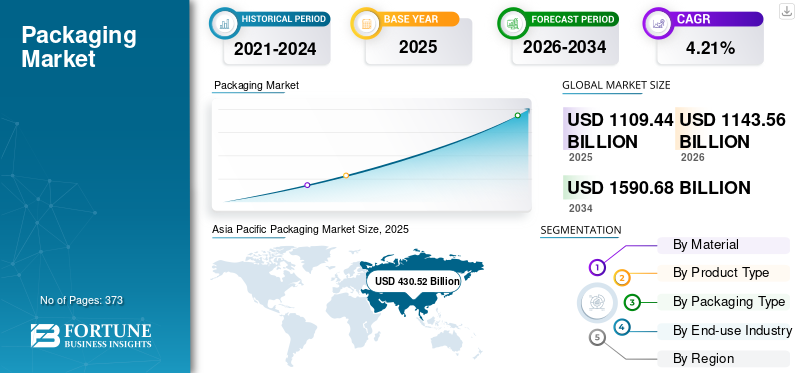
Download Free sample to learn more about this report.
Packaging Market Key Takeaways
 Global Market Size & Forecast
- 2025 Market Size: USD 1,109.44 billion
- 2026 Market Size: USD 1,143.56 billion
- 2034 Forecast Market Size: USD 1,590.68 billion
- CAGR: 4.21% from 2026–2034
 Market Share
- Asia Pacific dominated the market with a 38.80% share in 2025.
- Plastic segment is projected to hold a 40.79% share in 2026.
- Food segment is projected to hold a 46.41% share in 2026.
 Key Regional Highlights
North America
The market reached USD 310.99 billion in 2025, driven by technological advancements and sustainable packaging adoption.
Asia Pacific
The market reached USD 430.52 billion in 2025, supported by rising food & beverage demand and rapid urbanization.
Europe
The market reached USD 224.47 billion in 2025, driven by circular economy initiatives and sustainable packaging adoption.
U.S.
The market is projected to reach USD 280.60 billion by 2026.
Japan
The market is projected to reach USD 79.65 billion by 2026.
Read More

MARKET DYNAMICS
MARKET GROWTH
Use of Intelligent Packaging Systems for Controlling, Monitoring, and Optimizing Material Flow to Fuel Market Growth
The use of technology as a medium for tracking and managing raw materials and finished and unfinished goods is on the rise. Manufacturers, distributors, and retailers can access detailed information about the location and condition of their products through the intelligent features of industrial packaging. Intelligent industrial packaging is experiencing faster growth, mostly due to the increasing use of indicators such as time and temperature indicators, product differentiation, traceability, and other interactive features at more reasonable prices. Radiofrequency Identification (RFID) tags are an innovative form of data information carrier that can identify and trace products, making them a highly effective solution for managing industrial bulk packaging within a warehouse, facility, or during transportation.
For instance, Greif Inc. introduced the first Internet of Things (IoT) based device to be applied to an IBC, which can track real-time information and check the filling level. These factors increase the demand for intelligent packaging in the industry.
Increasing Demand in Healthcare and Medical Applications is Fueling Market Growth
The healthcare and medical sectors have emerged as major factors driving the growth of the market, especially in the wake of the COVID-19 pandemic. Adhesive tapes play a crucial role in medical device assembly, wound care, surgical procedures, and patient monitoring applications. The rising demand for medical tapes is driven by several factors, including an aging population, rising healthcare expenditures, and advancements in medical technology.
In addition, there is a growing focus on infection prevention and control measures in healthcare settings, driving the demand for antimicrobial and hypoallergenic products. These tapes help minimize the risk of infections and allergic reactions, making them essential for medical applications where hygiene and patient safety are paramount. These factors are proving to be significant market drivers for the adhesive tapes market.
MARKET RESTRAINTS
Environmental Concerns and Economic Fluctuations Hinder Market Growth
The environmental impact of packaging materials, particularly plastics, is a major restraint in the global packaging market growth. The widespread use of non-biodegradable and non-recyclable packaging contributes to pollution and waste management issues. Plastic packaging accounts for a significant portion of global plastic waste. Single-use plastics, in particular, contribute to marine pollution and landfills, causing severe environmental damage. Volatility in the prices of raw materials, such as paper, plastics, and metals, can significantly impact production costs for packaging manufacturers. Economic uncertainty can lead to reduced investment in new technologies and sustainability initiatives, slowing down innovation and adoption of advanced packaging solutions.
MARKET OPPORTUNITIES
Major Attention from Healthcare Companies for Eco-friendly Packaging Drives Market Growth
Eco-friendly packaging materials naturally decompose, reducing carbon emissions compared to conventional options. They are produced under strict regulations, ensuring safety and quality. This has attracted significant interest from healthcare companies. Growing consumer awareness of environmental damage from conventional packaging, increased greenhouse gases, and landfill waste is driving a shift toward sustainable alternatives. Many companies are developing innovative green packaging solutions from materials such as corn starch, sugarcane, cotton, and cassava.
MARKET CHALLENGES
Rising Costs Challenge Global Packaging, Impacting Profits, Innovation, and Quality
Global packaging faces a major hurdle that includes rising costs, squeezing profits, and hindering innovation. Soaring raw material prices, especially for paper, plastics, and metals, force manufacturers to balance affordability and quality. The volatile cost of sustainable materials such as biodegradable plastics adds another layer of complexity, especially with growing eco-conscious demand. Furthermore, weakened consumer spending due to rising living costs push buyers toward cheaper packaging, leaving manufacturers to innovate while controlling costs, often compromising design or functionality.
PACKAGING MARKET TRENDS
Enhanced Product Traceability and Authentication Offered by Smart Packaging
There has been a growing emphasis on enhancing product traceability and authentication within the market. This trend has been driven by increased consumer awareness regarding the origin and authenticity of products, especially in industries such as pharmaceuticals, food, and luxury goods. Technologies such as RFID, NFC, and QR codes play a pivotal role in enabling product traceability. RFID, in particular, allows for real-time tracking of products throughout the supply chain, offering precise information about the location and movement of goods.
- Asia Pacific witnessed a packaging market growth from USD 400.32 billion in 2023 to USD 415.13 billion in 2024.
NFC and QR codes provide consumers with easy access to detailed product information, allowing them to verify the authenticity of the item. The integration of smart packaging technologies imposes a significant burden on counterfeiters to replicate products, as each item can be uniquely identified and verified.
These factors are expected to contribute to the growth of the smart packaging market trends over the coming years.
Download Free sample to learn more about this report.
IMPACT OF COVID-19
The COVID-19 pandemic substantially affected the global packaging market, fostering growth in specific areas while posing difficulties in others. The healthcare industry experienced an increase in packaging requirements for syringes, vials, and PPE kits. In contrast, the rise of e-commerce heightened the need for packaging materials for food and products.
At the same time, the pandemic hastened advancements in packaging design to satisfy safety and hygiene requirements. In spite of obstacles such as shortages of raw materials and rising expenses, the packaging sector exhibited resilience by adjusting to evolving consumer habits and regulatory expectations. This era transformed priorities within the industry, highlighting sustainability along with functionality.
TRADE PROTECTIONISM
Trade protectionism, characterized by tariffs, quotas, and regulations that favor domestic production, has affected the packaging industry. Countries are imposing tariffs on imported packaging materials to support local manufacturing, which increases production costs and reduces the flexibility of packaging companies to source materials globally. This has led to inefficiencies and price hikes in packaging solutions, particularly in North America and Europe.
SEGMENTATION ANALYSIS
By Material
Food Safety and Barrier for Protection Drive Plastic Segment Growth
Based on material, the market is segmented into plastic, paper & paperboard, metal, glass, wood, and others.
Plastic segment is anticipated to hold a dominant market share of 40.79% in 2026. It offers an excellent barrier against moisture, oxygen, and other contaminants, ensuring the protection and preservation of the packaged contents. These properties help maintain food quality, flavor, and nutritional value, reducing food waste and ensuring consumer safety.
Paper & paperboard is the second-largest segment of this market. This packaging is highly favored for its environmental benefits. It is biodegradable, recyclable, and derived from renewable resources, making them a sustainable choice for eco-conscious consumers and companies.
By Product Type
Ease of Use and Material Efficiency of Flexible Packaging Products Make them a Dominating Segment
Based on product type, the market is segmented into rigid packaging and flexible packaging.
Flexible packaging dominates the market. This packaging typically requires less material and energy to produce compared to rigid packaging. This results in lower manufacturing costs, making it an attractive option for companies seeking to optimize their budgets. Flexible packaging is lightweight and easy to carry, making it ideal for on-the-go consumers. Products such as snack packs, pouches, and single-serve items benefit from this portability. This packaging can be tailored to a wide range of products, including liquids, solids, powders, and gels. It adapts to various shapes and sizes, providing versatility across industries.
Rigid packaging segment is anticipated to hold a dominant market share of 58.10% in 2026. This packaging offers superior protection for products, especially during transportation and handling. It prevents crushing and provides a sturdy barrier against external forces.
By Packaging Type
Protection and Efficiency in Logistics of Secondary Packaging Products Make them a Leading Segment
Based on packaging type, the market is segmented into primary packaging, secondary packaging, and tertiary packaging.
Secondary packaging segment is anticipated to hold a dominant market share of 48.54% in 2026. Secondary packaging provides an additional layer of protection for primary packaged goods during storage, transportation, and handling. This packaging safeguards primary packaged items from damage, contamination, and tampering during transit and storage, ensuring product integrity and reducing wastage. The rise of e-commerce has significantly boosted the demand for secondary packaging.
Primary packaging is the second dominating segment of this market. It is essential for direct product containment and protection. It includes immediate packaging that directly holds the product, such as bottles, cans, blister packs, and jars.
By End-use Industry
To know how our report can help streamline your business, Speak to Analyst
Diversity of Products and Applications in Food & Beverage Industry Drives Food Segment Growth
Based on end-use industry, the market is segmented into food, beverages, cosmetics & personal care, chemicals & lubricants, healthcare, consumer products, building & construction, electronics, automotive, and others.
- The food segment segment is anticipated to hold a dominant market share of 46.41% in 2026.
Food packaging is the dominating application segment of the packaging industry. With the growing emphasis on food safety and transparency, the food and beverage industry has embraced packaging solutions to provide consumers with real-time access to product information, sourcing details, and nutritional content.
Healthcare is the second dominating segment of this market. Packaging plays a crucial role in the safe transportation and storage of vaccines, medications, and other temperature-sensitive medical supplies, leading to the growth of this segment.
PACKAGING MARKET REGIONAL OUTLOOK
The market has been studied geographically across five main regions: North America, Europe, Asia Pacific, Latin America, and the Middle East & Africa.
Asia Pacific
Rising Middle-Class Consumption and Plastic Bans Propel Packaging Innovation in Asia Pacific
Asia Pacific Packaging Market Size, 2025 (USD Billion)
To get more information on the regional analysis of this market, Download Free sample
Asia Pacific recorded a market size of USD 430.52 billion in 2025, capturing 38.80% of the global market share, and is projected to reach USD 448.02 billion in 2026. This region is home to a vast and rapidly growing population. The growing food and beverages industry, driven by a rising middle class and changing consumption patterns, contributes to the demand for packaging. Companies in the APAC region are focusing on materials such as paper, bioplastics, and biodegradable plastics. There is a significant opportunity for packaging companies to innovate in this space, especially in response to bans on single-use plastics in India, China, and Australia. The rapid expansion of the packaging sector in emerging economies such as India is also cushioning the market growth in the Asia Pacific region.
- As per PMMI, the Association for Packaging and Processing Technologies, with a total market size of 1,431.5 billion units sold, the Asia Pacific region is a significant player in the packaging industry – and that size is expected to reach 1,724 billion by 2020. There is higher demand for extremely large and small packages due to the desire for “more bang for your buck” and a rise in travel or outdoor activities, respectively. While glass bottles make up 16 percent, flexible plastic makes up 22 percent of the packaging materials, and PET bottles are on the rise. The forecasted CAGR (2015-2020) is 3.8 percent.
North America
Technological Advancements and Sustainability Drive North America's Competitive Packaging Market Growth
In 2025, North America generated USD 310.99 billion, contributing 28.03% to global market revenue, and is projected to grow to USD 320.09 billion in 2026. It represents a mature and highly competitive market driven by stringent regulatory standards, technological advancements, and consumer preferences for convenience and sustainability. In addition, robotic technologies, including Autonomous Mobile Robots (AMRs), are rapidly becoming more prevalent in the North American packaging industry. These powerful solutions are designed to increase productivity and reduce the manual labor required in the packaging process. Moreover, by using Industry 4.0 solutions, companies can improve the efficiency of their packaging processes and reduce costs.
It includes the use of connected devices, big data analysis, and predictive maintenance, all of which can help companies optimize their packaging processes. A shift towards sustainable packaging, rising demand for flexible packaging, and a focus on convenience as well as product safety is enhancing the U.S. packaging market. The U.S. market is projected to reach USD 280.6 billion by 2026.
- According to the Flexible Packaging Association, flexible packaging is the second largest packaging segment in the U.S., garnering about 21% of the USD 180.3 billion U.S. packaging market.
Europe
Circular Economy Initiatives and Automation Drive Sustainable Growth in Europe's Packaging Industry
The Europe market accounted for USD 224.47 billion in 2025, representing 20.23% of the global industry, and is expected to reach USD 229.67 billion in 2026. Europe’s emphasis on the circular economy encourages the use of recyclable and reusable materials, promoting the use of packaging as a sustainable alternative to single-use packaging. Sustainability is gaining more significance in the European packaging sector, and businesses are seeking strategies to minimize their ecological footprint. Automation can aid businesses in accomplishing this by reducing waste, enhancing material utilization, and increasing the efficiency of the packaging process. The UK market is projected to reach USD 26.58 billion by 2026, and the Germany market is projected to reach USD 51.4 billion by 2026.
- As per the European Union, in 2022, the EU generated an estimated 186.5 kg of packaging waste per inhabitant. This quantity varied between 78.8 kg per inhabitant in Bulgaria and 233.8 kg per inhabitant in Ireland. In the year 2022, paper and cardboard (40.8%), plastic (19.4%), glass (18.8%), wood (16.0%), and metal (4.9%) are the most common materials of packaging waste in the EU. Other materials represented only 0.2% of the total volume of packaging waste generated in 2022.
Latin America
Urbanization and Modern Retail Channels Drive Packaging Market Growth in Latin America
Latin America exhibits steady growth in the market, driven by increasing urbanization, changing lifestyles, and expanding retail sectors. The rise of modern retail channels such as supermarkets, hypermarkets, and online grocery shopping in Brazil and Mexico increases the need for packaging that can stand out on shelves and handle the complexities of e-commerce shipping. This drives the growth of the Latin American packaging market.
- In June 2021, Smurfit Kappa Group, a large integrated manufacturer of paper-based packaging products with operations in Europe and the Americas, completed the acquisition of Cartones del Pacifico, a paper-based packaging company based in Peru. With this acquisition, Smurfit Kappa expanded its presence in Peru. According to a news release from Smurfit Kappa, this acquisition also builds on the group’s leadership position as a large pan-regional supplier of packaging in Latin America.
Middle East & Africa
Infrastructure Development and Evolving Consumer Preferences Propel Packaging Market Growth in the Middle East & Africa
The Middle East & Africa market generated USD 41.17 billion in 2025, representing 3.71% of the global market landscape, and is expected to reach USD 41.65 billion in 2026. The Middle East & Africa is experiencing growth owing to infrastructure development and a shift in consumer preferences toward eco-friendly products. This leads to increased demand for packaging in logistics and manufacturing. The rapidly growing food and beverages sector in the region also influences the growth of the packaging market. The massive growth is especially prominent in the GCC countries, where the food and beverage sector benefits from robust economic infrastructure, favorable business conditions, and a growing focus on health and wellness among consumers. Innovations emphasizing sustainability and catering to consumer preferences for health-conscious and convenient options are critical.
- As per Plastics Europe, in 2021, the Middle East & Africa reached 7-8% of the world’s plastics production.
Latin America
Latin America accounted for USD 102.29 billion in 2025, representing 9.22% of the global market share, and is projected to reach USD 104.14 billion in 2026.
COMPETITIVE LANDSCAPE
KEY INDUSTRY PLAYERS
The global market is highly fragmented and competitive. A few significant players are dominating the market by offering innovative packaging solutions in the packaging industry. These major market players constantly focus on expanding their customer base across regions by innovating their existing wide range of products. The market report also highlights the key developments by the manufacturers.
Major players in the industry include Amcor Plc, Mondi Group, Berry Global Inc., Smurfit Kappa, Ball Corporation, and others. Numerous other companies operating in the market are focused on market scenarios and delivering advanced packaging solutions.
List of Key Packaging Companies Profiled
- Amcor Plc (Switzerland)
- Mondi Group (U.K.)
- Berry Global Inc. (U.S.)
- Smurfit Kappa (Ireland)
- Ball Corporation (U.S.)
- O-I Glass, Inc. (U.S.)
- Sonoco Products Company (U.S.)
- Schütz GmbH & Co. KGaA (Germany)
- International Paper (U.S.)
- Huhtamaki Inc. (Finland)
- Tetra Pak (Switzerland)
- Schoeller Allibert (Netherlands)
- Silgan Holdings Inc. (U.S.)
- ALLTUB GROUP (France)
- Albéa Group (France)
- 3M Company (U.S.)
- Avery Dennison Corporation (U.S.)
- Nitto Denko Corporation (Japan)
- CCL Industries (Canada)
- Mauser Packaging Solutions (U.S.)
- Gerresheimer (U.S.)
- Constantia Flexibles (Austria)
- Sealed Air Corporation (U.S.)
- Ardagh Group (Luxembourg)
- Greif, Inc. (U.S.)
KEY INDUSTRY DEVELOPMENTS
- January 2025: Ardagh Glass Packaging-North America, a division of Ardagh Group, enhanced its 12oz Heritage glass beer bottle range by introducing a new bottle color and an additional closure choice. The two new 12oz (355ml) Heritage bottles come in flint (clear) glass featuring a pry-off cap and amber (brown) glass with a twist-off cap. The new 12oz Heritage bottles feature a nostalgic design and provide a larger label space for enhanced design flexibility and branding possibilities in a shorter, lighter container compared to a conventional long-neck bottle.
- January 2025: Mauser Packaging Solutions, a worldwide leader in packaging solutions and services throughout the packaging lifecycle, revealed the enhancement of its capabilities at its facility in Haiyan, China. The tactical investment comprises cutting-edge machinery for the production of Intermediate Bulk Containers (IBCs). The updated line manufactures UN-certified IBCs suitable for the chemical, food, and additive sectors while providing clients with a wide range of IBC options to fulfill their unique requirements. Furthermore, this funding aids the expansion of Mauser Packaging Solutions' Infinity Series IBC line, highlighting Recolene.
- October 2024: Silgan Holdings Inc., a top leader of eco-friendly rigid packaging solutions for essential consumer goods globally, finalized its acquisition of Weener Plastics Holdings B.V., a prominent manufacturer of unique dispensing solutions for personal care, food, and healthcare items. The company funded the acquisition price and associated costs and expenses via term and revolving loan borrowings under its senior secured credit facility, which included a USD 734 million incremental term loan.
- September 2024: Marigold Health Foods, in partnership with Sonoco, introduced its new, completely recyclable packaging for an array of natural, plant-based food items. Marigold offers a variety of products, including Engevita nutritional yeast, bouillon, gravy, stock cubes, sauces, and plant-based alternatives for meat and fish. This completely recyclable packaging solution developed by Sonoco showcases Marigold's dedication to sustainability and innovation, establishing a new benchmark in the industry.
- July 2024: Mondi, a global leader in sustainable packaging and paper, introduced the newest member of its well-known collection of eco-friendly pre-made plastic bags - Flexibag Reinforced, a series of cutting-edge mono-PE-based, recyclable packaging solutions featuring enhanced mechanical characteristics. Mondi developed the bags internally, utilizing its integrated value chain. This implies that the solutions can be customized to meet various customers' particular requirements more economically.
INVESTMENT ANALYSIS AND OPPORTUNITIES
In February 2025, Global packaging solutions provider SIG will invest USD 43.29 million (around Rs 360 crore) in the second phase to increase the capacity of its plant in India, a "key growth market" for the Swiss multinational, a top company official said.
With the new tranche of fund infusion, the total investment of SIG at the Ahmedabad-based plant will increase to USD 140.69 million (around Rs 1,168 crore), including the USD 97.40 million of assets during the first phase.
REPORT COVERAGE
The market research report provides a detailed market analysis. The packaging market overview also focuses on key aspects, such as top key players, competitive landscape, product types, market segmentation, Porter’s five forces analysis, and leading segments of the product. Besides, the report offers insights into the market trends and highlights key industry developments. In addition to the abovementioned factors, the report encompasses several factors that have contributed to the market intelligence & growth in recent years.
Request for Customization to gain extensive market insights.
Report Scope and Segmentation
|
ATTRIBUTE |
DETAILS |
|
Study Period |
2021-2034 |
|
Base Year |
2025 |
|
Estimated Year |
2026 |
|
Forecast Period |
2026-2034 |
|
Historical Period |
2021-2024 |
|
Growth Rate |
CAGR of 4.21% from 2026 to 2034 |
|
Unit |
Value (USD Billion) |
|
Segmentation |
By Material
|
|
By Product Type
|
|
|
By Packaging Type
|
|
|
By End-use Industry
|
|
|
By Region
|
Frequently Asked Questions
As per Fortune Business Insights study, the market size was USD 1,109.44 billion in 2025.
The market is likely to grow at a CAGR of 4.21% over the forecast period (2026-2034).
By material, the plastic segment dominates the market.
The market size of Asia Pacific stood at USD 430.52 billion in 2025.
The packaging market thrives due to the use of intelligent packaging systems for controlling, monitoring, and optimizing material flow.
Some of the top players in the market are Amcor Plc, Mondi Group, Berry Global Inc., Smurfit Kappa, Ball Corporation, and others.
The global market size is expected to reach USD 1,590.68 billion by 2034.
Seeking Comprehensive Intelligence on Different Markets?Get in Touch with Our Experts
Speak to an Expert



- 2021-2034
- 2025
- 2021-2024
- 373
-
(Offer valid till 30th Sep 2026)
Download Free Sample
Jump to Content
Get 30-60 hrs Free Customization
Expand Regional and Country Coverage, Segments Analysis, Company Profiles, Competitive Benchmarking, and End-user Insights.
Packaging
Clients






Related Reports
-
US +1 833 909 2966 ( Toll Free )
-
Get In Touch With Us