Virtual Event Platform Market Size, Share & Industry Analysis, By Deployment (Cloud-based and Mobile-based), By Enterprise Type (Large Enterprises, Medium-sized Enterprises, and Startups and Small Enterprises), By End-user (Government & Non Profit Organizations, Healthcare, Education, Corporate and Business, Third-Party Planners, and Others), and Regional Forecast, 2026-2034
 Download Free Sample
KEY MARKET INSIGHTS
 Listen to Audio Version
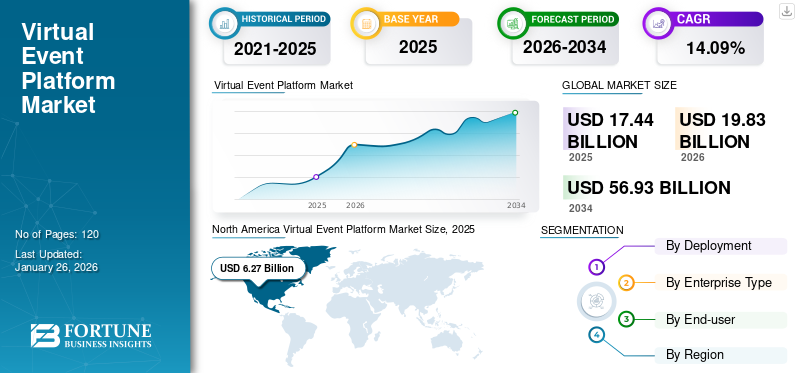
The global virtual event platform market size was valued at USD 17.44 billion in 2025. The market is projected to grow from USD 19.83 billion in 2025 to USD 56.93 billion by 2034, exhibiting a CAGR of 14.09% during the forecast period. North America dominated the virtual event platform market with a market share of 35.98% in 2025.
A virtual event platform is a digital solution that allows enterprises and individuals to manage and host events online. This platform offers a variety of tools for engagement, interaction, and content delivery. They are developed to improve in-person events such as webinars, seminars, conferences, meetings, and exhibitions in a virtual setup. Advancements in Augmented Reality (AR), Virtual Reality (VR), and 5G technology have played a vital role in increasing the popularity of virtual event platforms among businesses globally. These technologies provide more immersive and engaging experiences for virtual meetings. Thus, this trend is gaining rapid pace to boost market growth.
The market is leading owing to presence of prominent key players, including Zoom Communications, Inc., BigMarker, Cvent, Inc., Hubilo Technologies Inc., and vFairs. These companies concentrate on integrating AI-enabled features such as automated event management and personalized content delivery to enhance the engagement of attendees and reorganize event planning. This is anticipated to bolster the market growth across the globe.
Download Free sample to learn more about this report.
Virtual Event Platform Market Key Takeaways
 Global Market Size & Forecast
- 2025 Market Size: USD 17.44 billion
- 2026 Market Size: USD 19.83 billion
- 2034 Forecast Market Size: USD 56.93 billion
- CAGR: 14.09% from 2026–2034
 Market Share
- North America dominated the virtual event platform market with a 35.98% share in 2025.
- The cloud-based segment is projected to hold the largest market share of 71.29% in 2026.
- The large enterprises segment is projected to account for a 50.54% market share in 2026.
 Key Regional Highlights
North America
North America generated USD 6.27 billion in 2025 and is projected to reach USD 6.97 billion in 2026.
Europe
Europe accounted for USD 4.50 billion in 2025 and is expected to grow to USD 5.09 billion in 2026.
Asia Pacific
Asia Pacific recorded a market size of USD 4.42 billion in 2025 and is projected to reach USD 5.21 billion in 2026.
U.S.
U.S. The market is projected to reach USD 4.93 billion by 2026.
Japan
Japan The market is projected to reach USD 1.02 billion by 2026.
Read More

IMPACT OF RECIPROCAL TARIFF
Virtual event platforms are mainly dependent on innovative technologies such as video streaming technology, cloud services, and real-time communication tools. These technologies include components such as hardware and software services from global suppliers. The imposition of tariffs, especially on Chinese electronics devices, may increase the cost of hardware required for virtual event platforms, leading to a surge in operational costs for companies using this technology and that are heavily dependent on Chinese manufacturers. Thus, Trump’s tariffs on Chinese electronics devices are expected to disrupt market growth.
IMPACT OF GENERATIVE AI
Increasing Popularity of AI-powered Content Personalization Fuels Market Growth
Incorporation of generative AI technology in virtual event platforms plays a crucial role in enhancing the personalized experience of attendees. Virtual event platforms usually face difficulty in providing highly tailored experiences for individual attendees. However, with the integration of AI, platforms can provide more personalized content and improved networking opportunities. AI technology is capable of generating real-time summaries and translations during events. This feature is useful for international audiences, as it translates the content in multiple languages in real-time.
Further, a Generative AI tool can create AI-powered speakers that can interactively present content. Also, an AI-enabled platform helps to automate tasks such as attendee registration, scheduling, and event coordination, minimizing the dependency on humans for event planning.
For instance,
- Kaltura, Inc., the U.S.-based software company, integrated generative AI capabilities into its platforms, enhancing content personalization and interactivity.
MARKET DYNAMICS
Market Drivers
Rising Focus on Digital Transformation and Technological Advancements Drives Market Growth
The growing popularity of remote and hybrid working pushes market players to adopt innovative technologies such as Artificial Intelligence (AI), augmented reality (AR), and virtual reality (VR) to enhance the performance of virtual meeting tools. For instance,
- Virtual event startups raised over USD 1.8 billion in funding in 2023, with major rounds led by companies specializing in AI-driven event tech and immersive experiences.
Further, digital transformation helps businesses to make more informed decisions and amend their strategies to maximize the impact of their events. New technologies enable platforms for more engaging, interactive, and personalized events for participants. This strategy will help to increase the number of participants for the virtual event.
Also, advancements in streaming technologies play a key role in enhancing the quality and reliability of virtual events. This leads to the growing adoption of virtual event tools across various sectors. Thus, these factors play an important role in fueling market growth.
Market Restraints
Network Inconsistency and Lack of Communication Infrastructure May Restrict Market Growth
Virtual event platforms rely heavily on high-speed, stable internet connections to deliver real-time video, audio. Also, a high-speed internet connection is important to offer interactive features (e.g., live Q&A, breakout rooms, polls). Many regions across the globe, lack in providing high-speed and stable internet connections, which causes video buffering and call drops, delayed audio responses, poor quality of visuals and streaming, and inability to join or remain connected to sessions. These factors can significantly hamper market growth. As it may reduce engagement and dissatisfaction among attendees, as well as it may also cause poor brand perception for hosts. Thus, the lack of a strong communication infrastructure and internet connectivity is anticipated to restrict market growth.
Market Opportunities
Surge in Dependence on BYOD Solutions Creates Profitable Opportunities for Market Growth
Several businesses and organizations are adopting bring-your-own-device (BYOD) solutions, such as smartphones, laptops, and tablets, to join virtual events. These solutions enable employees to access corporate data from any remote location. Along with the adoption of BYOD solutions, organizations are increasingly adopting virtual event software solutions to interact with a large number of people on a real-time basis. This increases the accessibility of virtual events, as users are no longer limited by location or specific hardware.
Further, virtual event platforms can increase user reach by offering cross-device compatibility and mobile-optimized experiences. The virtual event software solution enables businesses to host advertising campaigns, exhibitions, and new product launches from remote locations. Thus, the growing popularity of BYOD solutions among businesses is expected to fuel the market growth during the forecast period.
- According to industry experts, over 85% of Fortune 500 companies have integrated virtual or hybrid event platforms into their event strategies as of 2024.
Virtual Event Platform Market Trends
Rising Popularity of Mobile-First Experiences Among Users is Expected to be a Prominent Market Trend
The popularity of mobile device usage is growing among participants for attending virtual events. Recently, multiple market players have been focusing on developing mobile apps dedicated to attending virtual events. These apps provide attendees with features such as live streaming, notifications, seamless navigation, and interaction features. This trend fulfils the growing need for on-the-go participation and wider accessibility.
Further, mobile apps enable attendees to communicate directly with one another, encouraging relationships before, during, and after the event. These apps also provide points and rewards systems for attendees to participate in activities and attend sessions, which they can redeem for prizes later. Thus, these factors play a crucial role in fueling the virtual event platform market growth during the forecast period.
SEGMENTATION ANALYSIS
By Deployment
Rising Demand for Scalability and Accessibility Boosts Adoption of Cloud-based Virtual Event Software
Based on deployment, the market is divided into cloud-based and mobile-based.
The cloud-based segment is projected to dominate the market with a share of 71.29% in 2026, as it can accommodate large audience sizes without on-premise hardware limitations. Also, organizers and users can access the platform from anywhere, at any time. This software is user-friendly, as it does not require expensive IT infrastructure and maintenance costs.
The mobile-based segment is anticipated to grow at the highest CAGR during the forecast period, as businesses do not require investing heavily in infrastructure, hardware, or software licenses. The service can be offered on a pay-per-use or subscription basis, which helps businesses control costs. This feature is beneficial for SMEs with a limited budget for infrastructure.
By Enterprise Type
Growing Need for Extensive Events Fueled Adoption of Virtual Event Tools in Large Enterprises
Based on enterprise type, the market is divided into large enterprises, medium-sized enterprises, startups & small enterprises.
Large enterprises segment is projected to dominate the market with a share of 50.54% in 2026, owing to their growing reliance on virtual platforms for cost-effective event hosting. This dominance is driven by extensive event needs, such as product launches, global conferences, and training. Further, the availability of ample amount of funds for investment in R&D activity and adoption of feature-rich platforms boosts the adoption of virtual event tools in large enterprises.
Startups & small enterprises are anticipated to grow at the highest CAGR during the forecast period. These organizations are increasingly adopting virtual event platforms, with rising awareness and adoption of cost-effective virtual event solutions. Also, these solutions are easy to use. Moreover, the rising adoption of remote work culture enables startups and small-scale companies to host workshops, webinars, and networking events, which boosts segment growth.
By End-user
To know how our report can help streamline your business, Speak to Analyst
Rise in Demand for Remote and Hybrid Work Models Propelled Corporate and Business Segment Growth
Based on end-user, the market is categorized into government & non profit organizations, healthcare, education, corporate and business, third-party planners, and others (associations, etc.).
The corporate and business segment is projected to dominate the market with a share of 30.84% in 2026. The rise of remote and hybrid workforces has made virtual event software necessary for maintaining collaboration, communication, and engagement of teams present in various countries globally . Corporate offices and businesses use this software for team training and onboarding, and internal communication.
The healthcare segment is anticipated to grow at the highest CAGR during the forecast period. This software provides a cost-effective way to host large-scale medical conferences, telehealth consultations, and patient education seminars. Also, this software ensures the confidentiality of patients' data. For instance,
- According to industry experts, healthcare virtual conferences grew by 38% YoY in 2023, largely due to ongoing telemedicine and professional training needs.
Thus, these factors fuel the global virtual events market growth.
VIRTUAL EVENT PLATFORM MARKET REGIONAL OUTLOOK
Based on the region, the market is studied across North America, Europe, Asia Pacific, Middle East & Africa, and South America.
North America
North America Virtual Event Platform Market Size, 2025 (USD Billion)
To get more information on the regional analysis of this market, Download Free sample
In 2025, North America generated USD 6.27 billion, contributing 35.98% to global market revenue, and is projected to grow to USD 6.97 billion in 2026. The presence of an advanced digital infrastructure, high internet penetration, and early adoption of digital transformation strategies in the region play a pivotal role in driving market growth in the region. Also, market players are focusing on designing virtual event tools enabled with AI technology, which plays a vital role in revolutionizing the event planning process. The U.S. market is projected to reach USD 4.93 billion by 2026. For instance,
- In June 2023, Remo USA Inc. introduced two new AI-powered event planning tools including the Event Idea Generator and Event Name Generator. These tools are developed to streamline the event planning process, making it efficient and more interactive.
These factors bolster the market growth across the region.
Download Free sample to learn more about this report.
In the U.S., tech firms, finance, and healthcare sectors are the major adopters of virtual platforms. They use this platform for various purposes, including investor meetings and product launches, global conferences and trade shows, and employee training and onboarding. Further, schools and universities across the country are increasingly using this platform for remote learning and hybrid academic events. These factors play a key role in fostering market growth.
South America
The adoption of virtual event platforms is increasing substantially in South America, owing to rapid growth in internet access and smartphone usage in countries namely Brazil, Argentina, and Chile. The government in the region uses this platform for regional conferences and training. For instance,
- Sympla, a Brazil-based startup company, gained traction by offering localized virtual event solutions tailored to South American markets.
Further, startups, small businesses, and universities are also significantly using virtual platforms for marketing, remote learning, and sales purposes.
Europe
The Europe market accounted for USD 4.5 billion in 2025, representing 25.81% of the global industry, and is expected to reach USD 5.09 billion in 2026. In Europe, the adoption of virtual event software is rising considerably, owing to rapid digital transformation investments and the demand for hybrid event solutions in countries, including the U.K. and Germany. In the U.K., the market is driven by growing demand for remote and hybrid work models and sponsorship for online events. Moreover, the implementation of digital communication tools and advancements in technologies such as virtual reality (VR) and artificial intelligence (AI) are contributing to this growth. The UK market is projected to reach USD 0.97 billion by 2026, while the Germany market is projected to reach USD 0.95 billion by 2026.The UK market is projected to reach USD 0.97 billion by 2026, while the Germany market is projected to reach USD 0.95 billion by 2026. For instance,
- In Europe, companies, such as Conference Compass and Meetyoo are well known for their virtual event solutions offerings tailored to the European market.
Middle East & Africa
The Middle East & Africa market generated USD 1.28 billion in 2025, representing 7.35% of the global market landscape, and is expected to reach USD 1.46 billion in 2026. The Middle East & Africa region is anticipated to witness a significant growth during the forecast period. Governments across the region are investing heavily in digital infrastructure to support economic diversification and modernization. For instance,
- UAE's Smart Dubai Initiative and Saudi Arabia's Vision 2030 aim to enhance digital capabilities, including the adoption of virtual platforms for events and conferences.
Also, the availability of high-speed and stable internet connections supports the seamless delivery of virtual events. These factors play a crucial role in fueling market growth in the region.
Latin America
Latin America accounted for USD 0.96 billion in 2025, representing 5.50% of the global market share, and is projected to reach USD 1.1 billion in 2026.
Asia Pacific
Asia Pacific recorded a market size of USD 4.42 billion in 2025, capturing 25.36% of the global market share, and is projected to reach USD 5.21 billion in 2026. This is owing to increasing internet penetration and the rising use of virtual events in government, healthcare, educational institutions, corporate training, and Tech sectors. Further, emerging markets such as India, China, and Southeast Asia are contributing significantly to the market growth in the region. Thus, the increasing adoption of virtual event tools across the corporate and financial sectors is expected to fuel market growth across the region. The Japan market is projected to reach USD 1.02 billion by 2026, the China market is projected to reach USD 1.06 billion by 2026, and the India market is projected to reach USD 0.74 billion by 2026. For instance,
- In July 2023, Zoho Corporation Pvt. Ltd. engaged in a partnership with PwC India to boost the digital transformation across businesses. Through this collaboration, Zoho aims to integrate its products with PwC’s consulting services to enhance business efficiency.
COMPETITIVE LANDSCAPE
KEY INDUSTRY PLAYERS
Notable Players Focus on Introducing Novel Products to Enhance Their Market Expansion
Key players are focusing on expanding their global geographical reach by offering industry-specific services. Notable players are strategically directed toward acquisitions and partnerships with regional players to sustain predominance across regions. Prominent market players are introducing novel solutions to grow their consumer base. An increase in constant R&D investments for product innovations is enhancing market expansion. Therefore, major companies are promptly implementing these strategic initiatives to maintain their robust competitiveness in the market.
List of Key Virtual Event Platform Companies Studied
- Zoom Communications, Inc. (U.S.)
- BigMarker (U.S.)
- Cvent Inc. (U.S.)
- Hubilo Technologies Inc. (U.S.)
- Zoho Corporation Pvt. Ltd. (India)
- Remo (U.S.)
- vFairs (U.S.)
- EventMobi (Canada)
- 6Connex (U.S.)
- Microsoft Corporation (U.S.)
- Joyn Experiences Inc. (Zuddl) (U.S.)
- Cisco Systems, Inc. (U.S.)
- Avntri (U.S.)
- Socio (U.S.)
- Hopin (U.K.)
- Eventcube (U.K.)
- SpotMe (Switzerland)
- Orbits (Australia)
- Attendify (India)
- Samaaro (India)
….and more
KEY INDUSTRY DEVELOPMENTS
- April 2025: Hubilo secured USD 40 million in Series C funding to expand its AI-powered event marketing and engagement platform, focusing on increasing automation and personalization features. Through this funding, the company intends to expand its business in North America and Middle East Africa region.
- April 2024: Remo unveiled AI-driven networking features in virtual event software. It also includes automated matchmaking and virtual “tables” to replicate natural networking environments more effectively. Through this feature, the company aims to enhance attendee engagement and networking quality during virtual meetings.
- July 2023: Microsoft partnered with InEvent to integrate virtual event capabilities into its Microsoft 365 ecosystem, improving collaboration during hybrid events.
- March 2023: Zoom launched "Zoom Events," an end-to-end virtual event solution with integrated features for live streaming, networking, and attendee interaction.
- July 2021: 6Connex entered into a collaboration with Hitachi Solutions, Ltd. Through this collaboration, the company aims to expand its business in multiple sectors across Japan.
INVESTMENT ANALYSIS AND OPPORTUNITIES
Key players operating in the market, such as Zoom Communications, Inc., BigMarker, Cvent Inc., Hubilo Technologies Inc., and Zoho Corporation Pvt. Ltd., are increasingly investing in AI, machine learning, and immersive technologies (VR/AR) and incorporating them into virtual platforms to enhance their user experience. Also, funding rounds focused on technology enhancements indicate investor confidence in the sector’s innovation potential. For instance,
- According to industry experts, series C and D funding rounds accounted for nearly 65% of the total investment, indicating maturity in the sector.
These factors are expected to create a lucrative opportunity for market growth.
REPORT COVERAGE
The report provides a detailed analysis of the market and focuses on key aspects such as leading companies, product/service types, and leading applications of the product. Besides, the report offers insights into the market trends and highlights key industry developments. In addition to the factors above, the report encompasses several factors that contributed to the growth of the market in recent years.
Request for Customization to gain extensive market insights.
REPORT SCOPE & SEGMENTATION
|
ATTRIBUTE |
DETAILS |
|
Study Period |
2021-2034 |
|
Base Year |
2025 |
|
Estimated Year |
2026 |
|
Forecast Period |
2026-2034 |
|
Historical Period |
2021-2024 |
|
Growth Rate |
CAGR of 14.09% from 2026 to 2034 |
|
Unit |
Value (USD Billion) |
|
Segmentation |
By Deployment
By Enterprise Type
By End-user
By Region
|
|
Companies Profiled in the Report |
|
Frequently Asked Questions
The market is expected to reach USD 56.93 billion by 2034.
In 2025, the market was valued at USD 17.44 billion.
The market is projected to grow at a CAGR of 14.09% during the forecast period.
By deployment, the cloud-based segment led the market.
Increasing focus on digital transformation and technology advancements drives market growth.
Zoom Communications, Inc., BigMarker, Cvent Inc., Hubilo Technologies Inc., Zoho Corporation Pvt. Ltd., Remo, vFairs, EventMobi, 6Connex, and Microsoft Corporation are the top players in the market.
North America held the highest market share.
By end-user, the healthcare sector is expected to grow with the highest CAGR during the forecast period.



- 2021-2034
- 2025
- 2021-2024
- 120
Get 30-60 hrs Free Customization
Expand Regional and Country Coverage, Segments Analysis, Company Profiles, Competitive Benchmarking, and End-user Insights.




















Related Reports
-
US +1 833 909 2966 ( Toll Free )
-
Get In Touch With Us