Vision Processing Unit Market Size, Share & Industry Analysis, By Fabrication Process, By Application (Drones, AR/VR, ADAS), By Vertical (Security & Surveillance, Automotive, Healthcare), and Regional Forecast, 2026-2034
 Download Free Sample
Vision Processing Unit Market Overview
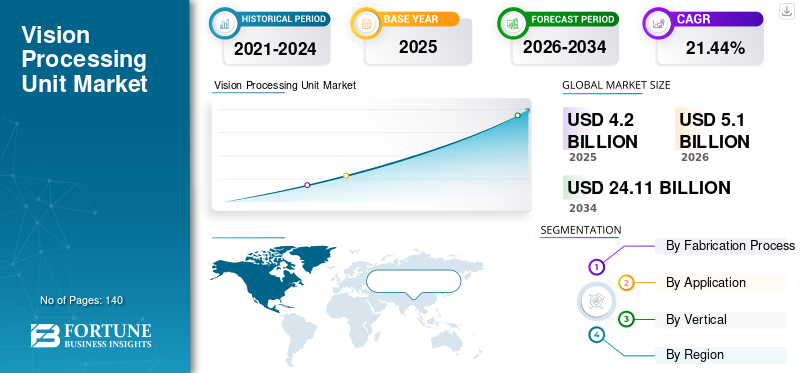
The global vision processing unit market size was valued at USD 4.2 billion in 2025. The market is projected to grow from USD 5.1 billion in 2026 to USD 24.11 billion by 2034, exhibiting a CAGR of 21.44% during the forecast period. The market in North America dominated with a revenue share of 38% in 2025.

The vision processing unit market is expanding rapidly due to increasing adoption of artificial intelligence, computer vision, and edge computing technologies across industrial and consumer applications. Vision processing units are specialized processors designed to accelerate image recognition, object detection, and machine vision workloads while reducing power consumption. The growing deployment of autonomous systems, smart surveillance platforms, and intelligent consumer electronics is supporting market expansion. Vision processing unit market analysis indicates rising integration of VPUs in drones, robotics, automotive systems, and augmented reality devices. Semiconductor manufacturers are focusing on high-performance architectures capable of handling complex neural network operations with lower latency and enhanced processing efficiency.
The USA vision processing unit market is witnessing strong growth due to increasing investment in artificial intelligence infrastructure, autonomous mobility technologies, and advanced semiconductor development. Major technology companies are integrating VPUs into edge devices, smart cameras, and ADAS platforms to improve real-time image processing capabilities. The United States continues to lead innovation in machine vision systems used across healthcare, automotive, defense, and industrial automation sectors. Vision processing unit market research report findings show growing adoption of AI-powered surveillance systems and autonomous drones throughout the country. Demand for energy-efficient AI accelerators is also increasing across data-intensive applications requiring high-speed image analysis and low-power processing capabilities.
Download Free sample to learn more about this report.
Vision Processing Unit Market Key Takeaways
 Global Market Size & Forecast
- 2025 Market Size: USD 4.2 Billion
- 2026 Market Size: USD 5.1 Billion
- 2034 Forecast Market Size: USD 24.11 Billion
- CAGR: 21.44% from 2026-2034
 Market Share
- The market in North America dominated with a revenue share of 38% in 2025.
- The 7nm fabrication process held a 41% market share.
- ADAS applications accounted for a 36% market share.
 Key Regional Highlights
North America
North America led the market with a 38% share in 2025.
Asia-Pacific
Asia-Pacific held a 29% market share, supported by growing AI and semiconductor adoption.
Europe
Europe accounted for 25% of the global market, driven by automotive and industrial applications.
U.S
The U.S. is witnessing strong demand for VPUs across automotive, surveillance, and AI-powered applications.
Japan
Japan accounted for 21% of the Asia-Pacific market, supported by advanced automotive and electronics technologies.
Read More

vision processing unit market Latest Trends
The vision processing unit market trends reveal significant advancements in AI acceleration, edge computing, and low-power neural processing technologies. Manufacturers are increasingly developing VPUs optimized for machine learning workloads, enabling faster object recognition and enhanced visual analytics. More than 54% of newly developed edge AI devices now integrate dedicated vision processing capabilities for real-time data interpretation. Compact VPUs designed for wearable electronics and smart cameras are becoming increasingly popular due to rising demand for intelligent edge devices.
Download Free sample to learn more about this report.
Vision processing unit industry analysis highlights growing integration of VPUs into autonomous vehicles and advanced driver assistance systems to support lane detection, pedestrian recognition, and collision avoidance applications. Demand for AI-enabled surveillance systems with facial recognition and behavioral analytics is also accelerating market growth. Semiconductor companies are focusing on smaller fabrication nodes to improve processing speed and reduce thermal output. vision processing unit market Forecast indicates increasing use of VPUs in AR/VR headsets, robotics, healthcare imaging equipment, and industrial automation systems. Cloud-connected edge processors with enhanced security features and neural network optimization capabilities continue to reshape the global vision processing unit market Outlook.
vision processing unit market Dynamics
DRIVER
Rising Adoption of Artificial Intelligence and Edge Computing
The growing adoption of artificial intelligence and edge computing technologies is a major driver supporting vision processing unit market growth. Industries are increasingly deploying AI-powered devices capable of processing visual information locally without relying on centralized cloud infrastructure. More than 61% of intelligent edge devices now incorporate machine vision technologies for real-time analytics and automation. VPUs enable faster image recognition and lower latency compared to conventional processors, making them essential for applications such as autonomous vehicles, robotics, and smart surveillance systems. vision processing unit market Insights indicate rising demand for low-power AI accelerators in battery-operated devices and portable electronics. Businesses are investing heavily in AI-enabled hardware platforms capable of supporting deep learning operations with enhanced efficiency and reduced operational delays.
RESTRAINT
High Semiconductor Development and Integration Costs
High semiconductor manufacturing costs and integration complexities remain major restraints affecting the vision processing unit market. Advanced VPU architectures require sophisticated fabrication processes and extensive research investments, increasing production expenses. Small and medium-sized electronics manufacturers often face difficulties integrating VPUs into existing hardware platforms because of compatibility challenges and design complexity. More than 43% of hardware developers report rising costs associated with AI chip integration and thermal management systems. Vision processing unit industry report findings indicate that advanced fabrication nodes require expensive manufacturing infrastructure and highly specialized engineering expertise. Supply chain disruptions affecting semiconductor materials and wafer production are also impacting product availability and manufacturing timelines across global technology markets.
OPPORTUNITY
Expansion of Autonomous Systems and Smart Devices
The rapid expansion of autonomous systems and intelligent connected devices is creating significant opportunities for the vision processing unit market. Autonomous vehicles, drones, industrial robots, and smart surveillance systems require high-speed visual data processing for operational accuracy and safety. More than 58% of next-generation robotics platforms are expected to integrate dedicated VPUs for machine vision applications. vision processing unit market Opportunities are also increasing in healthcare imaging systems, smart retail analytics, and AR/VR applications. Demand for compact, low-power processors capable of handling neural network workloads is expanding across consumer electronics and wearable devices. The growth of edge AI infrastructure and smart city projects is further supporting opportunities for advanced vision processing technologies across multiple industrial sectors.
CHALLENGE
Rapid Technological Evolution and Product Obsolescence
Rapid technological advancement and short semiconductor product cycles present major challenges for the vision processing unit market. Manufacturers must continuously invest in research and development to remain competitive in AI acceleration and machine vision technologies. More than 47% of semiconductor firms face pressure to shorten product development cycles because of fast-changing customer requirements and AI innovation trends. vision processing unit market Analysis indicates that maintaining compatibility with evolving neural network frameworks and software ecosystems is becoming increasingly complex. Frequent updates in AI algorithms and edge computing architectures also increase the risk of product obsolescence. Companies are challenged to balance processing performance, power efficiency, and cost optimization while maintaining long-term scalability across rapidly evolving hardware platforms.
vision processing unit market Segmentation
By Fabrication Process
The 7nm fabrication process holds 41% of the vision processing unit market share due to its superior balance between power efficiency and processing performance. Semiconductor manufacturers are increasingly utilizing 7nm architectures for AI acceleration and neural network optimization across edge devices and smart electronics. These processors support faster image recognition and lower thermal output compared to larger fabrication nodes. vision processing unit market research report findings indicate growing demand for 7nm VPUs in autonomous vehicles, smart surveillance systems, and industrial robotics. Advanced transistor density enables efficient handling of machine vision workloads while maintaining reduced power consumption. Manufacturers are also integrating enhanced security and memory optimization features within 7nm VPU architectures to improve edge AI performance.
By Application
Drones account for 21% of the vision processing unit market share due to increasing demand for autonomous navigation and aerial imaging systems. VPUs enable drones to perform real-time obstacle detection, object tracking, and terrain mapping with improved operational accuracy. vision processing unit market trends show rising integration of AI-powered visual analytics within commercial drones used for agriculture, infrastructure inspection, and defense operations. Low-power VPU architectures are particularly important for extending drone battery life and improving flight efficiency. Manufacturers are developing lightweight processors optimized for autonomous flight control and image stabilization applications. Growing use of drones in logistics and industrial monitoring continues to strengthen demand for advanced machine vision processing technologies.
AR/VR applications hold 19% of the vision processing unit market due to increasing adoption of immersive technologies across gaming, healthcare, education, and enterprise collaboration platforms. VPUs are essential for handling real-time image rendering, gesture recognition, and spatial mapping within augmented and virtual reality environments. vision processing unit market Insights indicate growing demand for compact AI accelerators capable of supporting low-latency visual experiences. Semiconductor manufacturers are focusing on high-efficiency processors optimized for wearable headsets and lightweight AR glasses. Enhanced visual computing capabilities are improving user interaction and display performance in next-generation immersive devices. Expanding investment in metaverse technologies and virtual collaboration tools is further supporting market growth.
ADAS applications contribute 36% of the vision processing unit market share due to increasing deployment of intelligent driver assistance and autonomous vehicle technologies. Vision processing units are widely used for lane detection, pedestrian recognition, traffic sign identification, and collision prevention systems. Automotive manufacturers are integrating AI-enabled VPUs into next-generation vehicle platforms to improve driving safety and automation capabilities. vision processing unit market Forecast indicates rising adoption of edge AI processors in electric and autonomous vehicles. High-speed visual data processing and low-latency decision making remain critical requirements for ADAS functionality. Growing consumer demand for vehicle safety features continues to accelerate adoption of advanced machine vision technologies across the automotive industry.
By Vertical
Security and surveillance applications account for 31% of the vision processing unit market due to rising deployment of AI-enabled monitoring systems across commercial and government sectors. VPUs support facial recognition, behavioral analytics, and automated threat detection capabilities in intelligent surveillance cameras. Vision Processing Unit Industry Analysis highlights increasing demand for edge-based image processing solutions capable of reducing cloud dependency and improving response speed. Smart city projects and infrastructure security investments are further supporting market expansion. Manufacturers are introducing low-power surveillance processors optimized for continuous operation and high-definition image analysis. Growing cybersecurity concerns and public safety initiatives continue to strengthen demand for advanced visual analytics technologies.
Automotive applications represent 28% of the vision processing unit market share because of increasing integration of AI-powered visual processing systems within connected and autonomous vehicles. Vehicle manufacturers are utilizing VPUs to support intelligent navigation, driver monitoring, parking assistance, and traffic analysis systems. vision processing unit market Size is expanding rapidly due to rising production of electric vehicles equipped with advanced safety technologies. Semiconductor companies are developing automotive-grade processors capable of operating under high-temperature and high-vibration conditions. Enhanced machine learning capabilities are improving autonomous driving accuracy and real-time environmental analysis. Demand for energy-efficient AI accelerators remains strong across modern automotive electronics platforms.
Healthcare applications contribute 17% of the vision processing unit market due to growing use of AI-powered imaging systems and diagnostic technologies. VPUs are increasingly integrated into medical imaging devices for enhanced image recognition and automated analysis capabilities. vision processing unit market opportunities are expanding in radiology, pathology, robotic surgery, and patient monitoring systems. Healthcare providers are adopting intelligent imaging solutions to improve diagnostic accuracy and reduce processing time. Semiconductor manufacturers are focusing on high-performance processors capable of supporting advanced neural network algorithms for medical applications. Rising adoption of telemedicine and AI-assisted healthcare technologies continues to support market expansion across hospitals and diagnostic laboratories.
vision processing unit market Regional Outlook
North America
North America dominates the vision processing unit market with 38% market share due to strong presence of semiconductor manufacturers, AI research companies, and advanced computing infrastructure. The region is witnessing rapid adoption of edge AI technologies across autonomous vehicles, industrial automation, and smart surveillance systems. Technology firms in the United States and Canada are investing heavily in machine vision processors optimized for real-time analytics and neural computing. vision processing unit market Report findings show rising deployment of VPUs in defense systems, robotics, and healthcare imaging applications. Demand for AI-enabled cloud-edge integration is also increasing across commercial enterprises. Semiconductor innovation and strong research capabilities continue to support product development across advanced computing architectures. Growing adoption of autonomous mobility platforms and smart city technologies is accelerating demand for low-power visual processing units throughout North America.
Europe
Europe accounts for 25% of the vision processing unit market share due to increasing integration of AI technologies across automotive, manufacturing, and industrial automation sectors. Countries including Germany, France, and the United Kingdom are adopting machine vision systems for smart factories and intelligent transportation applications. vision processing unit market trends indicate strong demand for automotive-grade VPUs supporting ADAS and autonomous driving technologies. European semiconductor firms are focusing on energy-efficient edge AI processors designed for industrial robotics and surveillance platforms. Government initiatives promoting digital transformation and Industry 4.0 technologies are strengthening regional market expansion. Increasing investment in AI-powered healthcare imaging systems and smart infrastructure projects is further driving adoption of advanced visual processing technologies across Europe.
Germany vision processing unit market
Germany contributes 32% share within the European vision processing unit market due to strong automotive manufacturing and industrial automation capabilities. German technology companies are integrating VPUs into autonomous driving systems, robotics platforms, and smart manufacturing environments. Vision Processing Unit Industry Report findings indicate rising adoption of AI-enabled machine vision technologies across industrial facilities and connected mobility applications. Automotive manufacturers continue investing in intelligent driver assistance systems requiring advanced image processing capabilities. Semiconductor innovation and engineering expertise are supporting development of high-performance edge AI processors. Growing focus on industrial digitalization continues to strengthen Germany’s role within the regional semiconductor ecosystem.
United Kingdom vision processing unit market
The United Kingdom vision processing unit market represents 18% share within Europe due to increasing investment in artificial intelligence, cybersecurity, and smart surveillance technologies. British technology firms are utilizing VPUs for facial recognition, video analytics, and autonomous mobility applications. vision processing unit market Insights reveal growing adoption of edge AI processors across healthcare diagnostics and smart infrastructure projects. Universities and research institutions are contributing to innovation in machine learning and computer vision technologies. Demand for low-power processors supporting real-time analytics is also increasing across commercial enterprises. Expansion of intelligent monitoring systems continues to support market growth throughout the United Kingdom.
Asia-Pacific
Asia-Pacific accounts for 29% of the vision processing unit market share due to strong electronics manufacturing infrastructure and rising adoption of AI-enabled consumer devices. China, Japan, South Korea, and India remain major contributors to regional semiconductor demand. vision processing unit market Analysis indicates increasing production of smart cameras, drones, and wearable devices integrating advanced visual processing technologies. Regional manufacturers are investing heavily in AI chip development and semiconductor fabrication capabilities. Demand for machine vision systems is also increasing across automotive production, healthcare imaging, and industrial robotics sectors. Government support for digital transformation and AI innovation is accelerating market expansion across Asia-Pacific. Growth in smart city infrastructure and connected devices continues to strengthen regional adoption of edge AI processors.
Japan vision processing unit market
Japan accounts for 21% share within the Asia-Pacific vision processing unit market due to strong leadership in robotics, semiconductor innovation, and intelligent electronics manufacturing. Japanese companies are increasingly integrating VPUs into industrial robots, autonomous systems, and healthcare imaging technologies. vision processing unit market Forecast indicates growing demand for low-power AI accelerators supporting advanced automation platforms. Consumer electronics manufacturers are also utilizing vision processors for smart cameras and immersive AR/VR devices. Strong investment in AI research and machine learning technologies continues to support semiconductor innovation across Japan. Expansion of intelligent robotics and industrial automation applications remains a major growth driver within the country.
China vision processing unit market
China holds 29% share within the Asia-Pacific vision processing unit market due to rapid semiconductor expansion and strong demand for AI-enabled consumer electronics. Domestic manufacturers are increasing production of edge AI processors used in smart surveillance systems, drones, and autonomous vehicles. vision processing unit market Size is growing rapidly because of rising adoption of intelligent monitoring systems and connected infrastructure projects. Government-backed semiconductor initiatives are supporting local chip manufacturing and AI innovation. Consumer electronics companies are integrating VPUs into smartphones, wearable devices, and smart home products. Expansion of smart city technologies and industrial automation continues to strengthen market demand throughout China.
Rest of World
Rest of World accounts for 8% of the global vision processing unit market share and includes Latin America, the Middle East, and Africa. These regions are witnessing increasing adoption of AI-powered surveillance systems, smart infrastructure technologies, and industrial automation platforms. vision processing unit market opportunities are expanding due to rising digital transformation initiatives across commercial and government sectors. Countries in the Middle East are investing in smart city projects utilizing advanced visual analytics and security monitoring systems. Latin American industries are adopting machine vision technologies for manufacturing automation and logistics optimization. Demand for intelligent edge devices and connected infrastructure continues to increase throughout developing technology markets. Semiconductor suppliers are also expanding regional partnerships to strengthen AI hardware accessibility and deployment capabilities.
List of Top Vision Processing Unit Companies
- Advanced Micro Devices, Inc.
- Ambarella International LP
- Broadcom
- Huawei Technologies Co., Ltd.
- Intel Corporation
- NVIDIA Corporation
- Qualcomm Technologies, Inc.
- Samsung
- Sony Semiconductor Solutions Corporation
- Verkada Inc.
Top Two Companies with Highest Market Share
- NVIDIA Corporation – 22% market share
- Intel Corporation – 19% market share
Investment Analysis and Opportunities
The vision processing unit market is attracting strong investment due to rising adoption of artificial intelligence, machine vision, and edge computing technologies across multiple industries. Semiconductor manufacturers are allocating substantial resources toward development of AI accelerators optimized for image recognition and neural network processing. Investment in autonomous mobility platforms and smart surveillance infrastructure is significantly supporting demand for advanced VPUs. vision processing unit market opportunities are increasing across healthcare imaging, industrial robotics, drones, and AR/VR systems requiring real-time visual analytics.
Technology firms are also expanding fabrication facilities and research centers focused on low-power AI processing architectures. Venture capital investment in edge AI startups and machine vision software providers continues to accelerate semiconductor innovation. vision processing unit market research report findings indicate growing partnership activity between automotive manufacturers and AI chip developers to strengthen autonomous driving capabilities. Cloud-edge integration platforms and smart city infrastructure projects are creating additional growth opportunities for VPU manufacturers. Rising demand for intelligent consumer electronics and connected devices is further supporting long-term investment across the global Vision Processing Unit Industry Analysis landscape.
New Product Development
New product development within the vision processing unit market is accelerating due to rising demand for high-performance AI acceleration and low-power visual computing solutions. Semiconductor companies are introducing next-generation VPUs designed for neural processing, object recognition, and advanced image analytics applications. vision processing unit market trends indicate increasing focus on processors capable of supporting edge AI operations with minimal latency and improved thermal efficiency. Manufacturers are developing compact VPUs optimized for wearable electronics, autonomous drones, and smart surveillance cameras.
Several companies are launching automotive-grade vision processors supporting advanced driver assistance systems and autonomous mobility platforms. AI-enabled chips integrated with machine learning accelerators and enhanced cybersecurity features are gaining commercial importance. Vision Processing Unit Industry Report findings show growing adoption of chiplet architectures and heterogeneous computing designs to improve processing flexibility and scalability. Semiconductor manufacturers are also introducing energy-efficient processors compatible with AR/VR headsets and industrial robotics systems. Enhanced software optimization for neural network workloads and cloud-edge interoperability continues to drive innovation across the global vision processing unit market Outlook.
Recent Developments (2023-2025)
- In 2023, NVIDIA Corporation launched a next-generation AI vision processor for autonomous mobility applications.
- In 2023, Intel Corporation expanded its edge AI portfolio with new low-power VPU technologies.
- In 2024, Qualcomm Technologies, Inc. introduced advanced AR/VR processors with enhanced machine vision capabilities.
- In 2024, Sony Semiconductor Solutions Corporation developed AI-enabled imaging processors for intelligent surveillance systems.
- In 2025, Advanced Micro Devices, Inc. announced high-efficiency neural processing chips optimized for industrial robotics and edge computing.
Report Coverage of vision processing unit market
The vision processing unit market report provides detailed analysis of market dynamics, competitive landscape, technological developments, and application-specific growth opportunities across the semiconductor industry. The report evaluates fabrication processes, AI acceleration technologies, and machine vision applications utilized in drones, ADAS, AR/VR systems, healthcare imaging, and industrial automation. vision processing unit market Analysis includes comprehensive assessment of edge computing integration, neural network optimization, and low-power semiconductor architectures supporting intelligent visual processing.
Request for Customization to gain extensive market insights.
The report also examines major market drivers including rising adoption of artificial intelligence, autonomous mobility systems, and smart surveillance technologies. Detailed regional analysis covers North America, Europe, Asia-Pacific, and Rest of World while highlighting country-specific semiconductor trends and market share performance. vision processing unit market Insights further analyze investment activities, product innovation strategies, and competitive positioning among leading semiconductor manufacturers. The study additionally evaluates supply chain developments, fabrication technologies, and operational challenges affecting AI chip deployment. Emerging opportunities associated with edge AI infrastructure, connected devices, and intelligent automation platforms are also extensively covered within the vision processing unit market research report.
Frequently Asked Questions
Fortune Business Insights says that the global Vision Processing Unit Market value stood at USD 4.19 billion in 2025 and is projected to reach USD 24.10 billion by 2034.
The market is expected to exhibit a CAGR of 21.44% during the forecast period of 2026-2034.
ADAS was the leading application segment, accounting for 36% of the market, driven by increasing adoption of intelligent driver-assistance and autonomous vehicle technologies.
Key players include NVIDIA Corporation, Intel Corporation, Advanced Micro Devices, Inc., Qualcomm Technologies, Inc., Ambarella International LP, and Sony Semiconductor Solutions Corporation.
Major trends include advances in AI acceleration, edge computing, and low-power neural processing, along with growing VPU integration in autonomous vehicles, smart surveillance, AR/VR, and robotics. North America leads regionally with a 38% market share.



- 2021-2034
- 2025
- 2021-2024
- 140
-

(Offer valid till 30th Sep 2026)
Get 30-60 hrs Free Customization
Expand Regional and Country Coverage, Segments Analysis, Company Profiles, Competitive Benchmarking, and End-user Insights.




















-
US +1 833 909 2966 ( Toll Free )
-
Get In Touch With Us