Wood Based Panel Market Size, Share & Industry Analysis, By Product Type (Particleboard, Medium Density Fiberboard (MDF), Oriented Strand Board (OSB), Softboard, Plywood, and Others), By Application (Furniture, Construction, Packaging, and Others), and Regional Forecast, 2026-2034
 Download Free Sample
KEY MARKET INSIGHTS
 Listen to Audio Version
The global wood based panel market size was valued at USD 126.58 billion in 2025. The market is projected to grow from USD 131.01 billion in 2026 to USD 177.03 billion by 2034, exhibiting a CAGR of 3.9% during the forecast period. Asia Pacific dominated the global wood based panel market with a market share of 19.17% in 2025.
Wood based panels are engineered sheet materials manufactured by bonding wood elements such as veneers, fibers, strands, or particles using adhesives under controlled heat and pressure to achieve consistent structural and surface properties. These panels are designed to optimize the use of wood resources by converting logs, residues, and recycled wood into standardized products with predictable strength, dimensional stability, and workability. They are widely used in furniture manufacturing, interior fittings, flooring substrates, construction sheathing, packaging, and industrial applications. Their adoption is driven by cost efficiency, uniform quality, compatibility with automated processing, and the ability to incorporate sustainable forestry inputs and recycled wood, making them a critical material category in modern construction and manufacturing value chains.
The market’s growth is driven by demand from construction, furniture and cabinetry, interior decoration, flooring, packaging, and industrial manufacturing. These businesses value wood based panels for their uniformity, cost efficiency, ease of processing, and material optimization compared to solid wood.
Furthermore, the market is comprised of several major players, including Kronoplus Limited, EGGER, West Fraser Timber Co., ARAUCO, and Georgia-Pacific. A broad portfolio, innovative product launches, and strong geographic presence expansion have supported their dominance in the global market.
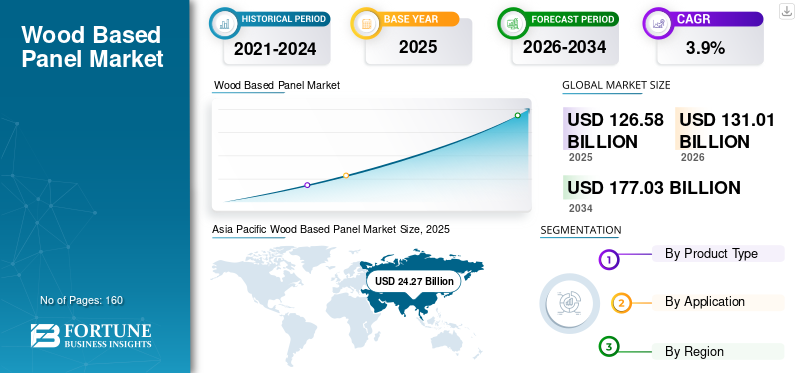
Download Free sample to learn more about this report.
WOOD BASED PANEL MARKET KEY TAKEAWAYS
 Market Size & Forecast
- 2025 Market Size: USD 126.58 billion
- 2026 Market Size: USD 131.01 billion
- 2034 Forecast Market Size: USD 177.03 billion
- CAGR: 3.90% from 2026–2034
 Market Share
- Asia Pacific dominated the global wood based panel market with a market share of 19.17% in 2025.
- The particleboard segment accounted for the largest wood based panel market share of 38.5% in 2025.
- The furniture segment accounted for the largest share of 52.8% in 2025.
 Key Regional Highlights
North America
Asia Pacific held the dominant share in 2025, valued at USD 24.27 billion, and is expected to maintain the leading share in 2026, with USD 25.08 billion.
Europe
Europe is expected to experience growth rate of 3.8% in the coming years and reach USD 25.08 billion in 2026.
Asia Pacific
Asia Pacific held the dominant share in 2025, valued at USD 24.27 billion, and is expected to maintain the leading share in 2026, with USD 25.08 billion.
U.S.
In 2025, the U.S. market reached USD 20.16 billion driven by residential construction, home remodeling, and structural applications.
Japan
Demand is supported by growing adoption of engineered wood products, sustainable construction practices, and the need for high-quality panels in furniture and interior applications.
Read More

WOOD BASED PANEL MARKET TRENDS
Technological Advancements in Panel Pressing, Surface Finishing, and Digital Printing
Technological advancements in panel pressing, surface finishing, and digital printing have emerged as a significant trend shaping the global market. Continuous press systems and improved hot-press control technologies enhance panel density uniformity, thickness precision, and production efficiency, enabling manufacturers to scale output while reducing defects and energy consumption. Advances in surface finishing, such as synchronized embossing, advanced laminates, and UV-cured coatings, allow panels to closely replicate natural wood, stone, and textured surfaces at lower cost. In parallel, digital printing technologies enable short production runs, rapid design changes, and high-resolution décor customization for furniture and interior applications.
- For example, digitally printed MDF panels are increasingly used in modular furniture and interior wall solutions to meet fast-changing design trends. These technologies improve product differentiation, support premium applications, and strengthen competitive positioning across global markets.
Download Free sample to learn more about this report.
MARKET DYNAMICS
MARKET DRIVERS
Expansion of Furniture Manufacturing, Especially Ready-To-Assemble and Modular Furniture, Drives Market Growth
Ready-to-assemble and modular formats rely heavily on engineered panels, such as particleboard, MDF, and plywood, due to their dimensional stability, uniform thickness, and compatibility with CNC machining and flat-pack logistics. These panels enable high-volume, standardized furniture production while minimizing material costs and waste. Global furniture brands and regional manufacturers increasingly design cabinets, wardrobes, shelving, and office furniture around panel-based construction to support rapid assembly, customization, and efficient transportation.
- For instance, modular kitchen and storage systems widely use laminated MDF and particleboard cores for consistent surface quality and hardware fitting. Rising urbanization, smaller living spaces, and e-commerce furniture sales are further accelerating demand for panel-based furniture.
MARKET RESTRAINTS
Volatility in Timber and Wood Fiber Supply Affects Input Costs, Restricting Market Expansion
Panel manufacturers rely on consistent supplies of logs, chips, and recycled wood, making them vulnerable to disruptions from forest conservation policies, harvesting restrictions, climate-related events, and competing demands for biomass. Supply tightness often leads to sharp fluctuations in raw material prices, compressing margins for producers operating under long-term supply contracts.
- Reduced log availability due to stricter forestry regulations and weather-related harvesting disruptions has increased fiber costs for particleboard and MDF producers in several regions. Additionally, rising competition for wood residues from bioenergy and pulp sectors further strains availability. These cost pressures limit capacity expansion, reduce pricing flexibility, and create uncertainty for long-term investment decisions in the wood based panel industry.
MARKET OPPORTUNITIES
Increasing Adoption of Low-Emission and No-Added-Formaldehyde Panels to Create Lucrative Growth
Stricter indoor air quality regulations, green building standards, and heightened consumer awareness are pushing furniture manufacturers, builders, and interior solution providers to shift toward panels with reduced volatile organic compound emissions. Low-emission MDF and particleboard formulated with alternative binders such as MDI, soy-based, or lignin-based resins are gaining traction in residential furniture, schools, healthcare facilities, and commercial interiors.
- Cabinetry and modular furniture suppliers increasingly specify California Air Resources Board (CARB) Phase 2 and E0/E1-compliant panels to meet regulatory and sustainability requirements. This transition enables panel producers to differentiate their portfolios, command pricing premiums, and strengthen partnerships with environmentally focused furniture and construction customers, supporting long-term wood based panel market growth.
MARKET CHALLENGES
Competition from Alternative Materials May Hamper Market Growth
Competition from alternative materials, such as plastics, metals, and cement-based boards, is hindering market growth. In moisture-prone, high-load, or outdoor applications, materials such as, PVC boards, aluminum panels, steel furniture frames, and fiber-cement boards often outperform wood based panels in terms of durability, water resistance, and fire performance. These substitutes reduce maintenance needs and offer longer service life, making them attractive for infrastructure, modular construction, and commercial interiors.
- PVC and WPC boards are widely used in bathroom cabinets and exterior cladding, where MDF or particleboard may face swelling risks. Similarly, fiber-cement boards are gaining preference in wall sheathing and façade systems due to their resistance to fire and weather. As these alternatives become more cost-competitive and design-flexible, they limit the penetration of wood based panels in specific end-use segments.
Segmentation Analysis
By Product Type
Particleboard Segment Dominates Owing to its Efficiency, Affordability, and Suitability
Based on product type, the market is sub-segmented into particleboard, Medium Density Fiberboard (MDF), Oriented Strand Board (OSB), softboard, plywood, and others.
The particleboard segment accounted for the largest wood based panel market share of 38.5% in 2025 driven by its cost-effectiveness, efficient use of wood residues, and suitability for mass-produced furniture. It is widely used in ready-to-assemble and modular furniture, cabinetry, and shelving, where price sensitivity and standardized dimensions are critical. Advances in surface lamination and low-emission resins have improved its acceptance in residential interiors. Rising urbanization, affordable housing, and expanding furniture manufacturing capacity in Asia Pacific and Eastern Europe continue to support demand.
The Medium Density Fiberboard (MDF) segment is driven by its smooth surface finish, uniform density, and superior machinability, making it ideal for decorative and precision applications. It is widely used in furniture fronts, doors, moldings, wall panels, and interior décor where paintability and design flexibility are essential. The expansion of modular furniture, interior renovation, and customized design solutions boosts MDF consumption. The segment is projected to grow at a CAGR of 3.7% during the study period.
The Oriented Strand Board (OSB) segment is projected to experience significant growth in the years to come driven by its structural strength, cost advantage over plywood, and suitability for various construction applications. It is extensively used in wall sheathing, roofing, flooring, and structural panels in residential and light commercial buildings. Growth in housing construction, prefabricated buildings, and timber-based construction systems supports the adoption of OSB.
By Application
To know how our report can help streamline your business, Speak to Analyst
Furniture Segment Dominates the Market Due to the Extensive Use of the Product
In terms of application, the market is categorized into furniture, construction, packaging, and others.
The furniture segment accounted for the largest share of 52.8% in 2025 due to the widespread use of particleboard and MDF in modular, ready-to-assemble, and mass-market furniture. Panels offer dimensional consistency, ease of machining, and cost control, which are critical for large-scale production. Growth in urban households, rising demand for space-saving furniture, and expansion of e-commerce furniture sales support panel consumption. Interior customization trends, including laminated and digitally printed surfaces, further increase the use of panels.
The construction segment is also expected to experience favorable growth rate of 3.8% over the projected period fueled by the demand for structural sheathing, flooring substrates, roofing, and interior wall systems. OSB and plywood dominate structural uses, while MDF and particleboard support interior applications. Growth in residential construction, renovation activity, and prefabricated building systems fuels demand. Wood based panels enable faster construction, design flexibility, and material efficiency compared with traditional materials. Sustainability-driven construction practices and increased adoption of engineered wood systems further support panel usage, particularly in low-rise buildings and interior architectural applications across developed and emerging regions.
The packaging segment is witnessing favorable growth throughout the forecast period, driven by the need for durable, reusable, and load-bearing packaging solutions. Panels are used in industrial crates, pallets, boxes, and protective packaging for heavy machinery, electronics, and export goods. Growth in global trade, industrial manufacturing, and logistics supports demand. Compared with solid wood, panels offer better dimensional stability and efficient material use.
Wood Based Panel Market Regional Outlook
By geography, the market is categorized into North America, Europe, Asia Pacific, Latin America, and the Middle East & Africa.
Asia Pacific
Asia Pacific Wood Based Panel Market Size, 2025 (USD Billion)
To get more information on the regional analysis of this market, Download Free sample
Asia Pacific held the dominant share in 2025, valued at USD 24.27 billion, and is expected to maintain the leading share in 2026, with USD 25.08 billion. The growth is driven by urbanization, housing construction, and the expansion of furniture manufacturing capacity. China dominates regional production and consumption, supported by large-scale panel manufacturing and export-oriented furniture industries. Rising middle-class incomes in India, Southeast Asia, and other emerging markets fuel demand for affordable furniture and interior solutions. Particleboard and MDF are experiencing strong growth in the modular furniture and cabinetry markets, while OSB adoption is gradually increasing in the construction sector.
China Wood Based Panel Market
In 2025, the Chinese market reached USD 24.76 billion owing its expansive furniture manufacturing base, construction activity, and export-oriented production. Particleboard and MDF dominate due to their extensive use in ready-to-assemble furniture, cabinetry, and interior fittings, while plywood remains important in construction and packaging. The country benefits from large-scale manufacturing clusters, cost-efficient production, and strong domestic demand from urban housing and renovation. Environmental regulations and emission standards are gradually prompting manufacturers to shift toward low-emission, value-added panels.
To know how our report can help streamline your business, Speak to Analyst
North America
North America is also a significant contributor to the market and is estimated to reach USD 23.76 billion in 2026, driven by residential construction, remodeling activity, and furniture demand in the U.S. Oriented strand board plays a crucial role due to its widespread acceptance in structural applications, including wall sheathing, roofing, and flooring. A strong preference for timber-frame housing and prefabricated construction supports sustained OSB consumption. Additionally, demand for MDF and particleboard is supported by cabinet manufacturing and interior renovation projects. Stringent indoor air quality regulations encourage the adoption of low-emission panels. Stable forestry resources, technological leadership in continuous pressing, and strong distribution networks reinforce the region’s mature but resilient market structure.
U.S. Wood Based Panel Market
In 2025, the U.S. market reached USD 20.16 billion driven by residential construction, home remodeling, and structural applications. Oriented strand board is the dominant product, widely used in wall sheathing, roofing, and flooring due to strong acceptance in building codes and timber-frame construction.
Europe
Europe is expected to experience growth rate of 3.8% in the coming years and reach USD 25.08 billion in 2026. The region's growth is driven by strong demand for particleboard and MDF in modular furniture, interior fittings, and flooring substrates. High utilization of recycled wood and certified timber supports compliance with environmental standards. Construction demand, particularly for OSB, is supported by renovation-led activity and energy-efficient building programs.
U.K. Wood Based Panel Market
The U.K. market in 2025 hit USD 2.98 billion, representing approximately 3.0% of the global market revenue.
Germany Wood Based Panel Market
Germany’s market reached approximately USD 4.73 billion in 2025, equivalent to around 4.2% of global sales.
Latin America
Latin America is experiencing steady growth and is expected to reach a valuation of USD 9.18 billion in 2026, driven by abundant forestry resources, export-oriented production, and growing domestic construction demand. Brazil and Chile are major producers of particleboard, MDF, and plywood, leveraging plantation-based wood supplies. Furniture manufacturing and residential construction drive regional consumption, while exports supply North American and European markets. The region’s growth is moderated by economic volatility and infrastructure constraints in some countries.
Middle East & Africa
The Middle East & Africa is gradually expanding, driven by construction, interior fit-outs, and furniture imports, particularly in urban and commercial developments. Limited local wood resources lead to high reliance on imports of panels and raw materials. Demand is concentrated in residential housing, hospitality projects, and commercial interiors, with MDF and particleboard widely used for furniture and cabinetry.
Saudi Arabia Wood Based Panel Market
Saudi Arabia touched USD 2.44 billion in 2025, representing roughly 2.0% of global wood based panel revenues.
COMPETITIVE LANDSCAPE
Key Industry Players
Key Players are Adopting Business Expansion Strategies to Maintain Their Positions
Manufacturers are expanding their business to gain a competitive edge in the industry and mitigate threats posed by new entrants. Some of the key market players include Kronoplus Limited, EGGER, West Fraser Timber Co., ARAUCO, and Georgia-Pacific. Market participants are fiercely competing with international and regional players that have extensive distribution networks, regulatory expertise, and established suppliers. Additionally, companies enter into contracts, acquisitions, and strategic partnerships with other leaders to expand their reach.
LIST OF KEY WOOD BASED PANEL COMPANIES PROFILED
- Kronoplus Limited (U.K.)
- EGGER (Austria)
- West Fraser Timber Co. (Canada)
- ARAUCO (Chile)
- Georgia-Pacific (U.S.)
- Weyerhaeuser Company (U.S.)
- Duratex (Brazil)
- Greenply (India)
- Kastamonu Entegre (Turkey)
- Swiss Krono Group (Switzerland)
KEY INDUSTRY DEVELOPMENTS
- April 2023: Roseburg announced a USD 700 million multi-year investment in Southern Oregon manufacturing, including two new panel-related facilities (MDF/HDF and components), with both new plants expected to begin operations in 2025.
- April 2023: Kronospan announced a USD 350 million OSB plant expansion at its Oxford, Alabama site, directly targeting construction-panel demand while also highlighting adjacent MDF/particleboard capacity upgrades underway at the same complex.
- September 2022: ARAUCO’s Board approved construction of a new MDF line in Zitácuaro, Mexico (estimated USD 235 million), designed to add ~300,000 m³/year of MDF capacity and planned to begin operating in Q2 2025.
- September 2020: EGGER’s Lexington, North Carolina facility started production (particleboard with TFL laminations capacity), marking a major new North American wood-based panel supply addition tied to a ~USD 700 million total project investment.
REPORT COVERAGE
Request for Customization to gain extensive market insights.
Report Scope & Segmentation
|
ATTRIBUTE |
DETAILS |
|
Study Period |
2021-2034 |
|
Base Year |
2025 |
|
Estimated Year |
2026 |
|
Forecast Period |
2026-2034 |
|
Historical Period |
2021-2024 |
|
Growth Rate |
CAGR of 3.9% from 2026-2034 |
|
Unit |
Value (USD Billion) Volume (Million Cubic Meters) |
|
Segmentation |
By Product Type, Application, and Region |
|
By Product Type |
· Particleboard · Medium Density Fiberboard (MDF) · Oriented Strand Board (OSB) · Softboard · Plywood · Others |
|
By Application |
· Furniture · Construction · Packaging · Others |
|
By Geography |
· North America (By Product Type, Application, and Country) o U.S. (By Application) o Canada (By Application) · Europe (By Product Type, Application, and Country/Sub-region) o Germany (By Application) o France (By Application) o Italy (By Application) o UK (By Application) o Rest of Europe (By Application) · Asia Pacific (By Product Type, Application, and Country/Sub-region) o China (By Application) o Japan (By Application) o India (By Application) o South Korea (By Application) o Rest of Asia Pacific (By Application) · Latin America (By Product Type, Application, and Country/Sub-region) o Brazil (By Application) o Mexico (By Application) o Rest of Latin America (By Application) · Middle East & Africa (By Product Type, Application, and Country/Sub-region) o Saudi Arabia (By Application) o South Africa (By Application) o Rest of the Middle East & Africa (By Application) |
Frequently Asked Questions
Fortune Business Insights says that the global market size was valued at USD 126.58 billion in 2025 and is projected to reach USD 177.03 billion by 2034.
The market will record a CAGR of 3.9% during the forecast period.
The furniture application segment led in 2025.
Asia Pacific held the highest market share in 2025.
Kronoplus Limited, EGGER, West Fraser Timber Co., ARAUCO, and Georgia-Pacific are some of the prominent players in the market.
The primary growth drivers are the expansion of furniture manufacturing and residential construction, and the rise of modular and ready-to-assemble furniture.
The major factors expected to favor product adoption in the market are supported by cost advantages over solid wood, efficient use of wood residues, and compatibility with automated manufacturing.



- 2021-2034
- 2025
- 2021-2024
- 160
Get 30-60 hrs Free Customization
Expand Regional and Country Coverage, Segments Analysis, Company Profiles, Competitive Benchmarking, and End-user Insights.


















-
US +1 833 909 2966 ( Toll Free )
-
Get In Touch With Us