Yoga Market Size, Share & Industry Analysis, By Type (Online Course, Offline Course, and Accreditation Training Program) By Gender (Male and Female), By Age Group (Below 18, 18 to 29 Years, 30 to 50 Years, and Above 50 Years), and Regional Forecast, 2026-2034
 Download Free Sample
(Offer valid till 30th Sep 2026)

Yoga Market Size and Indsutry Overview
 Listen to Audio Version
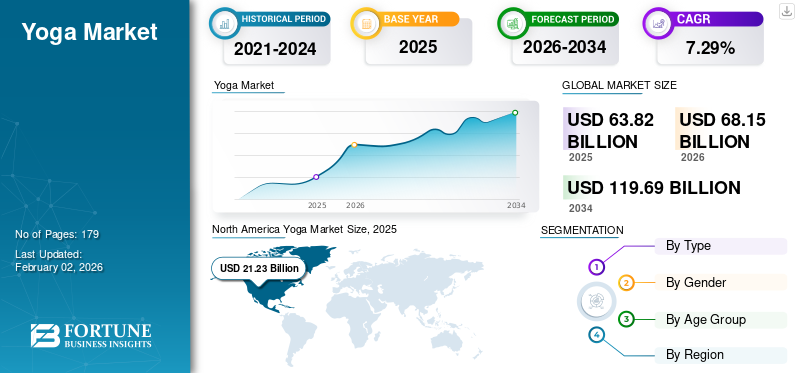
The global yoga market size was valued at USD 63.82 billion in 2025 and is projected to grow from USD 68.15 billion in 2026 to USD 119.69 billion by 2034, exhibiting a CAGR of 7.29% over the forecast period. North America dominated the yoga market with a market share of 33.27% in 2025.
Yoga is witnessing remarkable growth, led by growing awareness of its physical and mental health benefits. Originated in India, yoga has evolved into a mainstream wellness practice globally, encompassing classes, retreats, apparel, and digital offerings. This surge is prompted by rising health consciousness, the popularity of online platforms, and a growing demand for holistic well-being solutions.
Key players operating in the market include CorePower Yoga, Honor Yoga, Glo Digital, Inc., Pure Yoga, and YogaOne. These players emphasize on community building and raise brand loyalty through referral programs, instructor discounts, and exclusive member events. Yoga studios are focused on creating community wellness experiences and personalized services to retain clients. Studio chains and digital platforms such as CorePower Yoga, Gaia, and YogaWorks are emphasizing on digital expansion, online classes, on-demand content, and mobile apps, making yoga accessible globally.
Download Free sample to learn more about this report.
Yoga Market Key Takeaways
 Market Size & Forecast
- 2025 Market Size: USD 63.82 Billion
- 2026 Market Size: USD 68.15 Billion
- 2034 Forecast Market Size: USD 119.69 Billion
- CAGR: 7.29% from 2026–2034
 Market Share
- North America dominated the yoga market with a 33.27% share in 2025.
- The offline course segment is projected to account for 62.54% of the market in 2026.
- The female segment is expected to hold a 68.57% market share in 2026.
 Key Regional Highlights
North America
North America generated USD 21.23 billion, accounting for 33.27% of the global market in 2025.
Europe
Europe reached USD 19.03 billion, representing 29.82% of the global market in 2025.
Asia Pacific
Asia Pacific recorded USD 17.78 billion, capturing 27.85% of the global market in 2025.
U.S.
The market is projected to reach USD 18.90 billion by 2026.
Japan
The market is projected to reach USD 1.96 billion by 2026.
Read More

YOGA MARKET TRENDS
Digitalization and AI-Driven Personalization on Yoga Apps and Platforms
The industry is experiencing a trend of rapid digitalization, with AI-powered apps and virtual reality (VR) platforms transforming how mind-body exercises are accessed and experienced. These technologies provide real-time feedback, personalized routines, and immersive environments, making yoga more accessible and tailored to individual requirements. Hybrid models combining online and in-person classes, along with smart wearables for posture correction, are redefining yoga instruction and expanding its global acceptance.
MARKET DYNAMICS
Market Drivers
Rising Health Awareness and Mental Well-Being Leads to Market Growth
Growing awareness of mental and physical health benefits drive the yoga market growth. More consumers are seeking holistic approaches to wellness, using yoga as an activity for stress relief, improved flexibility, and overall well-being. Health departments and wellness campaigns promoting yoga practices as a tool for mental wellness, thus broadening its appeal across age groups and demographics.
Growth of Retreat Centers and Wellness Tourism to Drive Market Expansion
Expanding popularity of spiritual retreat centers and wellness tourism is further driving the market expansion. Consumers are progressively seeking experiences that combine travel with physical fitness and spiritual transformation, leading demand for retreats and curated wellness packages. This in turn, creates new growth prospects for instructors, travel agencies, and hospitality providers, significantly supplementing overall market growth.
Market Restraints
Intense Competition from Alternative Fitness Options to Hamper Market Growth
High level of competition from alternative wellness and fitness programs, such as Pilates, HIIT, CrossFit, and weight training stands as major restraints. These substitutes often promise rapid or more visible results, appealing to mass consumers seeking swift physical transformation. Consequently, yoga can become limited to niche segments, making it challenging for studios and instructors to attract and maintain clients. This intense competition forces yoga service provider to constantly innovate, differentiate offerings, and maintain market relevance.
Market Opportunities
Implementing Corporate Wellness Programs Offers Potential Growth Opportunities
One unique opportunity in the industry lies in developing and offering specialized corporate wellness programs. As companies increasingly prioritize employee health and productivity, there is a growing demand for on-site and virtual yoga sessions tailored to workplace needs. These programs help manage stress levels, improve focus, and foster team unity. By collaborating with organizations, yoga businesses can tap into a lucrative B2B segment, diversify their offerings, and subsidize healthier, more engaged workforces.
Market Challenges
Lack of Inclusivity and Accessibility to Pose as Challenge
The yoga industry faces a considerable challenge due to lack of inclusivity and accessibility. Despite the industry’s rapid expansion, traditional studios and classes often cater to a limited demographic, typically those who are already fit, affluent, or familiar with yoga, excluding seniors, beginners, people with disabilities, and diverse communities. High costs, intimidating environments, and a focus on aesthetics further alienate many potential practitioners. Addressing these barriers is crucial for the yoga industry to recognize its full potential and serve a broader, more diverse population.
SEGMENTATION ANALYSIS
By Type
In Person Experience Fuels Trust and Engagement, Driving Growth of Offline Courses
By type, the market is divided into online course, offline course, and accreditation training program.
The offline course segment is projected to hold the majority of the market with a share of 62.54% in 2026, as trained and certified professionals conduct them in person. They also offer personalized guidance, hands-on correction of postures, along with a group environment. Moreover, wellness and retreat centers offer a broad range of yoga variations, catering to wide fitness levels, interest, and needs. Additionally, a rising number of wellness studios offering mind-body relaxing services are making it easier for individuals to visit affordable and convenient classes. For instance, according to the Rishikesh Yogkulam, Certified Yoga Teacher Training Center in India, the number of Americans who engaged in Yoga activity at least once from 2010 to 2021 increased by 64%, from 21 million to 35 million people.
Meanwhile, the online course segment is predicted to record the fastest CAGR over the forecast period. Growing penetration of digital technology has spurred the growth of online platforms. They provide a range of options, fulfilling the demand for different styles and preferences, from beginner to advanced levels. Online courses enable users to access them remotely, providing flexibility in scheduling and practicing. In June 2023, YogiFi, an Indian health-tech startup and Samsung Partners collaborated to offer an interactive yoga experience on its range of smart televisions.
To know how our report can help streamline your business, Speak to Analyst
By Gender
High Number of Tailored Yoga Programs Designed for Female Leads to Growth of Women’s Segment
By gender, the market is segmented into male and female.
The female gender segment is projected to dominated the market with a share of 68.57% in 2026, contributing to the largest revenue and yoga market share. Female practitioners appreciate the social interaction, communal aspect, and sense of belonging offered by yoga classes and therefore are more inclined toward the activity. Moreover, yogism is associated with helping different transitions of women’s life cycle including pregnancy, menopause, managing PCOS or PCOD, or periods of high stress. It often offers practices and tools to navigate these transitions more easily. Tailored yoga programs designed for women, such as classes focused on women's health issues, postnatal yoga for new mothers, and prenatal yoga for expectant mothers, address specific needs and life stages.
Meanwhile, the male segment is anticipated to grow the highest CAGR over the assessment period. Primary factors contributing to the growth of the segment include growing awareness of the diverse health benefits of the practice beyond traditional fitness routines. There has been a rising inclination of men toward yoga practice. For instance, according to the Yogkulam Organization’s findings, the male participation in the U.S. grew from 4 million in 2012 to 14 million in 2022. In addition, men are also incorporating the practice into their routine to enhance flexibility, recovery, and overall performance.
By Age Group
Emphasis on Life Experiences and Financial Stability Support 30 to 50 Years Segment Growth
Based on age group, the market is segmented into below 18, 18 to 29 years, 30 to 50 years, and above 50 years.
The 30 to 50 years segment is anticipated to accounted for the highest market with a share of 41.29% in 2026. Individuals in this age bracket often opt for fitness activity such as yogism to maintain fitness, overcome stress and promote mental relaxation. They seek to maintain a balanced work-life responsibility, which is driving the growth of the segment.
On the other hand, the 18 to 29 years age group segment is expected to grow at the fastest rate over the forecast years. Individuals of this age group are turning to this practice as a means of staying fit and improving their mental well-being, while battling the demands of personal, corporate, or educational life. They tend to experiment with a different variety of yoga styles, ranging from mind-work sessions to dynamic and advanced batches, which is likely to supplement the segmental growth.
YOGA MARKET REGIONAL OUTLOOK
Geographically, the market is divided into North America, South America, Europe, Asia Pacific, and the Middle East & Africa.
North America
North America Yoga Market Size, 2025 (USD Billion)
To get more information on the regional analysis of this market, Download Free sample
North America dominated the global market accounting for the significant share of revenue. In 2025, the North America market stood at USD 21.23 billion, representing 33.27% of global demand, and is projected to grow to USD 22.62 billion in 2026. A rising consciousness around physical and mental wellness, particularly stress management, has boosted demand for yogic activity and mindfulness practices. Digital transformation plays a major role with the introduction of online classes, apps, and smart-wearables making yogism convenient and personalized.
The U.S. accounted for the majority of the share in North America. Millennials who value holistic health are fueling the country’s growth. Corporate wellness programs and wellness tourism such as retreats are also supporting the market growth. Moreover, the use of digital technology to attend online classes, to book sessions, and access-personalized experiences is on the rise, amplifying the growth of the U.S. market. The U.S. yoga market is projected to reach USD 18.90 billion by 2026.
Download Free sample to learn more about this report.
Europe
The Europe region captured 29.82% of the global market in 2025, generating USD 19.03 billion in revenue, and is projected to reach USD 20.33 billion in 2026. Europe held the second largest share in 2024 in terms of revenue and is expected to grow considerably during the forecast period. Europeans are increasingly focused on complete health and mental well-being, seeking services that address both physical and intellectual health. This shift is driven by heightened awareness of stress management, chronic illness prevention, and the desire for a balanced lifestyle, leading to regional market expansion. In addition, the adoption of the practice and meditation as integrative mental health therapies is becoming mainstream, with mindfulness practices incorporated into daily routines at home and work which is likely to aid in further market development. The UK yoga market is projected to reach USD 2.73 billion by 2026, while the Germany yoga market is projected to reach USD 3.69 billion by 2026.
Asia Pacific
Asia Pacific maintained a strong presence in the global market, reaching USD 17.78 billion in 2025, accounting for 27.85% share, and is expected to reach USD 19.1 billion in 2026. Asia Pacific is expected to record the fastest CAGR during the forecast period. The growth of the region is likely to be driven by a vast and varied population, with growing numbers of young people aged between 18 – 29 years adopting the practice for fitness and stress management. This demographic is predominantly drawn to online courses and is influenced by social media and celebrity endorsements. Additionally, economic growth in China, Japan, India, and South Korea has led to higher disposable income, enabling more people to spend on wellness services. Moreover, the region’s deep-rooted traditions, particularly in India, are being adapted to contemporary lifestyles. Hybrid yoga experiences such as yoga combined with Ayurveda, sports, and wellness tourism are attracting new participants and increasing engagement, which is likely to propel market growth. The Japan yoga market is projected to reach USD 1.96 billion by 2026, the China yoga market is projected to reach USD 5.33 billion by 2026, and the India yoga market is projected to reach USD 4.7 billion by 2026.
South America and the Middle East & Africa
The South America and the Middle East & Africa market is projected to witness substantial growth over the coming years. The Middle East & Africa market accounted for USD 2.11 billion in 2025, representing 3.31% of the global industry, and is expected to reach USD 2.22 billion in 2026. There is an increasing acknowledgement of yoga’s benefits for pain management and chronic condition rehabilitation across both the regions. Additionally, the COVID-19 pandemic has accelerated the adoption of online and hybrid yoga models, making it accessible through digital platforms, apps, and virtual classes. This trend continues to drive growth as consumers seek flexible and convenient wellness solutions at home. Moreover, organizations and institutional adoption of meditation and yogic practices to improve individual productivity is anticipated to boost market expansion. South America accounted for USD 3.67 billion in 2025, representing 5.75% of the global market share, and is projected to reach USD 3.89 billion in 2026.
COMPETITIVE LANDSCAPE
Key Industry Players
Diversified Offerings and Robust Marketing Along with Community Engagement Helps Key Players to Reinforce Market Position
The market players are expanding their service offerings beyond traditional yoga to include a variety of styles including Yin, Vinyasa, or aerial yoga. They conduct specialized workshops for children, senior citizens, or prenatal-postnatal to attract all kinds of demographics. Unique programs such as wellness retreats, themed classes, and hybrid yoga-sport offerings help to differentiate brands in an ever-evolving competitive landscape. Key players are also leveraging technology to offer hybrid or virtual classes, increasing service accessibility to wider audiences and accommodating shifting consumer preference for convenience and flexibility. An all-inclusive marketing plan covering target audience analysis, branding consistency, and adaptability to trends is emphasized by major players to stay ahead of the competition. Studios are building strong online presence, using social media, email marketing, and digital advertising to attract and retain clientele.
LIST OF KEY YOGA COMPANIES PROFILED
- CorePower Yoga (U.S.)
- Honor Yoga (U.S.)
- PURE International (Hong Kong)
- Glo Digital, Inc. (U.S.)
- YogaOne (U.S.)
- YogaSix (U.S.)
- Yoga Pod (U.S.)
- MoreYoga (UK)
- Power Yoga Canada (Canada)
- Flyogi LLC (U.S.)
Key Industry Developments
- February 2025: FitLab, a fitness and sports lifestyle company, expanded its portfolio by adding Y7, a yoga brand well-recognized for its music-driven and heated Vinyasa experience within a candlelit studio. With this acquisition, Y7 hands over to FitLab nine studios- a number that is expected to increase.
- October 2024: YogaEasy, online studio for classes, live sessions & programs released its English-language online yoga platform for the international community, providing a broad spectrum of teachings for both mind and body, including yoga, meditation, Pilates, and Qigong.
- October 2024: YogaSix, a franchised yoga brand, announced its expansion beyond North America into Europe with its first German studio opening in Frankfurt. This new studio offers a new, innovative, modern, and inclusive experience. This expansion is part of YogaSix’s ongoing global expansion, which includes additional planned openings in Germany.
- September 2024: U.K. based, Yoga Kula announced the expansion of its Chapel Allerton studio and unveiled the biggest yoga timetable in the U.K. for an independent studio. Yoga Kula’s new facilities have doubled in size with a magnificent new space across two studios and include dedicated therapy rooms comprising a range of holistic practices such as Reiki, Ayurvedic Yoga Massage, and Cranio-Sacral Therapy.
- November 2022: Y7, the U.S.-based yoga studio declared a collaboration with Universal Music Group, a Netherlands-based music and entertainment company, to create the music-driven yoga platform for online yoga classes. This online platform embraces hit music that is synced into all classes. It can be accessed through omnichannel memberships or a new digital-only subscription.
REPORT COVERAGE
The yoga market research report provides a detailed analysis of the market and focuses on key aspects, such as competitive landscape, services, and leading regions. Besides this, the report offers market trends, dynamics, and highlights key industry developments. In addition to the aforementioned factors, the report encompasses several factors that have contributed to the growth of the market in recent years.
Request for Customization to gain extensive market insights.
Report Scope & Segmentation
|
ATTRIBUTE |
DETAILS |
|
Study Period |
2021-2034 |
|
Base Year |
2025 |
|
Estimated Year |
2026 |
|
Forecast Period |
2026-2034 |
|
Historical Period |
2021-2024 |
|
Growth Rate |
CAGR of 7.29% from 2026 to 2034 |
|
Unit |
Value (USD Billion) |
|
Segmentation
|
By Type
|
|
By Gender
|
|
|
By Age Group
|
|
|
By Geography
|
Frequently Asked Questions
According to Fortune Business Insights, the global market size will be valued at USD 68.15 billion in 2026 and is anticipated to reach USD 119.69 billion by 2034.
In 2025, the global market value stood at USD 63.82 billion.
Recording a CAGR of 7.29% the market will exhibit a steady growth rate during the forecast period of 2026-2034.
By type, the offline course segment dominated the market.
Rising health consciousness, the popularity of online platforms, and a growing demand for holistic well-being solutions are the factors driving the market’s growth.
CorePower Yoga, Honor Yoga, Glo Digital, Inc., Pure Yoga, and YogaOne are a few significant players in the global market.
North America held the highest market share in 2025.
Institutions and corporates prioritizing employee health and productivity and offering on-site or virtual sessions is likely to encourage the adoption of these services.



- 2021-2034
- 2025
- 2021-2024
- 179
-
(Offer valid till 30th Sep 2026)
Get 30-60 hrs Free Customization
Expand Regional and Country Coverage, Segments Analysis, Company Profiles, Competitive Benchmarking, and End-user Insights.



















Related Reports
-
US +1 833 909 2966 ( Toll Free )
-
Get In Touch With Us