2D Barcode Reader Market Size, Share & Industry Analysis, By Application (Point of Sale (POS), Inventory Management, Product Identification, Tracking and Traceability, Ticketing & Event Management, and Others), By Product Type (Handheld and Fixed), By Technology (Laser-based and Image-based), By End-Use Industry (Transportation and Logistics, Hotels and Hospitality, Retail and E-Commerce, Government and Public, Manufacturing, Healthcare and Pharmaceuticals, and Others), and Regional Forecast, 2026-2034
 Download Free Sample
KEY MARKET INSIGHTS
 Listen to Audio Version
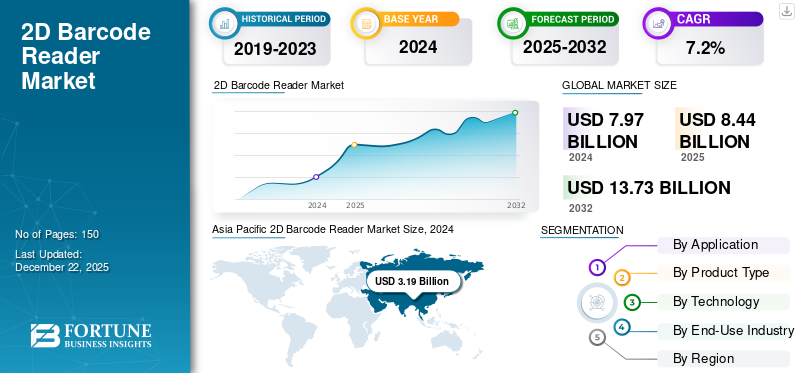
The global 2D barcode reader market size was valued at USD 8.44 billion in 2025 and is projected to grow from USD 8.97 billion in 2026 to USD 15.58 billion by 2034, exhibiting a CAGR of 7.10% during the forecast period. Asia Pacific dominated the market with a share of 40.10% in 2025.
A 2D barcode reader is a device used to interpret 2D barcodes. Unlike traditional 1D barcodes, which consist only of lines, 2D barcodes can contain a greater amount of information. They encode data both horizontally and vertically, which can include text, URLs, and images. Major players included in this market are Casio Computer Co., Ltd., Cognex Corp., Datalogic S.p.A., Denso Wave Inc., Honeywell International, Inc., Omron Microscan Systems, Inc., Zebra Technologies Corp., Keyence Corp., Juniper Systems Inc., and Opticon Inc.
The 2D barcode readers market is witnessing significant growth due to the rising automation, smart warehousing, and e-commerce expansion. Growing urbanization and retail sector expansion are creating a higher need for automated inventory and tracking solutions, which in turn is driving the market.
As per GS1 US, global utilization of barcode technology has significantly increased between 2024 and 2025, with approximately 90% of major retailers incorporating barcodes into their inventory and sales systems. Moreover, the rising adoption of contactless and Omnichannel solutions has increased the demand for 2D barcode readers.
While the COVID-19 pandemic temporarily disrupted demand for 2D barcode readers due to supply chain disruptions and lockdown, the overall need for 2D barcode readers, especially in healthcare and supply chain management, remained strong. Their ability to support efficient and precise operations, particularly in contactless applications, made them a critical tool during and after the pandemic.
Download Free sample to learn more about this report.
2D Barcode Reader Market Key Takeaways
 Global Market Size & Forecast
- 2025 Market Size: USD 8.44 billion
- 2026 Market Size: USD 8.97 billion
- 2034 Forecast Market Size: USD 15.58 billion
- CAGR: 7.10% from 2026–2034
 Market Share
- Asia Pacific dominated the 2D barcode reader market with a 40.10% share in 2025.
- The POS segment is projected to account for 32.86% of the market in 2026.
- The handheld segment is expected to lead with a 59.11% market share in 2026.
 Key Regional Highlights
Asia Pacific
Asia Pacific generated USD 3.39 billion in 2025, capturing 40.10% of the global market.
Europe
Europe accounted for USD 1.61 billion, representing 19.10% of the global market in 2025.
North America
North America is expected to register the second-highest CAGR during the forecast period, driven by automation and digital transformation.
U.S.
The U.S. 2D barcode reader market is projected to reach USD 1.90 billion in 2026.
Japan
The Japan 2D barcode reader market is projected to reach USD 0.78 billion in 2026.
Read More

IMPACT OF GENERATIVE AI
Integration of Generative AI with 2D Barcode Reader to Enhance Decoding Capabilities
Generative AI is transforming the barcode reading sector by allowing the development of new barcode formats, improving decoding capabilities, and boosting operational efficiency. Numerous AI-driven barcode scanners, including Cognex VisionPro and Zebra’s SmartLens, utilize machine learning techniques to identify the features of impaired or worn barcodes. As a result, this enhances reading accuracy over time, even in difficult environments, enabling companies to sustain operational effectiveness without the need for expensive manual efforts.
IMPACT OF RECIPROCAL TARIFFS
The impact of reciprocal tariffs has introduced considerable difficulties and strategic changes within the barcode industry, leading to higher raw material costs, restricted market access, and supply chain disruptions. To offset the financial burden of tariffs, manufacturers are increasingly adopting automation and advanced barcode scanning technology. This helps streamline operations, reduce manual errors, and improve inventory management, thereby partially compensating the increased costs brought on by tariffs.
MARKET DYNAMICS
Market Drivers
Increasing Use of Automation and Smart Warehousing Technology to Aid Market Growth
The increasing use of automation and intelligent warehousing technologies is significantly boosting the demand for 2D barcode readers. Logistics, e-commerce, healthcare, and manufacturing are growing sectors that embrace automation to boost productivity, fewer errors, and accelerate workflows. Such readers are needed for controlling the stock, keeping the shipment record, and other applications requiring real-time data capture.
Additionally, the growing need for contactless and fast check-in systems is pushing firms to spend on strong hand-held scanners, set barcode readers, and phone-based barcode reading apps. As groups work to make operations better and adopt Industry 4.0 tech, the need for advanced 2D barcode readers is likely to grow, making them an important component of modern automated logistics and inventory management systems.
Market Restraints
Compatibility Issues to Hinder Market Expansion
Outdated legacy systems in many organizations need to integrate effectively with the latest 2D barcode scanners. This inability may cause integration problems, requiring companies to spend additional time on system enhancements. These upgrades are quite expensive and time-intensive, potentially delaying the adoption of newer barcode technologies.
Market Opportunities
Integration of Barcode Scanning Technology with Mobile Devices Creates Lucrative Opportunities
With the widespread adoption of smartphones and tablets, there is an increasing tendency toward the use of mobile devices for barcode scanning. Apps for mobile barcode scanning are getting better and enabling users to point their camera and scan barcodes with ease. This trend holds significant value for sectors such as retail and logistics, where employees can use their mobiles for item scanning, inventory scanning, and shipment management. The simple usability and low cost of mobile barcode reading make them an attractive option for many businesses.
2D Barcode Reader Market Trends
Rising Multimodal Data Capture in Barcode Scanning to Emerge as a Key Market Trend
The capture of multimodal data is an emerging trend in barcode scanning, aimed at increasing accuracy and reliability. This approach involves coupling barcode scanning with other tech such as RFID, NFC, and optical character recognition (OCR). Using several sources helps businesses create a complete and more accurate picture of their stock. This trend is especially relevant in complex settings such as manufacturing and logistics.
Download Free sample to learn more about this report.
SEGMENTATION ANALYSIS
By Application
POS Segment Dominated, Driven by Widespread Adoption among Retailers and Supermarkets
Based on application, the market is segmented into point of sale (POS), inventory management, product identification, tracking and traceability, ticketing & event management, and others.
The POS segment is projected to dominate the market with a share of 32.86% in 2026. Retailers and supermarkets are integrating these readers into POS systems to speed up transactions, improve inventory management, and enhance customer engagement. These readers can quickly scan multiple items, including damaged or poorly printed barcodes, which speeds up checkout and improves customer satisfaction.
The tracking and traceability segment is expected to witness the highest CAGR throughout the forecast period. The growth is fueled by the rising need for regulatory compliance, optimizing supply chain, and supporting automation and digitization across industries, making these devices critical for efficient, transparent, and secure operations worldwide.
By Product Type
Handheld Segment Led due to its Ease of Use in Fast-Paced Settings
Based on product type, the market is segmented into handheld and fixed.
The handheld segment is expected to lead the market, contributing 59.11% globally in 2026, due to its adaptability, user-friendliness, and broad use across different sectors. These devices provide versatility and mobility, allowing users to scan codes from several locations and angles. This makes them beneficial in fast-paced settings such as warehouses, retail spaces, and logistics operations. The capacity to interpret different barcode formats, even those on curved or damaged surfaces, has rendered handheld 2D barcode readers essential in situations demanding precision and dependability.
The fixed segment is anticipated to register the highest CAGR during the forecast period. The demand for fixed 2D barcode readers is growing rapidly, especially in manufacturing, logistics, and retail sectors, due to their ability to perform quick, hands-free scanning and seamless integration into automated systems. These compact devices can be installed on production lines, kiosks, and conveyor systems and provide high-performance scanning in a demanding operational environment.
By Technology
Laser-based Segment to Dominate due to Its Ability to Read Different Bar Code Types
Based on technology, the market is categorized into laser-based and image-based.
In 2026, the laser-based segment is projected to lead the market with a 61.93% share. Laser barcode scanners can read different bar code types and sizes, including 2D codes, and are usually built tough for industrial settings. This makes them suitable for diverse operational settings, from rugged manufacturing floors to busy retail checkouts.
The image-based segment is likely to hold the highest CAGR during the forecast period. Better image processing, cameras with higher resolution, and algorithms supported by AI have made 2D bar code scanning much more accurate, faster, and reliable. These advancements allow image-based readers to decode barcodes even in poor lighting or when codes are damaged, outperforming traditional laser-based tasks.
By End-Use Industry
To know how our report can help streamline your business, Speak to Analyst
Retail and E-Commerce Segment Leads due to Rising Demand for Online Shopping and Omnichannel Retail
Based on end-use industry, the market is categorized into transportation and logistics, hotels and hospitality, retail and e-commerce, government and public, manufacturing, healthcare and pharmaceuticals, and others.
The retail and e-commerce segment held the largest market share in 2026, driven by the rapid growth of online shopping and the expansion of Omnichannel retail strategies. This surge has increased the need for readers in warehouse management automation. Additionally, as digital mobile payment solutions such as Google Pay, Apple Pay, and Amazon Pay gain traction, numerous retailers are providing barcode scanners at the POS to facilitate fast and secure purchases. Moreover, the increasing prevalence of self-service kiosks and cashier-less stores is driving the transition toward both fixed and handheld barcode readers to improve the shopping experience.
The manufacturing segment is expected to register the highest CAGR during the forecast period. Manufacturers are increasingly embracing Industry 4.0 principles, which emphasize automation, real-time data analytics, and connectivity. These readers are integral to smart manufacturing, enabling real-time tracking of materials, products, and finished goods throughout the production line.
2D BARCODE READER MARKET REGIONAL OUTLOOK
The market is divided into five regions: North America, South America, Europe, the Middle East & Africa, and Asia Pacific.
Asia Pacific
Asia Pacific 2D Barcode Reader Market Size, 2025 (USD Billion)
To get more information on the regional analysis of this market, Download Free sample
Asia Pacific recorded a market size of USD 3.39 billion in 2025, capturing 40.10% of the global market share, and is projected to reach USD 3.61 billion in 2026. The growth of the retail and e-commerce sectors in the region is driving this rapid expansion. The rise in automated warehouses has further boosted the need for these readers as manufacturing techniques evolve. Due to increasing funding and investments in sectors such as healthcare, pharmaceuticals, transportation, and military applications in China and India, the region is witnessing significant 2D barcode reader market growth. The Japan market is projected to reach USD 0.78 Billion by 2026, the China market is projected to reach USD 1.16 Billion by 2026, and the India market is projected to reach USD 0.5 Billion by 2026.
The demand for 2D readers in China has increased due to factors such as contemporary consumer lifestyles and a rising number of businesses participating in online marketplaces. China’s expansive industrial sector, combined with strong government support for the adoption of advanced technologies will improve its business operations.
To know how our report can help streamline your business, Speak to Analyst
South America
The market in South America is experiencing stable growth due to recent shifts in the local economy and initial government funding for research initiatives.
Europe
The Europe market accounted for USD 1.61 billion in 2025, representing 19.10% of the global industry, and is expected to reach USD 1.72 billion in 2026. The rising focus on Industry 4.0 and the adoption of smart manufacturing methods are essential drivers of this region. The region's commitment to sustainable and efficient supply chain processes also boosts the use of advanced barcode scanning technologies. The UK market is projected to reach USD 0.37 Billion by 2026, while the Germany market is projected to reach USD 0.36 Billion by 2026.
Middle East & Africa
The Middle East & Africa market generated USD 0.38 billion in 2025, representing 4.50% of the global market landscape, and is expected to reach USD 0.4 billion in 2026. The growth of the e-commerce industry in the Gulf nations is driven by rapidly changing consumer preferences for more convenient and efficient shopping experiences, along with the rise of digitalization in the retail sector.
North America
The market in North America is experiencing second-highest CAGR driven by the growing application of automation and digital transformation in sectors such as retail, logistics, and healthcare. Organizations utilize these devices to improve operational efficiency, optimize inventory control, and adhere to strict regulatory requirements. Furthermore, innovations in wireless and rugged barcode scanners cater to the challenges of varied and tough operational settings, which enhances their uptake in the region. The U.S. is a top market for 2D barcode scanners, mainly due to the swift growth of e-commerce and Omnichannel retailing. The U.S. market is projected to reach USD 1.9 Billion by 2026.
Latin America
Latin America accounted for USD 0.56 billion in 2025, representing 6.70% of the global market share, and is projected to reach USD 0.58 billion in 2026.
COMPETITIVE LANDSCAPE
KEY INDUSTRY PLAYERS
Major Companies Adopt Acquisition Approaches to Expand their Business Operations
Significant companies actively working in the 2D barcode readers market are introducing advanced solutions that enable faster and more accurate data capture, enhanced information access, and improved customer experience. They are deploying new approaches by acquiring domestic and small corporations to expand their operations. In addition, injecting funds for R&D, collaborations, and partnerships, are certain approaches taken into consideration to increase the demand for this technology.
List of Key 2D Barcode Reader Companies Studied
- Casio Computer Co., Ltd. (Japan)
- Cognex Corp. (U.S.)
- Datalogic S.p.A. (Italy)
- Denso Wave Inc. (Japan)
- Honeywell International, Inc. (U.S.)
- Omron Microscan Systems, Inc. (U.S.)
- Zebra Technologies Corp. (U.S.)
- Keyence Corp. (Japan)
- Juniper Systems Inc. (U.S.)
- Opticon Inc. (U.S.)
- Marson Technology Co., Ltd. (Taiwan)
- General Data Company, Inc. (U.S.)
- Sato Holdings Corp. (Japan)
- Scandit (Switzerland)
- SICK AG (Germany)
- Unitech Electronics Co., Ltd. (Taiwan)
- Wasp Barcode Technologies (U.S.)
- Zebex Industries Inc. (Taiwan)
- JADAK - A Novanta Company (U.S.)
- Motorola Solutions (U.S.)
…and more
KEY INDUSTRY DEVELOPMENTS
- June 2025: Omron presented the VHV5 Ultra-High Performance Barcode Reader, a refined fixed-mount device engineered to reliably decode barcodes on challenging direct part marks (DPMs) and rapid packaging lines.
- January 2025: Cognex Corporation introduced the DataMan 290 and 390 barcode readers. Due to AI technology, these devices provide dependable decoding capabilities suitable for a wide variety of manufacturing applications.
- April 2024: Keyence launched the SR-X series, a new collection of AI-driven code readers aimed at improving performance and accuracy. Each model in this series is equipped with a high-intensity green LED pointer as its light source, guaranteeing accurate targeting and dependable functionality.
- July 2023: Datalogic introduced the Gryphon 4500 Fixed Series, built for self-service applications across retail, manufacturing, healthcare, and transportation & logistics. This device combines advanced technology with sturdy durability in a compact design, making it ideal for integration into kiosks, self-check-in systems, information points, and access control systems.
- May 2023: EM Microelectronic and SATO Corporation, a global manufacturer of printing and labeling solutions, revealed that SATO's series of RAIN RFID and HF printers, including the CL4NX and CL6NX Plus industrial printers, and the CT4-LX desktop printer are capable of natively printing and encoding em|echo-V RAINFC labels, specifically designed for retail, healthcare, and smart industrial applications.
INVESTMENT ANALYSIS AND OPPORTUNITIES
Investors can expect growth in regions and sectors embracing automation, digital retail, and supply chain modernization. Focus areas for investment include AI-driven solutions, mobile/web-compatible devices, and applications in high-growth end-use industries. Moreover, companies can develop secure and integrated solutions for cloud-based and IoT-enabled devices, presenting a huge opportunity for players operating in this market.
REPORT COVERAGE
The report provides a detailed analysis of the market and focuses on key aspects, such as leading companies, product types, and leading applications of the product. Besides, it offers insights into the 2D barcode reader industry trends and highlights key industry developments. In addition to the factors mentioned above, the report encompasses several factors that have contributed to the growth of the market in recent years.
Request for Customization to gain extensive market insights.
REPORT SCOPE & SEGMENTATION
|
ATTRIBUTE |
DETAILS |
|
Study Period |
2021-2034 |
|
Base Year |
2025 |
|
Estimated Year |
2026 |
|
Forecast Period |
2026-2034 |
|
Historical Period |
2021-2024 |
|
Growth Rate |
CAGR of 7.10% from 2026 to 2034 |
|
Unit |
Value (USD Billion) |
|
Segmentation |
By Application
By Product Type
By Technology
By End-Use Industry
By Region
|
|
Companies Profiled in the Report |
Casio Computer Co., Ltd. (Japan) Cognex Corp. (U.S.) Datalogic S.p.A. (Italy) Denso Wave Inc. (Japan) Honeywell International, Inc. (U.S.) Omron Microscan Systems, Inc. (U.S.) Zebra Technologies Corp. (U.S.) Keyence Corp. (Japan) Juniper Systems Inc. (U.S.) Opticon Inc. (U.S.) |
Frequently Asked Questions
The market is projected to reach a valuation of USD 15.58 billion by 2034.
In 2025, the market was valued at USD 8.44 billion.
The market is projected to record a CAGR of 7.10% during the forecast period.
By application, the POS segment led the market in 2026.
Increasing use of automation and smart warehousing technology is a key factor driving market growth.
Casio Computer Co., Ltd., Cognex Corp., Datalogic S.p.A., Denso Wave Inc., Honeywell International, Inc., Omron Microscan Systems, Inc., Zebra Technologies Corp., Keyence Corp., Juniper Systems Inc., and Opticon Inc. are the top players in the market.
Asia Pacific dominated the market with a share of 40.10% in 2025.
By end-use industry, the manufacturing segment is expected to record the highest CAGR during the forecast period.


- 2021-2034
- 2025
- 2021-2024
- 150
Get 30-60 hrs Free Customization
Expand Regional and Country Coverage, Segments Analysis, Company Profiles, Competitive Benchmarking, and End-user Insights.




















Related Reports
-
US +1 833 909 2966 ( Toll Free )
-
Get In Touch With Us