Adaptive Deep Brain Stimulation Systems Market Size, Share & Industry Analysis By Component (Implantable Pulse Generator (IPG), DBS Leads & Extensions, and Accessories & Ancillary Components), By Application (Parkinson’s Disease, Epilepsy, Essential Tremor, and Others), By End User (Hospitals & ASCs, Specialty Clinics, and Others), and Regional Forecast, 2026-2034
 Download Free Sample
Adaptive Deep Brain Stimulation Systems Market Size and Future Outlook
 Listen to Audio Version
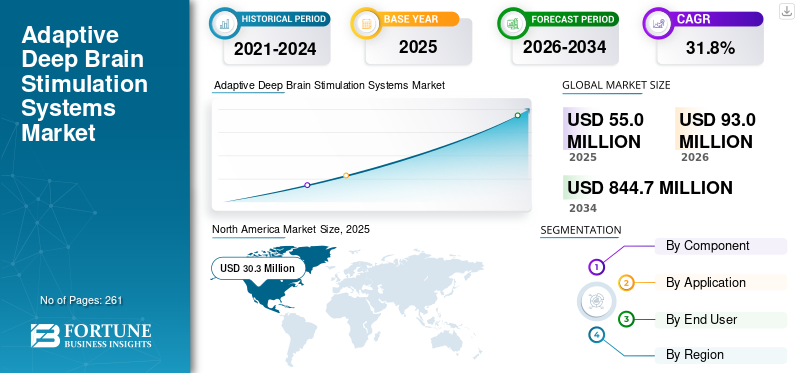
The adaptive deep brain stimulation systems market size was valued at USD 55.0 million in 2025 and is projected to grow from USD 93.0 million in 2026 to USD 844.7 million by 2034, exhibiting a CAGR of 31.8% during the forecast period. North America dominated the adaptive deep brain stimulation systems market with a market share of 55.09% in 2025.
Adaptive deep brain stimulation systems are an established neuromodulation technique for the treatment of movement disorders related to neurodegenerative disorders, including essential tremor and others. The growing prevalence of neurological disorders, the rising demand for sensing-enabled neurostimulators, and growing investments in neuroscience research are boosting the adoption rate of these devices in the market. The rising aging population is further driving the penetration rate for adaptive deep brain stimulation systems products among the patient population in the market.
- For instance, according to the 2024 data published by the World Health Organization (WHO), it was reported that around 50 million people have epilepsy globally.
Furthermore, the rising integration of technological advancements in these devices by major players, such as Medtronic and Newronika S.p.A., is contributing to the demand for these devices worldwide.
Download Free sample to learn more about this report.
Adaptive Deep Brain Stimulation Systems Market Key Takeaways
 Global Market Size & Forecast
- 2025 Market Size: USD 55.0 million
- 2026 Market Size: USD 93.0 million
- 2034 Forecast Market Size: USD 844.7 million
- CAGR: 31.8% from 2026–2034
 Market Share
- North America dominated the adaptive deep brain stimulation systems market with a 55.09% share in 2025.
- The Parkinson’s disease segment dominated the global market in 2025 and held a 94.6% share.
- The Hospitals & ASCs segment is set to hold an 80.1% share in 2026.
 Key Regional Highlights
North America
The region generated USD 30.3 million in 2025 and maintained its leadership, supported by the rising prevalence of neurological disorders, advanced healthcare infrastructure, and ongoing R&D activities.
Europe
The market is projected to reach USD 40.9 million in 2026, expanding at a 24.0% CAGR, driven by the strong presence of neuroscience research institutes and manufacturers.
Asia Pacific
The region is estimated to reach USD 3.7 million in 2026, supported by expanding healthcare infrastructure and increasing clinical trials for advanced adaptive stimulation systems.
U.S.
The U.S. market can be analytically approximated at around USD 44.2 million in 2026, accounting for roughly 47.5% of global sales.
Japan
The market is estimated to reach USD 0.9 million in 2026, driven by the growing prevalence of neurological diseases and increasing awareness of adaptive deep brain stimulation systems.
Read More

Adaptive Deep Brain Stimulation Systems Market Trends
Integration of Programming Software and Therapy Personalization is Emerging Market Trend
There is an increasing shift toward the incorporation of sensing-enabled therapy platforms that combine DBS leads, implantable pulse generators, signal-sensing algorithms, programming software, and patient-specific therapy adjustment. These systems use neural signals, including local field potentials, to detect changes in brain activity and modify stimulation in real time. These advancements position aDBS as a personalized neuromodulation therapy, enabling clinicians to tailor stimulation according to each patient’s symptom fluctuations, brain-signal patterns and medication state.
Market Dynamics
Market Drivers
Download Free sample to learn more about this report.
Increasing Prevalence of Neurological Disorders to Drive Market Growth
The rising prevalence of chronic conditions, including epilepsy, Parkinson’s disease, and others, is resulting in the growing adoption of adaptive deep brain stimulation systems for treatment among the patient population in the market.
- For instance, according to 2026 data published by the Parkinson’s Foundation, about 1.1 million people are affected by Parkinson’s disease in the U.S.
This, along with a rising aging population and growing demand for personalized therapies, is augmenting the product adoption rate for the management of these disorders in the market. Therefore, these factors, along with the growing emphasis of major companies on R&D activities to introduce novel devices, are supporting the adaptive deep brain stimulation systems market growth.
Market Restraints
High Procedure and Device Costs to Hamper Market Growth
The high procedure and device cost associated with these systems remains a major restraint for market growth. Adaptive DBS requires an implantable pulse generator, programming software, advanced sensing capabilities, battery management, follow-up optimization, and long-term clinical monitoring. This, along with stimulation based on patient-specific signals, adds further technological complexity, resulting in increasing costs for these devices.
Moreover, the requirement of advanced hospital infrastructure, image-guided planning, and highly trained neurologists also increases the overall treatment costs. These factors make it challenging to adopt novel devices among small and mid-sized clinical facilities, thus hindering the market growth.
- For instance, according to the 2024 statistics published by Nature, it was reported that advances in DBS technology have led to more complex and time-consuming programming.
Market Opportunities
Expansion of Healthcare Infrastructure in Developing Countries Offers Lucrative Market Opportunities
There is an increasing expansion of healthcare infrastructure in emerging countries, creating lucrative opportunities for the market. The emerging economies, including China, Brazil, and several Southeast Asian countries, are emphasizing investment in neurology centers, tertiary hospitals, medical technology access, and specialist care networks. These investments are improving access to diagnosis, procedures, and treatment, thereby boosting the adoption rate of adaptive deep brain stimulation systems devices. These are also creating emerging opportunities for the key companies to introduce novel devices in the market.
- According to 2025 statistics published by the Organisation for Economic Co-operation and Development (OECD), the healthcare spending is about USD 1,588 per capita in Mexico.
Market Challenges
Limited Healthcare Access in Emerging Countries to Limit Market Development
The limited access to healthcare infrastructure in many emerging nations remains a major challenge in the market. A limited number of neurologists and neurosurgical centers hinder the adoption of advanced products in the such countries. Additionally, limited healthcare spending and insufficient insurance coverage further hinder the adoption of these systems. Therefore, despite the increasing prevalence of neurological conditions, many patients in emerging countries are unable to access advanced neurological-based treatments, thus limiting the market growth.
- For instance, according to 2023 statistics published by The World Bank Group, approximately 4.5 billion people do not receive full access to essential health services worldwide.
SEGMENTATION ANALYSIS
By Component
Increasing Prevalence of Neurological Conditions Led to Implantable Pulse Generator (IPG) Segment Dominance
Based on the component, the market is classified into implantable pulse generator (IPG), DBS leads & extensions, and accessories & ancillary components.
To know how our report can help streamline your business, Speak to Analyst
The Implantable Pulse Generator (IPG) segment held the largest adaptive deep brain stimulation systems market share in 2025. The growth is owing to the increasing prevalence of neurological conditions among the patient population. Additionally, benefits of advanced devices results in a rising adoption of implantable pulse generators globally. This, along with the increasing number of key companies developing and introducing innovative systems, is also anticipated to contribute to segment dominance.
The DBS leads & extensions segment is expected to grow at a CAGR of 31.7% over the forecast period.
By Application
Growing Prevalence of Parkinson’s Disease Led to Segment Dominance
Based on application, the market is segmented into parkinson’s disease, epilepsy, essential tremor, and others.
The parkinson’s disease segment dominated the global market in 2025 and held a share of 94.6%. The growth is due to the growing prevalence of parkinson’s disease, resulting in a growing adoption rate of these devices globally.
- For instance, according to the 2026 statistics published by Parkinson’s Australia, it was reported that about 10 million people are affected by parkinson’s disease globally.
The epilepsy segment is set to grow with a CAGR of 41.4% during the forecast period.
By End-user
Increasing Prevalence of Chronic Disorders Leads to the Domiance of Hospitals & ASCs Segment
Based on end user, the market is divided into hospitals & ASCs, specialty clinics, and others.
The hospitals & ASCs segment dominated the market in 2025. The increasing prevalence of chronic disorders, the rising number of neurological procedures in hospitals, increasing number of hospitals, among others, are some of the key factors contributing segment’s dominance in the market. Furthermore, the segment is set to hold an 80.1% share in 2026.
- For instance, according to 2026 data published by the Australian Private Hospitals Association (APHA), it was reported that there are 637 private hospitals in Australia.
In addition, specialty clinics segment is projected to grow at a 32.2% CAGR during the forecast period.
Adaptive Deep Brain Stimulation Systems Market Regional Outlook
Based on region, the market has been studied across North America, Europe, Asia Pacific, Latin America, and the Middle East & Africa.
North America
North America Market Size, 2025 (USD Million)
To get more information on the regional analysis of this market, Download Free sample
The North America market took the leading share in 2025 with a value of USD 30.3 million. The growing prevalence of neurological disorders, developed healthcare infrastructure, and R&D activities for adaptive deep brain stimulation systems, among others, are some of the key factors contributing to the regional market growth.
- For instance, according to 2023 data published by the Centers for Disease Control & Prevention (CDC), around 1.2% of the people have active epilepsy in the U.S.
U.S. Adaptive Deep Brain Stimulation Systems Market
Based on North America’s strong contribution, the U.S. market can be analytically approximated at around USD 44.2 million in 2026, accounting for roughly 47.5% of global sales.
Europe
Europe is projected to record a growth rate of 24.0% in the coming years, which is the second highest among all regions, and reach a valuation of USD 40.9 million by 2026. The strong presence of neuroscience academic and research institutes and manufacturers is likely to support the market growth.
U.K Adaptive Deep Brain Stimulation Systems Market
The U.K. market in 2026 is estimated at around USD 7.3 million, representing roughly 7.8% of global revenues.
Germany Adaptive Deep Brain Stimulation Systems Market
Germany market is projected to reach approximately USD 9.2 million in 2026, equivalent to around 9.9% of global sales.
Asia Pacific
Asia Pacific is estimated to reach USD 3.7 million in 2026 and secure the position of the third-largest region in the market. This rapid growth is driven by expanding healthcare facilities and growing clinical trials for advanced systems.
Japan Adaptive Deep Brain Stimulation Systems Market
The Japan market in 2026 is estimated at around USD 0.9 million, accounting for roughly 0.9% of global revenues. Japan has historically reported a relatively increasing prevalence of neurological diseases, with a rising awareness about adaptive deep brain stimulation systems.
China Adaptive Deep Brain Stimulation Systems Market
China’s market is projected to be one of the largest worldwide, with 2026 revenues estimated at around USD 0.9 million, representing roughly 1.0% of global sales.
India Adaptive Deep Brain Stimulation Systems Market
The India market in 2026 is estimated at around USD 0.4 million, accounting for roughly 0.4% of global revenues.
Latin America and Middle East & Africa
The Latin America and Middle East & Africa regions are expected to witness moderate growth during the forecast period. The Latin America market is currently in the research and early-development phase, with commercial growth anticipated to gain momentum from 2027. Similarly, the market is projected to reach a valuation of USD 1.0 million in 2027. The growth is due to the increasing adoption of advanced devices in the region. The Middle East & Africa are also anticipated to grow, mainly driven by healthcare investments supporting research and development activities in the region. In the Middle East & Africa, the GCC is projected to reach a value of USD 0.2 million in 2027.
South Africa Adaptive Deep Brain Stimulation Systems Market
The South Africa market is projected to reach around USD 0.1 million in 2026, representing roughly 0.1% of global revenues.
Competitive Landscape
Key Industry Players
Increasing Number of Product Approvals to Support Key Players Dominance in Market
A significant adaptive DBS systems portfolio, along with a focus on inorganic growth strategies globally, is one of the major factors contributing to the dominance of key companies in the market. Medtronic and Newronika S.p.A., are major companies in the market. Furthermore, the rising emphasis of key companies on receiving product approvals is anticipated to strengthen their presence.
- For instance, in February 2025, Medtronic, a global player in healthcare technology, received FDA approval of BrainSense Adaptive deep brain stimulation (aDBS) and BrainSense Electrode Identifier (EI).
Other key players are also growing in the market, mainly due to their increasing emphasis on research and development activities to introduce novel devices in the market.
List of Key Adaptive Deep Brain Stimulation Systems Companies Profiled
- Medtronic (U.S.)
- Newronika S.p.A. (Italy)
- The Regents of The University of California (U.S.)
- Stanford University (U.S.)
- University of Toronto (Canada)
- University of Florida Health (U.S.)
KEY INDUSTRY DEVELOPMENTS
- April 2026: Medtronic, a global company in healthcare technology, launched its Adaptive Deep Brain Stimulation (aDBS) system in India to further improve quality of life of patients living with Parkinson’s disease.
- September 2025: Medtronic, a global player in healthcare technology, announced the results from the Medtronic Adaptive DBS Algorithm for Personalized Therapy in Parkinson’s Disease (ADAPT-PD) trial. This helped the company strengthen its presence.
- May 2025: Newronika S.p.A., the developer of adaptive deep brain stimulation technology, received the receipt of an Investigational Device Exemption (IDE) from the U.S. Food and Drug Administration (FDA). This helped the company to increase its brand presence.
- March 2025: Newronika S.p.A., a company in neuromodulation and adaptive deep brain stimulation (DBS) technology, received CE Mark approval for its AlphaDBS device, a next-generation closed-loop DBS system that dynamically adjusts stimulation based on real-time brain signals.
- February 2025: Newronika S.p.A., a global company in advanced deep brain stimulation, announced the successful closing of its USD 15.3 million Series B funding round.
- January 2025: The Parkinson and Parkinsonism Centre of the ASST Gaetano Pini-CTO, the University Hospital of Würzburg and Newronika S.p.A. are promoting a scientific initiative aimed at developing new devices for deep brain stimulation specifically designed to improve the treatment of “freezing” of gait in patients with Parkinson's disease.
- September 2024: A research team led by Drs. Simon Little and Philip Starr from the University of California, San Francisco, developed a technique called adaptive DBS (aDBS).
- June 2022: The University of Toronto conducted a The CANadian Adaptive DBS TriAl in the University of Toronto, which was registered to compare adaptive/closed-loop DBS vs continuous/open-loop DBS in Parkinson’s disease in Canada. The trial was designed as a two-phase, crossover, double-blind study in patients with Parkinson’s disease.
REPORT COVERAGE
The report provides a detailed adaptive deep brain stimulation systems market analysis and focuses on key aspects such as leading companies and market segmentation, including component, application, and end user. Besides this, the global report offers insights into the market growth trends and highlights key industry developments. In addition to the aforementioned factors, the report encompasses several factors that have contributed to the growth and advancement of the market over recent years.
Request for Customization to gain extensive market insights.
Report Scope & Segmentation
| ATTRIBUTE | DETAILS |
| Study Period | 2021-2034 |
| Base Year | 2025 |
| Estimated Year | 2026 |
| Forecast Period | 2026-2034 |
| Historical Period | 2021-2024 |
| Growth Rate | CAGR of 31.8% from 2026-2034 |
| Unit | Value (USD Million) |
| Segmentation | By Component, Application, End User, and Region |
| By Component |
|
| By Application |
|
| By End User |
|
| By Region |
|
Frequently Asked Questions
Fortune Business Insights says that the global market size was USD 55.0 million in 2025 and is projected to reach USD 844.7 million by 2034.
In 2025, the North America regional market value stood at USD 30.3 million.
Growing at a CAGR of 31.8%, the market will exhibit steady growth over the forecast period (2026-2034).
By component, the Implantable Pulse Generator (IPG) segment is leading the market.
The introduction of novel adaptive deep brain stimulation systems is a key factor driving the market's growth.
Medtronic and Newronika S.p.A., are the major players in the global market.
North America held the highest share of the market.
The growing prevalence of neurological conditions, the increasing demand for advanced devices, among others, are some of the key factors expected to drive the adoption of these devices globally.



- 2021-2034
- 2025
- 2021-2024
- 261
Get 30-60 hrs Free Customization
Expand Regional and Country Coverage, Segments Analysis, Company Profiles, Competitive Benchmarking, and End-user Insights.













.webp)






Related Reports
-
US +1 833 909 2966 ( Toll Free )
-
Get In Touch With Us