Agricultural Electric Vehicle Market Size, Share & Industry Analysis, By Vehicle Type (Electric Tractors, Electric Utility Vehicles, Electric All-Terrain Vehicles, Electric Harvesting Equipment, Electric Sprayers & Other Farm Vehicles), By Application (Field Cultivation & Tillage, Crop Harvesting, Material Handling & Transportation, Spraying & Crop Protection, Livestock & Dairy Operations), By Power Output (Below 50 HP, 50-100 HP, & Above 100 HP), By Battery Type (Lithium-Ion & Lead-Acid Batteries, & Other Battery Types), By Propulsion Type (BEV & HV), and Regional Forecast, 2026-2034
 Download Free Sample
(Offer valid till 30th Sep 2026)

Agricultural Electric Vehicle Market Size and Future Outlook
 Listen to Audio Version
The global agricultural electric vehicle market size was valued at USD 225.7 million in 2025 and is projected to grow from USD 286.7 million in 2026 to USD 1,518.4 million by 2034, exhibiting a CAGR of 23.2% during the forecast period. North America dominated the agricultural electric vehicle market with a market share of 39.21% in 2025.
Agricultural electric vehicles are battery-powered or hybrid farm vehicles and machinery used for agricultural operations such as cultivation, spraying, transportation, and harvesting, offering lower emissions, reduced fuel costs, and quieter operation. Market growth is driven by rising demand for sustainable farming practices, government incentives for agricultural electrification, increasing fuel costs, advancements in battery technology, labor shortages, and growing adoption of precision agriculture solutions.
Major players in the market include Deere & Company, Monarch Tractor, Solectrac, AGCO (Fendt), Kubota Corporation, and Yanmar Holdings, competing through battery innovation, autonomous capabilities, precision agriculture integration, charging efficiency, and sustainable farm mobility solutions.
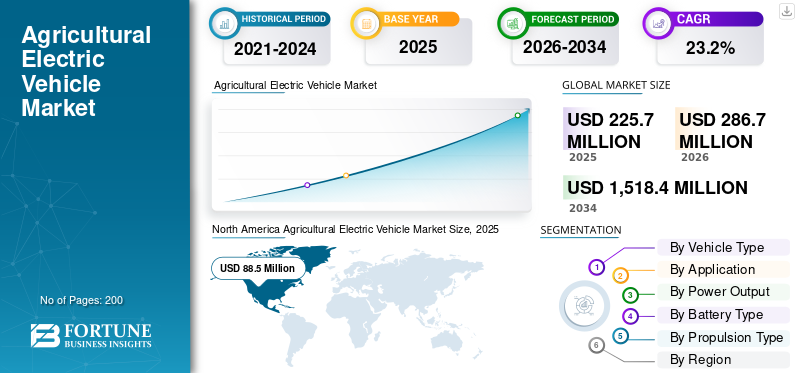
Download Free sample to learn more about this report.
Agricultural Electric Vehicle Market KEY TAKEAWAYS
 Global Market Size & Forecast
- 2025 Market Size: USD 225.7 million
- 2026 Market Size: USD 286.7 million
- 2034 Forecast Market Size: USD 1,518.4 million
- CAGR: 23.2% from 2026–2034
 Market Share
- North America dominated the market with a 39.21% share in 2025
- HV was the second-largest segment and is projected to grow at a 14.5% CAGR from 2026–2034.
- Other battery types are expected to grow fastest at a 28.1% CAGR from 2026–2034.
 Key Regional Highlights
Asia Pacific
Asia Pacific is the fastest-growing region, with a 24.1% CAGR from 2026–2034, driven by agricultural mechanization, electric mobility support, and declining battery costs.
North America
North America led the market with a 39.21% share in 2025, supported by strong farm mechanization, advanced technology adoption, and sustainable equipment investments.
Europe
Europe is the second-largest market, supported by strict environmental regulations, carbon-reduction targets, sustainable farming, and strong support for green technologies.
U.S.
The U.S. market is estimated at USD 92.6 million in 2026, accounting for 32.3% of global revenues, driven by farm mechanization and demand for low-emission equipment.
Japan
Japan is estimated at USD 8.2 million in 2026, accounting for 2.9% of global revenues, driven by advanced technologies, labor shortages, and demand for compact electric equipment.
Read More

AGRICULTURAL ELECTRIC VEHICLE MARKET TRENDS
Integration of Precision Agriculture Technologies in Electric Vehicles Boosts Market
Manufacturers are increasingly integrating GPS guidance, telematics, remote monitoring, autonomous navigation, and data analytics capabilities into agricultural electric vehicles. These technologies enable farmers to optimize field operations, improve resource utilization, and enhance productivity through real-time decision-making. Electric platforms are particularly suitable for digital integration due to their advanced electronic architectures. As precision agriculture becomes more widely adopted, demand is growing for connected electric vehicles that can seamlessly interact with farm management systems and support data-driven agricultural practices.
- In May 2026, ePropelled launched a fully integrated propulsion and power system for agricultural UAVs, combining motors, electronic speed controllers, and intelligent power management. The solution is designed to improve flight efficiency, payload capacity, reliability, and precision spraying performance, supporting the growing adoption of agricultural drones in precision farming and automated field operations across the globe.
Expansion of Autonomous and Smart Electric Farm Equipment Augments Market Development
The agricultural industry is witnessing growing market trends with smart farm vehicles capable of operating with minimal human intervention. Advances in artificial intelligence, machine vision, sensors, and machine learning are enabling electric agricultural equipment to perform tasks such as planting, spraying, and field monitoring autonomously. Farmers are increasingly exploring these solutions to improve productivity, reduce labor requirements, and enhance operational accuracy. This trend is encouraging manufacturers to accelerate innovation and expand their portfolios of intelligent electric agricultural machinery.
- In June 2025, Voltrac launched an autonomous electric tractor platform and secured USD 2.27 million in funding from FoodLabs and Antler. The software-defined vehicle integrates AI, per-wheel electric propulsion, and reinforcement learning, supporting advanced agricultural automation, operational efficiency, and adaptive performance across farming applications.
MARKET DYNAMICS
MARKET DRIVERS
Download Free sample to learn more about this report.
Rising Focus on Sustainable Farming and Emission Reduction Drives Market Growth
Governments, agricultural cooperatives, and farmers are increasingly prioritizing sustainable farming practices to reduce greenhouse gas emissions and dependence on fossil fuels. Agricultural electric vehicles offer a cleaner alternative to conventional diesel-powered equipment while helping farms meet environmental regulations and sustainability targets. Growing awareness of carbon footprint reduction, combined with incentives for low-emission agricultural machinery, is encouraging adoption. As agricultural stakeholders seek environmentally responsible solutions, market demand for electric tractors, utility vehicles, and farm transport equipment continues to rise globally.
- In November 2025, Carraro Group and Seederal announced a strategic partnership at Agritechnica 2025 to develop a next-generation, fully electric tractor. The collaboration combines Carraro’s driveline expertise with Seederal’s electric platform, supporting the development of a 160 HP electric tractor for sustainable and high-performance agricultural operations.
Growing Labor Shortages Accelerate Farm Mechanization, Generating Market Expansion
Agricultural sectors across many countries are facing persistent labor shortages due to urbanization, aging rural populations, and declining interest in manual farm work. Electric agricultural vehicles equipped with advanced automation and precision farming technologies help improve operational efficiency while reducing dependence on human labor. Farmers are increasingly investing in mechanized solutions that can perform repetitive tasks with greater consistency and lower operating costs. Increased shift toward technology-driven farming practices is fostering the agricultural electric vehicle market growth.
- In November 2022, Monarch Tractor received a USD 3 million grant from the California Energy Commission to advance autonomous electric farm equipment. Through the Farm Electrification Consortium, the company aims to develop battery-powered agricultural technologies, grid-connected charging stations, and autonomous tractors to improve sustainability, operational efficiency, and resilience against labor shortages and power disruptions.
MARKET RESTRAINTS
Limited Rural Charging Infrastructure Restricts Adoption
The limited availability of charging infrastructure remains a significant barrier to widespread deployment of agricultural electric vehicles, particularly in remote and rural farming regions. Many farms lack adequate electrical capacity or charging facilities required to support large-scale electric equipment operations. Long charging times compared to conventional refueling can also create operational challenges during peak agricultural seasons. While infrastructure investments are gradually increasing, limitations in charging accessibility and grid connectivity continue to slow adoption rates among farmers considering a transition to electric machinery.
MARKET OPPORTUNITIES
Government Incentives Encourage Agricultural Electrification Investments
Governments across the globe are introducing subsidies, tax benefits, low-interest financing programs, and sustainability initiatives to promote agricultural electrification. These supportive policies are reducing the initial investment burden associated with electric farm equipment and encouraging farmers to adopt cleaner technologies. In addition, national decarbonization strategies and rural development programs increasingly prioritize low-emission agricultural machinery. As financial support mechanisms expand across developed and emerging economies, manufacturers have substantial opportunities to increase market penetration and accelerate the commercialization of agricultural electric vehicles.
- In May 2025, Maharashtra introduced its EV Policy 2025, targeting 10% electric agricultural vehicle registrations by 2030 through purchase incentives, charging infrastructure expansion, tax exemptions, and local manufacturing support.
Advancements in Battery Technology Improve Equipment Performance & Market Growth
Continuous improvements in battery energy density, charging speed, durability, and lifecycle performance are creating significant opportunities for the market. Modern battery systems are enabling longer operating hours, improved reliability, and lower maintenance requirements compared to earlier generations of electric equipment. As battery costs decline and technological efficiency increases, electric agricultural vehicles are becoming more economically attractive for farmers. These developments are expected to expand the range of viable agricultural applications and support broader adoption across farming operations.
- In June 2026, BASF introduced Oppanol N PLUS, a high-performance binder for next-generation EV batteries, including solid-state batteries. The product enhances battery durability, production efficiency, and process reliability, supporting the advancement of high-performance electric mobility
MARKET CHALLENGES
High Initial Purchase Costs Limit Farmer Adoption for Electric Vehicles
Despite lower operating and maintenance expenses over time, agricultural electric vehicles often require significantly higher upfront investments than conventional diesel-powered alternatives. Small and medium-sized farms, particularly in developing regions, may face financial constraints that limit their ability to adopt electric machinery. Uncertainty regarding long-term return on investment, battery replacement costs, and resale values can further delay purchasing decisions. Addressing affordability concerns through financing solutions, economies of scale, and technology advancements remains a critical challenge for market participants.
Segmentation Analysis
By Propulsion Type
Rapid Integration of Precision Farming Technologies Boosted BEV Segment Growth
Based on propulsion type, the market is segmented into BEV and HV.
The BEV segment dominated the market in 2025 and is also projected to grow at the fastest CAGR over the forecast period. Growth is driven by increasing adoption of fully electric agricultural machinery as farmers seek to reduce fuel expenses, lower emissions, and comply with sustainability regulations. Government incentives supporting agricultural electrification, coupled with advancements in battery technology, longer operating ranges, and expanding product availability, are accelerating demand. Growing integration of precision farming technologies and autonomous capabilities further strengthens the adoption of battery-electric agricultural vehicles across commercial farming operations.
- In January 2026, John Deere unveiled a 130 hp fully electric E-Power Tractor prototype at Grüne Woche 2026. Featuring modular batteries and fast charging technology, the tractor supports low-emission agricultural operations, with a limited market launch planned for 2027 and full-scale production expected from 2028.
The HV segment represents the second-largest market category and is projected to grow at a CAGR of 14.5% during 2026-2034. Growth is supported by farmers seeking a gradual transition from conventional diesel equipment to electrified solutions. Hybrid vehicles offer improved fuel efficiency, operational flexibility, and reduced infrastructure dependence, making them attractive in regions with limited charging availability.
By Battery Type
Lithium-ion Batteries Led Market Due to Their Superior Energy Density & Longer Operating Life
Based on battery type, the market is segmented into lithium-ion batteries, lead-acid batteries, and other battery types.
The lithium-ion batteries segment dominated the market in 2025. Growth is driven by superior energy density, longer operating life, faster charging capabilities, and lower maintenance requirements compared to conventional battery technologies. Agricultural electric vehicle manufacturers increasingly prefer lithium-ion systems due to their ability to support extended field operations and advanced digital farming technologies. Declining battery costs, improving performance characteristics, and growing investments in battery manufacturing are further strengthening adoption across tractors, utility vehicles, and other agricultural electric equipment.
- In November 2023, AGCO and BMZ announced a strategic partnership and launched the Fendt e100 Vario Battery Electric Tractor. The collaboration combines advanced lithium-ion battery technology and precision farming capabilities to promote sustainable, low-emission, and high-performance agricultural operations across the globe.
Other battery types are projected to be the fastest-growing segment, registering a CAGR of 28.1% during 2026-2034. Growth is supported by ongoing research into alternative battery chemistries offering enhanced safety, sustainability, and performance advantages. Emerging technologies are attracting interest for specialized agricultural applications requiring improved durability, operational efficiency, and reduced environmental impact.
By Application
Rising Mechanization and Electrification of Field Operations Boosted Field Cultivation & Tillage Segment Growth
Based on application, the market is segmented into field cultivation & tillage, crop harvesting, material handling & transportation, spraying & crop protection, and livestock & dairy operations.
The field cultivation & tillage segment dominated the market in 2025. Growth is driven by the widespread use of tractors and utility vehicles for essential farming activities such as plowing, soil preparation, seeding, and land management. These operations account for a significant share of daily farm equipment utilization, creating strong demand for electric alternatives. Increasing focus on reducing fuel consumption, improving operational efficiency, and supporting sustainable farming practices is accelerating the adoption of electric vehicles in cultivation and tillage applications across commercial farms.
- In November 2025, VST Tillers Tractors unveiled its first EV Power Tiller and EV Power Weeder at EIMA Agrimach 2025. Developed in-house, the products expand VST’s electric farm machinery portfolio, supporting sustainable farming and reduced operating costs for small-scale agricultural operations.
Spraying & crop protection is projected to be the fastest-growing segment, registering a CAGR of 25.3% during 2026-2034. Growth is supported by increasing adoption of precision agriculture technologies, automated spraying systems, and electric utility vehicles for targeted chemical application. Farmers are prioritizing efficient crop protection methods that reduce input costs, improve accuracy, and support agricultural operations.
By Power Output
Increasing Adoption of Compact Electric Farm Equipment Boosted Below 50 HP Segment Growth
Based on power output, the market is segmented into below 50 HP, 50-100 HP, and above 100 HP.
The below 50 HP segment dominated the market in 2025 and is also projected to grow at the fastest-growing CAGR over the forecast period. Growth is driven by strong adoption among small and medium-sized farms that require compact, versatile, and cost-effective electric vehicles for routine agricultural operations. These vehicles are widely used for cultivation, transportation, spraying, and utility applications. Lower acquisition costs, easier charging requirements, and increasing availability of electric compact tractors are supporting demand, particularly in regions with fragmented landholdings and growing farm mechanization initiatives.
- In October 2025, Gromax Agri Equipment launched eight new Trakstar tractors, including India’s first factory-fitted cabin tractor in the sub-50 HP segment. The new models target specialized farming applications, improving operator comfort, productivity, and efficiency across diverse agricultural operations.
The 50-100 HP segment represents the second-largest market category and is projected to grow at a CAGR of 22.7% during 2026-2034. Growth is supported by rising demand for mid-range electric agricultural vehicles capable of handling diverse farming activities. These vehicles offer a balance between power, efficiency, and operational flexibility, making them suitable for commercial farms seeking higher productivity and reduced operating expenses.
By Vehicle Type
To know how our report can help streamline your business, Speak to Analyst
Expanding Adoption of Electric Tractors across Farming Operations Fueled Segment Growth
Based on vehicle type, the market is segmented into electric tractors, electric utility vehicles, electric all-terrain vehicles, electric harvesting equipment, and electric sprayers & other farm vehicles.
The electric tractors segment dominated the market in 2025 and is also projected to develop at the fastest-growing CAGR over the forecast period. Growth is driven by the central role tractors play in agricultural activities, including cultivation, tillage, hauling, planting, and general farm operations. Farmers are increasingly adopting electric tractors to reduce fuel expenses, lower emissions, and improve operational efficiency. Advancements in battery technology, supportive government incentives, and growing demand for sustainable farm machinery are further accelerating the deployment of electric tractors across both small-scale and commercial farming operations.
- In November 2022, Sonalika Tractors introduced the Tiger Electric, India’s field-ready electric tractor. Equipped with an electric drivetrain and fast-charging capability, the tractor offers lower operating costs, zero emissions, and enhanced efficiency, supporting sustainable and affordable farming practices.
The electric sprayers & other farm vehicles segment represents the second-fastest-growing category and is projected to grow at a CAGR of 23.9% during 2026-2034. Growth is supported by increasing adoption of precision agriculture practices, targeted crop protection methods, and specialized electric vehicles designed to improve efficiency, reduce operating costs, and support environmentally sustainable farming activities.
Agricultural Electric Vehicle Market Regional Outlook
By geography, the market is categorized into Europe, North America, Asia Pacific, South America, and the Middle East & Africa.
North America
North America Agricultural Electric Vehicle Market Size, 2025 (USD Million)
To get more information on the regional analysis of this market, Download Free sample
North America held the largest agricultural electric vehicle market share in 2025. Growth is supported by high levels of farm mechanization, strong adoption of advanced agricultural technologies, and increasing investments in sustainable farming equipment. The region benefits from favorable government programs promoting agricultural electrification and emission reduction initiatives. Large-scale commercial farms are actively adopting electric tractors, utility vehicles, and autonomous farming solutions to improve productivity and lower operating costs. Continuous technological innovation and robust charging infrastructure development further strengthen regional market leadership.
- In November 2025, AGCO Power unveiled a 150 kWh concept battery and next-generation electric tractor powertrain at Agritechnica 2025. Designed specifically for agricultural machinery, the solution supports lower operating costs, reduced maintenance, and the advancement of electric tractors for light-duty farming applications.
U.S. Agricultural Electric Vehicle Market
The U.S. market in 2026 is estimated at around USD 92.6 million, accounting for roughly 32.3% of global revenues. As the largest country market, growth is supported by extensive farm mechanization, strong technology adoption, increasing investments in precision agriculture, favorable incentive programs, and growing demand for low-emission farm equipment.
Europe
Europe is the second-largest market, driven by stringent environmental regulations, ambitious carbon reduction targets, and increasing adoption of sustainable agricultural practices. Farmers are investing in electric farm equipment to comply with emission standards while reducing fuel dependency. Strong support from the European Union for green technologies and rural modern agriculture programs is accelerating market expansion. The presence of leading agricultural machinery manufacturers and the rising demand for precision farming solutions further contribute to steady regional growth.
- In November 2025, John Deere showcased its fully battery-electric 130 hp E-Power tractor prototype at Agritechnica. Designed exclusively as an electric platform, the tractor features modular battery packs and supports low-emission agricultural operations, highlighting advances in electric farm machinery and sustainable farming technologies.
Germany Agricultural Electric Vehicle Market
The Germany market in 2026 is estimated at around USD 27.2 million, accounting for roughly 9.5% of global revenues. Growth is supported by strict emission regulations, strong adoption of sustainable farming practices, technological innovation, and the presence of leading agricultural machinery manufacturers investing in electrified equipment.
U.K. Agricultural Electric Vehicle Market
The U.K. market in 2026 is estimated at around USD 18.6 million, accounting for roughly 6.5% of global revenues. Growth is driven by decarbonization initiatives, increasing focus on sustainable agriculture, government support for clean technologies, and growing adoption of electric machinery among commercial farming operations.
Asia Pacific
Asia Pacific is the fastest-growing regional market and is projected to expand at a CAGR of 24.1% during 2026-2034. Growth is fueled by rapid agricultural mechanization, increasing government support for electric mobility, and rising demand for efficient farming equipment. Countries such as China, India, Japan, and South Korea are investing heavily in agricultural modernization and clean energy technologies. Expanding rural electrification, declining battery costs, and growing awareness of sustainable farming practices are creating favorable conditions for the widespread adoption of agricultural electric vehicles.
- In May 2026, SIIC IIT Kanpur, CSIR-CMERI, and NRDC signed a technology transfer agreement for India’s indigenous 100% electric compact tractor. The tractor features over 90% local content and Vehicle-to-Load functionality, supporting affordable mechanization, reduced diesel dependence, and sustainable farming for smallholder farmers.
China Agricultural Electric Vehicle Market
The China market in 2026 is estimated at around USD 23.4 million, accounting for roughly 8.2% of global revenues. Government electrification initiatives, strong domestic manufacturing capabilities, increasing agricultural mechanization, and widespread adoption of smart farming technologies across large-scale agricultural operations support growth.
Japan Agricultural Electric Vehicle Market
The Japan market in 2026 is estimated at around USD 8.2 million, accounting for roughly 2.9% of global revenues. Growth is driven by advanced agricultural technologies, labor shortages, demand for compact electric farm equipment, and increasing investments in automation solutions for high-efficiency farming operations.
India Agricultural Electric Vehicle Market
The India market in 2026 is estimated at around USD 25.2 million, accounting for roughly 8.8% of global revenues. As the fastest-growing country market, growth is fueled by rapid farm mechanization, supportive government programs, rising sustainability awareness, expanding rural electrification, and increasing demand for affordable electric agricultural machinery.
South America
South America represents the fourth-largest market. Market growth in the region is supported by the gradual modernization of farming operations and increasing awareness of sustainable agricultural practices. Large agricultural economies such as Brazil and Argentina are exploring electrified farm equipment to improve efficiency and reduce long-term operating expenses. Growing exports of agricultural products are encouraging investment in advanced farming technologies. Although adoption remains at an early stage compared to developed regions, improving access to technology and supportive sustainability initiatives are driving market expansion.
- In June 2026, Sany began testing its 652-horsepower electric 6×4 MTB 588SUPER truck in Brazilian sugarcane operations. Equipped with a 588 kWh battery and battery-swap capability, the vehicle supports heavy agricultural transport, advancing electrification and decarbonization efforts in agribusiness logistics.
Middle East & Africa
The Middle East & Africa region holds the least market share. Growth is primarily driven by increasing focus on food security, agricultural modernization, and sustainable resource management. Governments in selected countries are supporting investments in smart farming technologies to improve agricultural productivity under challenging climatic conditions. Rising interest in renewable energy integration and off-grid farming solutions is also creating opportunities for electric agricultural vehicles. However, infrastructure limitations and relatively low mechanization levels continue to moderate the pace of adoption.
- In May 2026, Zoomlion launched the DV3504 hybrid tractor in South Africa, claiming it as the country’s first commercially available hybrid tractor. The 350 hp model combines diesel and electric power systems, reducing fuel consumption by up to 30% while enhancing efficiency, precision farming capabilities, and sustainable agricultural operations.
COMPETITIVE LANDSCAPE
Key Industry Players
Battery Innovation, Autonomous Farming, and Precision Agriculture Integration Define Competitive Landscape
The market is fragmented, with established agricultural machinery manufacturers, emerging electric vehicle developers, and specialized agri-tech companies competing through battery innovation, autonomous capabilities, and precision farming integration. Key players such as Deere & Company, Monarch Tractor, Solectrac, AGCO (Fendt), Kubota Corporation, and Yanmar Holdings focus on expanding electric product portfolios and improving operational efficiency. To strengthen competitive positioning, companies are investing in smart farming technologies, strategic partnerships, and battery advancements. Product innovation, regional expansion, and technology collaborations remain central strategies for addressing evolving farmer requirements and accelerating agricultural electrification across the globe.
- In November 2024, John Deere partnered with Mississippi State University to advance automation technologies for cotton and other crops. The collaboration focuses on autonomous farming solutions aimed at improving labor efficiency, reducing operational costs, enhancing productivity, and supporting climate-resilient agricultural practices.
LIST OF KEY AGRICULTURAL ELECTRIC VEHICLE COMPANIES PROFILED
- Deere & Company (U.S.)
- AGCO Corporation (U.S.)
- Kubota Corporation (Japan)
- Yanmar Holdings Co., Ltd. (Japan)
- CNH Industrial N.V. (U.K.)
- Monarch Tractor (U.S.)
- Solectrac, Inc. (U.S.)
- Mahindra & Mahindra Ltd. (India)
- Escorts Kubota Limited (India)
- SDF Group (Italy)
- Alke S.r.l. (Italy)
- ONOX Group (Netherlands)
- Ztractor Inc. (U.S.)
- AutoNxt Automation Pvt. Ltd. (India)
KEY INDUSTRY DEVELOPMENTS
- March 2026: John Deere unveiled the 5M Series 5130M (130 HP) tractor in India at its Power & Technology Show. The tractor integrates precision agriculture technologies, connectivity solutions, and digital farming capabilities, supporting higher productivity, efficient resource utilization, and sustainable agricultural operations.
- January 2026: John Deere announced plans to launch autonomous battery-electric tractors in Australia, targeting horticulture and high-value crop production. The initiative supports lower emissions, reduced operating costs, autonomous farming capabilities, and broader adoption of sustainable agricultural machinery across the region.
- December 2025: German startup ONOX showcased its all-electric tractor prototype featuring modular swappable battery packs that can be exchanged in about five minutes. The concept aims to reduce downtime, support energy-autonomous farming, and advance sustainable agricultural machinery through innovative battery-swap technology and renewable energy integration.
- September 2024: Fendt introduced the fully electric e100 Vario tractor, designed for municipal, livestock, and vegetable farming applications. Featuring a 100 kWh battery, fast-charging capability, and emission-free operation, the tractor supports sustainable agriculture while reducing operating costs, maintenance requirements, and on-farm carbon emissions.
- November 2023: AGCO and BMZ announced a collaboration to develop and launch the Fendt e100 Vario Battery Electric Tractor. The partnership combines advanced battery technology and precision farming capabilities to enhance sustainability, reduce emissions, improve operational efficiency, and support the adoption of electric and autonomous agricultural equipment.
- December 2022: CNH Industrial unveiled the New Holland T4 Electric Power, the industry’s first all-electric light utility tractor prototype with autonomous features. The tractor delivers zero-emission operation, advanced automation capabilities, lower operating costs, and enhanced efficiency for mixed farming, livestock, orchard, and municipal applications.
- November 2022: Solectrac and Energica announced a technical collaboration to develop a new generation of electric tractors. The partnership focuses on advanced battery systems, vehicle control technology, and prototype development to improve operating efficiency, runtime, performance, and the adoption of sustainable agricultural machinery.
REPORT COVERAGE
The global agricultural electric vehicle market analysis provides an in-depth study of the market size & forecast by all the market segments included in the market report. It includes details on the market dynamics and trends expected to drive the market over the forecast period. It offers information on technological advancements, new product launches, key automotive industry developments, and details on partnerships, mergers, and acquisitions. The market report scope also encompasses a detailed competitive landscape with information on the market share and profiles of key operating players.
Request for Customization to gain extensive market insights.
Report Scope & Segmentation
| ATTRIBUTE | DETAILS |
| Study Period | 2021-2034 |
| Base Year | 2025 |
| Estimated Year | 2026 |
| Forecast Period | 2026-2034 |
| Historical Period | 2021-2024 |
| Growth Rate | CAGR of 23.2% from 2026 to 2034 |
| Unit |
Value (USD Million) Volume (Units) |
| Segmentation | By Vehicle Type, By Application, By Power Output, By Battery Type, By Propulsion Type, and By Region |
| By Vehicle Type |
|
| By Application |
|
| By Power Output |
|
| By Battery Type |
|
| By Propulsion Type |
|
| By Region |
|
Frequently Asked Questions
Fortune Business Insights says that the global market value stood at USD 225.7 million in 2025 and is projected to reach USD 1,518.4 million by 2034.
In 2025, the North America market value stood at USD 88.5 million.
The market is expected to exhibit a CAGR of 23.2% during the forecast period of 2026-2034.
The electric tractors segment led the market by vehicle type.
Rising focus on sustainable farming and emission reduction drives market growth.
Key players in the market include Deere & Company, Monarch Tractor, Solectrac, AGCO (Fendt), Kubota Corporation, and Yanmar Holdings.
North America held the largest market share in 2025.



- 2021-2034
- 2025
- 2021-2024
- 200
-
(Offer valid till 30th Sep 2026)
Get 30-60 hrs Free Customization
Expand Regional and Country Coverage, Segments Analysis, Company Profiles, Competitive Benchmarking, and End-user Insights.




















Related Reports
-
US +1 833 909 2966 ( Toll Free )
-
Get In Touch With Us