AI-Enabled Defense Manufacturing Equipment Market Size, Share & Industry Analysis, By Equipment Type (CNC Machines, 3D Printing, Robotics, Inspection Systems, and Others), By Application (Production Optimization, Predictive Maintenance, Quality Control & Inspection, Supply Chain Optimization, and Others), By End User (Aerospace & Defense OEMs, Defense Contractors, and Maintenance, Repair & Overhaul (MRO)), and Regional Forecast, 2026 – 2034
 Download Free Sample
AI-Enabled Defense Manufacturing Equipment Market Size and Future Outlook
 Listen to Audio Version
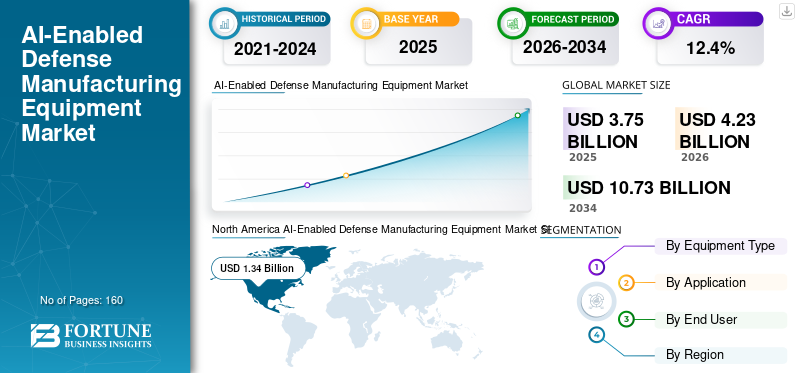
The global AI-enabled defense manufacturing equipment market size was valued at USD 3.75 billion in 2025. The market is projected to grow from USD 4.23 billion in 2026 to USD 10.73 billion by 2034, exhibiting a CAGR of 12.4% during the forecast period. North America dominated the AI-enabled defense manufacturing equipment market with a market share of 35.73% in 2025.
The market is witnessing steady expansion as defense manufacturers increasingly integrate advanced technologies to strengthen national security and enhance production capabilities within the defense industrial base. Growth is driven by the expanding application of AI across manufacturing processes, including the use of AI algorithms and computer vision to enable precision machining, real-time monitoring, and automated quality control. These technologies are improving efficiency, reducing errors, and supporting the production of complex defense systems.
Key players such as Lockheed Martin, Northrop Grumman, and General Dynamics are actively investing in AI-driven manufacturing technologies to enhance production capabilities and maintain competitive advantage. Over the long term, increasing focus on automation, digital manufacturing, and advanced analytics is expected to support sustained market growth.
Download Free sample to learn more about this report.
AI-Enabled Defense Manufacturing Equipment Market Key Takeaways
 Global Market Size & Forecast
- 2025 Market Size: USD 3.75 billion
- 2026 Market Size: USD 4.23 billion
- 2034 Forecast Market Size: USD 10.73 billion
- CAGR: 12.4% from 2026–2034
 Market Share
- North America dominated the AI-enabled defense manufacturing equipment market with a 35.73% share in 2025.
- CNC machines held the largest share by equipment type in 2025 due to high-precision defense manufacturing needs.
- Production optimization accounted for the leading application segment share in 2025.
 Key Regional Highlights
North America
North America reached USD 1.34 billion in 2025, driven by strong defense spending and advanced manufacturing infrastructure.
Asia Pacific
Asia Pacific is projected to reach USD 1.06 billion in 2026, supported by rising defense budgets and manufacturing expansion.
Europe
Europe is estimated to reach USD 1.10 billion in 2026, supported by defense modernization and automation adoption.
U.S.
The U.S. market is estimated at around USD 1.30 billion in 2026, driven by defense modernization initiatives and AI adoption.
Japan
The Japanese market is estimated at around USD 0.14 billion in 2026, accounting for approximately 3.4% of global revenue.
Read More

AI-ENABLED DEFENSE MANUFACTURING EQUIPMENT MARKET TRENDS
Integration of Artificial Intelligence into Manufacturing Systems is Enhancing Precision and Operational Efficiency
The market is witnessing a growing trend toward the integration of artificial intelligence into manufacturing equipment to improve precision, efficiency, and decision-making. AI-enabled systems allow real-time monitoring, predictive analytics, and automated adjustments in production processes, significantly reducing errors and downtime. These capabilities are particularly critical in defense manufacturing, where high accuracy and reliability are essential. Additionally, the integration of machine learning and data analytics is enabling manufacturers to optimize workflows, improve resource utilization, and enhance overall productivity, driving widespread adoption of AI-enabled manufacturing equipment.
- For instance, defense companies such as Lockheed Martin are investing in AI-driven manufacturing solutions to enhance production efficiency and maintain high-quality standards in aerospace and defense systems.
MARKET DYNAMICS
MARKET DRIVERS
Download Free sample to learn more about this report.
Rising Defense Modernization and Need for Advanced Manufacturing Efficiency are Driving Market Growth
The increasing focus on defense modernization and the need to improve manufacturing efficiency are key drivers of the market. Governments across the globe are investing in advanced defense technologies, which require high-precision manufacturing processes supported by AI-enabled equipment. These systems enable automation, real-time monitoring, and optimized production workflows, helping manufacturers reduce costs and improve output quality. Additionally, the growing complexity of defense systems is driving the adoption of advanced manufacturing solutions capable of meeting stringent performance and quality requirements.
- For example, the U.S. Department of Defense continues to invest in advanced manufacturing technologies, including AI and automation, to strengthen defense production capabilities.
MARKET RESTRAINTS
High Implementation Costs and Integration Challenges are Limiting Adoption
Despite strong growth potential, the market faces challenges due to the high cost associated with implementing AI-enabled manufacturing equipment. Integration of AI systems into existing production lines requires significant investment, technical expertise, and infrastructure upgrades. Additionally, concerns related to data security, interoperability, and system reliability can further limit adoption, particularly among smaller contractors. These challenges may slow down the pace of implementation in certain regions and organizations.
MARKET OPPORTUNITIES
Advancements in Digital Manufacturing and Automation are Creating Long-Term Growth Opportunities
The increasing adoption of digital manufacturing and automation technologies is creating significant opportunities for the market. AI-enabled systems are enabling manufacturers to optimize production processes, improve quality control, and enhance predictive maintenance capabilities. These advancements are particularly valuable in defense manufacturing, where precision and reliability are critical. Furthermore, increasing investments in smart factories and Industry 4.0 technologies are supporting the development of advanced manufacturing solutions, driving long-term AI-enabled defense manufacturing equipment market growth.
- For instance, aerospace and defense manufacturers are increasingly adopting digital twin and AI-based production systems to enhance manufacturing efficiency and product quality.
Segmentation Analysis
By Equipment Type
CNC Machines Segment Held Largest Share Due to High Precision Requirements in Defense Manufacturing
Based on equipment type, the market is divided into CNC machines, 3D printing, robotics, inspection systems, and others.
In 2025, the CNC machines segment accounted for the highest AI-enabled defense manufacturing equipment market share due to their critical role in producing high-precision components required in defense applications. CNC machines offer superior accuracy, repeatability, and efficiency, making them essential for manufacturing complex aerospace and defense parts. The integration of AI technologies further enhances their capabilities by enabling predictive maintenance, process optimization, and real-time performance monitoring. Increasing demand for advanced defense systems is further driving adoption of AI-enabled CNC machines.
- For example, defense manufacturers are increasingly integrating AI into CNC machining processes to improve precision and reduce production time.
The 3D printing segment is anticipated to rise with a CAGR of 13.1% over the forecast period.
To know how our report can help streamline your business, Speak to Analyst
By Application
Production Optimization Segment Held Largest Share as it Directly Impacts Manufacturing Efficiency, Cost Reduction, and Output Quality
Based on application, the market is segmented into production optimization, predictive maintenance, quality control & inspection, supply chain optimization, and others.
In 2025, the production optimization segment accounted for the highest market share as it directly impacts manufacturing efficiency, cost reduction, and output quality. AI-enabled systems allow real-time monitoring and adjustment of production processes, enabling manufacturers to optimize workflows and reduce downtime. This is particularly important in defense manufacturing, where efficiency and precision are critical. The increasing adoption of data-driven manufacturing practices is further supporting growth in this segment.
The predictive maintenance segment is expected to grow at a CAGR of 13.0% over the forecast period.
By End User
Aerospace & Defense OEMs Segment Held Largest Share Due to High Demand for Advanced Manufacturing Capabilities
Based on end user, the market is segmented into aerospace & defense OEMs, defense contractors, and maintenance, repair & overhaul (MRO).
In 2025, the aerospace & defense OEMs segment accounted for the highest market share due to their direct involvement in manufacturing complex defense systems and components. These organizations require advanced manufacturing equipment to meet stringent quality, performance, and regulatory standards. The adoption of AI-enabled systems helps OEMs improve production efficiency, reduce errors, and enhance product quality. Additionally, increasing investments in defense programs are further driving demand for advanced manufacturing solutions in this segment.
The Maintenance, Repair & Overhaul (MRO) segment is expected to grow at a CAGR of 13.0% over the forecast period.
AI-Enabled Defense Manufacturing Equipment Market Regional Outlook
By geography, the market is categorized into Europe, North America, Asia Pacific, South America, and the Middle East & Africa.
North America
North America AI-Enabled Defense Manufacturing Equipment Market Size, 2025 (USD Billion)
To get more information on the regional analysis of this market, Download Free sample
North America held the dominant position in the market in 2024 and continued to lead in 2025, with a market valuation of USD 1.34 billion. The growth is driven by strong defense spending, advanced manufacturing infrastructure, and early adoption of AI technologies. The region benefits from the presence of major defense contractors and OEMs investing in AI-enabled manufacturing solutions to enhance efficiency and innovation.
U.S. AI-Enabled Defense Manufacturing Equipment Market
The U.S. market is estimated at around USD 1.30 billion in 2026, driven by significant investments in defense modernization and advanced manufacturing technologies. The adoption of AI-enabled equipment is increasing as manufacturers focus on improving production efficiency, precision, and operational capabilities.
Europe
Europe market is estimated at around USD 1.10 billion in 2026. Europe demonstrates steady growth supported by increasing defense investments and adoption of advanced manufacturing technologies. Countries are focusing on enhancing defense production capabilities through automation and digitalization.
U.K. AI-Enabled Defense Manufacturing Equipment Market
The U.K. market is estimated at around USD 0.18 billion in 2026, representing roughly 4.3% of global revenues.
Germany AI-Enabled Defense Manufacturing Equipment Market
Germany’s market is projected to reach USD 0.28 billion in 2026, equivalent to around 6.5% of global sales.
Asia Pacific
Asia Pacific’s market is projected to reach USD 1.06 billion in 2026. Asia Pacific is witnessing growing adoption driven by increasing defense budgets and expanding manufacturing capabilities across China, India, and Japan.
Japan AI-Enabled Defense Manufacturing Equipment Market
The Japanese market is estimated at around USD 0.14 billion in 2026, accounting for roughly 3.4% of global revenue.
China AI-Enabled Defense Manufacturing Equipment Market
The Chinese market is estimated at around USD 0.41 billion in 2026, accounting for roughly 9.7% of global revenue.
India AI-Enabled Defense Manufacturing Equipment Market
The Indian market is estimated at around USD 0.18 billion in 2026, accounting for roughly 4.1% of global market.
South America and Middle East & Africa
South America and the Middle East & Africa are anticipated to experience moderate growth in this market over the forecast period. South America is projected to reach a market value of USD 0.21 billion by 2026, with growth supported by rising defense investments and ongoing modernization initiatives. Meanwhile, the Middle East & Africa market is expected to attain a value of USD 0.35 billion by 2026, driven by increasing defense expenditure and a growing emphasis on enhancing manufacturing capabilities.
GCC AI-Enabled Defense Manufacturing Equipment Market
The GCC market is projected to reach around USD 0.18 billion in 2026, representing roughly 4.2% of global market.
COMPETITIVE LANDSCAPE
Key Industry Players
Key Industry Players Focus on AI Integration and Advanced Manufacturing Technologies to Strengthen Market Position
The AI-enabled defense manufacturing equipment market is moderately competitive, with key players focusing on integrating artificial intelligence, automation, and digital manufacturing technologies into production systems. Companies such as Lockheed Martin, Northrop Grumman, Raytheon Technologies, and General Dynamics are investing in advanced manufacturing capabilities to enhance efficiency, precision, and scalability. Market participants are also emphasizing innovation, strategic partnerships, and digital transformation to strengthen their market position. Increasing focus on smart manufacturing and data-driven operations is further driving competition in the market.
LIST OF KEY AI-ENABLED DEFENSE MANUFACTURING EQUIPMENT COMPANIES PROFILED IN REPORT
- Lockheed Martin Corporation (U.S.)
- Northrop Grumman Corporation (U.S.)
- General Dynamics Corporation (U.S.)
- Raytheon Technologies Corporation (U.S.)
- BAE Systems plc (U.K.)
- L3Harris Technologies, Inc. (U.S.)
- Leonardo S.p.A. (Italy)
- Thales Group (France)
- Saab AB (Sweden)
- Rheinmetall AG (Germany)
KEY INDUSTRY DEVELOPMENTS
- April 2026: Autonomous Resource Corporation partnered with Oak Ridge National Laboratory to launch the “Exascale Foundry”, combining AI-driven distributed manufacturing with high-performance computing to enable autonomous, large-scale defense manufacturing systems.
- March 2026: Krafton partnered with Hanwha Aerospace with a planned investment of up to USD 1 billion to develop “physical AI” technologies for defense manufacturing and autonomous systems production.
- December 2025: JSW Group partnered with Shield AI to invest USD 90 million in a drone manufacturing facility in India, enabling local production of AI-enabled unmanned aerial systems (V-BAT drones) through technology transfer.
- November 2025: Palladyne AI acquired GuideTech, Warnke Precision Machining, and MKR Fabricators to form Palladyne Defense, integrating embodied AI, avionics, and precision manufacturing into a vertically integrated defense production platform.
- September 2025: Altair announced AI-powered engineering and smart manufacturing solutions for defense applications at DSEI 2025, focusing on computational intelligence and connected manufacturing systems.
REPORT COVERAGE
The global AI-enabled defense manufacturing equipment market analysis includes a comprehensive study of the market size & forecast by all the market segments included in the report. It includes details on the market dynamics and market trends expected to drive the market over the forecast period. It provides information on key aspects, including an overview of technological advancements, pipeline candidates, the regulatory environment, and product launches. Additionally, it details partnerships, mergers & acquisitions, as well as key industry developments and prevalence by key regions. The global market research report also provides a depth competitive landscape with information on the market share and profiles of key operating players.
Request for Customization to gain extensive market insights.
Report Scope & Segmentation
| ATTRIBUTE | DETAILS |
| Study Period | 2021-2034 |
| Base Year | 2025 |
| Estimated Year | 2026 |
| Forecast Period | 2026-2034 |
| Historical Period | 2021-2024 |
| Growth Rate | CAGR of 12.4% from 2026-2034 |
| Unit | Value (USD Billion) |
| Segmentation | By Equipment Type, Application, End User, and Region |
| By Equipment Type |
|
| By Application |
|
| By End User |
|
| By Region |
|
Frequently Asked Questions
According to Fortune Business Insights, the global market value stood at USD 3.75 billion in 2025 and is projected to reach USD 10.73 billion by 2034.
In 2025, the North America’s market value stood at USD 1.34 billion.
The market is expected to exhibit a CAGR of 12.4% during the forecast period of 2026-2034.
By end user, the aerospace & defense OEMs segment led the market.
The market is driven by increasing defense modernization efforts and the growing need for advanced, AI-enabled manufacturing systems to improve production efficiency and precision.
Lockheed Martin, Northrop Grumman, Raytheon Technologies, and General Dynamics are the top players in the global market.
North America held the largest market share in 2025.



- 2021-2034
- 2025
- 2021-2024
- 160
Get 30-60 hrs Free Customization
Expand Regional and Country Coverage, Segments Analysis, Company Profiles, Competitive Benchmarking, and End-user Insights.















Related Reports
-
US +1 833 909 2966 ( Toll Free )
-
Get In Touch With Us