Off-highway Vehicle Engine Market Size, Share & Industry Analysis, By Power Output (Below 100 HP, 101–300 HP, and Above 300 HP), By Fuel Type (Diesel and Gasoline), By Cooling Type (Air-Cooled Engines and Water-Cooled Engines), By Vehicle Type (Construction Equipment, Agricultural Equipment, Mining Equipment, and Others), and Regional Forecast, 2026–2034
 Download Free Sample
(Offer valid till 30th Sep 2026)

Off-Highway Vehicle Engine Market Size and Future Outlook
 Listen to Audio Version
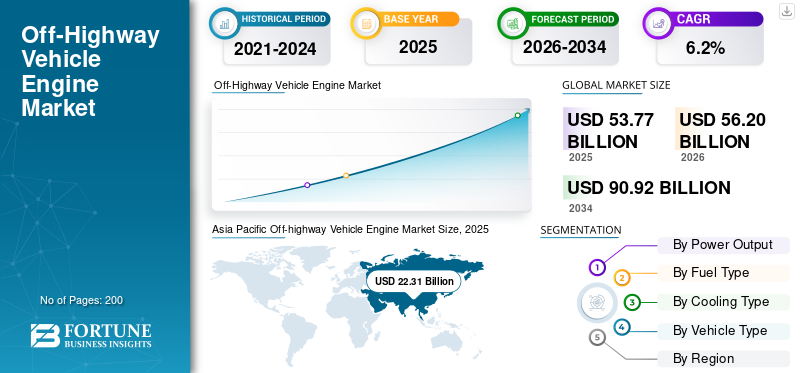
The off-highway vehicle engine market size was valued at USD 53.77 billion in 2025. The market is projected to grow from USD 56.20 billion in 2026 to USD 90.92 billion by 2034, exhibiting a CAGR of 6.2% during the forecast period. Asia Pacific dominated the off-highway vehicle engine market with a market share of 41.49% in 2025.
The market refers to the industry focused on engines used in heavy duty vehicles operating outside public road networks, including construction, mining, agriculture, forestry, and industrial equipment. These engines power tractors, excavators, loaders, bulldozers, harvesters, and haul trucks. The market growth is driven by infrastructure development, mechanized farming, mining activities, emission regulations, and demand for fuel-efficient, durable, and high-performance diesel, gasoline, and alternative-fuel engines.
Key drivers of the market include rising construction and infrastructure activities, increasing mechanization in agriculture, and growing mining and industrial operations. Demand for high-power, fuel efficient, and durable engines is increasing across heavy-duty applications. Stricter emission regulations, adoption of advanced diesel engines, hybrid powertrains, and telematics-enabled engine monitoring further support market growth.
Key players in the market include Cummins Inc., Caterpillar Inc., Deere & Company, Kubota Corporation, Volvo Penta, Deutz AG, Yanmar Holdings Co., Ltd., and Perkins Engines Company Limited., competing through fuel-efficient engine platforms, low-emission technologies, electrification-ready solutions, telematics integration, and durable power systems for construction, agriculture, mining, and industrial off-road applications.
Download Free sample to learn more about this report.
OFF-HIGHWAY VEHICLE ENGINE MARKET TRENDS
Integration of Telematics and Smart Engine Management is Emerging Market Trends
A major trend in the market is the integration of telematics, sensors, and smart engine management systems. Modern engines are increasingly equipped with electronic control modules that monitor fuel consumption, temperature, load conditions, emissions, operating hours, and maintenance requirements in real time. This data helps fleet operators reduce downtime, improve preventive maintenance planning, and optimize equipment utilization. In mining, construction, and large-scale farming, connected engine platforms support remote diagnostics and performance tracking across dispersed fleets. Manufacturers are also using digital platforms to offer predictive maintenance, software updates, and lifecycle service support. This trend is shifting engine value from basic power generation toward intelligent, data-driven performance management and operational efficiency.
MARKET DYNAMICS
MARKET DRIVERS
Download Free sample to learn more about this report.
Rising Infrastructure Development and Mechanized Agriculture to Drive Market Growth
The off-highway vehicle engine market growth is primarily driven by increasing infrastructure development, mining activities, and agricultural mechanization across developed and emerging economies. Governments are investing heavily in roads, bridges, railways, smart cities, irrigation projects, and industrial zones, which is raising demand for construction and earthmoving equipment such as excavators, loaders, bulldozers, and graders. These machines require durable, high-torque engines capable of operating in harsh environments. In agriculture, the shift from manual labor to mechanized farming is increasing the adoption of tractors, harvesters, sprayers, and other off-road equipment. As productivity, fuel efficiency, and operational reliability become key priorities, demand for advanced off-highway engines with improved power output and emission performance continues to grow.
MARKET RESTRAINTS
Stringent Emission Regulations and High Development Costs to Restrain Market Expansion
The market faces restraint from increasingly strict emission regulations and the high cost of developing compliant engine technologies. Off-highway engines used in construction, agriculture, and mining equipment must meet evolving standards related to particulate matter, nitrogen oxides, and fuel efficiency. Compliance often requires advanced after-treatment systems, electronic control units, exhaust gas recirculation, selective catalytic reduction, and cleaner combustion technologies. These additions increase engine manufacturing costs, maintenance complexity, and final equipment prices. Smaller equipment manufacturers and price-sensitive end users may delay fleet upgrades due to higher ownership costs. In developing regions, limited access to ultra-low-sulfur fuel and skilled maintenance support can further slow adoption of advanced engines, restricting market expansion despite steady demand for off-road machinery.
MARKET OPPORTUNITIES
Adoption of Alternative Fuel and Hybrid Powertrains to Create Market Growth Opportunities
The growing focus on sustainability, fuel efficiency, and carbon reduction is creating strong opportunities for alternative fuel and hybrid off-highway vehicle engines. Manufacturers are increasingly exploring engines compatible with biodiesel, renewable diesel, hydrogen, natural gas, and hybrid-electric systems to reduce emissions without compromising heavy-duty performance. Construction, mining, agriculture, and port operations are seeking cleaner equipment solutions to meet corporate sustainability targets and regulatory requirements. Hybrid engines can improve fuel economy, support load optimization, and reduce idle-time emissions, especially in applications with variable duty cycles. As battery technology, charging infrastructure, and fuel availability improve, engine manufacturers can expand their portfolios with flexible powertrain solutions that bridge the gap between conventional diesel engines and fully electric off-highway equipment.
MARKET CHALLENGES
Balancing Performance, Emissions Compliance, and Cost Efficiency to Challenge Manufacturers
One of the key challenges in the market is balancing high performance, regulatory compliance, and cost efficiency. Off-road machinery often operates under extreme load, dust, vibration, temperature variation, and long working hours, requiring engines with strong durability and torque output. Similarly, manufacturers must reduce emissions and improve fuel efficiency without making engines overly expensive or complex to maintain. End users in agriculture, construction, and mining expect reliable engines with low downtime and affordable service requirements. Meeting these expectations while integrating advanced emission control systems, digital monitoring, and alternative fuel compatibility is technically demanding. This challenge is especially significant in price-sensitive regions where buyers prioritize lifecycle cost and ease of maintenance.
Segmentation Analysis
By Power Output
Balanced Power Delivery and Broad Equipment Use to Propel 101-300 HP Segmental Dominance
Based on power output, the market is categorized into below 100 HP, 101-300 HP, and above 300 HP.
The 101-300 HP segment held the highest off-highway vehicle engine market share due to its wide use across construction, agriculture, material handling, and medium-duty mining equipment. Engines in this range provide an optimal balance of power, fuel efficiency, durability, and operating cost, making them suitable for tractors, excavators, loaders, graders, and harvesters. Strong demand from infrastructure projects and mechanized farming continues to support steady adoption across developed and emerging economies.
The above 300 HP segment is projected to expand at a CAGR of 7.2% over the forecast period. The segment growth is driven by rising demand for high-capacity engines in heavy mining trucks, large excavators, bulldozers, and large-scale construction equipment requiring superior torque and continuous-duty performance.
To know how our report can help streamline your business, Speak to Analyst
By Fuel Type
Superior Torque Output and Heavy-Duty Reliability to Propel Diesel Segmental Dominance
Based on fuel type segmentation, the market is categorized into diesel and gasoline.
The diesel segment dominates the market due to its high torque output, fuel efficiency, durability, and suitability for continuous heavy-duty operations. Diesel engines are widely used in construction equipment, agricultural machinery, mining vehicles, loaders, tractors, excavators, and haul trucks where strong pulling power and long operating hours are essential. Their established fueling infrastructure, proven reliability, and ability to perform under harsh off-road conditions continue to support strong segment adoption.
The gasoline segment is projected to expand at a CAGR of 7.2% over the forecast period. This growth is driven by demand for lighter off-highway equipment, compact utility vehicles, and small agricultural machinery requiring lower upfront cost, easier maintenance, and flexible operation.
By Cooling Type
Efficient Thermal Management and Heavy-Duty Suitability to Propel Water-Cooled Engines Segment Dominance
Based on cooling type segmentation, the market is categorized into air-cooled engines and water-cooled engines.
The water-cooled engines segment dominates the market due to its superior heat control, stable performance, and suitability for high-load operations. These engines are widely used in construction, mining, and agricultural machinery where equipment operates for long hours under demanding conditions. Water-cooled systems help maintain optimal engine temperature, improve durability, reduce overheating risks, and support higher power output, making them preferred for excavators, tractors, loaders, bulldozers, and haul trucks.
The air-cooled engines segment is projected to expand at a CAGR of 4.7% over the forecast period. This growth is supported by demand for compact, low-maintenance engines in small agricultural equipment, utility vehicles, and light-duty off-highway applications.
By Vehicle Type
Rising Infrastructure Projects and Equipment Utilization Drives Construction Equipment Dominance
Based on vehicle type segmentation, the market is categorized into construction equipment, agricultural equipment, mining equipment, and others.
The construction equipment segment dominates the global market due to strong demand from infrastructure development, urbanization, road construction, commercial buildings, and industrial projects. Equipment such as excavators, loaders, bulldozers, graders, and compactors require durable engines with high torque, fuel efficiency, and long operating life. Continuous fleet usage across public and private construction projects supports replacement demand and adoption of advanced engines with improved emission performance and productivity.
The mining equipment segment is projected to expand at a CAGR of 6.6% over the forecast period. This is due to rising mineral extraction, demand for high-capacity haul trucks and excavators, and increasing use of powerful engines in continuous heavy-load mining operations.
Off-Highway Vehicle Engine Market Regional Outlook
By geography, the market is categorized into Europe, North America, Asia Pacific, Latin America, and Middle East & Africa.
Asia Pacific
Asia Pacific Off-highway Vehicle Engine Market Size, 2025 (USD Billion)
To get more information on the regional analysis of this market, Download Free sample
Asia Pacific dominates the market due to rapid infrastructure expansion, large-scale agricultural mechanization, and strong mining activity across Japan, Southeast Asia, China, and India. Rising investments in roads, railways, ports, urban construction, and industrial zones are increasing demand for construction equipment powered by durable engines. The region also has a large agricultural base, supporting tractor and harvester engine demand. Cost-effective manufacturing, growing domestic equipment production, and expanding replacement needs further strengthen the Asia Pacific’s leading market position.
China Off-Highway Vehicle Engine Market
The China market in 2026 is estimated at around USD 11.31 billion, driven by construction activity, agricultural mechanization, mining expansion, domestic equipment production, and demand for cost-effective, fuel-efficient engines.
North America
North America holds the second-largest market share and is projected to grow at a CAGR of 6.0% over the forecast period. This growth is supported by strong demand for construction, agriculture, and mining equipment across the U.S. and Canada. Ongoing infrastructure modernization, residential and commercial construction, and mechanized farming sustain engine adoption. The region also benefits from advanced emission-compliant engines, fleet replacement activities, and rising use of telematics-enabled equipment, which improves productivity, maintenance planning, and fuel efficiency across off-highway applications.
U.S. Off-Highway Vehicle Engine Market
The U.S. market in 2026 is estimated at around USD 12.14 billion, supported by infrastructure investment, mining operations, large-scale agriculture, and steady replacement demand for durable, high-torque engines.
Europe
Europe represents the third-largest market, supported by mature agriculture, industrial equipment, and construction sectors. Countries such as Germany, France, the U.K., Italy, and Spain have a strong demand for efficient and low-emission engines used in tractors, loaders, excavators, and material handling equipment. Strict emission regulations encourage the adoption of advanced diesel, hybrid, and alternative-fuel engines. Although market growth is moderate, equipment replacement, sustainability targets, and technology upgrades continue to support regional demand.
U.K. Off-Highway Vehicle Engine Market
The U.K. market in 2026 is estimated at around USD 2.72 billion, supported by construction redevelopment, agricultural equipment replacement, infrastructure modernization, and growing adoption of low-emission engines across off-road machinery fleets.
Germany Off-Highway Vehicle Engine Market
The Germany market in 2026 is estimated at around USD 1.61 billion, driven by advanced engineering, strong construction equipment manufacturing, farm mechanization, and demand for high-performance engines meeting strict emission standards.
Middle East & Africa
The Middle East & Africa market is growing steadily due to increasing construction, mining, oil & gas, and infrastructure development activities. Gulf countries are investing in roads, airports, smart cities, ports, and industrial projects, creating demand for heavy-duty construction equipment engines. In Africa, mining operations and agricultural mechanization are supporting the adoption of off-highway machinery. Demand is strongest for durable engines capable of operating in harsh climates, dusty environments, and remote locations where reliability and low downtime are critical.
UAE Off-Highway Vehicle Engine Market
The UAE market in 2026 is estimated at around USD 0.75 billion, supported by smart city projects, road development, construction megaprojects, logistics infrastructure, and demand for reliable engines in harsh operating conditions.
Latin America
Latin America is witnessing gradual growth in the market, driven by agriculture, mining, construction, and infrastructure development across Brazil, Mexico, Chile, and Argentina. The region’s large farming sector supports demand for tractors, harvesters, and other agricultural machinery engines. Mining activities also increase the need for high-power engines in haul trucks, loaders, and excavators. Economic fluctuations and equipment cost sensitivity may limit faster adoption, but replacement demand and mechanization trends continue to create growth opportunities.
Brazil Off-Highway Vehicle Engine Market
The Brazil market in 2026 is estimated at around USD 1.52 billion, driven by agricultural mechanization, mining activity, infrastructure development, and increasing demand for tractors, harvesters, loaders, and excavators.
COMPETITIVE LANDSCAPE
Key Industry Players
Fuel Efficiency, Emission Compliance, and OEM Partnerships Shape Market Competitive Landscape
The off-highway vehicle engine market is moderately consolidated, with leading players focusing on fuel efficiency, emission compliance, durability, and application-specific engine development. Companies compete through broad engine portfolios serving construction, agriculture, mining, and industrial equipment applications. These players are investing in advanced diesel platforms, electronic engine controls, after-treatment systems, and hybrid-ready technologies to meet evolving regulatory standards while improving performance and lifecycle value for equipment manufacturers and fleet operators.
Competition is increasingly shaped by technological innovation, regional expansion, and partnerships with OEMs. Major manufacturers are strengthening their presence in high-growth regions such as Asia Pacific and Latin America, where infrastructure development and agricultural mechanization are increasing equipment demand. Companies are also emphasizing telematics, predictive maintenance, alternative fuel compatibility, and lower-emission engine solutions to differentiate their offerings. Aftermarket service networks, spare parts availability, and customized engine solutions remain key competitive factors, as end users prioritize reliability, uptime, fuel economy, and lower total cost of ownership.
LIST OF KEY OFF-HIGHWAY VEHICLE ENGINE COMPANIES PROFILED
- Cummins Inc. (U.S.)
- Caterpillar Inc. (U.S.)
- Deere & Company (U.S.)
- Kubota Corporation (Japan)
- Yanmar Holdings Co., Ltd. (Japan)
- DEUTZ AG (Germany)
- Volvo Penta (Sweden)
- Perkins Engines Company Limited (U.K.)
- FPT Industrial (Italy)
- MAN Engines (Germany)
- Kohler Co. (U.S.)
- Weichai Power Co., Ltd. (China)
- Doosan Infracore Co., Ltd. (South Korea)
- Isuzu Motors Limited (Japan)
- Mitsubishi Heavy Industries Engine & Turbocharger, Ltd. (Japan)
KEY INDUSTRY DEVELOPMENTS
- February 2026: Cummins announced it would display its 3.8L Power Unit, B6.7, and Next Gen X15 Off-Highway engines at CONEXPO-CON/AGG 2026, targeting small, medium, and large construction machinery applications.
- November 2025: Cummins received POWERTRAIN International’s 2026 Alternative Engine of the Year award for its X15 Off-Highway engine and started limited production of the F4.5 Structural tractor engine at Agritechnica.
- February 2025: Volvo Penta announced its bauma 2025 showcase, highlighting battery-electric platforms, BESS subsystems, electric drivelines, and combustion engine solutions for construction and mining equipment applications.
- November 2024: DEUTZ joined a consortium to develop hydrogen engines for off-highway applications, with Germany’s Federal Ministry for Economic Affairs and Climate Protection providing USD 5.82 million in funding.
- May 2024: Volvo Penta presented modular off-highway electric driveline technologies at TOC Europe, highlighting electrification opportunities for port handling, container logistics, and industrial off-road vehicle applications.
- April 2024: Cummins launched its Next Generation X15 Off-Highway diesel engine at Intermat 2024 in Paris, targeting construction, agriculture, and industrial equipment with improved power density and efficiency.
- January 2024: Caterpillar launched a three-year U.S. Department of Energy-backed project to demonstrate a hydrogen-hybrid power solution using its Cat C13D engine platform for off-highway equipment, with OEM pilots planned in 2025 and production scheduled for 2026.
REPORT COVERAGE
The off-highway vehicle engine market analysis provides an in-depth study of market size and forecast by all the segments included in the report. It includes details on the market dynamics and trends expected to drive the market during the forecast period. It offers information on the technological advancements, new product launches, key industry developments, and details on partnerships, mergers & acquisitions. The market research report also encompasses a detailed competitive landscape, including market share and profiles of key operating players.
Request for Customization to gain extensive market insights.
Report Scope & Segmentation
| ATTRIBUTE | DETAILS |
| Study Period | 2021-2034 |
| Base Year | 2025 |
| Estimated Year | 2026 |
| Forecast Period | 2026-2034 |
| Historical Period | 2021-2024 |
| Growth Rate | CAGR of 6.2% from 2026-2034 |
| Unit | Value (USD Billion) |
| Segmentation | By Power Output, By Fuel Type, By Cooling Type , By Vehicle Type, and By Region |
| By Power Output |
|
| By Fuel Type |
|
| By Cooling Type |
|
| By Vehicle Type |
|
| By Geography |
|
Frequently Asked Questions
Fortune Business Insights says that the global market value stood at USD 53.77 billion in 2025 and is projected to reach USD 90.92 billion by 2034.
In 2025, the Asia Pacific market value stood at USD 22.31 billion.
The market is expected to exhibit a CAGR of 6.2% during the forecast period of 2026-2034.
The market is expected to exhibit a CAGR of 6.2% during the forecast period of 2026-2034.
Rising infrastructure development and mechanized agriculture to drive market growth.
Asia Pacific held the largest share in the market.



- 2021-2034
- 2025
- 2021-2024
- 200
-
(Offer valid till 30th Sep 2026)
Get 30-60 hrs Free Customization
Expand Regional and Country Coverage, Segments Analysis, Company Profiles, Competitive Benchmarking, and End-user Insights.




















Related Reports
-
US +1 833 909 2966 ( Toll Free )
-
Get In Touch With Us