 Download Free Sample



Get a Quote
Receive a tailored pricing based on your needs.
- Choose license type
- Multiple user options
- Custom scope & coverage
- Fast turnaround
"Designing Growth Strategies is in our DNA"
 Listen to Audio Version
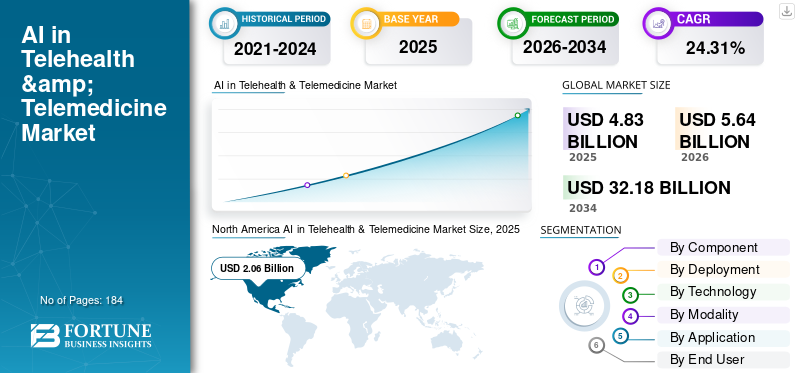
The global AI in telehealth & telemedicine market size was valued at USD 4.83 billion in 2025. The market is projected to grow from USD 5.64 billion in 2026 to USD 32.18 billion by 2034, exhibiting a CAGR of 24.31% during the forecast period. North America dominated the AI in telehealth & telemedicine market with a market share of 42.65% in 2025.
AI in telehealth & telemedicine involves using artificial intelligence to enhance virtual care through real-time video/voice consultations, asynchronous messaging, store-and-forward methods, and hybrid approaches. It improves traditional telehealth methods by alleviating clinician administrative tasks, increasing throughput and accessibility, tailoring patient education and involvement, and streamlining scheduling, capacity management, and contact-center functions via smart automation. Factors affecting this market comprise the ongoing standardization of virtual care after the pandemic, rising chronic conditions prevalence that necessitates continual monitoring, ongoing clinician shortages and burnout that elevate the need for automated documentation, and payer/provider emphasis on reducing costs.
Key companies such as Teladoc Health, Amwell, Included Health, Microsoft, and specialized AI firms are enhancing AI-driven telehealth solutions via integrated platforms that merge intake and navigation, virtual visit facilitation, ambient documentation, RPM analytics, and operational insights.
Download Free sample to learn more about this report.
 Market Size & Forecast
 Market Share
 Key Regional Highlights
North America
Reached USD 2.06 billion in 2025 after recording USD 1.78 billion in 2024, supported by strong AI adoption and a robust healthcare ecosystem.
Europe
The market is expected to grow at a 22.91% CAGR during the forecast period, supported by mature healthcare systems and regulatory initiatives.
Asia Pacific
The market is projected to reach USD 1.03 billion by 2026, driven by expanding telemedicine infrastructure and digital health programs.
U.S.
The U.S. market is projected to reach USD 2.22 billion by 2026, accounting for approximately 39.4% of the global market.
Japan
The Japanese market is projected to reach USD 0.15 billion by 2026, representing approximately 2.7% of global revenue.
Read More

Advances in AI Algorithms and Expansion of RPM Platforms is a Significant Market Trend
Improvements in AI algorithms and the growth of Remote Patient Monitoring (RPM) systems are emerging as a distinct trend in AI-enhanced telehealth, as providers transition from virtual visits only to ongoing, predictive care between appointments. Recent ML models can analyze high-frequency vital signs and symptom indicators to identify subtle declines sooner, minimize false alerts, and prioritize clinician intervention, in turn enhancing the scalability of RPM programs with limited personnel. Simultaneously, RPM platforms are broadening their scope beyond fundamental chronic care to include hospital-at-home, post-acute recovery, and virtual wards, where AI-powered triage and escalation protocols help maintain safety while reducing facility strain. This trend is further enhanced by the growing adoption of RPM data in virtual-care processes, driving higher recurring software and analytics revenues. These factors are supporting the overall global AI in telehealth & telemedicine market growth.
Download Free sample to learn more about this report.
Rising Shortage of Clinical Staff and Need for Automation in Remote Care Amplified Market Growth
Rising shortage of clinical staff is a strong driver of AI in telehealth & telemedicine market. Health systems are being forced to deliver more care with fewer clinicians, especially in primary care and nursing-heavy workflows. The World Health Organization has raised its projected global health workforce shortage by 2030 to 11 million, increasing pressure to redesign care models rather than rely solely on hiring. In remote care, this directly translates into demand for automation that reduces non-clinical load, AI-assisted documentation, automated intake/triage, smart routing, follow-up reminders, and escalation triggers, so that clinicians can focus on higher-acuity decisions. Automation also helps virtual programs scale safely by standardizing workflows and improving throughput during demand peaks without proportional staffing increases. All these factors cumulatively drive the overall market growth.
Regulatory Uncertainty and Need for Clinical Validation to Hamper Market Growth
Regulatory ambiguity and the need for clinical validation hinder AI-enabled telehealth, as numerous tools exist in a gray area between workflow support and clinical decision/diagnosis, which can rapidly alter approval, documentation, and quality-system requirements. When vendors are unable to accurately predict whether their AI capabilities will be classified as a medical device, they postpone product launches, restrict claims, or defer entering specific markets, particularly for AI that screens, assesses risk, or recommends diagnoses remotely. On the buyer side, providers and payers require more robust validation evidence, which raises deployment time and costs and frequently extends pilot evaluation periods. Cross-border compliance introduces obstacles: standards for data governance, risk management, transparency, and post-market oversight may differ, making global expansion more challenging and costly. In general, uncertainty increases legal and compliance risks, leading procurement committees to be more cautious, which in turn decreases short-term adoption despite significant clinical demand. This limits market growth to a certain extent.
Increased Investor Funding into AI Healthcare Startups to Offer Market Growth Opportunities
The rise in investor funding for AI healthcare startups presents a significant market opportunity, as new capital enables vendors to progress from pilot projects to enterprise-level products that can be implemented widely. The investment focuses on AI that enhances the economics of remote care, automates intake and triage processes, provides tools to improve clinician productivity, and develops continuous remote monitoring models to minimize unnecessary utilization. This speeds up product development for regulated healthcare requirements such as security, clinical governance, integration with EHR/RPM systems, and ongoing model monitoring features that providers and payers are increasingly requesting before significant rollouts. It facilitates quicker geographical growth, partnerships with channels, and service capacity, which decreases adoption obstacles and broadens reachable customer segments. At the same time, broader investments in digital health have shifted the focus to AI, boosting the number of well-financed rivals and accelerating innovation processes, thereby broadening the market by expanding use cases and reducing time-to-value for purchasers. In summary, investor funding serves as a catalyst that transforms high demand for remote-care automation into scalable, commercial applications. All these factors would drive the market growth over the coming years.
Lack of Reliable Digital Infrastructure in Rural or Resource-Limited Settings Pose a Prominent Challenge to Market Growth
The absence of dependable digital infrastructure in rural or resource-constrained areas continues to pose a significant challenge for AI-driven telehealth & telemedicine, as the quality of virtual care depends on stable broadband or mobile connectivity, minimal latency, and sufficient bandwidth for virtual consultations, image uploads, and ongoing RPM data transmission. When the connection is poor, interactions transition from video to audio or don't occur at all, leading to deficiencies in clinical context and diminishing the efficacy of AI-driven processes such as automated intake, immediate risk evaluation, and CV-based remote evaluations. Intermittent networks also lead to increased drop-outs during onboarding and follow-ups, resulting in reduced program adherence and making outcomes more challenging to demonstrate, hindering payer/provider expansion. In AI, inadequate infrastructure restricts access to high-quality multimodal inputs such as video, high-frequency vitals, and images, leading to more false alerts or necessitating conservative thresholds that diminish effectiveness. All the factors cumulatively affect the market growth.
Software-centric Virtual Care Workflows to Drive the Software Segment’s Dominance
Based on the component, the market is divided into services and software.
In 2025, the software segment dominated the market, as most AI value in telehealth is delivered through scalable platforms and modules such as AI-enabled intake/triage, clinician-facing documentation and summarization, workflow orchestration, RPM analytics dashboards, and intelligent scheduling/routing. These capabilities are typically monetized through subscriptions and usage-based licensing, and they can be rolled out rapidly across sites and specialties without proportionate headcount increases. In addition, tighter integration of AI into telehealth platforms and EHR-connected “digital front doors” has increased recurring license spend versus one-time services.
The services segment is anticipated to rise with a CAGR of 26.56% over the forecast period.
To know how our report can help streamline your business, Speak to Analyst
Faster Rollouts and Easier Scaling to Drive the Cloud-based Segment’s Dominance
Based on the deployment, the market is divided into cloud-based, hybrid, and on-premise.
The cloud-based segment is anticipated to capture the largest global AI in telehealth & telemedicine market share in 2025. Most telehealth AI tools need quick setup, elastic compute, and frequent model updates, which are easier to deliver through the cloud. Cloud deployment also helps providers and payers scale virtual care across multiple sites without buying and maintaining heavy IT infrastructure. In addition, cloud platforms simplify integration with EHRs, contact centers, and RPM dashboards, enabling standardized workflows for AI triage, documentation, and alerting across service lines. As virtual care volumes fluctuate, cloud systems handle peak demand better and support usage-based pricing, which buyers prefer for cost control. Furthermore, the segment is set to hold a 60.8% share in 2026.
The hybrid segment is anticipated to rise with a CAGR of 21.52% over the forecast period.
Predictive Analytics and Signal Interpretation to Drive the ML & Deep Learning Segment’s Growth
In terms of technology, the market is divided into natural language processing, machine learning & deep learning, computer vision, and others.
The machine learning & deep learning segment dominated the global market in 2025. ML/DL models handle large volumes of time-series data from wearables and home devices and convert it into actionable insights, which directly improve clinical efficiency in remote care. These algorithms are also widely embedded inside telehealth platforms for automated triage, escalation rules, and population-level monitoring, making them easier to scale than specialist point solutions. Additionally, new product launches based on these technologies also support the segment growth. Furthermore, the segment is set to hold a 39.7% share in 2026.
The natural language processing segment is expected to grow with a CAGR of 26.34% over the forecast period.
Real-time Doctor–Patient Interaction to Drive the Synchronous Segment’s Dominance
In terms of modality, the market is divided into synchronous, asynchronous, and hybrid.
The synchronous segment captured the highest share of the global market in 2025. Most telehealth care still relies on live video/voice consultations where clinicians can ask follow-up questions instantly, assess urgency in real time, and make faster treatment decisions. Synchronous visits are also preferred for higher-acuity cases such as urgent care, complex symptoms, and medication changes, where payers and providers want stronger clinical confidence and clearer documentation. In addition, many hospitals scaled synchronous virtual workflows in inpatient and emergency settings, such as virtual rounding and specialist consults, which improve access to clinicians without delaying care. Furthermore, the segment is set to hold a 54.0% share in 2026.
The asynchronous segment is anticipated to rise with a CAGR of 29.14% over the forecast period.
Core Virtual Care Functions to Propel the Clinical Care Enablement Segment’s Growth
On the basis of application, the market is divided into clinical care enablement, Remote Patient Monitoring (RPM), clinical documentation & clinician productivity, patient engagement & experience, revenue cycle & administrative automation, virtual care operations optimization, and others.
The clinical care enablement segment captured the highest share of the global market in 2025. Providers and payers prioritize this segment as it improves access and throughput without increasing clinical staff proportionally. As virtual care volumes grow, standardized enablement software reduces variability across sites and makes quality easier to manage. Even when other applications expand, enablement remains the base layer that connects patient entry, clinician workflow, and follow-ups, keeping it the largest revenue pool in many deployments. Furthermore, the segment is set to hold a 21.5% share in 2026.
The revenue cycle & administrative automation segment is anticipated to rise with a CAGR of 25.31% over the forecast period.
Provider-led Adoption of AI Virtual Care Platforms to Drive the Healthcare Providers Segment’s Dominance
Based on end user, the market is segmented into healthcare payers, healthcare providers, homecare, and others.
In 2025, the healthcare providers segment held the leading position in the global market. Hospitals and clinics are the main controllers of clinical workflows in which AI is used daily, such as patient admission, triage, online consultations, record-keeping, and decision-making for escalations. Providers are also the primary buyers of telehealth platforms and AI modules to enhance access and reduce clinician workload, meaning that the majority of revenue is initially generated at the provider level. Additionally, healthcare providers require AI to standardize care protocols across various departments and locations, particularly for high-demand scenarios such as urgent care, inpatient virtual nursing, and specialist consultations. As capacity limitations increase, provider-led implementations expand more rapidly since they provide instant operational ROI. Furthermore, the segment is set to hold a 56.0% share in 2026.
In addition, homecare segment are projected to witness 30.63% growth rate during the forecast period.
By geography, the market is divided into Asia Pacific, Europe, North America, Latin America, and the Middle East & Africa.
North America AI in Telehealth & Telemedicine Market Size, 2025 (USD Billion)
To get more information on the regional analysis of this market, Download Free sample
In 2024, the North America market reached USD 1.78 billion, accounting for the largest share of the global market. In 2025, the region maintained its leading position, with USD 2.06 billion. In North America, growth is mainly fueled by the largest adoption of AI-enabled telehealth, a strong payer/tech ecosystem, and workforce shortages that push automation.
The U.S. market dominated the North American market and can be analytically approximated at around USD 2.22 billion in 2026, accounting for roughly 39.4% of global market.
Europe’s market size is expected to grow at a CAGR of 22.91% during the forecast period. The regional growth is supported by regulatory push toward cross-border health data availability, mature healthcare systems, and increasing chronic disease burden across European countries.
The U.K. market in 2026 is estimated at around USD 0.32 billion, representing roughly 5.7% of global revenues.
Germany’s market size is projected to reach approximately USD 0.36 billion in 2026, equivalent to around 6.4% of global sales.
The Asia Pacific market is expected to reach a valuation of USD 1.03 billion by 2026, making it the third largest region in the global market. In the Asia Pacific, growth is propelled by rapid adoption in key countries such as China, India, and South Korea, by expanding telemedicine infrastructure, and by increasing national digital health infrastructure programs across Asia.
The Japanese market in 2026 is estimated at around USD 0.15 billion, accounting for roughly 2.7% of global revenues.
China’s market is projected to reach revenues of around USD 0.34 million in 2026, representing roughly 6.0% of global sales.
The Indian market in 2026 is estimated at around USD 0.16 billion, accounting for roughly 2.8% of global revenues.
The Middle East & Africa and Latin America are expected to experience slower growth throughout the forecast period. By 2026, the market value in Latin America is projected to hit USD 0.41 billion. Crucial factors, such as significant unmet patient needs, rising healthcare expenditures, and government-initiated digital transformation initiatives, are expected to drive expansion in these areas.
In the Middle East & Africa, the GCC market is projected to attain approximately USD 0.11 billion by 2026, representing about 2.0% of global revenues.
Increasing Client Base of Key Companies to Strengthen Market Share
The global AI in telehealth & telemedicine market reflects a moderately fragmented structure, with the presence of well-established players and an increasing number of new market entrants. Key entities in this space include Teladoc Health, Microsoft, Oracle, and others. These organizations are progressively highlighting LLM/GenAI integration for symptom capture, care navigation, and visit summarization, along with stronger security and governance, and integrations with EHR/RPM/RCM systems to reduce provider adoption friction and accelerate enterprise rollouts.
Other prominent players in the market include Ada Health GmbH,Infermedica, TytoCare Ltd., Abridge Al, Inc. and others. Emphasis on new software launches, customer expansion, and partnerships is a key strategic undertaking for these players.
The global AI in telehealth & telemedicine market analysis encompasses an extensive examination of the market size and projections for all market segments featured in the report. It provides information on the market dynamics and trends that are anticipated to propel the market during the forecast period. It offers insights into crucial elements, such as innovations in products, the regulatory landscape, and the introduction of new products. Furthermore, it outlines collaborations, mergers, and acquisitions, along with significant advancements in the industry within the market. The market forecast report additionally offers a comprehensive competitive landscape with details on market share and profiles of major active participants.
Request for Customization to gain extensive market insights.
| ATTRIBUTE | DETAILS |
| Study Period | 2021-2034 |
| Base Year | 2025 |
| Estimated Year | 2026 |
| Forecast Period | 2026-2034 |
| Historical Period | 2021-2024 |
| Growth Rate | CAGR of 24.31% from 2026-2034 |
| Unit | Value (USD Billion) |
| Segmentation | By Component, Deployment, Technology, Modality, Application, End User, and Region |
| By Component |
|
| By Deployment |
|
| By Technology |
|
| By Modality |
|
| By Application |
|
| By End User |
|
| By Region |
|
According to Fortune Business Insights, the global market value stood at USD 4.83 billion in 2025 and is projected to reach USD 32.18 billion by 2034.
In 2025, the North Americas market value stood at USD 2.06 billion.
The market is expected to exhibit a CAGR of 24.31% during the forecast period.
By component, the software segment led the market in 2025.
Rising shortage of clinical staff and need for automation in remote care are the key factors driving the market.
Teladoc Health, Inc., Epic Systems Corporation, and Microsoft are some of the prominent players in the global market.
North America dominated the market in 2025 with the largest share.

Get 30-60 hrs Free Customization
Expand Regional and Country Coverage, Segments Analysis, Company Profiles, Competitive Benchmarking, and End-user Insights.













.webp)






Related Reports
Get In Touch With Us
US +1 833 909 2966 ( Toll Free )
Receive a tailored pricing based on your needs.
Discuss your questions with our industry experts.
Have questions? Get quick answers before you purchase.

