Aircraft Electric Motor Market Size, Share & Industry Analysis, By Motor Type (Brushless DC Motors, Permanent Magnet Synchronous Motors, Induction Motors, and Others), By Power Output, By Aircraft Type (Commercial Aircraft, Business & General Aviation Aircraft, Military Aircraft, and Others), By Application (Propulsion Systems, Thermal Management Systems, Pump & Auxiliary Systems, Landing Gear & Braking Systems, and Others), By End User (Aircraft OEMs, Airlines & Aircraft Operators, Military & Defense Agencies, MRO Providers, and Others), and Regional Forecast, 2026-2034
 Download Free Sample
Aircraft Electric Motor Market Size and Future Outlook
 Listen to Audio Version
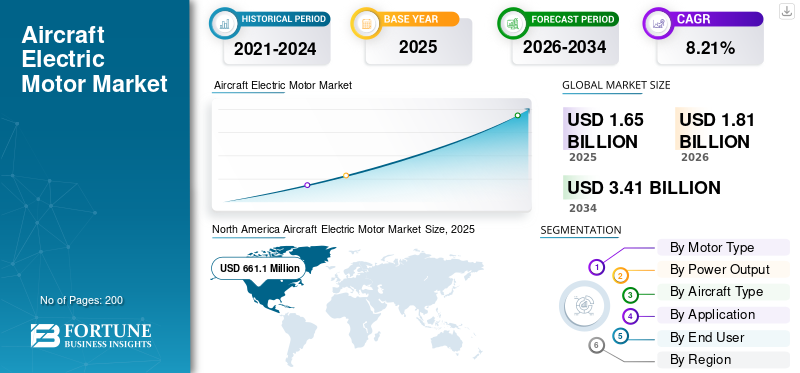
The global aircraft electric motor market size was valued at USD 1,655.6 million in 2025 and is projected to grow from USD 1,814.9 million in 2026 to USD 3,412.7 million by 2034, exhibiting a CAGR of 8.21% during the forecast period. North America dominated the aircraft electric motor market with a market share of 39.93% in 2025.
The market covers aviation-grade motors used to convert electrical energy into mechanical power across aircraft propulsion, actuation, pumps, fans, braking, landing gear, cabin systems, environmental control, and thermal management applications. These motors are used in commercial aircraft, business jets, military aircraft, helicopters, UAVs, and emerging eVTOL platforms. The market growth is being supported by more-electric aircraft design, wider use of electric actuation, rising UAV deployment, and early hybrid electric aircraft propulsion programs. Key players include Safran, Collins Aerospace, Honeywell, magniX, H3X, and Moog, who are developing electric propulsion motors, motor-generators, actuation systems, and aircraft power technologies.
Download Free sample to learn more about this report.
Aircraft Electric Motor Market Key Takeways
 Global Market Size & Forecast
- 2025 Market Size: USD 1,655.6 million
- 2026 Market Size: USD 1,814.9 million
- 2034 Forecast Market Size: USD 3,412.7 million
- CAGR: 8.21% from 2026–2034
 Market Share
- North America dominated the aircraft electric motor market with a 39.93% share in 2025.
- The Aircraft OEMs segment accounted for the largest market share in 2025.
- The Flight Control & Actuation System segment led the global market share in 2025.
 Key Regional Highlights
North America
North America remained the leading regional market, reaching USD 661.1 million in 2025.
Europe
Europe is projected to reach USD 480.6 million in 2026, growing at a CAGR of 8.26%.
Asia Pacific
Asia Pacific is expected to reach USD 376.2 million in 2026 and emerge as the fastest-growing regional market.
U.S.
U.S. The U.S. aircraft electric motor market is projected to reach USD 452.8 million in 2026.
Japan
Japan Japan is expected to witness steady growth, supported by increasing investments in aerospace electrification and advanced aircraft technologies.
Read More

AIRCRAFT ELECTRIC MOTOR MARKET TRENDS
Shift toward More-Electric and Propulsion-Grade Motor Architectures is a Market Trend
Aircraft manufacturers are progressively replacing hydraulic and pneumatic systems with electric equivalents under the More Electric Aircraft (MEA) architecture, visible on platforms such as the Boeing 787 and Airbus A350. Electric motors increasingly power flight control actuators, landing gear, fuel pumps, and environmental control systems, while hybrid-electric and fully electric propulsion units advance through NASA-backed flight demonstrations involving magniX and GE Aerospace. Parallel innovation in axial-flux and integrated motor-drive designs from firms such as Evolito and H3X is raising power density while cutting weight. Momentum is also building toward eVTOL and urban air mobility propulsion, broadening the motor market beyond traditional fixed-wing aircraft.
MARKET DYNAMICS
MARKET DRIVERS
Download Free sample to learn more about this report.
Aviation's Decarbonization Commitments and Rising Air Traffic to Drive Motor Demand
The global commitments to net-zero carbon aviation by 2050, endorsed by ICAO and reaffirmed by IATA member airlines, are pushing manufacturers to electrify propulsion and onboard power systems wherever feasible, propelling aircraft electric motor market growth. The rising air transport and passenger traffic, which grew by over 5% in 2025 with continued expansion into 2026, according to IATA, is increasing aircraft production and fleet renewal, lifting the demand for lighter, more efficient electric components. Replacing hydraulic and pneumatic systems with electric motors cuts aircraft weight, fuel burn, and maintenance needs, directly supporting airline cost and emissions goals. Government-backed research, including NASA's electrified propulsion initiatives, is further accelerating electric aviation technology maturity and certification pathways for next-generation electric and hybrid-electric aircraft.
MARKET RESTRAINTS
Limited Battery Energy Density May Restrain Large-Scale Electric Propulsion Adoption
High-efficiency electric motors are limited to short-range, light aircraft, or hybrid configurations rather than long-haul commercial propulsion due to the significantly lower energy density of current lithium-ion battery technology compared to jet fuel. It is still challenging to meet the high continuous power density requirements of aviation, which are frequently benchmarked around 12 kilowatts per kilogram, requiring trade-offs between motor weight, cooling, and dependability. Given how tight that supply is, many designs still rely on permanent magnets based on neodymium, which increases cost exposure. The speed at which manufacturers can expand electric motors beyond actuation toward primary propulsion is further constrained by the high research and certification costs for new electric aircraft propulsion systems as well as the requirement for redundant, fault-tolerant designs to satisfy aviation safety regulations.
MARKET OPPORTUNITIES
Expanding eVTOL and Urban Air Mobility Sector to Open Doors to New Growth Avenues
The rise of electric vertical take-off and landing aircraft presents a major opportunity for motor manufacturers, with companies such as Joby Aviation, Archer Aviation, and Eve Air Mobility advancing toward type certification while pilot programs already run across several U.S. states. Each eVTOL needs multiple high-power-density motors for distributed propulsion, creating recurring demand beyond traditional single or twin-engine aircraft. Additional opportunity lies in retrofitting regional turboprops with hybrid aerospace electric systems and powertrains, as NASA's Electrified Powertrain Flight Demonstration project is showing, and in electrifying secondary systems such as taxiing, actuation, and environmental control on new commercial aircraft to help airlines meet efficiency and emissions targets.
MARKET CHALLENGES
Regulatory Uncertainty and Rare-Earth Supply Risk May Create Challenges for Market Expansion
Certification frameworks for electric and hybrid-electric propulsion remain incomplete, with regulators such as the FAA still finalizing rules for powered-lift and eVTOL aircraft, leaving manufacturers uncertain about timelines despite years of flight testing. China's tightening export controls on neodymium, dysprosium, and terbium, key inputs for high-performance permanent magnets, have introduced supply-chain risk for motor producers, prompting costly redesigns toward ferrite or rare-earth-reduced alternatives that trade off performance. Thermal management at high power densities, integration with existing aircraft electrical architectures, and a shortage of standardized testing protocols for new motor and inverter combinations add further engineering complexity, slowing the path from demonstration programs to certified, in-service systems.
Segmentation Analysis
By Motor Type
Superior Efficiency and Lower Maintenance Needs to Support Brushless DC Motors Segment Growth
Based on motor type, the market is segmented into brushless DC motors, permanent magnet synchronous motors, induction motors, and others.
The brushless DC motors segment is anticipated to account for the largest market share. The segment is growing due to its high efficiency, compact design, low maintenance needs, and suitability for pumps, fans, actuation systems, UAV propulsion, and aircraft auxiliary systems. Its ability to deliver precise speed control and reliable performance under continuous operating conditions makes it well-suited for modern aircraft electrical architectures.
The permanent magnet synchronous motors segment is anticipated to rise with a high CAGR of 8.89% over the forecast period.
By Power Output
Broad Motor Use in Aircraft to Support 10 kW to 100 kW Segment Growth
Based on power output, the market is segmented into below 10 kW, 10 kW to 100 kW, 101 kW to 500 kW, and above 500 kW.
In 2025, the 10 kW to 100 kW segment dominated the global market. The 10 kW to 100 kW segment is growing as these motors are widely used in flight-control actuation, pumps, environmental control systems, UAV propulsion, and light aircraft electrification applications. This power range offers a practical balance between performance, weight, and integration flexibility, making it suitable for multiple onboard systems.
The above 500 kW segment is projected to grow at a high CAGR of 8.83% over the forecast period.
By Aircraft Type
Rising Aircraft Production and Fleet Size to Support Commercial Aircraft Segment Growth
Based on aircraft type, the market is segmented into commercial aircraft, business & general aviation aircraft, military aircraft, unmanned aerial vehicles, eVTOL & advanced air mobility aircraft, and others.
The commercial aircraft segment is anticipated to witness a dominating aircraft electric motor market share over the forecast period. The segment is growing given that large aircraft fleets and new aircraft production continue to drive the demand for motors used in actuation, pumps, fans, braking, thermal management, and cabin systems. Commercial aircraft also require a high volume of electric motors across distributed onboard applications, creating steady demand from both line-fit and replacement channels. The shift toward lighter, more efficient, and lower-maintenance aircraft systems is further supporting motor adoption in next-generation narrow-body and wide-body platforms.
The eVTOL & advanced air mobility aircraft segment is projected to grow at a high CAGR of 9.03% over the forecast period.
By Application
More-Electric Aircraft Architectures to Impel Flight Control & Actuation Systems Segment Growth
Based on application, the market is segmented into propulsion systems, flight control & actuation systems, environmental control & thermal management systems, pump & auxiliary systems, landing gear & braking systems, and others.
The flight control & actuation system segment dominated the global market share. The segment is growing as aircraft manufacturers increasingly use electric and electrohydrostatic actuation to reduce hydraulic complexity and improve control precision. Furthermore, electric motor-driven actuation supports better reliability, lower maintenance burden, and improved system responsiveness compared with traditional hydraulic architectures.
In addition, the propulsion systems segment is projected to grow at a high CAGR of 8.82% during the analysis period.
By End User
To know how our report can help streamline your business, Speak to Analyst
Platform Integration Control by OEMs to Bolster Aircraft OEMs Segment Growth
Based on end user, the market is segmented into aircraft OEMs, airlines & aircraft operators, military & defense agencies, MRO providers, and others.
The aircraft OEMs segment dominated the global market share in 2025. The segment is growing given that OEMs control line-fit integration, system architecture, supplier selection, and certification of electric motors across aircraft propulsion and subsystem applications. OEM-led demand is also supported by the rising integration of motors at the design stage for actuation, cooling, fuel management, landing gear, braking, and cabin systems.
In addition, the military & defense agencies segment is projected to grow at a CAGR of 8.54% during the forecast period.
Aircraft Electric Motor Market Regional Outlook
By geography, the market is categorized into Europe, North America, Asia Pacific, and the rest of the world.
North America
North America Aircraft Electric Motor Market Size, 2025 (USD Million)
To get more information on the regional analysis of this market, Download Free sample
North America market held the dominant share in 2024, valuing at USD 600.5 million, and also maintained the leading share in 2025, with a value of USD 661.1 million. North America leads the market as it combines large aircraft production, deep aerospace supply chains, UAV demand, and early electric propulsion R&D. The region benefits from NASA’s megawatt-class electric machine work, FAA-led AAM certification activity, and strong OEM/Tier 1 presence.
U.S. Aircraft Electric Motor Market
Based on North America’s strong contribution and the U.S. dominance within the region, the U.S. market is anticipated to reach a value of around USD 452.8 million in 2026. The U.S. market is poised to expand at a CAGR of roughly 8.46% over the analysis period. The U.S. is the strongest market in the region due to Boeing’s commercial and defense aircraft base, NASA’s electrified aircraft propulsion programs, and FAA activity around powered-lift and advanced air mobility certification.
Europe
The Europe market is projected to reach a valuation of USD 480.6 million by 2026 and record a steady growth rate of 8.26% during the forecast period, which is the second highest among all regions. Europe is a significant market given that it has a strong commercial aircraft base, advanced certification frameworks, and active hybrid-electric aircraft research.
U.K. Aircraft Electric Motor Market
The U.K. market is estimated to reach around USD 152.7 million in 2026, representing a CAGR of roughly 8.71% during the forecast period. The U.K. market is supported by aerospace R&D funding, eVTOL certification planning, and a strong cluster of electric aviation companies. The Civil Aviation Authority is working toward frameworks for initial commercial passenger eVTOL flights by 2028, while the Aerospace Technology Institute continues to fund zero-carbon and advanced propulsion projects.
Germany Aircraft Electric Motor Market
The Germany market is projected to reach approximately USD 133.2 million in 2026. Germany is an important market due to its aerospace engineering base, DLR research, Airbus activity, and hybrid-electric propulsion programs.
Asia Pacific
The Asia Pacific market is estimated to reach USD 376.2 million in 2026 and secure the position of the third-largest and fastest-growing region in the market during the analysis period. The regional market is rapidly expanding owing to growing aircraft fleet, UAV adoption, low-altitude mobility policy, and domestic aerospace programs.
China Aircraft Electric Motor Market
The China market is projected to be one of the largest markets in Asia Pacific, with 2026 revenues estimated to reach around USD 119.6 million. China is one of the fastest-growing demand centers due to its large civil aviation base, fast-expanding UAV fleet, low-altitude economy policy, and eVTOL certification momentum. CAAC-backed certification progress for passenger eVTOLs and rising UAV flight activity support the demand for electric propulsion motors and drone-grade aviation motors.
India Aircraft Electric Motor Market
The India market is estimated to reach around USD 104.2 million in 2026. India is an emerging market, but growth is supported by drone regulation, UAV adoption, defense unmanned systems, and early eVTOL development.
Rest of the World
The rest of the world includes the Middle East and Africa and Latin America. The market growth is supported by Brazil’s ANAC eVTOL regulatory consultation and Eve certification activity, Dubai RTA/Joby eVTOL flight activity, Saudi GACA/Archer regulatory pathway work, and NEOM/Volocopter’s Saudi eVTOL test flights. The Middle East & Africa and Latin America markets are set to reach USD 141.8 million and USD 92.4 million in 2026, respectively.
COMPETITIVE LANDSCAPE
Key Industry Players
Companies Emphasize Lifecycle Support and OEM Relationships to Gain an Edge over Industry Competition
The aircraft electric motor market is moderately consolidated, with established aerospace suppliers and specialist electric propulsion firms competing across propulsion, actuation, motor-generators, and more-electric aircraft systems. Key players include Safran, Collins Aerospace, Honeywell, GE Aerospace, and Moog.
Competition is shaped by certification readiness, power density, thermal control, redundancy, OEM relationships, and lifecycle support. Safran’s certified ENGINeUS motor, Collins’ high-power motor-generator work, and specialist propulsion developments from magniX, H3X, and Evolito show that the market is moving from prototype motors toward certified, integrated aircraft motor systems.
LIST OF KEY AIRCRAFT ELECTRIC MOTOR COMPANIES PROFILED
- Safran (France)
- Collins Aerospace (U.S.)
- Honeywell Aerospace Inc. (U.S.)
- GE Aerospace (U.S.)
- Moog Inc. (U.S.)
- Parker Aerospace (U.S.)
- magniX (U.S.)
- H3X Technologies (U.S.)
- Evolito (U.K.)
- Liebherr Group (Switzerland)
KEY INDUSTRY DEVELOPMENTS
- April 2026: H55 selected Safran Electrical & Power to integrate the ENGINeUS electric motor into H55’s electric propulsion system for the fully electric Bristell B23 Energic aircraft.
- February 2026: Vertical Aerospace selected Evolito as the electric propulsion unit partner for its Valo eVTOL, covering lightweight electric motors and DAL-A power electronics in an integrated electric engine architecture.
- December 2025: Eve Air Mobility selected BETA Technologies as the pusher motor supplier for its eVTOL aircraft, strengthening the aircraft’s electric propulsion architecture for conforming prototypes and future production aircraft.
- February 2025: ZeroAvia signed its first sale of a standalone 600 kW electric propulsion system with Jetcruzer International for the Jetcruzer 500E program. The agreement supports electric flight testing of the aircraft and marks ZeroAvia’s move beyond hydrogen electric systems into standalone electric propulsion system supply.
- July 2024: American Airlines entered a conditional purchase agreement with ZeroAvia for 100 hydrogen-electric engines intended for regional jet aircraft. The agreement expanded American’s investment in ZeroAvia and supported the airline’s longer-term interest in lower-emission regional propulsion technologies.
REPORT COVERAGE
The global aircraft electric motor industry analysis includes a comprehensive study of the market size and forecast by all the market segments included in the report. It includes details on the market dynamics and market trends expected to drive the market over the forecast period. It provides information on key aspects, including an overview of technological advancements the regulatory environment, Porter’s five forces analysis, company profiles, and retrofitting program. Additionally, it details partnerships, mergers, acquisitions, as well as key aviation industry developments and prevalence by key regions. The global market report also provides an in-depth competitive landscape with information on the market share and profiles of key operating players.
Request for Customization to gain extensive market insights.
Report Scope & Segmentation
| ATTRIBUTE | DETAILS |
| Study Period | 2021-2034 |
| Base Year | 2025 |
| Estimated Year | 2026 |
| Forecast Period | 2026-2034 |
| Historical Period | 2021-2024 |
| Growth Rate | CAGR of 8.21% from 2026-2034 |
| Unit | Value (USD Million) |
| Segmentation | By Motor Type, Power Output, Aircraft Type, Application, End User, and Region |
| By Motor Type |
|
| By Power Output |
|
| By Aircraft Type |
|
| By Application |
|
| By End User |
|
| By Region |
|
Frequently Asked Questions
According to Fortune Business Insights, the global market value stood at USD 1,655.6 million in 2025 and is projected to reach USD 3,412.7 million by 2034.
In 2025, the North America market value stood at USD 661.1 million.
The market is expected to exhibit a CAGR of 8.21% during the forecast period of 2026-2034.
By motor type, the brushless DC motors segment is expected to dominate the market.
Decarbonization commitments across the aviation sector and rising air traffic are key factors propelling the market growth.
Safran, Collins Aerospace, Honeywell, GE Aerospace, and Moog are key players in the global market.
North America dominated the market in 2025.



- 2021-2034
- 2025
- 2021-2024
- 200
Get 30-60 hrs Free Customization
Expand Regional and Country Coverage, Segments Analysis, Company Profiles, Competitive Benchmarking, and End-user Insights.




















Related Reports
-
US +1 833 909 2966 ( Toll Free )
-
Get In Touch With Us