Aircraft Overhead Stowage Bins Market Size, Share & Industry Analysis, By Aircraft Type (Narrow-Body, Wide-Body, Regional Jets, and Business Jets), By Fit Type/Sales Channel (Line-Fit and Retrofit/Aftermarket), By Bin Design/Mechanism (Pivot Bins, Shelf/Translating Bins, and Fixed Bins), By Material (Composite Honeycomb Sandwich Panels, Thermoplastics, and Aluminum & Metallic Hardware), By Technology (Conventional/Manual Bins, Smart/Connected Bins, and Lift-Assist Mechanisms), By End User (Aircraft OEMs, Airlines, MRO Providers, and Aircraft Lessors), and Regional Forecast, 2026-2034
 Download Free Sample
Aircraft Overhead Stowage Bins Market Size and Future Outlook
 Listen to Audio Version
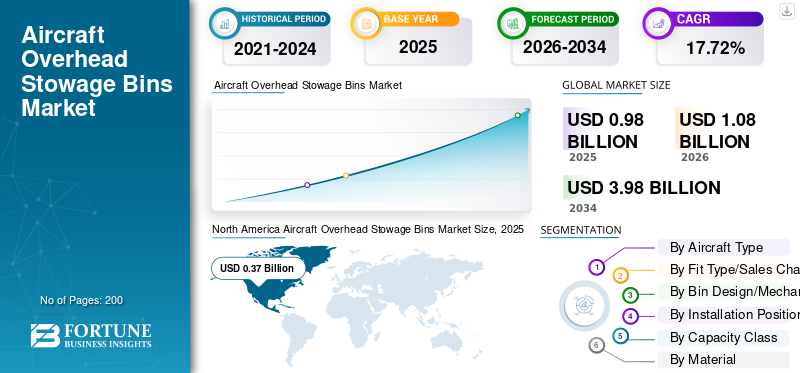
The global aircraft overhead stowage bins market size was valued at USD 0.98 billion in 2025. The market is projected to grow from USD 1.08 billion in 2026 to USD 3.98 billion by 2034, exhibiting a CAGR of 17.72% during the forecast period. North America dominated the aircraft overhead stowage bins market with a market share of 37.76% in 2025.
Aircraft overhead stowage bins are enclosed cabin compartments attached to the ceiling above passenger seats. The industry covers the design, manufacture, installation, retrofit, and maintenance of these sections used for passenger comfort, baggage, and crew equipment. The market includes shelf bins, pivot bins, enlarged-capacity bins, bin doors, structural supports, latches, and integrated passenger-service-unit interfaces for commercial, regional, and business aircraft.
The global market growth is driven by rising aircraft production, cabin-modernization programs, increasing carry-on baggage volumes, and airlines’ need to reduce gate-checked bags and shorten boarding times. Demand is shifting toward wheels-first storage, higher-capacity compartments, lightweight composite structures, improved ergonomics, and fast-installation retrofit systems that extend the commercial life and passenger appeal for long-haul flights of existing fleets and improve operational efficiency.
Major participants include Safran Cabin, The Boeing Company, Diehl Aviation Laupheim GmbH, FACC AG, and Airbus SE, supported by manufacturing partners such as Elbe Flugzeugwerke. Across the market, companies are developing bins offering approximately 50–60% greater capacity, recyclable or lightweight materials, standardized plug-and-play retrofit kits, modular cabin architectures, and common components that reduce installation time, maintenance requirements, and spare-parts costs.
Download Free sample to learn more about this report.
AIRCRAFT OVERHEAD STOWAGE BINS MARKET KEY TAKEAWAYS
 Global Market Size & Forecast
- 2025 Market Size: USD 0.98 billion
- 2026 Market Size: USD 1.08 billion
- 2034 Forecast Market Size: USD 3.98 billion
- CAGR: 17.72% from 2026–2034
 Market Share
- North America dominated the market with a 37.76% share in 2025.
- The Narrow-body Aircraft segment held the largest market share 47.40% in 2025.
- The Line-fit segment held the largest market share 52.44% in 2025.
 Key Regional Highlights
North America
North America reached USD 0.37 billion in 2025, driven by airline fleet modernization and adoption of larger overhead bins to reduce gate-checked baggage and improve turnaround times.
Europe
Europe reached USD 0.28 billion in 2025, growing at an 18.32% CAGR, supported by cabin harmonization and installation of higher-capacity bins across mixed-generation narrow-body fleets.
Asia Pacific
Asia Pacific reached USD 0.24 billion in 2025, growing at the fastest 19.10% CAGR, driven by rapid fleet renewal, rising air travel demand, and high-density domestic operations.
U.S.
Reached USD 0.34 billion in 2025 and is projected to grow at a 16.82% CAGR, supported by extensive narrow-body fleet modernization and demand for higher-capacity cabin storage.
Japan
Reached USD 0.04 billion in 2025, growing at a 15.29% CAGR, supported by fleet modernization, rising passenger traffic, and increasing adoption of advanced cabin storage systems.
Read More

Aircraft Overhead Stowage Bins Market Trends
Lightweight, Recyclable, and Ergonomically Assisted Designs are Replacing Conventional Bin Architectures
The market is moving from basic fixed compartments toward lightweight, high-capacity, ergonomic, and lifecycle-optimized cabin space systems. Wheels-first storage, lower bin lips, pivoting buckets, larger openings, mechanical closing assistance, modular doors, and common components are becoming central product features. Safran’s ECOS products provide up to 60% more baggage capacity, while Boeing and Airbus are using vertical bag orientation to increase capacity without reducing passenger headroom.
The growing focus on sustainability is also influencing material selection and manufacturing methods. Diehl’s ECO Bin uses a lightweight thermoplastic sandwich structure that can be shredded, remelted, and reused, unlike conventional thermoset structures.
For instance, in March 2026, Diehl Aviation announced that its AIX 2026 cabin portfolio would emphasize integrated interior systems, reliable in-service performance, and weight reductions and system complexity, reflecting the wider movement toward integrated and lifecycle-efficient cabin products.
Market Dynamics
MARKET DRIVERS
Download Free sample to learn more about this report.
Expanding Aircraft Fleets and Carry-On-Intensive Operations Accelerate Demand for Higher-Capacity Bins
The aircraft overhead stowage bins market growth is driven by the expansion and renewal of the global commercial aircraft fleet. Airbus forecasts demand for approximately 42,060 new aircraft between 2026 and 2045, including 33,920 typically single-aisle aircraft, while the fleet is expected to rise from 23,210 aircraft in 2025 to 45,550 aircraft by 2045. Every newly delivered passenger aircraft requires a complete line-fit cabin-stowage system, directly supporting demand for bin structures, doors, latches, hinges, support fittings, passenger-service-unit interfaces, and related replacement parts.
Airlines are also carrying more passenger baggage inside the cabin to reduce checked-baggage handling and support chargeable baggage models. Boeing’s 737 Space Bins provide 50% more storage and can hold up to three additional bags per bin, while Airbus Airspace L Bins increase capacity by 60% and support vertical loading.
For instance, in July 2026, Airbus released its 2026–2045 Global Market Forecast, projecting demand for 42,060 new aircraft and annual passenger traffic growth of 3.9%, strengthening the long-term line-fit demand outlook for overhead stowage systems.
MARKET RESTRAINTS
Strict Certification and Structural-Safety Requirements and Increased Development Costs Hinder Market Growth
Overhead bins are certified aircraft structures rather than ordinary cabin furniture. Under U.S. transport-aircraft requirements, stowage compartments must withstand their placarded maximum load, critical load distribution, flight loads, ground loads, and emergency-landing conditions without injuring occupants or damaging nearby aircraft systems. Suppliers must therefore conduct structural, vibration, flammability, smoke, toxicity, latch-retention, attachment, and emergency-load testing before a new bin or retrofit configuration can enter service.
Retrofit programs must also be adapted to aircraft configuration, ceiling panels, sidewalls, lighting, oxygen systems, passenger-service units, ventilation ducts, and structural attachment points. Even Airbus’ simplified L Bin solution requires three to five days for installation. At the same time, Boeing highlights the need for Federal Aviation Administration (FAA) service-bulletin and EASA supplemental-type-certificate approval for its retrofit.
MARKET OPPORTUNITIES
Large Installed Narrow Body Aircraft Fleets Create a Scalable Retrofit and Lifecycle-Service Opportunity
The largest near-term opportunity lies in retrofitting existing A320-family, 737NG, 737 MAX, A220, and selected widebody fleets. Airlines can modernize older cabins without purchasing new aircraft, while lessors can use bin upgrades to improve aircraft value, cabin consistency, and remarketing potential. Airbus L Bins reuse several existing cabin elements, require 30% fewer replacement parts than broader bin upgrades, and can be installed within normal maintenance periods.
Retrofit suppliers can generate recurring revenue through installation kits, engineering support, spare doors, latches, hinges, mechanical-assist systems, maintenance services, and cabin reconfiguration programs. Boeing secured an agreement to retrofit 21 flydubai 737 MAX aircraft with Space Bins, while Airbus’ Viva program covers 52 A320-family aircraft.
MARKET CHALLENGES
Supply-Chain Volatility, Platform Customization, and Quality Control Complicate Production Scaling
Overhead-bin manufacturers must align production with aircraft assembly rates, airline-selected cabin layouts, aircraft variants, monument positions, emergency-equipment locations, and changing certification baselines. A bin developed for one aircraft configuration cannot automatically be transferred to another, as attachments, ceiling geometry, passenger-service units, oxygen systems, and load paths can differ. This limits standardization and creates additional tooling, documentation, inventory, engineering, and qualification requirements.
The market also depends heavily on aircraft-production schedules that cabin suppliers cannot control. Airbus reported that its A220 ramp-up remained dependent on the integration of Spirit AeroSystems work packages, while engine shortages affected the A320-family production trajectory.
SEGMENTATION ANALYSIS
By Aircraft Type
Rising Single-Aisle Aircraft Deliveries and High-Cycle Cabin Modernization Boosted Narrow-Body Aircraft Segment Growth
By aircraft type, the market is classified into narrow-body aircraft, wide body aircraft, regional jets, turboprops, business jets & VIP aircraft, and military transport/special mission aircraft.
The narrow-body aircraft segment is estimated to grow at the highest CAGR of 18.56% during the forecast period of 2026-2034. The segment held the largest aircraft overhead stowage bins market share of 47.40% in 2025. Growth is supported by high production volumes of single-aisle aircraft and their extensive use on short-and medium-haul routes, where frequent boarding cycles increase the need for larger and more durable bins. Airlines are also prioritizing wheels-first baggage storage to reduce gate-checked bags and accelerate aircraft turnaround.
The wide body aircraft segment accounted for the second-largest market share of 21.10% in 2025. In addition, the segment is projected to grow at a CAGR of 18.38% during the forecast period.
By Fit Type/Sales Channel
Higher Aircraft Production and Factory-Integrated Cabin Packages Supported Line-Fit Segment Expansion
By fit type/sales channel, the market is classified into line-fit and retrofit/aftermarket.
The line-fit segment is estimated to grow at the highest CAGR of 17.89% during the forecast period of 2026-2034. In addition, this segment accounted for the largest market share of 52.44% in 2025, as aircraft manufacturers increasingly offer enlarged overhead bins as part of standardized cabin packages, allowing airlines to receive aircraft with higher baggage capacity from the delivery stage. Factory installation also reduces certification complexity, aircraft downtime, and modification costs compared with later retrofits.
The retrofit/aftermarket segment accounted for the second-largest market share in 2025. In addition, the segment is projected to grow at a CAGR of 17.52% during the forecast period.
By Bin Design/Mechanism
Better Passenger Access and Space Utilization to Accelerate Adoption of Shelf/Translating Bins
By bin design/mechanism, the market is classified into pivot bins, shelf/translating bins, and fixed bins.
The shelf/translating bins segment is estimated to grow at the highest CAGR of 18.13% during the forecast period of 2026-2034. These designs provide wider openings, improved visibility, and easier passenger access while allowing baggage to be placed in a more organized orientation. Translating mechanisms can also improve head clearance when closed and move the bin closer to passengers during loading.
The pivot bins segment accounted for the largest market share of 46.75% in 2025. In addition, the segment is projected to grow at a CAGR of 17.80% during the forecast period.
By Installation Position
Wider Cabin Architectures and Increased Storage Requirements to Boost Center/Ceiling Bin Demand
By installation position, the market is classified into outboard bins and center/ceiling bins.
The center/ceiling bins segment is estimated to grow at the highest CAGR of 18.02% during the forecast period of 2026-2034. Wide-body aircraft, high-density cabin layouts, and premium cabin configurations increasingly use central stowage structures to maximize baggage capacity without placing excessive pressure on outboard bins. These systems also help distribute passenger baggage more evenly throughout the cabin, reducing aisle congestion during boarding.
The outboard bins segment accounted for the largest market share in 2025. In addition, the segment is projected to grow at a CAGR of 17.61% during the forecast period.
By Capacity Class
Increasing Carry-On Volumes and Faster Boarding Requirements to Drive Large/Extra-Large Capacity Bins Segment Growth
By capacity class, the market is classified into standard-capacity bins and large/extra-large capacity bins.
The large/extra-large capacity bins segment is estimated to grow at the highest CAGR of 18.33% during the forecast period of 2026-2034. Airlines are demanding greater cabin storage as passengers increasingly travel with wheeled carry-on baggage and seek to avoid checked-baggage fees or collection delays. Larger bins allow bags to be stored vertically or wheels-first, increasing the number accommodated within the same cabin length.
The standard-capacity bins segment accounted for the largest market share in 2025. In addition, the segment is projected to grow at a CAGR of 17.10% during the forecast period.
By Material
Sustainability Targets and Weight-Reduction Requirements to Accelerate Hybrid/Recyclable & Bio-Based Composite Adoption
By material, the market is classified into composite honeycomb sandwich panels, thermoplastics, aluminum & metallic hardware, and hybrid/recyclable & bio-based composites.
The hybrid/recyclable & bio-based composites segment is estimated to grow at the highest CAGR of 19.77% during the forecast period of 2026-2034. Aircraft and cabin suppliers are evaluating recyclable thermoplastics, natural-fiber reinforcements, and hybrid composite structures to reduce material waste and improve end-of-life recovery. These materials can also lower bin weight, supporting reduced aircraft fuel consumption and emissions over the operating lifecycle.
The composite honeycomb sandwich panels segment accounted for the largest market share of 56.58% in 2025. In addition, the segment is projected to grow at a CAGR of 17.45% during the forecast period.
By Technology
Real-Time Cabin Monitoring and Predictive Maintenance to Drive Smart/Connected Bins Segment Growth
By technology, the market is classified into conventional/manual bins, smart/connected bins, lift-assist/force-assist mechanisms, integrated lighting & passenger service unit, and antimicrobial/easy-clean surface bins.
The smart/connected bins segment is estimated to grow at the highest CAGR of 21.24% during the forecast period of 2026-2034, as the sensors can identify bin occupancy, door position, latch condition, overload risk, or maintenance requirements and transmit this information to cabin crew or aircraft health-monitoring systems.
The conventional/manual bins segment accounted for the largest market share of 53.20% in 2025. In addition, the segment is projected to grow at a CAGR of 16.17% during the forecast period.
By Component
Digitalization of Cabin Systems to Accelerate Demand for Sensors and Electronics
By component, the market is classified into bin shell/structure, bin doors/buckets, latches & locking systems, hinges, struts, dampers & kinematics, decorative laminates, placards & trim, and sensors & electronics.
The sensors & electronics segment is estimated to grow at the highest CAGR of 21.02% during the forecast period of 2026-2034. Growth is directly connected to the emergence of connected bins, electronic occupancy monitoring, latch-status detection, and cabin data-management systems. Airlines and MRO providers can use these components to improve maintenance planning and reduce unscheduled repairs caused by damaged latches, hinges, or door mechanisms.
The bin shell/structure segment accounted for the largest market share of 35.34% in 2025. In addition, the segment is projected to grow at a CAGR of 17.74% during the forecast period.
By End User
To know how our report can help streamline your business, Speak to Analyst
Expanding Cabin Retrofit Activity & Fleet Reconfiguration to Drive MRO Providers/Completion Centers Segment Growth
By end user, the global market is classified into aircraft OEMs, airlines, MRO providers/completion centers, aircraft lessors, and government/VIP/head-of-state operators.
The MRO providers/completion centers segment is estimated to grow at the highest CAGR of 19.16% during the forecast period of 2026-2034. Airlines are extending aircraft service lives and upgrading older cabins with larger bins rather than waiting for replacement aircraft deliveries. MRO companies and completion centers provide the engineering, certification, installation, interior integration, and maintenance support required for these programs.
The aircraft OEMs segment accounted for the largest market share in 2025. In addition, the segment is projected to grow at a CAGR of 17.46% during the forecast period.
Aircraft Overhead Stowage Bins Market Regional Outlook
By region, the market is categorized into Europe, North America, Asia Pacific, and the Rest of the World.
North America
North America Aircraft Overhead Stowage Bins Market Size, 2025 (USD Billion)
To get more information on the regional analysis of this market, Download Free sample
North America held the dominant share in 2025, valued at USD 0.37 billion, and also maintained the leading share in 2026, with USD 0.41 billion. The region is adopting larger overhead bins as airlines are modernizing extensive narrow-body fleets to reduce gate-checked baggage, shorten boarding time, and standardize the cabin experience across new and existing aircraft.
U.S. Aircraft Overhead Stowage Bins Market
Based on North America's strong contribution and the U.S. dominance within the region, the U.S. market reached USD 0.34 billion in 2025 and is estimated to have a CAGR of 16.82% during the forecast period.
Europe
Europe is projected to grow at the second-fastest rate with a CAGR of 18.32% during the forecast period. In 2025, the market value stood at USD 0.28 billion. European airlines are installing higher-capacity bins as mixed generations of A320-family aircraft require cabin harmonization and faster passenger turnaround at congested hub airports. Lufthansa is retrofitting 38 A320s, Iberia has selected the same technology, and SWISS is equipping A320 and A321 aircraft with Airbus L Bins that provide up to 60% more capacity and can be installed within normal maintenance periods.
U.K. Aircraft Overhead Stowage Bins Market
The U.K. market in 2025 was valued at USD 0.05 billion and is estimated to grow at a CAGR of 15.53% during the forecast period.
Eastern Europe Aircraft Overhead Stowage Bins Market
The Eastern Europe market in 2025 was valued at USD 0.04 billion and is estimated to grow at a CAGR of 20.75% during the forecast period.
Rest of Europe Aircraft Overhead Stowage Bins Market
The Rest of Europe market in 2025 was valued at USD 0.06 billion and is estimated to grow at a CAGR of 19.50% during the forecast period.
Asia Pacific
The Asia Pacific market was valued at USD 0.24 billion in 2025 and is estimated to be the fastest-growing region in global market growth, with the highest CAGR of 19.10% during the forecast period. Asia Pacific's rising demand for air travel is increasing as rapid fleet renewal and high-density domestic operations require airlines to accommodate more carry-on baggage without extending turnaround times. Qantas is upgrading 42 Boeing 737s with lockers offering up to 50% more space. At the same time, Jetstar’s A321neo aircraft use extra-large Airspace bins with around 40% greater volume, encouraging wider adoption across the region’s narrow-body fleets.
China Aircraft Overhead Stowage Bins Market
The China market in 2025 was valued at USD 0.07 billion and is estimated to grow at a CAGR of 19.29% during the forecast period.
India Aircraft Overhead Stowage Bins Market
The India market in 2025 was valued at USD 0.04 billion and is estimated to grow at a CAGR of 21.74% during the forecast period.
Japan Aircraft Overhead Stowage Bins Market
The Japan market in 2025 was valued at USD 0.04 billion and is estimated to grow at a CAGR of 15.29% during the forecast period.
Rest of the World
The Rest of the World, which consists of Latin America and Middle East & Africa regions, is expected to witness moderate growth in this market space during the forecast period. The Latin America market was valued at USD 0.03 billion in 2025. Latin American airlines are adopting enlarged bins as low-cost and high-utilization operators need faster boarding, fewer baggage interventions, and greater daily aircraft utilization. Viva is retrofitting 52 A320-family aircraft with Airbus L Bins that provide 60% more capacity and can be installed in three to five days, establishing a scalable model for other regional carriers operating large A320 fleets.
The Middle East & Africa market was valued at USD 0.06 billion in 2025. The region is acquiring advanced stowage systems as hub carriers are combining large fleet-expansion programs with premium cabin modernization and higher passenger throughput. Emirates’ USD 5 billion, 219-aircraft refurbishment program includes modifications to overhead storage bins and other stowage areas, creating substantial line-fit and retrofit demand.
COMPETITIVE LANDSCAPE
Key Industry Players
Top Companies Introduce High-Capacity, Lightweight, and Rapid-Retrofit Stowage Solutions to Maintain Their Dominance
The aircraft overhead stowage bins market is relatively concentrated among aircraft manufacturers and established cabin-interior suppliers, including Airbus, Boeing, Safran Cabin, Diehl Aviation, FACC, and Elbe Flugzeugwerke. Competition is increasingly based on the ability to secure line-fit positions on major aircraft platforms while also offering certified retrofit solutions for the large installed A320 and 737 fleets. Airbus and Boeing are expanding their aftermarket presence through platform-specific L Bins and Space Bins, while Tier-1 suppliers are combining design, certification, manufacturing, installation support, and replacement parts into broader cabin-upgrade packages. This approach increases customer retention as airlines generally prefer solutions supported by approved service bulletins, supplemental type certificates, common spare parts, and established global maintenance networks.
Technology competition is centered on providing 50–60% greater baggage capacity, vertical wheels-first loading, lower system weight, easier bin closure, and shorter aircraft downtime during installation. These developments show that market growth is moving beyond basic bin manufacturing toward modular, sustainable, ergonomically assisted, and lifecycle-supported cabin systems that help airlines improve boarding efficiency and standardize cabins across mixed-age fleets.
LIST OF KEY AIRCRAFT OVERHEAD STOWAGE BIN COMPANIES PROFILED
- Airbus SE (France)
- The Boeing Company (U.S.)
- Safran Cabin (France)
- Diehl Aviation Laupheim GmbH (Germany)
- FACC AG (Austria)
- Bucher Leichtbau AG (Switzerland)
- AVIC Cabin Systems (UK) Limited (U.K.)
- SEKISUI Aerospace Corporation (U.S.)
- Pexco Aerospace, Inc. (U.S.)
- General Aerospace GmbH (Germany)
- Hartwell Corporation (U.S.)
- Komy Co., Ltd. (Japan)
- J&C AERO, UAB (Lithuania)
- VT Volant Aerospace, LLC (U.S.)
- Cabinair Group (U.K.)
KEY INDUSTRY DEVELOPMENTS
- April 2026: Boeing secured an interior-modification agreement from All Nippon Airways to upgrade 21 Boeing 787-8s and 16 Boeing 787-9s. Boeing will provide engineering support, modification kits, and new cabin-furniture integration, creating associated demand for stowage-interface engineering and cabin components; the contract value was not disclosed.
- April 2026: Boeing received a cabin-retrofit contract from Virgin Atlantic covering the airline’s Boeing 787-9 fleet. Boeing will supply engineering services and part kits for the comprehensive interior reconfiguration, although the announcement did not separately identify the overhead-bin package or disclose the contract value.
- April 2025: Airbus signed a Letter of Intent with Thai Airways International for the modernization of the airline’s Airbus A350-900 cabins. Airbus will oversee the program and integrate new seating, entertainment systems, and cabin components from 2028, while the agreement value and overhead-stowage workshare remain undisclosed.
- November 2024: ST Engineering began executing a full-cabin retrofit program for Air New Zealand’s Boeing 787-9 aircraft. The nose-to-tail refurbishment covers the business, premium-economy, and economy sections and creates demand for cabin furniture, linings, monuments, and related stowage integration; the contract value was not disclosed.
- July 2024: Boeing awarded Lufthansa Technik a licensing agreement to become the first Boeing Licensed Service Center for Boeing 787 cabin modifications. Lufthansa Technik can design, integrate, install, and certify complete Dreamliner interiors, including modifications affecting overhead-bin and cabin-furniture interfaces; the commercial value was not disclosed.
REPORT COVERAGE
The global aircraft overhead stowage bins market analysis includes a comprehensive study of the market size & forecast by all the segments included in the report. It contains details on the market dynamics and global market trends expected to drive the market over the forecast period. It provides information on key aspects, including an overview of technological advancements, pipeline candidates, the regulatory environment, and product launches. Additionally, it details partnerships, mergers & acquisitions, key aviation sector developments, and prevalence by key regions. The global market research report also provides a detailed competitive landscape with information on the market share and profiles of key operating players.
Request for Customization to gain extensive market insights.
Report Scope & Segmentation
| ATTRIBUTE | DETAILS |
| Study Period | 2021-2034 |
| Base Year | 2025 |
| Estimated Year | 2026 |
| Forecast Period | 2026-2034 |
| Historical Period | 2021-2024 |
| Growth Rate | CAGR of 17.72% from 2026 to 2034 |
| Unit | Value (USD Billion) |
|
Segmentation |
By Aircraft Type
By Fit Type/Sales Channel
By Bin Design/Mechanism
By Installation Position
By Capacity Class
By Material
By Technology
By Component
By End User
By Region
|
Frequently Asked Questions
Fortune Business Insights says that the global market value stood at USD 0.98 billion in 2025 and is projected to reach USD 3.98 billion by 2034.
In 2025, the European market value stood at USD 0.28 billion.
The market is expected to exhibit a CAGR of 17.72% during the forecast period.
By end user, the MRO providers/completion centers segment is expected to grow at a highest CAGR over the forecast period.
Expanding aircraft fleets and carry-on-intensive operations accelerate demand for higher-capacity bins.
Major participants include Safran Cabin, The Boeing Company, Diehl Aviation Laupheim GmbH, FACC AG, and Airbus SE are the top key players in the market.
North America dominated the market in 2025.



- 2021-2034
- 2025
- 2021-2024
- 200
Get 30-60 hrs Free Customization
Expand Regional and Country Coverage, Segments Analysis, Company Profiles, Competitive Benchmarking, and End-user Insights.




















Related Reports
-
US +1 833 909 2966 ( Toll Free )
-
Get In Touch With Us