Airport Access Control Market Size, Share & Industry Analysis, By Component (Hardware, Software, and Services), By Authentication Technology (Card-Based, Biometric, and Mobile/Digital Credential), By Authentication Mode (Single-Factor and Multifactor), By Access Subject (Airport Employees, Contractors & Vendors, and Passengers), By Access Location (Terminal & Landside Facilities, Sterile & Security-Restricted Areas, and Airside & Apron Areas), By Deployment (On-Premises, Cloud-Hosted, and Hybrid), By Airport Size (Large, Medium-Sized, and Small Airports), and Regional Forecast, 2026-2034
 Download Free Sample
Airport Access Control Market Size and Future Outlook
 Listen to Audio Version
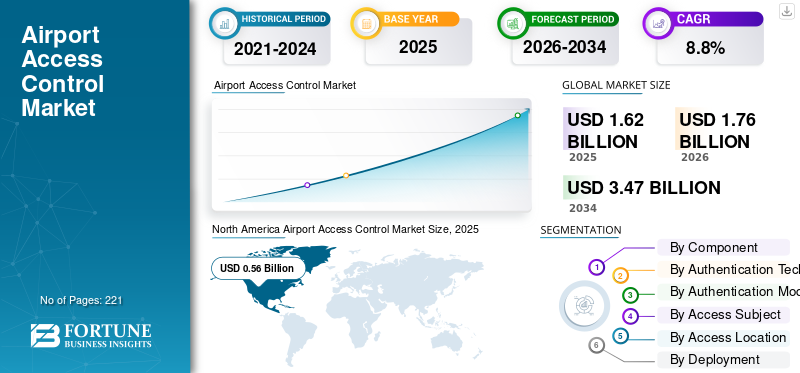
The global airport access control market size was valued at USD 1.62 billion in 2025. The market is projected to grow from USD 1.76 billion in 2026 to USD 3.47 billion by 2034, exhibiting a CAGR of 8.8% during the forecast period. North America dominated the global market with a market share of 34.57% in 2025.
Airport access control systems comprise integrated security solutions used to authenticate, authorize, monitor, and record the movement of individuals and vehicles across airport-controlled facilities. These systems support airport employees, airline crew, contractors, vendors, visitors, passengers, and authorized vehicles entering terminal buildings, sterile zones, security-restricted areas, airside facilities, aprons, ramps, baggage and cargo areas, maintenance hangars, operational buildings, and perimeter access points. The market includes physical hardware, access-control software, airport identity management and credential management platforms, and associated installation, integration, maintenance, and managed services.
Key market players such as HID Global, IDEMIA, and Honeywell provide airport-specific identity, physical access, and passenger-processing solutions. HID offers HID SAFE for Aviation, a physical identity and access management platform supporting airport workforce credentialing, access authorization, compliance, identity lifecycle management, and security reporting. Airport operators, airlines, government aviation-security agencies, ground handlers, cargo operators, MRO providers, and airport concessionaires are upgrading access-control infrastructure through greenfield installations, brownfield expansions, modernization programs, and full system replacements.
Download Free sample to learn more about this report.
Airport Access Control Market Key Takeaways
 Global Market Size & Forecast
- 2025 Market Size: USD 1.62 billion
- 2026 Market Size: USD 1.76 billion
- 2034 Forecast Market Size: USD 3.47 billion
- CAGR: 8.8% from 2026-2034
 Market Share
- North America dominated the airport access control market with a 34.57% share in 2025.
- The software segment is projected to grow at a 10.4% CAGR.
- The biometric authentication segment is projected to grow at an 11.0% CAGR.
 Key Regional Highlights
North America
North America dominated the market with USD 0.56 billion in 2025 and is projected to reach USD 0.60 billion in 2026.
Asia Pacific
Asia Pacific is expected to record the fastest growth, supported by expanding passenger traffic and airport infrastructure.
Europe
Europe represented a significant market in 2025, supported by its dense cross-border aviation network.
U.S.
The market was valued at USD 0.51 billion in 2025, supported by the country’s dominant position in North America.
Japan
The market was valued at USD 0.07 billion in 2025, accounting for roughly 4.1% of global revenues.
Read More

AIRPORT ACCESS CONTROL MARKET TRENDS
Biometric Identity, Mobile Credentials, and Automated E-Gates is Emerging as a Defining Market Trend
The market is shifting from conventional card-only and manually verified access toward integrated identity platforms combining facial recognition, fingerprints, mobile credentials, digital identification, airport badges, and multifactor authentication. Airports are increasingly deploying these technologies across physical access security entrances, employee access points, crew lanes, boarding gates, lounges, operational facilities, and other security-restricted areas. The transition supports faster identity verification, stronger credential assurance, reduced dependence on physical documents, and more consistent access records across multiple airport checkpoints. Modern systems increasingly connect biometric readers and electronic gates with airline reservation data, airport badging databases, government identity records, visitor-management platforms, video surveillance, and security-operation centers.
- For instance, in August 2025, the U.S. Transportation Security Administration introduced biometric e-gates at Hartsfield-Jackson Atlanta International Airport and announced planned deployments at Ronald Reagan Washington National Airport and Seattle-Tacoma International Airport.
This trend is expected to support demand for biometric access control systems, automated e-gates, mobile credentials, digital identity wallets, airport badging platforms, credential-authentication devices, and integrated physical identity and access-management software.
MARKET DYNAMICS
MARKET DRIVERS
Download Free sample to learn more about this report.
Mandatory Restricted-Area Protection and Rising Airport Throughput is Propelling Market Growth
Airport access control is fundamentally supported by mandatory aviation-security requirements governing entry into sterile areas, airside zones, aprons, baggage facilities, cargo terminals, maintenance buildings, operational rooms, and airport perimeters. Airport operators must maintain procedures that verify identities, restrict unauthorized access, monitor controlled entry points, and maintain security records. European aviation-security standards, for example, explicitly cover airport access control, surveillance, staff recruitment, training, and airport security programs. Rising passenger traffic increases the number of employees, airline crew members, ground handlers, contractors, concession workers, government personnel, and service providers operating within airport environments
- For instance, in September 2025, Airports Council International announced that global airport passenger traffic reached 9.8 billion passengers during the year, representing 3.7% growth compared with 2024.
This driver is expected to support airport access control market growth through new access-point installations, workforce badge issuance, passenger e-gates, contractor-management systems, vehicle-access controls, perimeter barriers, and airport-wide software integration.
MARKET RESTRAINTS
High Integration Costs and Biometric Data-Protection Requirements to Limit Near-Term Expansion
A major restraint for the market is the technical and financial complexity of upgrading access-control systems within operational airports. Airports frequently operate combinations of legacy card readers, proprietary controllers, separate badging databases, standalone vehicle gates, older door hardware, and independently managed passenger-processing systems. Replacing or integrating this critical infrastructure requires system design, cabling, controller migration, database cleansing, credential reissuance, employee enrolment, testing, cybersecurity controls, training, and phased cutover without interrupting airport operations.
Regulatory differences between countries can prevent airport operators from deploying a single standardized biometric architecture across international networks. Centralized biometric databases and cloud-hosted identity systems may face greater scrutiny than architectures that retain biometric templates on user-controlled devices. These constraints are likely to slow biometric and cloud migration at airports with limited capital budgets, fragmented legacy infrastructure, or restrictive data-protection environments.
MARKET OPPORTUNITIES
Security-by-Design Across Greenfield and Brownfield Airport Development Present Significant Opportunities
Greenfield airports, new terminals, airport-city projects, cargo hubs, maintenance zones, and brownfield capacity expansions present a significant opportunity for access-control providers. New infrastructure allows airport security systems to be incorporated during the architectural and engineering stages rather than installed through disruptive retrofits. Security-by-design supports better positioning of controlled doors, biometric checkpoints, security interlocks, vehicle gates, perimeter barriers, control rooms, network infrastructure, and emergency access arrangements.
The opportunity extends beyond hardware supply. Greenfield and expansion projects require identity-management software, contractor enrolment, airport badging, visitor management, mobile credentialing, video integration, alarm management, cybersecurity, system commissioning, training, and long-term maintenance. Suppliers capable of delivering airport-wide platforms rather than isolated readers or gates will be better positioned to capture larger project values.
MARKET CHALLENGES
Cybersecurity, Legacy-System Interoperability, and Third-Party Dependence Challenges Market Growth
Airport access-control platforms are increasingly connected with biometric databases, mobile credentials, HR systems, video surveillance, visitor-management applications, and government identity platforms. This growing integration improves operational visibility but also expands the potential cyberattack surface.
Compromised administrator accounts, manipulated permissions, or disrupted networked gates can create both physical-security and operational risks.
Legacy controllers and proprietary readers may also lack modern encryption, secure remote management, standardized interfaces, and biometric compatibility. Different modernization cycles across airports, airlines, ground handlers, tenants, and government agencies further complicate system interoperability.
Segmentation Analysis
By Component
Extensive Physical Infrastructure Requirements Supported Hardware Segment Dominance
Based on component, the market is divided into hardware, software, and services.
The hardware segment accounted for a leading airport access control market share in 2025 due to the large number of physical devices required across airport terminals, security-restricted areas, airside facilities, cargo buildings, maintenance zones, and perimeter entrances. Airport deployments require card and biometric readers, access controllers, electronic locks, turnstiles, e-gates, interlocks, sensors, badge printers, vehicle barriers, and supporting network equipment. Hardware expenditure is particularly high at large airports, where thousands of doors, gates, employee entrances, vehicle checkpoints, and passenger-processing points must be secured.
- For instance, in September 2025, dormakaba launched the Argus Air XS airport e-gate in North America. The company stated that it had deployed more than 7,000 airport e-gates globally, demonstrating the scale of physical access infrastructure installed across the aviation sector.
Software segment is anticipated to rise with a fastest CAGR of 10.4% over the forecast period.
To know how our report can help streamline your business, Speak to Analyst
By Authentication Technology
Established Airport Badging Infrastructure and Broad Reader Compatibility Supported Card-Based Authentication Segment Dominance
Based on authentication technology, the market is divided into card-based authentication, biometric authentication, mobile and digital credential authentication, PIN and keypad authentication, and QR code and barcode authentication.
The card-based authentication segment dominated the market in 2025 due to the widespread use of airport identification badges, proximity cards, contactless access technology, smart cards and access cards for employees, airline crew, contractors, ground handlers, and government personnel. Card credentials remain economical to issue, replace, and administer across large workforces, while maintaining compatibility with existing readers, controllers, door hardware, and airport identity-management systems. Airports can assign different permissions to each badge based on job role, employer, working hours, terminal, and security clearance.
- For instance, in August 2024, San Diego International Airport reported that approximately 1,400 Hirsch ScramblePad access-control readers were installed across the airport, with the new Terminal 1 expected to add another 1,000 readers.
Biometric authentication segment is anticipated to rise with a fastest CAGR of 11.0% over the forecast period.
By Authentication Mode
Lower Deployment Complexity and Large Existing Credential Base Supported Single-factor Authentication Segment Dominance
Based on authentication mode, the market is divided into single-factor authentication and multifactor authentication.
The single-factor authentication segment held the leading share in 2025 since a substantial portion of airport access points continues to rely on one primary credential, including an access card, PIN, barcode, mobile credential, or biometric identifier. Single-factor systems remain suitable for lower-risk offices, staff areas, commercial facilities, passenger-processing gates, and locations where additional security controls are provided through surveillance, guards, alarms, or controlled circulation routes. They require fewer devices, shorter verification times, and lower integration costs than multifactor systems. Multifactor authentication is increasingly adopted for sensitive airside and operational locations, but its additional hardware, enrolment, workflow, and system-integration requirements limit deployment across every airport door or checkpoint.
- For instance, in April 2024, HID and ASSA ABLOY announced a collaboration combining self-boarding gates with facial-recognition technology. The solution uses facial identity as the principal passenger-authentication mechanism at automated airport boarding points.
Multifactor authentication segment is anticipated to rise with a fastest CAGR of 9.6% over the forecast period.
By Access Subject
Large Credentialed Workforces and Repeated Restricted-Area Access Contributed to Airport Employees and Airline Crew Segment Dominance
Based on access subject, the market is divided into airport employees and airline crew, contractors, vendors and visitors, passengers, and vehicles.
The airport employees and airline crew segment dominated the market in 2025 as these personnel require repeated daily access to terminals, sterile areas, aprons, baggage facilities, aircraft stands, maintenance locations, airline offices, and operational buildings. Airports must manage credential enrollment, background-check status, training completion, badge issuance, access permissions, renewals, suspensions, and revocation across employees from multiple organizations. Insider-risk management and regulatory compliance further support investment in centralized airport badging and identity-management platforms.
- For instance, in June 2026, the U.S. Transportation Security Administration published details of its Crewmember Access Point program, which strengthens airline crew identity verification and provides eligible crewmembers with expedited access to airport sterile areas.
Passengers segment is anticipated to rise with a fastest growth rate of 10.5% over the forecast period.
By Access Location
Mandatory Access Restrictions and High Security Consequences Attributed to Sterile and Security-Restricted Segment Dominance
Based on access location, the market is divided into terminal and landside facilities, sterile and security-restricted areas, airside, apron and ramp areas, baggage and cargo facilities, maintenance, hangar and operational facilities, and vehicle and perimeter access points.
The sterile and security-restricted areas segment witnessed a leading share in 2025 since these locations require the most stringent identity verification, authorization, monitoring, and breach-response capabilities. Controlled areas include use of passenger screening solutions, restricted terminal corridors, airside transition points, baggage facilities, operational rooms, and access routes leading toward aircraft movement areas. Unauthorized entry into these locations can require terminal evacuation, passenger rescreening, operational suspension, and coordinated law-enforcement response.
- For instance, in June 2025, TSA and Seattle-Tacoma International Airport opened Security Checkpoint 1, comprising five screening lanes providing controlled passenger entry from the public terminal into the airport’s sterile gate area.
Terminal and landside facilities segment is anticipated to rise with a CAGR of 11.6% over the forecast period.
By Deployment
Data Control, Operational Continuity, and Local System Resilience Boosted On-Premises Segment Dominance
Based on deployment, the market is divided into on-premises, cloud-hosted, and hybrid.
In 2025, the on-premises segment dominated the market as airport access-control platforms support security-critical functions that must remain operational even during external network or cloud-service disruptions. Airports commonly retain access databases, badging systems, controllers, video integrations, alarm-management servers, and security-command platforms within airport-controlled infrastructure. This architecture provides greater control over sensitive identity data, system configuration, cybersecurity policies, redundancy, and emergency operations.
Cloud-hosted segment is anticipated to rise with a fastest CAGR of 11.2% over the forecast period.
By Installation Type
Large Legacy Installed Base and Increasing Integration Requirements Led to System Upgrade and Modernization Segment Dominance
Based on installation type, the market is divided into new/greenfield installation, brownfield expansion, system upgrade and modernization, and full system replacement.
The system upgrade and modernization segment held a leading share in 2025 as most established airports already operate access-control infrastructure but require newer credentials, cyber-hardened controllers, biometric readers, integrated software, and improved security analytics. Modernization enables airports to retain usable doors, cabling, readers, and physical infrastructure while replacing obsolete controllers, servers, databases, and management platforms. This approach generally involves lower operational disruption and capital expenditure than full system replacement. Demand is also supported by older proprietary systems that cannot easily integrate with mobile credentials, automated badging, video analytics, visitor management, or current cybersecurity standards.
- For instance, in 2025, British Airways Engineering and Johnson Controls completed a major security transformation at the airline’s Heathrow maintenance base, integrating access control, radar, high-definition video, and AI-enabled analytics after approximately 35 years of operating the CEM AC2000 platform.
Brownfield expansion segment is anticipated to rise with a fastest growth rate of 10.3% over the forecast period.
By Airport Size
Extensive Controlled Infrastructure and High Workforce Volumes Supported Large Airports Segment Dominance
Based on airport size, the market is divided into large airports, medium-sized airports, and small airports.
The large airports segment led the market in 2025 due to its substantially greater number of terminals, employees, airline tenants, controlled doors, passenger gates, baggage systems, cargo facilities, aircraft stands, vehicle entrances, and perimeter access points. Major hubs generally operate airport-wide badging and identity-management platforms connected with video surveillance, intrusion detection, license-plate recognition, human-resource databases, flight information, and security-operation centers. Their larger passenger and workforce volumes also justify investment in biometric gates, mobile credentials, multifactor authentication, redundancy, and advanced analytics.
- For instance, in July 2024, Heathrow Airport expanded its multi-year investment in Genetec Security Center to create a unified operational and security view across four passenger terminals and one cargo terminal, integrating multiple airport systems through a common platform.
Medium-sized airports segment is anticipated to rise with a fastest CAGR of 10.0% over the forecast period.
Airport Access Control Market Regional Outlook
By geography, the market is segmented into North America, Europe, Asia Pacific, Latin America, and the Middle East & Africa.
North America
North America Airport Access Control Market Size, 2025 (USD Billion)
To get more information on the regional analysis of this market, Download Free sample
North America dominated the market in 2025 with a valuation of USD 0.56 billion, growing to USD 0.60 billion in 2026. The growth is supported by its extensive commercial airport network, stringent aviation-security requirements, large installed base of physical access-control systems, and continued investment in airport identity and credential management. The region has substantial demand for access control system, airport badges, card and biometric readers, access controllers, electronic locks, vehicle gates, perimeter systems, and integrated security-management software. The FAA’s national airport system includes nearly 3,300 public-use airports, while U.S. regulations require controlled access to Security Identification Display Areas and Air Operations Areas.
- For instance, in October 2024, the TSA deployed its latest Credential Authentication Technology at West Virginia International Yeager Airport. The system verifies passenger identification, confirms flight information, and uses facial matching to strengthen identity authentication at the security checkpoint.
U.S. Airport Access Control Market
Based on North America’s strong contribution and the U.S. dominance within the region, the U.S. market was valued at USD 0.51 billion in 2025. The growth can be attributed to its substantially larger commercial airport base, extensive TSA-regulated credentialing environment, concentration of major airline hubs, and mature installed base of airport badging and physical access-control systems. Demand extends across large international gateways, domestic hubs, cargo airports, regional airports, maintenance facilities, and airport operations areas.
Europe
Europe represented a significant market in 2025 due to its dense cross-border aviation network, high concentration of international gateways, common aviation-security framework, and extensive stock of mature airport infrastructure requiring continuous modernization. Demand is concentrated across the U.K., Germany, France, Italy, Spain, Russia, and major hub markets such as the Netherlands and Switzerland. European airports require access-control systems for employees, airline crew, contractors, passengers, cargo facilities, airside areas, vehicle gates, and security-restricted zones.
U.K. Airport Access Control Market
The U.K. market was valued at USD 0.07 billion in 2025, representing roughly 4.4% of global revenues.
Germany Airport Access Control Market
Germany reached USD 0.06 billion in 2025, equivalent to around 3.9% of global sales.
Asia Pacific
Asia Pacific is expected to record the fastest growth in the global market, supported by expanding passenger traffic, greenfield airport construction, terminal capacity additions, airport privatization, and rapid adoption of biometric passenger-processing technologies. China, India, Japan, South Korea, Australia, Singapore, and Southeast Asian countries are investing in new terminals, expanded airside facilities, cargo infrastructure, and smart-airport systems.
Japan Airport Access Control Market
The Japanese market was valued at USD 0.07 billion in 2025, accounting for roughly 4.1% of global revenues.
China Airport Access Control Market
China’s market is projected to be one of the largest globally, with 2025 revenues valued at USD 1.19 billion representing roughly 11.5% of global sales.
India Airport Access Control Market
The Indian market was valued at USD 0.07 billion in 2025, accounting for roughly 4.3% of global revenues.
Latin America
Latin America is developing as an important market as airport concessions, terminal modernization, tourism growth, and rising regional connectivity increase security-technology requirements across commercial airports. Brazil and Mexico account for a significant share of regional demand, while Argentina, Colombia, Chile, Peru, and Panama contribute through airport redevelopment, international gateway expansion, and concession-led investment. The region’s airport market is highly influenced by private participation and public-private partnerships, which support phased replacement of access readers, controllers, airport badges, vehicle gates, perimeter systems, and passenger-authentication infrastructure.
Brazil Airport Access Control Market
Brazil market was valued at USD 0.47 billion in 2025, accounting for roughly 2.1% of global revenues.
Middle East & Africa
The Middle East & Africa market is supported by major hub-airport development, airline network expansion, airport infrastructure investment, and growing adoption of biometric and automated passenger-processing systems. The Middle East benefits from high international-transfer volumes and advanced smart-airport programs across the UAE, Saudi Arabia, and Qatar. These markets are investing in biometric gates, digital identity, enterprise access-control systems, airport-wide surveillance integration, and advanced workforce credentialing.
UAE Airport Access Control Market
UAE market reached USD 0.03 billion in 2025, accounting for roughly 2.1% of global revenues.
COMPETITIVE LANDSCAPE
Key Industry Players
Focus on Integrated Security Platforms, Biometric Capability, Airport-Specific Expertise by Key Players to Strengthen Market Share
The global airport access control market is characterized by competition among physical security technology providers, biometric identity companies, airport IT specialists, entrance-control manufacturers, security-system integrators, and credential-management platform developers. Competitive leadership is increasingly shaped by companies that can deliver integrated solutions covering airport badging, card and biometric authentication, mobile credentials, electronic access control, passenger e-gates, vehicle entry, airport perimeter security, visitor management, video integration, and centralized command platforms. Providers with proven airport references, scalable hardware and software portfolios, strong cybersecurity capabilities, compatibility with legacy infrastructure, regulatory compliance expertise, and global installation.
LIST OF KEY AIRPORT ACCESS CONTROL COMPANIES PROFILED IN REPORT
- HID Global Corporation (U.S.)
- IDEMIA Group (France)
- Honeywell International Inc. (U.S.)
- dormakaba Holding AG (Switzerland)
- Johnson Controls International plc (Ireland)
- Thales S.A. (France)
- NEC Corporation (Japan)
- SITA SC (Belgium)
- Genetec Inc. (Canada)
- Gunnebo AB (Sweden)
KEY INDUSTRY DEVELOPMENTS
- April 2026: Amadeus announced its intention to acquire IDEMIA Public Security, subject to transaction closing and regulatory approvals. The acquisition is expected to combine Amadeus’ airport and passenger-processing platforms with IDEMIA’s biometric identity, border management, and digital access technologies, strengthening Amadeus’ ability to provide integrated identity verification across airports, airlines, and border-control environments.
- March 2026: Manchester Airport implemented an Amadeus biometric identity-reconciliation system at Terminal 2 to support shared domestic and international passenger facilities. The system verifies passenger eligibility to enter specific terminal zones and achieved automated identity-reconciliation rates of approximately 99%, reducing dependence on repeated manual document checks.
- February 2026: IDEMIA Public Security and Elenium signed a global partnership agreement to combine biometric passenger-processing technology with airport self-service automation. The integrated platform is designed to create a unified identity layer across check-in, baggage drop, security access, airport lounges, and boarding gates while supporting cloud-based deployment and AI-enabled baggage identification.
- January 2026: New NAIA Infrastructure Corporation deployed Amadeus biometric immigration technology at Ninoy Aquino International Airport in Manila as part of the airport’s modernization program. The project covers 78 biometric e-gates integrating identity validation, document authentication, and real time border-system connectivity, with the first 24 gates operational from December 2025 and the remaining units scheduled for phased deployment during early 2026.
- December 2025: IDEMIA Public Security and MATARAT Holding signed a strategic memorandum of understanding to advance biometric identity and digital passenger-processing capabilities across Saudi Arabia’s airport network. MATARAT manages and develops 27 airports, and the partnership covers seamless passenger journeys, biometric verification, smart-airport platforms, operational efficiency, and wider airport digital transformation.
- August 2025: Philadelphia International Airport opened the first phase of its upgraded unmanned exit-lane system at Terminal D. The project included four dormakaba secure exit corridors integrated with the airport’s access-control and airport surveillance systems, using cameras, motion detectors, presence sensors, and video analytics to prevent unauthorized re-entry and detect security breaches
Request for Customization to gain extensive market insights.
Report Scope & Segmentation
| ATTRIBUTE | DETAILS |
| Study Period | 2021-2034 |
| Base Year | 2025 |
| Estimated Year | 2026 |
| Forecast Period | 2026-2034 |
| Historical Period | 2021-2024 |
| Growth Rate | CAGR of 8.8% from 2026-2034 |
| Unit | Value (USD Billion) |
| Segmentation | By Component, By Authentication Technology, By Authentication Mode, By Access Subject, By Access Location, By Installation Type, By Airport Size, and Region |
| By Component |
|
| By Authentication Technology |
|
| By Authentication Mode |
|
| By Access Subject |
|
| By Access Location |
|
| By Deployment |
|
| By Installation Type |
|
| By End User |
|
| By Region |
|
Frequently Asked Questions
According to Fortune Business Insights, the global market value stood at USD 1.62 billion in 2025 and is projected to reach USD 3.47 billion by 2034.
In 2025, the North America’s market value stood at USD 0.56 billion.
The market is expected to exhibit a CAGR of 8.8% during the forecast period of 2026-2034.
By deployment, the on-premises segment is expected to lead the market.
Mandatory restricted-area protection and rising airport throughput is driving market expansion.
HID Global Corporation, IDEMIA Group, and Honeywell International Inc. are the major players in the global market.
North America held the largest market share in 2025.



- 2021-2034
- 2025
- 2021-2024
- 221
Get 30-60 hrs Free Customization
Expand Regional and Country Coverage, Segments Analysis, Company Profiles, Competitive Benchmarking, and End-user Insights.




















Related Reports
-
US +1 833 909 2966 ( Toll Free )
-
Get In Touch With Us