Airport Full Body Scanners Market Size, Share & Industry Analysis, By Airport Type (Large International Hub, Medium-Sized Commercial, and Regional & Domestic), By Technology (Millimeter-Wave Scanners, Backscatter X-Ray Scanners, Terahertz Imaging Scanners, Infrared/Thermal Imaging Scanners, and Hybrid Imaging Scanners), By Scanner Type (Fixed Full Body, Walk-Through Full Body, Portal-Based, Mobile/Portable Full Body, and High-Definition Advanced Imaging), By Component (Scanner Hardware, Automated Threat Recognition Software, Imaging & Reconstruction Software) and Regional Forecast, 2026-2034
 Download Free Sample
Airport Full Body Scanners Market Size and Future Outlook
 Listen to Audio Version
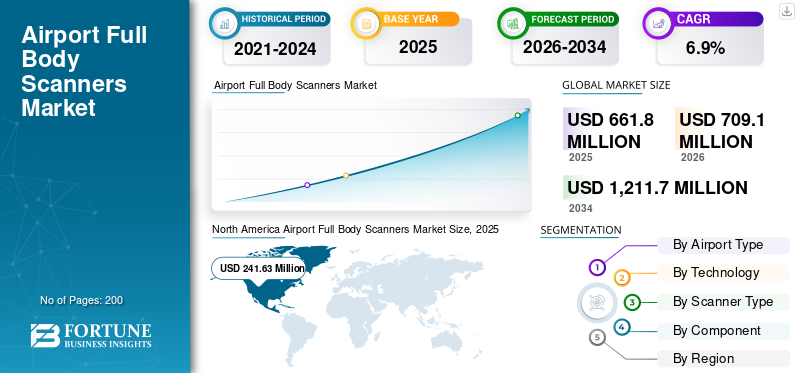
The airport full body scanners market size was valued at USD 661.8 million in 2025. The market is projected to grow from USD 709.1 million in 2026 to USD 1,211.7 million by 2034, exhibiting a CAGR of 6.9% during the forecast period. North America dominated the airport full body scanners market with a market share of 36.51% in 2025.
The market is witnessing strong momentum as airports invest in advanced imaging systems for non-invasive passenger screening. These scanners improve detection of concealed threats without physical contact, ensuring both safety and privacy. Passenger-traffic recovery, synchronized global security regulations, and rapid imaging-technology upgrades have enlarged budgets for next-generation checkpoint equipment. Airlines, airport authorities, and venue operators are replacing metal detectors with millimeter-wave and computed-tomography platforms that shorten wait times while improving threat detection. The increase in global air traffic, strict government policies, and modernization of airport infrastructure facilitate market growth. Artificial-intelligence software is turning every checkpoint into a data-rich node that informs staffing, lane allocation, and predictive threat analytics.
Key players in the market include Leidos, Smiths Detection, Rohde & Schwarz, Rapiscan Systems, and Nuctech. These companies compete through superior millimeter-wave and backscatter imaging technologies, broader product portfolios spanning fixed and portable scanner configurations, AI-powered automatic threat recognition, faster passenger throughput capabilities, and integrated security solutions tailored for commercial aviation checkpoints, international border security, critical infrastructure protection, and defense-related personnel screening applications.
Download Free sample to learn more about this report.
Airport Full Body Scanners Market Key Takeaways
 Global Market Size & Forecast
- 2025 Market Size: USD 661.8 million
- 2026 Market Size: USD 709.1 million
- 2034 Forecast Market Size: USD 1,211.7 million
- CAGR: 6.9% from 2026–2034
 Market Share
- North America dominated the airport full body scanners market with a 36.51% share in 2025.
- The regional & domestic airports segment is projected to grow at a CAGR of 8.2% during the forecast period.
- The terahertz imaging scanners segment is expected to grow at a CAGR of 7.4% during the forecast period.
 Key Regional Highlights
North America
North America maintained its leading position with a market value of USD 241.63 million in 2025.
Europe
Europe is projected to reach USD 197.4 million in 2026, remaining the second-largest regional market.
Asia Pacific
Asia Pacific is expected to register the highest regional CAGR of 7.5%, reaching USD 181.9 million by 2026.
U.S.
The market is estimated to reach USD 230.5 million in 2026, growing at an approximate 6.4% CAGR during the forecast period.
Japan
The market is estimated at USD 31.6 million in 2026, with an approximate 11.4% CAGR during the forecast period.
Read More

AIRPORT FULL BODY SCANNERS MARKET TRENDS
AI Integration and Contactless Screening Technologies are Redefining Airport Security Operations
The introduction of artificial intelligence and advanced contactless screening systems to enhance the passenger experience and the efficiency of security screening is the latest trend in the market of commercial airport full body scanners. Emerging trends include privacy-friendly AI threat recognition, higher resolution imaging, multi-sensor fusion platforms, and exploration of new frequency bands such as terahertz. Component cost deflation enables mid-tier facilities to migrate from manual inspection to advanced scanning, further widening the installation base. These converging technological advancements are accelerating the transition from conventional screening to fully automated, data-integrated checkpoint ecosystems across global aviation infrastructure.
MARKET DYNAMICS
MARKET DRIVERS
Download Free sample to learn more about this report.
Rising Global Passenger Traffic and Escalating Aviation Security Threats Fuel Scanner Adoption
The airport full body scanners market growth is largely driven by the continuous growth in worldwide passenger traffic through the air and the heightened security threats. As millions of passengers are screened in airports every day, safe and efficient passenger screening has become the number one priority among aviation authorities. Full body scanners provide non-invasive, precise, and quicker alternatives to manual checks by eliminating bottlenecks and improving security. Also, increasing threat of terrorism, contraband, and transported weapons have necessitated governments and airport authorities to invest in high-tech body scanning gadgets, which have directly driven demand and adoption on a global level.
MARKET RESTRAINTS
High Capital Expenditure and Complex Procurement Processes Limits Widespread Scanner Deployment
High initial investment and complex procurement processes are major restraints for the market. It also faces limitations due to technological dependence and adaptability issues. One of the most persistent restraints in the airport full body scanner market is the limited effectiveness of scanners against non-metallic threats. While modern systems are effective in identifying metallic objects, detecting plastic explosives, liquid-based contraband, or ceramic weapons remains a technical challenge. Legal liabilities and compliance challenges act as significant restraints on airport procurement cycles, further delaying broader technology integration across tier-2 and tier-3 airport segments globally.
MARKET OPPORTUNITIES
Expanding Airport Infrastructure in Emerging Economies Creates Untapped Deployment Potential
The rapid development of airports in low and middle-income countries is aiding the market growth. The evolution of contactless and faster screening technologies offers a major opportunity, as post-pandemic travel protocols prioritize minimal physical contact and higher throughput, with airports actively seeking systems that support both speed and safety in passenger screening. Cultural adaptation and reducing radiation levels are expected to provide new opportunities, while emerging technologies such as 3D body scanners and laser scanners are also expected to provide further market opportunities. These factors collectively present significant commercial expansion avenues for scanner manufacturers and system integrators.
MARKET CHALLENGES
Balancing Passenger Privacy Rights with Effective Threat Detection Challenges Market Expansion
One significant challenge in the market is the need to balance increased security with the rights to privacy of the passengers. Although these scanners are useful in identifying hidden threats, issues of invasive body imaging and misuse of data have made them a subject of scrutiny by people and authorities. In other places, privacy activists have delayed the rollout of scanners or forced them to be modified, including automated threat recognition software that instead of showing detailed images provides generic outlines. Key challenges involve balancing passenger privacy, throughput efficiency, and compliance with radiation safety limits. Overcoming these challenges requires coordinated regulatory clarity, transparent data governance frameworks, and continuous investment in privacy-preserving imaging innovations.
Segmentation Analysis
By Airport Type
Rising International Passenger Volumes and Mandatory Advanced Security Mandates are Accelerating Demand for the Large International Hub Airports Segment
Based on airport type, the market is segmented into large international hub airports, medium-sized commercial airports, and regional & domestic airports.
The large international hub airports segment accounted for the largest market share in 2025. Large international hub airports represent the primary deployment environment for full body scanners due to their high daily passenger throughput, stringent regulatory mandates, and multi-terminal security complexity. Demand for faster passenger throughput and threat detection is driving full body scanner deployments to accelerate screening processes while maintaining high levels of security. These hubs prioritize high-capacity, integrated scanning lanes to handle peak-hour traffic volumes efficiently.
The regional & domestic airports segment is anticipated to rise with a CAGR of 8.2% over the forecast period.
To know how our report can help streamline your business, Speak to Analyst
By Technology
Growing Adoption of Non-Invasive, Radiation-Safe Imaging Is Driving Robust Demand for the Millimeter-Wave Scanners Segment
Based on technology, the market is divided into millimeter-wave scanners, backscatter X-ray scanners, terahertz imaging scanners, infrared/thermal imaging scanners, and hybrid imaging scanners.
In 2025, the millimeter-wave scanners segment dominated the global market. This is due to its reliability, cost-effectiveness, and wide applicability. Millimeter-wave technology is preferred over backscatter X-ray due to its superior passenger safety profile, absence of ionizing radiation, and compatibility with automated threat recognition algorithms.
- In April 2025, GMR Group supplied four full body scanners for trials in the Delhi International Airport using millimeter-wave technology operating between 70 GHz to 80 GHz for enhanced security.
The terahertz imaging scanners segment is projected to grow at a CAGR of 7.4% over the forecast period.
By Scanner Type
Increasing Need for Permanent, High-Throughput Security Infrastructure is Propelling Demand for the Fixed Full Body Scanners Segment
Based on scanner type, the market is segmented into fixed full body scanners, walk-through full body scanners, portal-based scanners, mobile/portable full body scanners, and high-definition advanced imaging scanners.
The fixed full body scanners segment is anticipated to witness a dominating airport full body scanners market share over the forecast period. This is supported by established demand across core applications. Fixed installations are preferred at major airports due to their superior detection consistency, seamless integration with access control and baggage systems, and ability to support continuous high-volume screening. Their reliability and lower long-term operational cost make them the preferred choice for permanent checkpoint infrastructure.
The high-definition advanced imaging scanners segment is projected to grow at a high CAGR of 8.5% over the forecast period.
By Component
Technological Sophistication and Mandatory Compliance-Grade Imaging Requirements are Sustaining Strong Demand for the Scanner Hardware Segment
Based on component, the market is classified into scanner hardware, automated threat recognition software, imaging & reconstruction software, operator console/display system, data processing & networking unit, and maintenance, calibration & support services.
The scanner hardware segment dominated the segmental market share in 2025. This is due to the capital-intensive nature of checkpoint upgrades and the necessity for compliance-certified imaging equipment. Scanner hardware encompassing millimeter-wave antennas, signal processing units, and chassis structures forms the foundational procurement layer, as airports prioritize certified, durable hardware before integrating advanced software or analytics capabilities.
In addition, maintenance, calibration & support services are projected to grow at a CAGR of 7.5% during the study period.
Airport Full Body Scanners Market Regional Outlook
By geography, the market is categorized into North America, Europe, Asia Pacific, and Rest of the World.
North America
North America Airport Full Body Scanners Market Size, 2025 (USD Million)
To get more information on the regional analysis of this market, Download Free sample
North America held the dominant share in 2024, valuing at USD 219.97 million, and also maintained the leading share in 2025, with USD 241.63 million. This is due to strong security measures, strict regulations enforced by government agencies, and the development of innovative security solutions, necessitated by the high passenger throughput across the region's many major international airports.
U.S. Airport Full Body Scanners Market
Based on North America’s strong contribution, the U.S. market can be analytically approximated at around USD 230.5 million in 2026, representing roughly 6.4% CAGR of the forecast period. This market growth is driven by R&D investment and strong industry infrastructure, with the Transportation Security Administration (TSA) overseeing large-scale scanner deployments across hundreds of commercial airports under federally mandated security screening programs.
Europe
Europe is estimated to reach USD 197.4 million in 2026 and secure the position of second largest region in the market. The growing emphasis on full body scanning, which is non-invasive and not harmful to the human body, is driving market demand in Europe. Stringent ECAC security screening standards, modernization of major hub airports, and rising cross-border passenger traffic continue to reinforce steady scanner procurement across the region.
U.K. Airport Full Body Scanners Market
The U.K. market growth in 2026 is estimated at around USD 41.9 million, representing roughly 6.6% CAGR of the forecast period. The U.K. maintains strong scanner adoption across major international airports under Home Office and DfT regulatory frameworks, with continued investments in millimeter-wave technology and AI-enhanced imaging to modernize aging checkpoint infrastructure at Heathrow, Gatwick, and beyond.
Germany Airport Full Body Scanners Market
Germany’s market is projected to reach approximately USD 50.4 million in 2026. Frankfurt Airport completed a checkpoint upgrade using Rohde & Schwarz Walk2000 scanners in late 2024, reflecting Germany's commitment to deploying next-generation scanning technology across its major aviation hubs in compliance with European security directives.
Asia Pacific
Asia Pacific is projected to record a CAGR of 7.5% during the forecast period, which is the highest among all regions, and reach a valuation of USD 181.9 million by 2026. Asia Pacific stands out as the fastest-growing region in the market as increased air travel prompted airports to upgrade their security infrastructures, and saw the rise of regional enterprises as major players in the full body scanner manufacture and development.
China Airport Full Body Scanners Market
China’s market is projected to be one of the largest in Asia Pacific, with 2026 revenues estimated at around USD 69.9 million. China accounted for the maximum revenue share in the Asia Pacific market, supported by large-scale government investments in airport security infrastructure, domestic scanner manufacturing capabilities led by Nuctech, and rapid expansion of new airport facilities across tier-1 and tier-2 cities.
Japan Airport Full Body Scanners Market
The Japan market in 2026 is estimated at around USD 31.6 million, accounting for roughly 11.4% of CAGR during the forecast period. Japan is investing in advanced screening technologies across its major international airports in preparation for sustained growth in inbound tourism, reinforcing scanner procurement aligned with ICAO standards and national civil aviation authority security upgrade mandates.
India Airport Full Body Scanners Market
The India market in 2026 is estimated at around USD 28.0 million. In April 2025, GMR Group announced that it had supplied four full body scanners for trials in the Delhi International Airport, signaling India's accelerating push to deploy advanced millimeter-wave screening technology as part of broader airport modernization across its rapidly expanding aviation network.
Rest of the World
The rest of the world include Middle East & Africa and Latin America. These regions are expected to witness moderate growth in this market space during the forecast period. The Middle East & Africa and Latin America market is set to reach a valuation of USD 47.9 million and USD 23.9 million in 2026. These regions are witnessing growing scanner investments driven by new airport construction, rising tourism, and government-led aviation security modernization programs targeting both greenfield and legacy airport infrastructure upgrades.
COMPETITIVE LANDSCAPE
Key Industry Players
Key Players Focus on AI-Based Threat Recognition, Millimeter-Wave Screening, and Checkpoint Modernization to Boost Market Growth
The market is being strengthened by key players that are shifting airport people-screening from standalone body-scanning equipment toward software-led, privacy-focused, and high-throughput checkpoint security ecosystems. Companies such as Leidos, Rohde & Schwarz, Smiths Detection, and Rapiscan Systems/OSI Systems, are focusing on millimeter-wave advanced imaging technology, automated threat recognition, high-definition scanners, employee-screening portals, remote screening support, and lifecycle upgrade services. Leidos is reinforcing its position through AI-based algorithm upgrades for TSA’s Pro advanced imaging technology fleet, helping reduce false alarms and improve checkpoint efficiency. Rohde & Schwarz is expanding through its QPS201 advanced imaging scanners, supported by TSA procurement activity and Frankfurt Airport’s modernization program involving more than 100 new scanners. Smiths Detection is contributing through integrated aviation security solutions that combine people screening, trace detection, baggage screening, and employee access screening. Meanwhile, players such as Thruvision, Liberty Defense, LINEV Systems, Tek84, and VMI Security are supporting demand for staff screening, secondary screening, mobile inspection, and high-security airport access applications. These strategies are helping shift the market from hardware replacement demand toward recurring software upgrades, faster passenger processing, privacy-compliant screening, and broader deployment across passenger, crew, and airport-employee checkpoints.
LIST OF KEY AIRPORT FULL BODY SCANNERS COMPANIES PROFILED
- Leidos (U.S.)
- Smiths Detection (U.K.)
- Rohde & Schwarz (Germany)
- Rapiscan Systems (U.S.)
- Nuctech (China)
- Thruvision (U.K.)
- Liberty Defense (Canada)
- LINEV Systems (U.K.)
- Tek84 (U.S.)
- VMI Security (Brazil)
KEY INDUSTRY DEVELOPMENTS
- February 2026: The Israel Airport Authority (IAA) awarded a contract to Rohde & Schwarz to deploy AI-driven QPS201 personnel screening systems at Ben Gurion Airport and border crossings.
- January 2026: The TSA awarded a multi-million dollar procurement order to Rohde & Schwarz for QPS201 people screening portals to secure airports hosting the 2026 FIFA World Cup.
- July 2025: The TSA issued a Request for Information (RFI) to replace expiring Screening Partnership Program (SPP) contracts, expanding turnkey screening contracts up to an estimated USD 5.5 billion.
- May 2025: Smiths Detection secured a major contract with Dubai Aviation Engineering Projects (DAEP) to deliver checkpoint screening solutions (including computed tomography) to Dubai International Airport (DXB).
- November 2024: Fraport AG (Frankfurt Airport) entered a strategic partnership with Rohde & Schwarz to install AI-powered millimeter-wave security scanners across Germany’s largest aviation hub.
REPORT COVERAGE
This research offers a detailed analysis of emerging trends and rapidly adopted technologies in the industry across key regions. The report outlines key drivers of market growth and challenges to expansion, delivering a detailed overview of the maritime industry landscape. The study highlights recent advancements to boost industry insights and support stakeholders in making well-informed decisions.
Request for Customization to gain extensive market insights.
Report Scope & Segmentation
| ATTRIBUTE | DETAILS |
| Study Period | 2021-2034 |
| Base Year | 2025 |
| Estimated Year | 2026 |
| Forecast Period | 2026-2034 |
| Historical Period | 2021-2024 |
| Growth Rate | CAGR of 6.9% from 2026-2034 |
| Unit | Value (USD Million) |
| Segmentation | By Airport Type, By Technology, By Scanner Type, By Component and Region |
| By Airport Type |
|
| By Technology |
|
| By Scanner Type |
|
| By Component |
|
| By Region |
|
Frequently Asked Questions
According to Fortune Business Insights, the global market value stood at USD 661.8 million in 2025 and is projected to reach USD 1,211.7 million by 2034.
In 2025, the North America market value stood at USD 241.63 million.
The market is expected to exhibit a CAGR of 6.9% during the forecast period of 2026-2034.
By airport type, large international hub airports segment is expected to dominate the market.
Rising global passenger traffic and escalating aviation security threats fuel scanner adoption.
Leidos, Smiths Detection, Rohde & Schwarz, Rapiscan Systems, Nuctech, and Thruvision are few major players in the global market.
North America dominated the market in 2025



- 2021-2034
- 2025
- 2021-2024
- 200
Get 30-60 hrs Free Customization
Expand Regional and Country Coverage, Segments Analysis, Company Profiles, Competitive Benchmarking, and End-user Insights.




















Related Reports
-
US +1 833 909 2966 ( Toll Free )
-
Get In Touch With Us