Airport Hotel Market Size, Share & Industry Analysis, By Location Type (Airside Transit Hotels, Terminal-Connected Hotels, On-Airport Hotels, and Near-Airport Hotels), By Hotel Class (Luxury, Upscale, Midscale, and Economy), By Stay Duration (Hourly/Micro-Stay, Day-Use, Overnight, Multi-Night, and Extended Stay), By Booking Channel (Direct Hotel Channels, Online Travel Agencies, Global Distribution Systems, Airline/Airport Booking Platforms, and Tour Operators), By End User (Air Passengers, Airline Crew, Airport Ground Personnel, and Non-Aviation Guests), and Regional Forecast, 2026-2034
 Download Free Sample
Airport Hotel Market Size and Future Outlook
 Listen to Audio Version
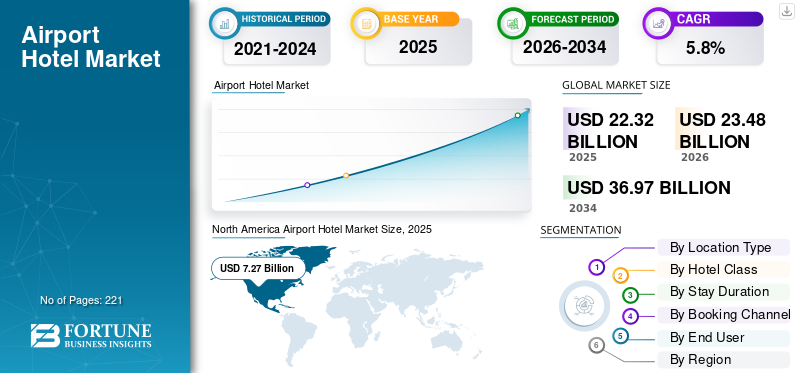
The airport hotel market size was valued at USD 22.32 billion in 2025. The market is projected to grow from USD 23.48 billion in 2026 to USD 36.97 billion by 2034, exhibiting a CAGR of 5.8% during the forecast period. North America dominated the airport hotel market with a market share of 32.48% in 2025.
Airport hotels comprise purpose-built accommodation facilities located within airport terminals, directly connected to terminals, situated on airport premises, or positioned near commercial airports to serve aviation-linked lodging demand. These properties support passengers requiring hotel accommodation before departure, after arrival, during layovers, following flight disruptions, or between connecting flights. Airport hotels also serve airline crews, airport personnel, aviation contractors, business travelers, and other guests requiring convenient access to airport infrastructure. The market includes luxury, upscale, midscale, and economy properties offering hourly stays, day-use rooms, overnight accommodation, multi-night stays, and extended-stay services across major international airports, regional airports, and airport commercial districts.
Marriott International, Inc., Hilton, and Accor S.A. are expanding airport hotel portfolios through airside transit hotels, terminal-connected properties, on-airport hotels, and near-airport hotels. These facilities increasingly incorporate digital check-in, mobile room access, automated reception, flexible-duration booking, flight information integration, airport shuttle services, crew accommodation programs, meeting facilities, food and beverage services, luggage storage, and disruption-response arrangements.
Download Free sample to learn more about this report.
Airport Hotel Market Key Takeaways
 Global Market Size & Forecast
- 2025 Market Size: USD 22.32 billion
- 2026 Market Size: USD 23.48 billion
- 2034 Forecast Market Size: USD 36.97 billion
- CAGR: 5.8% from 2026–2034
 Market Share
- North America dominated the airport hotel market with a 32.48% share in 2025.
- Airside transit hotels are projected to grow at a 9.1% CAGR during the forecast period.
- Upscale hotels are projected to grow at a 5.3% CAGR during the forecast period.
 Key Regional Highlights
North America
North America led the market with USD 7.27 billion in 2025 and is expected to reach USD 7.55 billion in 2026.
Europe
Europe remained a major market in 2025, supported by dense aviation networks and established airport hotel infrastructure.
Asia Pacific
Asia Pacific is projected to record the fastest growth, driven by rising air passenger volumes and airport development.
U.S.
The market reached USD 6.65 billion in 2025, supported by North America’s strong market contribution.
Japan
The market reached USD 0.81 billion in 2025, accounting for roughly 3.6% of global revenues.
Read More

AIRPORT HOTEL MARKET TRENDS
Flexible-Duration and Technology-Enabled Airport Accommodation is Emerging as a Prominent Market Trend
The market is shifting from conventional overnight-only lodging toward flexible accommodation designed around flight schedules, layovers, early departures, late arrivals, and short passenger-rest requirements. Airside transit hotels and terminal-connected properties are increasingly offering hourly rooms, day-use stays, automated or mobile check-in, compact guestrooms, flight-information access, luggage services, and 24-hour food and reception facilities. This model allows operators to sell the same room across multiple time blocks while providing passengers with private alternatives to airport lounges and terminal seating.
- For instance, in July 2025, YOTELAIR introduced its Slayover offering across airport hotels in London, Paris, Istanbul, and Singapore. The service included flexible cabin stays and hourly bookings starting from four hours. YOTEL also reported that day-use bookings across its YOTELAIR properties had increased by 5.2% year-on-year.
This trend is expected to support demand for airside transit hotels, compact-room formats, hourly accommodation, digital reservation systems, automated check-in, mobile room access, wellness services, and flight-linked guest services.
MARKET DYNAMICS
MARKET DRIVERS
Download Free sample to learn more about this report.
Rising Passenger Traffic and International Air Connectivity is Propelling Market Growth
The airport hotel market is primarily driven by the continued expansion of global passenger traffic and international aviation networks. Higher airport throughput increases the addressable pool of transit passengers, airline crews, early-departure travelers, late-arrival passengers, and guests affected by missed connections or schedule disruptions. International passengers generally generate stronger airport hotel requirement than domestic passengers as they face longer journeys, extended connections, immigration requirements, overnight schedules, and wider time-zone differences.
- For instance, in September 2025, Airports Council International projected that global airport passenger traffic would reach 9.8 billion passengers during the year, representing 3.7% year-on-year growth. International passenger traffic was expected to increase by 5.3%, compared with 2.4% growth for domestic traffic.
This driver is expected to support occupancy, room-night demand, airline crew contracts, day-use bookings, and new airport-oriented hotel development. Demand will grow significantly due to major international hubs, gateway airports, airports with high connecting-passenger volumes, and locations where terminal access or city-center travel requires substantial time.
MARKET RESTRAINTS
High Development Costs, Airport Concession Complexity, and Limited Terminal-Adjacent Land Limits Market Expansion
A major restraint for the market is the financial and contractual complexity associated with developing hotels inside or immediately adjacent to airports. Airside and terminal-connected properties require coordination with airport authorities, security agencies, terminal operators, airlines, infrastructure providers, and concession partners. Developers must also address land leases, concession payments, access restrictions, construction phasing, utility requirements, airport security standards, noise mitigation, and operational continuity within active airport environments. This restraint is likely to limit terminal-integrated hotel development at smaller and financially constrained airports. Near-airport hotels will remain easier to develop as they generally face fewer security, construction, and concession requirements.
MARKET OPPORTUNITIES
Airport-City Development and Hospitality Expansion Across Emerging Aviation Hubs Presents Significant Opportunities
The expansion of airport cities, aerotropolises, mixed-use commercial districts, and greenfield airports presents a major opportunity for hotel operators and real estate developers. Airports are increasingly being developed as broader commercial ecosystems incorporating hotels, offices, retail, food and beverage, convention facilities, logistics infrastructure, and leisure services. This creates opportunities for luxury, upscale, midscale, economy, extended-stay, and mixed-use hotel formats within the same airport catchment.
- For instance, in May 2026, IHG Hotels & Resorts signed a managed hotel portfolio agreement with Adani Airport Holdings covering nearly 1,500 rooms across five hotels in India. The portfolio includes Holiday Inn and Holiday Inn Express properties planned within airport-city and hospitality-led mixed-use developments in Navi Mumbai, Mangaluru, and Thiruvananthapuram.
The opportunity is expected to be particularly strong across India, China, Southeast Asia, the Middle East, Africa, and Latin America, where passenger traffic is expanding faster and airport-oriented hotel supply remains comparatively underdeveloped.
MARKET CHALLENGES
Maintaining 24-Hour Service Quality Amid Staffing and Operational Pressures Challenges Market Growth
Airport hotels operate around the clock as guest arrivals and departures are linked to airline schedules rather than conventional hotel check-in periods. This requires continuous front-desk coverage, housekeeping, food and beverage services, airport transfers, security coordination, maintenance support, and rapid room turnaround.
- In February 2025, the American Hotel & Lodging Association reported that 65% of surveyed hotels continued to experience staffing shortages. Approximately 71% had vacancies they were unable to fill, with housekeeping and front-desk positions identified among the most difficult roles to staff.
This challenge is expected to increase demand for automated check-in, mobile keys, centralized reservations, housekeeping-management software, self-service food options, workforce scheduling systems, and compact limited-service formats.
Segmentation Analysis
By Location Type
Larger Property Supply and Broader Customer Reach Drives Near-Airport Hotels Segment Dominance
Based on location type, the market is divided into airside transit hotels, terminal-connected hotels, on-airport hotels, and near-airport hotels.
The near-airport hotels segment held a leading share in the market in 2025 due to substantially larger supply of properties located along airport corridors and surrounding commercial districts. These hotels can be developed with fewer terminal-security, concession, land-access, and construction constraints than airside or terminal-connected properties. They also serve a broader customer base, including air passengers, airline crews, airport employees, corporate travelers, meeting participants, and local guests, while providing airport access through shuttle, taxi, rail, or road connections.
- For instance, in June 2025, Hilton opened the 140-room Hilton Garden Inn Mumbai International Airport in Mumbai’s Andheri East district, within minutes of Chhatrapati Shivaji Maharaj International Airport.
Airside transit hotels segment is anticipated to rise with fastest rate of 9.1% over the forecast period.
By Hotel Class
Balanced Pricing, Standardized Services, and Efficient Operating Models to Support Midscale Segment Leadership
Based on hotel class, the market is divided into luxury, upscale, midscale, and economy.
The midscale segment held a leading share in the market in 2025 as it provides an effective balance between room affordability, standardized service quality, operating efficiency, and essential traveler amenities. Midscale airport hotels are well positioned to serve airline crews, cost-conscious business travelers, disrupted passengers, families, and short-stay guests who prioritize reliability, convenient locations, breakfast, Wi-Fi, airport transfers, and comfortable accommodation over extensive luxury facilities.
- For instance, in October 2024, IHG Hotels & Resorts opened the 104-room Atwell Suites Kansas City Airport, located minutes from Kansas City International Airport. IHG identified Atwell Suites as an upper-midscale brand and reported continued interest in the segment from hotel owners and guests.
Upscale segment is anticipated to rise with a steady growth rate of 5.3% over the forecast period.
To know how our report can help streamline your business, Speak to Analyst
By Stay Duration
Early Departures, Late Arrivals, and Flight Disruptions to Augment Overnight Stay Segment Dominance
Based on stay duration, the market is divided into hourly or micro-stay, day-use stay, overnight stay, multi-night stay, and extended stay.
The overnight stay segment held a leading airport hotel market share in 2025 as the primary demand for airport accommodation continues to originate from early-morning departures, late-night arrivals, overnight connections, flight cancellations, missed connections, airline crew rotations, and long-distance access to airports.
- For instance, in October 2025, IHG opened Garner Hotel Istanbul–Airport Arnavutköy near Istanbul Airport. The property was specifically positioned for passengers arriving late, departing early, or passing through the airport and was designed to provide reliable overnight accommodation at an affordable price.
Hourly or micro-stay segment is anticipated to rise with a fastest growth rate of 9.6% over the forecast period.
By Booking Channel
Loyalty Ecosystems and Lower Distribution Costs Promotes Direct Hotel Channels Segment Leadership
Based on booking channel, the market is divided into direct hotel channels, online travel agencies, global distribution systems and travel management companies, airline and airport booking platforms, and tour operators and wholesalers.
The direct hotel channels segment held a leading share in the market in 2025 due to increasing use of brand websites, mobile applications, loyalty programs, reservation centers, corporate booking portals, and property-level reservations. Direct channels allow hotel operators to reduce third-party commissions, strengthen guest relationships, offer loyalty benefits, manage flexible check-in requirements, and communicate airport transfers, flight-linked services, and disruption-related accommodation arrangements directly to customers.
- For instance, in July 2025, IHG Hotels & Resorts launched its LINE MiniApp in Japan, enabling users to search and book more than 6,600 IHG hotels directly, register for IHG One Rewards, access membership information, and redeem rewards within the LINE platform.
Airline and airport booking platforms segment is anticipated to rise with a fastest growth rate of 7.5% over the forecast period.
By End User
Air Passengers Segment is Dominating Due to Loyalty Ecosystems and Lower Distribution Costs
Based on end user, the market is divided into air passengers, airline crew, airport ground and aviation personnel, and non-aviation guests.
The air passengers segment held a leading share in the market in 2025 as passengers represent the principal demand base for airport-oriented accommodation. This demand is generated by transit and layover requirements, early departures, late arrivals, international connections, schedule disruptions, pre-flight stays, and post-arrival accommodation.
- For instance, in September 2025, Airports Council International stated that global airport traffic reached 9.8 billion passengers during 2025, with international passenger traffic increasing by 5.3%, compared with 2.4% growth in domestic traffic.
airline crew segment is anticipated to rise with a steady growth rate of 5.6% over the forecast period.
Airport Hotel Market Regional Outlook
By geography, the market is segmented into North America, Europe, Asia Pacific, Latin America, and Middle East & Africa.
North America
North America Airport Hotel Market Size, 2025 (USD Billion)
To get more information on the regional analysis of this market, Download Free sample
North America dominated the market in 2025 with a valuation of USD 7.27 billion and is expected to reach USD 7.55 billion in 2026. This is supported by its extensive commercial airport network, large stock of branded near-airport hotels, relatively high room rates, and sustained accommodation demand from domestic passengers, airline crews, corporate travelers, and disrupted passengers. The region has a mature mix of terminal-connected, on-airport, and near-airport properties, while continued airport-terminal modernization is creating opportunities for premium, midscale, and mixed-use hotel developments.
- For instance, in March 2024, Hilton opened the 298-room Hilton BNA Nashville Airport Terminal, the first on-site hotel at Nashville International Airport.
U.S. Airport Hotel Market
Based on North America’s strong contribution, the U.S. market reached USD 6.65 billion in 2025. It accounted for the largest share of the North American market due to its substantially larger airport passenger base, concentration of major airline hubs, extensive hotel-chain presence, and established airport commercial districts. This demand is distributed across international gateways, domestic connecting hubs, regional airports, and airport business corridors. Near-airport and midscale hotels remain particularly important as they provide scalable accommodation for passengers and crews while also attracting corporate meetings, airport contractors, and local business demand.
Europe
Europe represented a major market in 2025 due to its dense cross-border aviation network, high concentration of international gateways, short-haul connecting traffic, and established terminal-linked hotel infrastructure. Airport hotels in the region benefit from early-morning departures, late-night arrivals, low-cost carrier operations, airline crew stays, and passenger connections across hubs such as London, Paris, Frankfurt, Amsterdam, Madrid, Munich, and Brussels. Near-airport and midscale properties remain dominant, although airside and terminal-connected formats are gaining importance at capacity-constrained international hubs.
U.K. Airport Hotel Market
The U.K. market in 2025 was at USD 1.47 billion, representing roughly 6.6% of global revenues.
Germany Airport Hotel Market
Germany market reached USD 0.92 billion in 2025, equivalent to around 4.1% of global sales.
Asia Pacific
Asia Pacific is expected to record the fastest growth in the market, supported by expanding air passenger volumes, new airport construction, terminal capacity additions, rising international connectivity, and airport-city development across India, China, Southeast Asia, Australia, Japan, and South Korea. The region remains underpenetrated in airport-oriented hotel rooms relative to its passenger base, creating opportunities across luxury, upscale, midscale, capsule, transit, and mixed-use hotel format.
Japan Airport Hotel Market
The Japan market in 2025 was at USD 0.81 billion, accounting for roughly 3.6% of global revenues.
China Airport Hotel Market
China’s market is projected to be one of the largest worldwide and 2025 revenues reached at USD 1.81 billion representing roughly 8.1% of global market sales.
India Airport Hotel Market
The India market in 2025 was at USD 0.71 billion, accounting for roughly 3.2% of global market revenues.
Latin America
Latin America is developing as an important market as airport concessions, terminal modernization, tourism growth, and expanding regional connectivity increase accommodation requirements around major gateways. Mexico and Brazil accounts for a significant share of demand, while Colombia, Chile, Peru, and other markets are gradually attracting branded hotel investment. Near-airport and midscale properties remain the most commercially viable formats due to their ability to serve passengers, airline crews, business travelers, and local corporate demand.
Brazil Airport Hotel Market
Brazil market in 2025 was at USD 0.47 billion, accounting for roughly 2.1% of global revenues.
Middle East & Africa
The Middle East & Africa market is supported by the development of major international aviation hubs, airline fleet expansion, airport infrastructure investment, and growing demand for branded accommodation near airports. The Middle East benefits from long-haul transfer traffic and airline crew demand across the UAE, Saudi Arabia, Qatar, and Türkiye, while Africa offers longer-term opportunities through new airports, expanding international routes, and limited existing branded airport-hotel supply.
UAE Airport Hotel Market
UAE market in 2025 was at USD 0.69 billion, accounting for roughly 3.1% of global revenues.
COMPETITIVE LANDSCAPE
Key Industry Players
Airport Integration, Brand Scale, Distribution Strength, Flexible-Stay Capability, and Operational Partnerships Drive Competitive Leadership
The airport hotel market is characterized by competition among international hotel chains, regional hospitality groups, independent operators, airport authorities, real estate developers, concessionaires, and third-party hotel management companies. Competitive leadership is increasingly shaped by operators that can secure strategically located airport properties, build strong airline and airport partnerships, maintain direct booking and loyalty ecosystems, offer flexible hourly, day-use, and overnight accommodation. Companies with established brand portfolios, standardized operating models, airport shuttle or terminal-access capability, digital check-in, corporate and crew contracting expertise, and a strong pipeline across major aviation hubs are better positioned to capture long term revenue growth.
LIST OF KEY AIRPORT HOTEL COMPANIES PROFILED
- Marriott International, Inc. (U.S.)
- Hilton (U.S.)
- InterContinental Hotels Group PLC (U.K.)
- Accor S.A. (France)
- Hyatt Hotels Corporation (U.S.)
- Wyndham Hotels & Resorts, Inc. (U.S.)
- Radisson Hotel Group (Belgium)
- Minor Hotels (Thailand)
- YOTEL Limited (U.K.)
- Plaza Premium Group (China)
KEY INDUSTRY DEVELOPMENTS
The global market analysis provides an in-depth study of market size & forecast by all the airport hotel market segmentation included in the report. It includes details on the market dynamics, and trends, and regional analysis expected to drive the market in the forecast period. The market report includes porters five forces analysis which illustrates the potency of buyers suppliers in the market. Market forecast offers information on the technological advancements, new product launches, key trends, major aviation sector developments, and details on partnerships, mergers & acquisitions. The market analysis also encompasses detailed competitive landscape with information on the market share and profiles of key players.
Request for Customization to gain extensive market insights.
Report Scope & Segmentation
| ATTRIBUTE | DETAILS |
| Study Period | 2021-2034 |
| Base Year | 2025 |
| Estimated Year | 2026 |
| Forecast Period | 2026-2034 |
| Historical Period | 2021-2024 |
| Growth Rate | CAGR of 5.8% from 2026-2034 |
| Unit | Value (USD Billion) |
| Segmentation | By Location Type, By Hotel Class, By Stay Duration, By Booking Channel, By End User, and Region |
| By Location Type |
|
| By Hotel Class |
|
| By Stay Duration |
|
| By Booking Channel |
|
| By End User |
|
| By Region |
|
Frequently Asked Questions
According to Fortune Business Insights, the global market value stood at USD 22.32 billion in 2025 and is projected to reach USD 36.97 billion by 2034.
In 2025, the North America market value stood at USD 7.27 billion.
The market is expected to exhibit a CAGR of 5.8% during the forecast period of 2026-2034.
By location type, the near-airport hotels segment is expected to lead the market.
Rising passenger traffic and international air connectivity is driving market expansion.
Marriott International, Inc., Hilton, InterContinental Hotels Group PLC, and Accor S.A. are some of the major players in the global market.
North America dominated the market in 2025.



- 2021-2034
- 2025
- 2021-2024
- 221
Get 30-60 hrs Free Customization
Expand Regional and Country Coverage, Segments Analysis, Company Profiles, Competitive Benchmarking, and End-user Insights.




















Related Reports
-
US +1 833 909 2966 ( Toll Free )
-
Get In Touch With Us